West
Woke cities and states reverse course and crack down on illegal drugs. Here's why

NEWYou can now listen to Fox News articles!
Leaders in many cities have recently concluded that it was a bad idea to decriminalize hard drugs.
Unless you get your news from NPR, you already knew that allowing people to buy fentanyl, methamphetamine, cocaine or heroin without consequences would end in pain and chaos for both drug users and their communities.
Woke cities and states throughout the country are now scrambling to reinstall policies to restore law and order by deterring drug use.
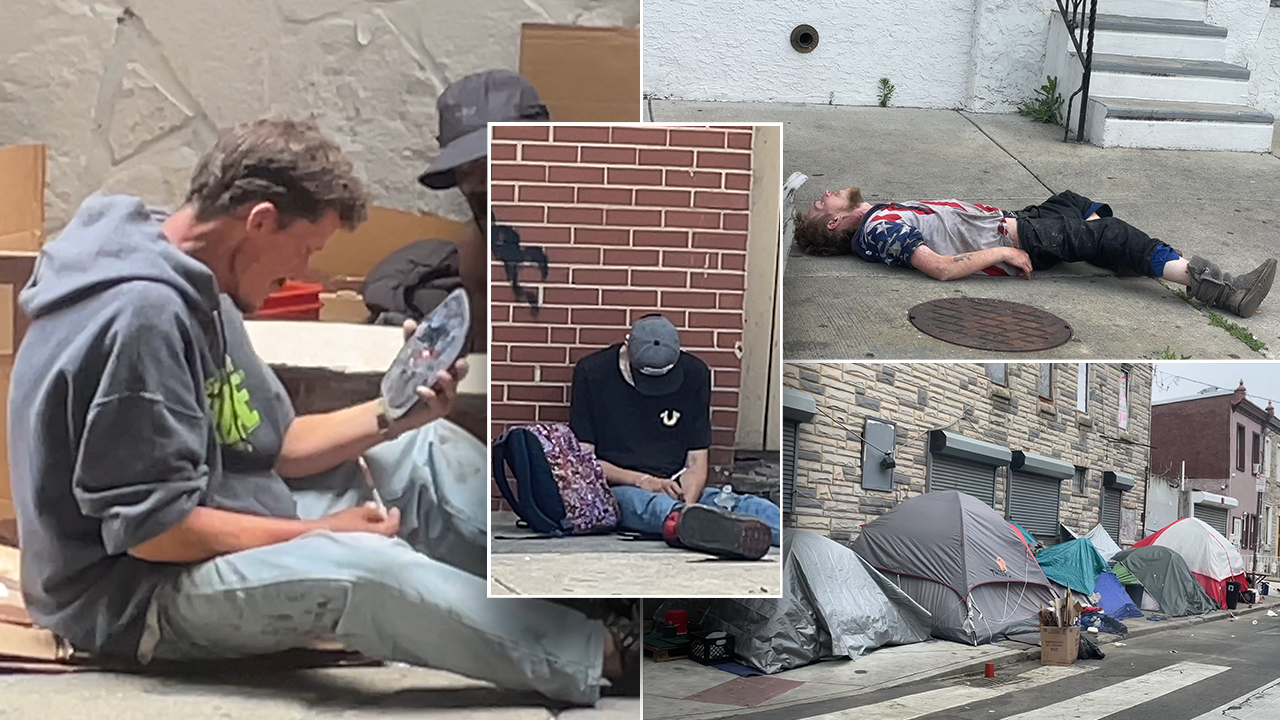
Scenes of drug use and homelessness in the Kensington neighborhood of Philadelphia on June 29, 2023. (Fox News Digital )
State lawmakers in Oregon, for example, recently passed a new law that put back in place criminal punishments for the possession of hard drugs. Lawmakers found this necessary a mere three years after voters passed Measure 110, a ballot initiative that limited criminal punishments for possessing hard drugs to only small fines – no jail time.
OREGON GOVERNOR SIGNS BILL RECRIMINALIZING HARD DRUGS, COMPLETING LIBERAL EXPERIMENT’S U-TURN
At the time, activists sold voters a bill of goods claiming that Measure 110 would help those with addiction. Activists seized upon the anti-cop riots in 2020 to argue that decriminalizing drugs would also give cops fewer reasons to “harass” drug users. Major activists lined up to fund the effort.
This foolishness sounded too good to people who have common sense, and it was.
Overdose deaths in Oregon shot up 44% between 2022 and 2023 – the highest increase in the nation. Law enforcement officers reported that rampant drug use also contributed to a 16.6% surge in violent crimes such as homicide, rape, assault and robbery from 2019 to 2022.
Activists claimed Measure 110 would help Black residents in particular. Instead, overdose rates among Black Oregonians doubled between 2020 and 2022. Today, one in 10 deaths among Black Oregonians results from a drug overdose.
Measure 110 failed those it purported to help in a deadly way.
DRUG RECRIMINALIZATION COULD SIGNAL CULTURAL SHIFT IN PROGRESSIVE STATE, PORTLAND TRIAL ATTORNEY SAYS
Oregon is not an outlier. San Francisco is walking back bone-deep, down-to-the-marrow stupid drug policies, too.
For years, local leaders allowed the City by the Bay to descend into chaos by declining to arrest or prosecute individuals who used illegal drugs in public. Open-air drug use became commonplace.
Many families left the city to avoid trudging through dirty needles and piles of human feces on their way to work. One deli owner found his “first dead body” while checking on the addicts who camped near his shop.
Californians seem willing to put up with a lot before reconsidering dumb dogma, but even San Francisco has its limits. Mayor London Breed recently announced that “change is coming,” including more funding for law enforcement to arrest those using drugs in public.
VIRGINIA FIRST LADY, AG TEAM WITH RECOVERING ADDICTS TO LAUNCH INITIATIVES TARGETING STATE’S FENTANYL CRISIS
These drug policy reversals are becoming the rule, not the exception. Other cities and states throughout the country – including Washington, D.C., Washington state and Boston – have taken steps to enforce drug laws after years of lax policies brought their residents nothing but misery.
Addiction is horrible. But policymakers cannot allow their empathy for Americans with addiction to blind them to the dangerous reality of drugs like fentanyl, heroin and cocaine.
Drug overdoses killed an estimated 112,000 Americans in 2023 – more than twice as many deaths as car crashes. Yet no sane lawmaker would legalize reckless driving. Heartbreaking stories in Oregon and San Francisco prove that deterrence must be part of the policymaking equation.
As cities and states work to replace failed, dumb crime policies with laws that deter drug use and promote safe communities, Congress must step up, too. That’s why I introduced the Fairness in Fentanyl Sentencing Act.
Fentanyl is a particularly deadly narcotic that Louisiana law enforcement has tied to 65% of our overdose deaths. My bill would hold drug dealers accountable by decreasing the amount of fentanyl a dealer has to possess before he faces a mandatory minimum sentence.
CLICK HERE FOR MORE FOX NEWS OPINION
Today, drug traffickers can carry enough fentanyl to kill every person in Shreveport, Louisiana, and still not face even a 10-year mandatory minimum prison sentence. Dealers caught with smaller amounts of less lethal drugs – such as methamphetamine or crack cocaine – face much longer sentences than those caught pushing fentanyl.
Lowering fentanyl possession limits would make sure fentanyl traffickers face punishments that reflect the deadliness of the poison they are peddling.
I don’t understand why some people seem wedded to the dumb-on-crime sentiments that San Francisco and Oregon have abandoned. The Fairness in Fentanyl Sentencing Act wouldn’t affect people suffering from addiction. It would only punish dealers for the hell they’re unleashing on too many innocent families. Still, a few of my colleagues have blocked every effort I’ve made to get this bill signed into law.
Overdose deaths don’t make cities more livable. Open-air drug use doesn’t make communities safer or cleaner. Fair, clear penalties help stop people from hurting themselves and their neighbors.
I hope more woke cities and states admit this and correct their dangerous policies before more Americans fall victim to drugs and stupidity.
CLICK HERE TO READ MORE FROM SEN. JOHN KENNEDY
Read the full article from Here


The people cheering and banging drums on the front steps of San Francisco’s Hall of Justice are usually quietly keeping the calendars and paperwork on track for the city’s courts.
Those court clerks are now hitting the picket lines, citing the need for better staffing and more training. It’s the second time the group has gone on strike since 2024, and this strike may last a lot longer than the last one.
Defense attorneys, prosecutors and judges agree that court clerks are the engines that keep the justice system running. Without them, it all grinds to a slow crawl.
“You all run this ship like the Navy,” District 9 Supervisor Jackie Fielder said to a group of city clerks.
The strike is essentially a continuation of an averted strike that occurred in October 2025.
“We’re not asking for private jets or unicorns,” Superior Court clerk employee Ben Thompson said. “We’re just asking for effective tools with which we can do our job and training and just more of us.”
Thompson said the training is needed to bring current employees up to speed on occasional changes in laws.
Another big issue is staffing, something that clerks said has been an ongoing issue since October 2024, the last time they went on a one-day strike.
Court management issued their latest statement on Wednesday, in which the court’s executive officer, Brandon Riley, said they have been at an impasse with the union since December.
The statement also said Riley and his team has been negotiating with the union in good faith. He pointed out the tentative agreement the union came to with the courts in October 2025, but it fell apart when union members rejected it.
California’s superior courts are all funded by the state. In 2024, Sacramento cut back on court money by $97 million statewide due to overall budget concerns.
While there have been efforts to backfill those funds, they’ve never been fully restored.
Inside court on Thursday, the clerk’s office was closed, leaving the public with lots of unanswered questions. Attorneys and bailiffs described a slightly chaotic day in court.
Arraignments were all funneled to one courtroom and most other court procedures were funneled to another one. Most of those procedures were quickly continued.
At the civil courthouse, while workers rallied outside, a date-stamping machine was set up inside so people could stamp their own documents and place them in locked bins.
Notices were also posted at the family law clinic and small claims courts, noting limited available services while the strike is in progress.
According to a union spokesperson, there has been no date set for negotiations to resume, meaning the courthouse logjams could stretch for days, weeks or more.

David Fountaine Black
OBITUARY
Dave and Martha and their three boys moved to Denver in 1974 when Dave started work at the Rocky Mountain Arsenal. He and a business partner later purchased Mid-America Plating Company. Dave operated Mid-America for 36 years and finally retired in 2018.
He was a great golfer and natural athlete. Dave was an avid runner, and for many years, he woke up before the sun to get his miles in before work. He and Martha loved playing bridge with friends, gardening – growing fruit and flowers – and spending time outside relaxing and walking on the High Line Canal Trail and in Bible Park. Dave and Martha enjoyed getting back to Arizona during the winter at their Tucson home. They loved spending time with their family.
Dave passed away on February 20, 2026. He is loved by family and friends and will be missed. Dave was a hard-working, kind, optimistic, and thoughtful person who leaves the world a better place. He is survived by his wife, Martha, and his three sons, Dave (Robin), Tom (Debbie), Eric (Kendra), as well as six grandchildren and three great grandchildren, Casey (Nicole), Jake (Ashleigh and great granddaughter Faye), Hailey (Robby and great granddaughter Jensen), Keenan (Nicole and great granddaughter Olivia), Griffin, and Addie (Erik).

ST. LOUIS (AP) — Dylan Holloway had a hat trick and added an assist in his return from a sprained ankle, Joel Hofer made 23 saves and the St. Louis Blues came off the Olympic break to beat the Seattle Kraken 5-1 on Thursday night.
St. Louis Blues 5, Seattle Kraken 1: Box score
Jordan Kyrou and Holloway — activated from injured reserve before the game — scored in a 23-second span early in the second period to give St. Louis a 3-1 lead.
Pius Suter added a goal and two assists to help the Blues end a three-game losing streak.
Holloway completed St. Louis’ first hat trick of the season with 3:01 left, scoring into an empty net for his 11th of the season.
Kaapo Kakko tied it at 1 for Seattle in the first period, and Philipp Grubauer stopped 26 shots. The Kraken were coming off a 4-1 loss in Dallas on Wednesday night.
Kyrou made it 2-1 at 1:12 of the second off a feed from Pavel Buchnevich on a break. Holloway poked the puck past Grubauer off a scramble at 1:35. Suter scored at 1:56 of the third.
St. Louis’ Cam Fowler appeared in his 1,100th game, becoming the 10th active defenseman in the NHL to reach the mark.
Up next
Kraken: Host Vancouver on Saturday night.
Blues: Host New Jersey on Saturday.
Seattle Kraken sign forwards Ben Meyers, Ryan Winterton to 2-year extensions

Robert ‘Fish’ Jenkins helped Detroit students soar in sports and life

San Francisco court clerks strike for better staffing, training

Mavericks vs Kings Final Score: Dallas falls to Sacramento, 130-121

Red Sox insider hints Boston may have Pablo Sandoval problem with Masataka Yoshida

David Fountaine Black Obituary | The Denver Post

Florida High School Football Rankings: Top 25 teams – Oct. 21

Cleary's 21 help Le Moyne down Central Connecticut State 69-64 in OT

How old is Bo Nix? What to know about Oregon quarterback ahead of 2024 NFL Draft

99th annual Pony Swim held in Virginia

Indiana Members Credit Union announced as new anchor tenant at Bottleworks District

Read Judge Schiltz’s Order

Vulnerable House Dem lashes out at Trump’s ‘racist’ SOTU challenge: ‘That was uncomfortable’

Italy calls for suspension of EU carbon market

Chicagoans pay respects to Jesse Jackson as cross-country memorial services begin

DHS shutdown triggers TSA ‘emergency measures’ as lawmaker warns airports could feel economic pain
-

 World1 day ago
Exclusive: DeepSeek withholds latest AI model from US chipmakers including Nvidia, sources say
-

 Massachusetts2 days ago
Mother and daughter injured in Taunton house explosion
-

 Montana1 week ago
2026 MHSA Montana Wrestling State Championship Brackets And Results – FloWrestling
-

 Oklahoma1 week ago
Wildfires rage in Oklahoma as thousands urged to evacuate a small city
-

 Louisiana4 days ago
Wildfire near Gum Swamp Road in Livingston Parish now under control; more than 200 acres burned
-

 Technology6 days ago
YouTube TV billing scam emails are hitting inboxes
-

 Denver, CO2 days ago
10 acres charred, 5 injured in Thornton grass fire, evacuation orders lifted
-

 Technology6 days ago
Stellantis is in a crisis of its own making