Utah
Voters weigh what kind of Democrat they want for Utah’s new, blue Congressional seat


Candidate handouts are displayed at an event for candidates running to represent Utah’s new Democratic-leaning congressional district in Taylorsville, Utah on March 21. While some candidates have since dropped out, four remain including former Rep. Ben McAdams and state Sen. Nate Blouin.
Hannah Schoenbaum/AP
hide caption
toggle caption
Hannah Schoenbaum/AP
In the past, a Democrat running for Congress in Utah would typically face an uphill battle. But, for the first time in modern history, Utah has a safe Democratic congressional seat that could help determine the makeup of the House majority come November.
The outcome is a result of a mid-decade redistricting process that had nothing to do with President Trump and everything to do with a years-long legal battle to prevent partisan gerrymandering. The legal battle ended with Utah’s four congressional districts redrawn.
Cook Political Report labels the newly redrawn 1st Congressional District as +12 points for Democrats, though some argue it’s even bluer, based on the percentage of its population that voted for former Vice President Kamala Harris. The new map concentrated the capital and largest city Salt Lake City, the bluest dot in a red sea, into one seat and included many of the more Democratic-leaning suburbs. The opportunity to elect a Democrat has generated enthusiasm among the Utah Democratic Party in an era when sentiment for the national party is floundering.
It’s also created one of the most competitive Democratic primary election races Utah has ever seen. In a crowded field, voters will pick between four candidates who are all different flavors of Democrat, ranging from moderate to much more progressive and aligned with the Democratic Socialists of America.
“Democrats are the odds on favorites to win this district. The question has shifted from can a Democrat win to the question of which Democrat will win,” said Damon Cann, professor of political science at Utah State University.
The top three candidates, Democratic state Sen. Nate Blouin, former Democratic Rep. Ben McAdams and the political newcomer and Utah Democratic convention winner Liban Mohamed, are all presenting different messages to voters.
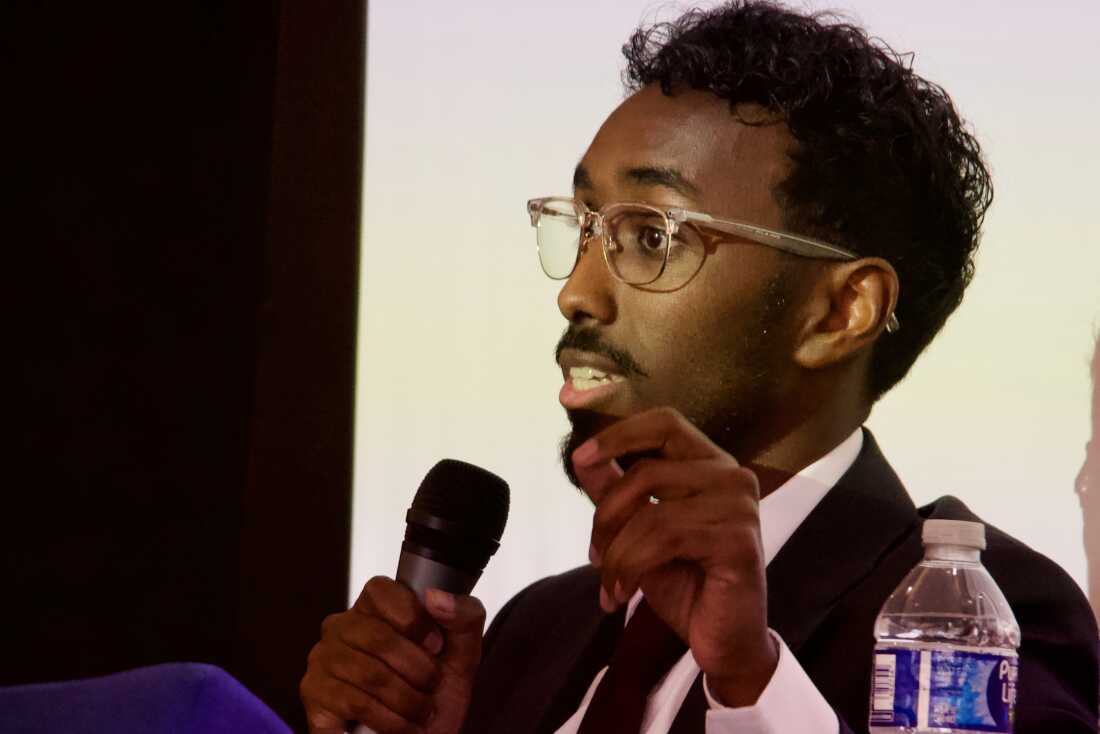
Liban Mohamed won more than 51% of the delegates at the Utah Democratic Party’s nominating convention in April, though the primary will decide the final nominee. In this file photo, Mohamed speaks on a panel of candidates running to represent Utah’s new Democratic-leaning congressional district in Taylorsville, Utah on March 21.
Hannah Schoenbaum/AP Photo/Hannah Schoenbaum/AP
hide caption
toggle caption
Hannah Schoenbaum/AP Photo/Hannah Schoenbaum/AP
Why Utah’s race matters nationally
The new district is the biggest opportunity Utah Democrats have ever had for Congressional representation, especially when the majority margin in Congress is miniscule.
“We have the ability to add to the body and the Democrats in the House of Representatives in a way that may swing that chamber back to Democratic control,” said Brian King, the chair of the Utah Democratic Party.
It’s also a pocket of blue energy during a time when excitement for the national Democratic party is low. The moment the district was solidified, King said candidates were immediately jumping in the race and participation at the Utah Democratic Convention hit a record turnout.
He said Utah is a successful example of why the national party should be investing in flipping red states and not just focusing on purple districts and areas they know they can win.
“Democrats, if they’re going to be successful across this country, they have to figure out how to speak, to reach and change the hearts and minds of voters in red areas,” he said.
Democratic factions on display

Former Rep. Ben McAdams, seen here in a campaign photo, argues the new district isn’t as blue as its rating might suggest and that a more moderate, pragmatic lawmaker makes sense.
Ben McAdams for Congress
hide caption
toggle caption
Ben McAdams for Congress
The candidate with the most name recognition is former Rep. Ben McAdams. In 2018, McAdams flipped a purple district when he beat a Republican incumbent.
While he’s widely considered a moderate, he calls himself a “pragmatic” Democrat that is keen on working across the aisle to get stuff done.
“I’m a candidate who can bring people from across the spectrum and rally them together and win tough elections. I’ve won tough elections before,” McAdams told NPR. “I’m somebody who has built coalitions to tackle some of our most difficult issues.”
He’s also presented by his opponents as the safe establishment choice. There have been questions about whether McAdams is too moderate for such a safely blue district. During his time in Congress, one analysis tagged him the most conservative Democrat in the caucus.
But McAdams believes the district isn’t as blue as people think it is. There is a significant percentage of Republicans and independents in the district. He is targeting those voters as well.
“Democrats aren’t going to win this district by appealing only to Democrats. We’re going to have to build a bigger coalition. We’re going to have to bring in the independents and unaffiliated. We’ll even have to bring in some Republicans,” McAdams said. “That’s the nature of the way things are in Utah.”
What voters want
Knocking on doors in a neighborhood right outside of Salt Lake City, state Sen. Nate Blouin made his case to voters as to why he should represent the new solidly blue congressional district in deep red Utah.
“I’m a progressive Democrat really focused on addressing people’s real material concerns,” Blouin told a prospective constituent who disclosed their loved one was battling cancer. “We’ve got to take on the big money in politics and actually find ways to reinvest in our communities. You know, affordable housing [and] Medicare for all are big proposals that I’m going to fight for in D.C.”

Utah state Sen. Nate Blouin is endorsed by Sen. Bernie Sanders and says his progressive message will win over Democratic voters. Before April’s nominating convention, Blouin, here in a campaign photo, was seen as the main challenger to McAdams.
Nate Blouin for Congress
hide caption
toggle caption
Nate Blouin for Congress
Blouin gained a reputation for being a rabble rouser during his time in the Utah state legislature as a vocal critic of controversial conservative legislation. But being outspoken can also backfire on him. More than a decade ago, he made lewd, disparaging remarks online about Latter-day Saints, the predominant religion in Utah, and sexual assault victims. Blouin has since apologized for his comments.
Meanwhile, 27-year-old political newcomer Liban Mohamed has gained an enormous amount of momentum after he won 51% of the delegate vote at the Utah Democratic convention. He’s the son of Somali immigrants. While the delegate win is important, the party will decide its candidate in Tuesday’s primary election.
Mohamed quit a job at TikTok where he lobbied against the U.S. ban of the social media platform and made the decision to run for office. Mohamed considers himself a progressive but has been called a Democratic Socialist over his political priorities.
“I’m focused on a platform to educate and advocate for the things that are going to help people have a roof over their head after working long hours, to be able to afford their health care, to be able to not have to choose between their paycheck or the well-being of their child,” Mohamed told NPR. “Most people might call this democratic socialism, progressive politics. I call it a working class, focused politics, people-centric politics.”
The fourth candidate on Tuesday’s ballot is another progressive, tax attorney Michael Farrell.
What the primary election outcome can message to the party
With both Blouin and Mohamed on the ballot, plus Farrell, there is a good chance the progressive vote will split, handing the victory to McAdams. But if both candidates combined win 50% or more of the vote, Damon Cann, the Utah State University political science professor said that is a persuasive argument about the direction Democratic candidates should be heading in the area.

“It would be wise for future candidates to read this as a matter of a majority of the district looking for a more progressive option,” Cann said. “It’s really just the field of candidates and the way votes broke down among them that led to this particular election outcome.”
Since the candidates are articulating different goals and ambitions, Cann said it signals the broad spectrum of what it means to be a Democratic in the U.S.. It can also inform the direction, the tone and policy priorities of the national Democratic Party.
In Utah, Cann believes the race in the 1st Congressional District lays out the choice facing Democrats across the country: whether voters want a party that will stand its ground on policy priorities, even if that means the needle doesn’t move quickly, or a party that aims for collaboration — even if that means compromise.


SALT LAKE CITY (KUTV) — There have been hundreds of human-caused wildfires this year in Utah, but the legal outcomes are hard to track.
At least two people have been charged recently for starting fires: one for the Memory Grove Fire in Salt Lake and one for the Mountain Road Fire in Ogden.
This year alone, 327 wildfires have been started by people in Utah — an act that should carry consequences, according to some.
“Certainly, if it’s intentional, it’s against the law,” resident David Mastroianni said. “If it’s not intentional, then they weren’t being as careful as they should be with something they should be careful with.”
But, before anyone gets to that point, there’s a lot of work that goes into figuring out what started the fire, let alone who.
“The fire investigator will show up on scene and will look at the scene, collect evidence, and then turn it over to the proper authorities,” said Kelly Wickens with Forestry, Fire, and State Lands.
Tracking which fires end with criminal charges or civil suits is difficult.
Wickens said that once the fire is out and the investigator turns the evidence over, their work is done, and it’s up to the proper authorities to press charges.
“Arson does require — this is what makes it difficult — is that you have to establish someone intentionally started a fire,” said former prosecutor Nathan Evershed.
Evershed said there are more charges than just arson, such as reckless burning.
“So, if it’s not intentional and it’s more accidental, it can still be viewed as being reckless,” Evershed said.
That could mean if a firework accidentally causes a fire.
Evershed said that there’s also a difference between causing a structure fire and a grass fire. A structure fire could result in aggravated arson charges.
But what happens if a fire is completely accidental?
“It’s more difficult to find a criminal sanction on that … still could be a civil sanction on that, where somebody would have to pay restitution,” Evershed said.
So, while there’s no concrete number for how many human-caused fires have led to charges or civil suits, there are a lot of avenues if someone does get caught.
Evershed said you can even be charged if you just abandon a campfire that causes a fire.
_____

Four lifts, 174 acres, night skiing and a concert venue near Logan are up for grabs.
(Photo courtesy of Dylan White |@blanco_photovideo/Cherry Peak Resort)
The entire front side of Cherry Peak Resort, located about half an hour north of Logan, is illuminated for night skiing.

President Donald Trump sharply reduced the size of two national monuments in Utah, undoing protections established by his Democratic predecessors on public lands that are sacred among many Native Americans.
Bears Ears and Grand Staircase-Escalante national monuments in southern Utah have ancient cliff dwellings, petroglyphs and scenic canyons, as well as coal and uranium deposits that state officials want made available for development.
Trump, a Republican, issued proclamations Monday under the Antiquities Act to reduce their size by about 90% each. He took similar actions during his first term, but those were reversed by President Joe Biden, a Democrat.
The latest move comes as Trump and other Republicans have drastically reshaped the management of vast taxpayer-owned lands concentrated in Western states. Trump administration officials and congressional Republicans have sought to expand drilling, mining and logging on public lands, while removing protections for imperiled species and rolling back rules for conservation.
“They took the land from the people quite honestly,” Trump said at a signing event at the White House Monday. “We’re giving it back.”
President Bill Clinton, a Democrat, established Grand Staircase-Escalante National Monument in 1996, and President Barack Obama, also a Democrat, created Bears Ears National Monument in 2016 under the Antiquities Act. The 1906 law gives presidents the powers to protect sites considered historic, archaeologically significant or culturally important.
Davina Smith-Idjesa, a citizen of the Navajo Nation and co-chair of the Bears Ears Inter-Tribal Coalition, said tribal leaders had braced for a reduction since Trump was elected to a second term. She said it was “heartbreaking” and accused federal officials of sidestepping their legal responsibility to consult with tribal nations that would be impacted.
“From a Navajo perspective, Bears Ears is not simply a piece of federal public land,” Smith-Idjesa said. “This is a living cultural site that holds our histories, our ceremonies, our traditional foods and medicines and our ancestors’ footprints.”
‘Big day for Utah’
Utah officials had long fought against the monument designations and argued that the state should be in charge of controlling its own lands. Trump in his first term reduced their size, calling their creation a “massive land grab.” Combined they spanned more than 3.2 million acres (13 million hectares), an area nearly the size of Connecticut.
Trump reduced them Monday to less than 303,000 acres (123,000 hectares) combined.
That’s a greater reduction than his first term, when he left Grand Staircase Escalante at 1 million acres (405,000 hectares) and Bears Ears at 213,000 acres (86,000 hectares).
“This is a big day for Utah,” Utah Gov. Spencer Cox as he stood next to Trump at the White House. “These monument designations are supposed to be the smallest area as possible to protect the antiquities.”
Bears Ears was the first national monument created at the request of tribal nations that consider the land sacred. The landscape contains ancestral villages, ceremonial and burial sites and features in some tribes’ creation and migration stories. Its designation honored five tribes in the region — Navajo, Hopi, Zuni, Ute Mountain Ute and Uintah-Ouray Ute.
Home to hundreds of thousands of objects of cultural and scientific significance, Bears Ears is jointly managed by an agreement between tribal nations and federal agencies.
Rick Bowmer/AP Photo
Rick Bowmer/AP Photo Newspaper Rock, featuring a rock panel of petroglyphs in the Indian Creek Area, is seen near Monticello, Utah, on July 14, 2016.
Grand Staircase-Escalante consists of cliffs, canyons, natural arches and archaeological sites, including rock paintings. It holds large coal reserves, while the Bears Ears area has uranium.
The national monument designation provides sweeping protections not just for significant geological features or artifacts but also for the surrounding landscape, banning drilling, mining and new construction nearby. Proponents of Trump’s move to downsize say the protective boundaries stretch too far and hinder mining for critical minerals.
Trump asserted Monday that people can not hunt, fish or “virtually not even walk” on the monuments. That’s false: Hunting, fishing, camping and other recreation are permitted under state and federal regulations, said Steve Bloch, legal director for the Southern Utah Wilderness Alliance, a conservation group.
Biden designated or expanded more than a dozen monuments and had a goal to conserve at least 30% of U.S. lands and waters by 2030.
Trump’s policies are largely the opposite: He wants to tap into the natural resource wealth of federal lands that total more than 100,000 square miles (260,000 square kilometers) and offshore areas under federal control, such as in the Gulf of Mexico and off Alaska.
That’s drawn backlash from Democrats who warn of the wholesale disposal of treasured landscapes for commercial gain.
“Today’s executive action is another chapter in this administration’s war on the West,” Democratic Sen. Martin Heinrich of New Mexico said Monday. He added that Trump was “turning the Antiquities Act on its head.”
Land sale proposals fell flat
Trump Interior Secretary Doug Burgum said last year that federal officials would review and consider redrawing monument boundaries as part of a push to expand U.S. energy production.
Trump in his current term has used proclamations to lift commercial fishing prohibitions within expansive marine monuments in areas of the Pacific Ocean and in the Atlantic Ocean off the New England coast. Those monuments were created by Democratic and Republican administrations. The effort to boost the fishing industry, which has been challenged in court, marks a dramatic shift in federal policy by prioritizing commercial interests over efforts to allow the fish supply to increase.
Some Republicans have tried to sell or transfer federal lands to states or other entities. Those efforts have largely fallen flat: A push by some GOP lawmakers in the House to sell public lands ran into bipartisan opposition, while another proposal by Sen. Mike Lee of Utah to sell more than 3,200 square miles (8,300 square kilometers) of federal lands was removed from Republicans’ big tax and spending bill.
The U.S. Supreme Court last year turned back a lawsuit from Utah officials who sought to wrest control of vast areas of public land within the state from the federal government.
__
Hannah Schoenbaum reported from Salt Lake City.
-

 Los Angeles, Ca1 hour ago
Southern California hits hottest day of its extreme heat warning
-

 Detroit, MI2 hours ago
Steve Yzerman out as Detroit Red Wings GM, moves to senior advisor role
-
 San Francisco, CA2 hours ago
Supervisors urge California to expand S.F. speed-camera program
-

 Dallas, TX2 hours ago
Five teens injured after crashing carjacked vehicle during Dallas police chase
-

 Miami, FL2 hours ago
Tokyo-style Neapolitan pizza is coming to Miami, led by legendary pizzaiolo chef Bun
-

 Boston, MA2 hours ago
SEE THE GOOD: Roxbury center reminds young adults ‘You got this’ – Boston News, Weather, Sports | WHDH 7News
-
Denver, CO2 hours ago
Five Points affordable housing building honors Dr. Justina Ford | Rocky Mountain PBS
-

 Seattle, WA2 hours ago
Seattle weather: Hot and sunny day Wednesday, highs in the 80s


