Cougars, Utes on the air
No. 9 BYU (8-0, 5-0) at Utah (4-4, 1-4)
- Nov. 9, 8:15 p.m. MST
- At Rice-Eccles Stadium
- TV: ESPN
- Radio: 102.7 FM/1160 AM


BYU and Utah football fans haven’t agreed on much throughout the history of their favorite schools’ storied, heated and mostly competitive rivalry.
But many are in accord that the disdain and boorish, out-of-control behavior and rhetoric hit a zenith 15 years ago, after BYU’s 26-23 overtime victory at LaVell Edwards Stadium in Provo. BYU fans stormed the field, at least one fight broke out when a man grabbed a fan’s cellphone to stop the fan from taking pictures of distraught Utes, and Utah coach Kyle Whittingham’s wife Jamie, who had intervened at some juncture, suffered a fat lip before police took control of the situation.
But that wasn’t all.
Special Collector’s Issue: “1984: The Year BYU was Second to None”
Get an inclusive look inside BYU Football’s 1984 National Championship season.
Nearly an hour after the game, BYU quarterback Max Hall uttered his now infamous anti-Utah rant, proclaiming he hated “everything” about the school, its fans and its football program. He apologized later, but the ugliness had reached a crescendo that late-November day.
The nastiness wasn’t just happening in Provo. In 2012 at Rice-Eccles Stadium, Utah fans stormed the field three times to celebrate a 24-21 win over BYU, even though the teams were no longer in the same conference, and a picture of fans taunting crestfallen BYU player JD Falslev went viral.
No question, the rivalry burned hot from 2009 to 2021, when BYU, having accepted an invitation to join the Big 12 the day before, snapped Utah’s nine-game winning streak in the series with a 26-17 win in Provo, setting off another wild postgame celebration on the field.
The Cougars and Utes haven’t played since, giving the rivalry its longest break since the schools separated by 45 miles skipped four years playing each other from 1942-46.
That recess will end Saturday, as struggling Utah hosts undefeated BYU at 8:15 p.m. MST in the first-ever Big 12 game pitting the longtime rivals. The stakes are incredibly high for both squads, but especially BYU, which is 8-0 and trying to get into the Big 12 championship game and, possibly, the College Football Playoff. Some say preseason Big 12 favorite Utah (4-4, 1-4) can resurrect a disappointing season with an upset win.
So what is the state of the rivalry now? What is its current temperature? Cold, hot as ever, or somewhere in between?
In his weekly press briefing Monday, BYU coach Kalani Sitake spent more than half of his 27 minutes behind the microphone talking about the rivalry, his friendship with Utah coach Kyle Whittingham — his former boss — and all his connections with the program on the Hill. His primary message to fans, after he said he didn’t like to tell fans how to behave, was to treat each other with respect and admiration.
“We need each other,” Sitake said. “That’s always been the case, and now that we are in the same conference, it is going to be fun (for it) to be a consistent thing that we get to count on this game being (played) every year.”
Sitake said that if it weren’t for Utah, he wouldn’t be at BYU, and if it weren’t for BYU, where Whittingham played, the legendary coach wouldn’t be at Utah.
“I have a lot of love for that program and a lot of love for the people there. I hope the fans can enjoy the game and keep it at that,” Sitake said. “Just remember we are all closely related and we are all connected. … This game can be a rivalry on the field, but let’s show a little bit more appreciation for each other as we go through this game.”
Sitake said having it be a conference game, with so much at stake, makes it even better.
“Now that it is back we can really have fun with it, and that is from the fans’ perspective, but also players and coaches,” he said. “This is a really cool thing that we are both in the Big 12. … This separation (wasn’t good). It truly is a cool reunion and I don’t know what the result of the game is going to be, but the level of respect and admiration should be from both sides, and maybe a bit more understanding.”
Whittingham was far less exhaustive when he talked about the rivalry’s renewal last Monday, which was expected. The Utes’ coach since 1995 has never been as outspoken about the rivalry, or lack of a game some years, as former BYU coach Bronco Mendenhall or Sitake have been.
Whittingham even said the dynamic of the rivalry game doesn’t change that much now that it is a league game again.
“It’s another game, and whether we are in the same league or not, all it does is have implications in the conference standings,” Whittingham said. “Now, we know we don’t have a shot at the conference championship, but otherwise, you approach it the same way.”
He did acknowledge that the tables have been turned from preseason expectations, and a win over the No. 9 team in the country “would be a big help” to Utah’s sinking season. The Utes have lost four straight games.
“We are in desperate need of a win; there’s no doubt about that,” Whittingham said. “We’ve had four in a row now, and the average margin is about a touchdown, so it’s not like we’re not competing.”
Fifteen years ago, after the 2009 game, Mendenhall had this to say to The Salt Lake Tribune about fan behavior getting out of hand:
“It would be great if the fans would take on a stronger spirit of sportsmanship and be able to compete against each other, but do it in a civil way. And I think it certainly is possible, and I think it is desirable, and would add a lot more class to the rivalry. … I am speaking for both sides. Not just one.”
Longtime media member and radio host for The Zone Sports Network, Patrick Kinahan has followed the BYU-Utah rivalry for more than three decades. He spends many of his mornings on 97.5/1280 talking with co-host David James, guests, and fans about the state’s best rivalry, and one of the best in the country.
Kinahan agrees that the rivalry has cooled off a bit because of its three-year absence, but believes Saturday’s game will jumpstart a new era of intensity.
“With a nonconference game, it stinks to lose, but it doesn’t have to be devastating,” Kinahan said, reminding fans that when the Utes lost to BYU in 2021, they still went to the Rose Bowl. “Now that it is back to a conference game, I think it is going to ramp up to all-time levels.”
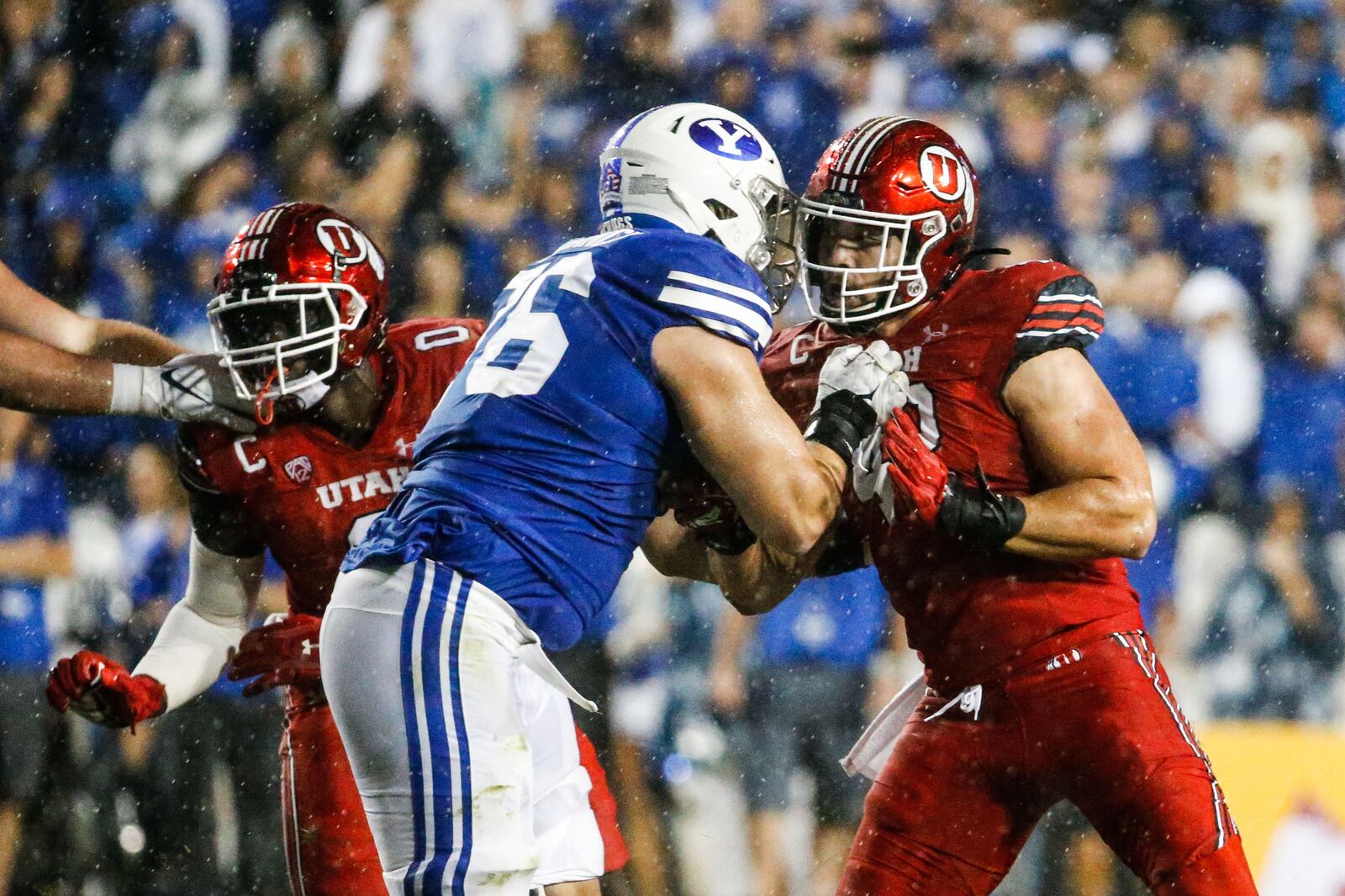
Kinahan said the rivalry from Utah’s perspective “did go down a little bit” because the Utes had won nine in a row, and also because winning Pac-12 games became more important.
“Utah fans were infatuated with beating USC more than BYU, and they were probably right in doing that,” he said. “For BYU, they have not been on a level playing field as an independent. But now, BYU and Utah can both achieve the same thing, so I think it is going to grow more intense despite Kalani’s repeated efforts to bring out the love between the two schools and the coaches — which is a true thing, but I don’t know if the fans are necessarily going to buy into that.”
Utah’s director of broadcasting, Bill Riley, who also serves as the play-by-play voice for the Utes’ men’s basketball and football teams, said he’s loved calling Utah’s Pac-12 games, particularly against USC, but nothing beats the rivalry game. He’s thrilled that it is back on the schedule, even if it might take a few years for it to get back to where it once was from an intensity standpoint.
“I think it has probably cooled off a little bit, just because they haven’t played in a few years, but I fully expect it to heat back up moving forward with them being in the same conference again and playing every year, which I think is great, because it is my favorite game to call,” Riley said. “I think it will heat up. Obviously this year (is different) with the juxtaposition of where people thought the seasons would be — high expectations going in for Utah and no real expectations for BYU, with so much unknown.
“And now with their seasons going opposite of what people thought before the year, I think that is going to add to next Saturday’s buildup coming in, especially with the game being at Rice-Eccles Stadium,” Riley continued. “It won’t take long to fire back up again.”
Riley believes the trash talk and rhetoric will be somewhat muted this week, partly because of what Sitake had to say Monday, but also because there are only a few players left who got a taste of the rivalry in 2021. The only players left from 2019, the last time BYU lost to Utah, are tight end Keanu Hill and right tackle Brayden Keim.
There’s also the added element of the “four most visible figures” on BYU’s staff “are all Kyle Whittingham’s guys,” Riley said, referring to Sitake, defensive coordinator Jay Hill, offensive coordinator Aaron Roderick and defensive analyst Gary Andersen.
“We have seen plenty of years when one team is a definitive underdog and it ends up being a one-possession game,” Riley said. “Obviously the game for Utah becomes a lot bigger because you can at least show something big for your season. For BYU, it is huge because you are trying to remain undefeated and push toward the playoff. So I don’t think it will lack for storylines, that’s for sure.”
Former BYU defensive lineman Hans Olsen, now a KSL Sports Zone daily radio host and radio color analyst for BYU football games on the BYU Sports Radio Network, said the rivalry is “pretty calm right now” and has “cooled off a little bit,” but quickly adds that everything will change on Saturday.
“All it takes is one league game, maybe even one drive, one coach to feel wronged, one player to feel like he took an illegal hit, one player who doesn’t like the crowd, and then it gets vocalized and then the rivalry fires back into the stratosphere,” Olsen said, sort of summarizing how things went in the 2000s and 2010s. “It will ignite again. It’s only a matter of time.”
Olsen said it “always felt like the games were on the verge of getting ugly” before Sitake replaced Mendenhall in 2015 and said he would cheer for then-Pac-12 member Utah to win every game except one.
“You have got Kalani telling everybody to calm down. Kyle is 4-4 so he is not stomping around and flexing on BYU, and so it feels like it is pretty calm right now,” said Olsen, who was teammates with Sitake. “I feel like ever since Kalani got in as head coach, he’s tried to keep it tempered. He doesn’t trash talk. He doesn’t flex on anybody. He doesn’t try to hold dominion on anybody. He wants it to be a fun game. He wants to win, but he also doesn’t want it to become something that is ugly.”
Olsen said BYU’s win in 2021 “took a lot of weight off a lot of people, including Kalani,” and also alleviated some tension, especially from the BYU side.
“But it probably quietly motivated Kyle, and I am sure it is quietly motivating Utah to get the win this year because they have had to sit on that loss,” Olsen said. “I feel like Kalani getting off that streak, it de-intensified it, deescalated it pretty well. Because now you just don’t hear the noise.”
A call for input from fans on the temperature of the rivalry via the social media website X drew a variety of opinions, mostly from BYU supporters who are feeling good about their team these days.
Here are some of the responses:
“What is the current state of the rivalry? I have no idea. But I’m happy the X algorithm has figured out that I like living in a world where Cougars and Utes can enjoy the rivalry, including playful trash talk, while still being cool to each other at the end of the day.” — Micah McBride, Texas
“The (rivalry) is as heated as it has ever been, for the fans. However, when it comes to the players, it may just be another game. Hopefully now that both teams are in the same conference, the players will start to really feel the heat of the rivalry as much as the fans do.” — Mitch McKenzie, Magna
“As a Utah fan, I’ve missed playing BYU the past few years, but I also miss some of the rivalries we developed in the Pac-12. A lot has changed. Saturday’s game will be interesting — I don’t sense as much animosity toward BYU as in the past. We will see, I guess.” — Kirk Livingston, Salt Lake City
“We don’t just want to beat the Utes this year, we want to blow them out. We want a drubbing. Haven’t given them a true beatdown since 1996.” — Brandon Greenwood, Smithfield
“The rivalry has definitely cooled. I think the landscape shifted, for good, when BYU was announced to the Big 12. The next day BYU finally wins that game vs. Utah, and all of a sudden, Utah’s advantage that it has had for so many years is gone. Utah fans (enjoyed) the fact that they were in a conference, making superior money, playing in ‘big-time’ matchups. Utah had what BYU couldn’t have, and Ute fans absolutely loved that and loved to remind BYU fans of it. The moment the field was leveled, it seems that now Utah fans realize their moment of superiority is gone, and you can now sense the panic up on the Hill. And I love every bit of it.” — Andrew Allman, South Jordan
“I thought it wasn’t a rivalry anymore. Ute fans and (Kyle Whittingham) have been telling us for years that they aren’t BYU’s rival anymore. They’ve got Colorado to worry about.” — Evan Frost, Millcreek
“My father got his BYU season tickets back in the ’70s and we’ve sat in the same spot for almost 50 years (42 in LES). I’ve always said the extreme Utah fans are bad winners and the extreme BYU fans are bad losers. So when BYU is winning the toxicity seems to go way down. In other words, the vitriol in these two weeks will be way better than if the win/loss records were switched.” — Eric Gibbons, Riverton
“I actually think the duration of the layoff has been the perfect amount of time. At the time they last played, I felt like the toxicity of the rivalry was so intense that the game was definitely not worth playing. Now that there has been some time for things to cool off, I feel like some civility has returned to the rivalry. In my interactions, just with friends, at work, at church, that kind of thing, there’s a lot more friendly banter and not nearly as much animosity. I think the timing to play the game again is good, and I’m excited for it to be back. I just hope the current civility can be maintained in the coming years. I have my doubts, but maybe both fan bases will surprise us.” — Parker Lee, Utah fan, South Jordan (Daybreak)
“BYU and Utah fans are missing the boat big time. If they want to be invited to the Big Boy Conferences — SEC, Big Ten — they need to be rooting for the other team to be good, too. They both are much more attractive and have more value if they are both good. Single teams don’t get invited to a conference. They are invited as pairs. We all need to get along and stop hoping for the worst for the other team. Wouldn’t it be great if the (rivalry game) was two 8-0 teams? That would have some national attention.” — Dave T. Fokken, Draper


SANDY — Vibes were as high as the temperature in some cases as thousands gathered at Real Salt Lake’s home stadium to cheer on the United States’ 2-0 win over Australia in the second match of the 2026 FIFA World Cup.
Fernando Sanchez took it all in, between belts of his drum standing in front of more than 4,000 people at the Sandy stadium.
“I was born and raised in Mexico City,” said Sanchez, who hosts a podcast called the “Fercho Show” from his current home in Utah. “But I’m from the U.S. now.”
Four years after scoring just two goals in three group games before a 3-1 exit to the Netherlands in the Round of 16, the United States is flying under Mauricio Pochettino, exciting fans across the country — from the sellout crowd at 69,000-seat Lumen Field in Seattle to watch parties around the world, including Friday in Sandy.
“The vibe is amazing,” Sanchez told KSL.com. “You can see all of the people who came out, everybody is happy because this World Cup means so much for Utah, for everybody. It’s the best of the best from each country fighting on the field. That’s what it feels like, and it’s so good to be part of this game.”
Less than 24 hours after some 9,200 fans showed up at America First Field for Mexico’s 1-0 win over South Korea, Real Salt Lake employees braced to host as many as 6,000 American fans who submitted an RSVP to spend a portion of the Juneteenth holiday in 94-degree weather.
In-game hydration breaks became as much of a necessity for fans as the players in Seattle, with hundreds flooding the open hydration stations, concessions area, and a few food trucks at each “quarter break” installed by FIFA for the first time at a men’s World Cup.
While final attendance dropped to around 4,500 fans in Sandy, the spirits remained high as Folarin Balogun, who scored two goals in a 4-1 win over Paraguay in the World Cup opener, forced the opening goal off Australia’s Cameron Burgess.
Alex Freeman, the son of former Super Bowl champion Antonio Freeman who at 21 is the youngest player on the roster, doubled the advantage in the 43rd minute off a set piece that was initially ruled offside.
But after a lengthy video review where fans refused to sit down, pandemonium ensued as the U.S. fans in Sandy recognized their national team was moments away from clinching passage out of the group in the first men’s World Cup on home soil since 1994.
It’s the first time the United States men’s national team has won consecutive games at a World Cup tournament since 1930.
Yet it’s not just the wins, but how the Yanks are winning that has Americans excited about a sport that has made significant strides domestically in three decades since the founding of Major League Soccer.
The U.S. is winning with an exciting brand of attacking soccer led by Balogun, who grew up in England but chose to represent the country of his birth over his parents’ native Nigeria in 2023, and Christian Pulisic, the AC Milan winger with 33 goals in 87 international appearances from Pennsylvania who did not play Friday due to a calf injury.
“There’s a lot of American pride,” said St. George youth soccer player Tate Hurst, who showed up to the watch party with a half-dozen club teammates at Fire SC during Western Presidents Cup regional this weekend. “The American dream.”
Sunburn, heat and hydration aside, the moment created a memory for thousands of soccer fans and casuals alike. That included RSL season ticket holders, waiting until the end of the month-long international break for the club’s MLS season to resume in July.
But for one afternoon — and perhaps another, as the club plans to host a similar watch party next Thursday when the United States hosts Türkiye in Los Angeles (8 p.m. MT, FS1) — each soccer fan was pulling for the same team.
Except, perhaps, for the dozen or so Australia fans in the corner of the east lawn who represented their own Socceroos for the entire 90 minutes.
“Soccer brings everybody together,” one RSL staff member said over the public-address system as fans headed for the parking lot while James Brown’s “Living in America” blasted over the sound system after the full-time whistle. “That’s what today was all about.”

SALT LAKE CITY — Utah athletics is making a notable change to the Huntsman Center gameday setup, but the move is about more than where the team sits.
The Runnin’ Utes are moving the team bench from the east side of the Jon M. Huntsman Center to the west side, returning the bench to the side it occupied during the Rick Majerus era. The change will also move the MUSS and band from the west side to the east side.
The shift is part of a larger effort by Utah Athletics to improve the student-section experience, create a more consistent setup inside the Huntsman Center and better connect the arena to the university’s growing College Town Magic initiative.
Nowlin said the primary motivation behind the change is improving the MUSS and the overall fan experience.
“The reason we’re doing this is we want to enhance the MUSS,” Utah’s Deputy Athletics Director & Chief Revenue Officer, Patrick Nowlin said. “As an ongoing effort, we’ve been working on for the past two years, how do we enhance the fan experience?”
One issue Utah identified was that the MUSS had been located in different areas for different events. Moving the student section and band to the east side gives the department a more consistent location to build around.
“We wanted to create a better fan experience,” Nowlin said. “We wanted to be able to have one spot that we can build on, which means we can brand. We can enhance everything about it.”
The move also ties directly into College Town Magic. Nowlin said the area around the Huntsman Center will include more than 2,900 total beds, including more than 1,400 new beds, giving students a direct path from nearby housing to the student-section entrance.
“There’s over 2,900 new beds that are right there, which will be right at the branded entrance, right where the student section is,” Nowlin said. “They don’t have to go far at all. So it’s just a walk straight down from the dorm, right in the door.”
And according to Utah’s Patrick Nowlin, the move is not limited to men’s basketball.
“It’s not just men’s basketball. It’s all Huntsman Center events,” Nowlin said.
While the move is primarily about fan experience, there is also a clear basketball-history component.
The west-side bench location is where Utah sat during the Majerus era, when the Runnin’ Utes were one of the top programs in the country and the Huntsman Center had a different level of edge. Alex Jensen was part of that era as a player, and now, as Utah’s head coach, the move reconnects the current program with one of its most successful periods.
Nowlin said the historical connection was part of the conversation, even if it was not solely Jensen’s decision.
“Yeah, it’s a nod to history,” Nowlin said. “I think Alex, him being here, he’s a steward of the program. There’s a lot of history to having it on that side.”
Still, Nowlin made clear the change was not simply pushed through by Jensen.
“It wasn’t a push from him,” Nowlin said. “It was a concerted effort from everybody to where, how do we create an area that the MUSS can have, but also how do we lean into our history, but still move forward in a way that we can honor that, but create an unbelievable environment.”
That is the heart of the move. Utah is trying to bring back a piece of its basketball identity while also reworking the building for the future.
The change will affect some season-ticket holders, donors and fans seated near the current bench, MUSS and band areas, but Utah tried to limit the disruption.
Nowlin said the department spent months working through the seating impact and expects fewer than 200 accounts to be directly affected. Those accounts are in sections T, U and V.
“This wasn’t something that just came about,” Nowlin said. “We’ve been working on this for a few months now, and we wanted to find a way that we could minimize the accounts that were directly impacted, but still create the fan experience change we were after.”
Utah’s plan is to work individually with affected fans and mirror their seat location as closely as possible on the other end of the court.
“If you’re on one end and now you’re going on the other end, we will work with you to get you in the seat that is similar to where you were and allow you to have the same experience you’ve had, just on the other end of the court,” Nowlin said.
Utah will also hold a virtual seat-selection process from July 7-17, allowing fans who want to move to choose from available options.
“We’re going to take care of everybody, but we’re also going to allow people the choice and the freedom to be able to make the changes they want to make,” Nowlin said. “We want to create every opportunity we can to give our fans opportunities to choose their own experience.”
The bench and MUSS move is not directly tied to the larger Huntsman Center renovation discussions. Nowlin said the change is instead connected to College Town Magic and Utah’s effort to improve the student and fan experience inside the building.
“It does not have to do with the renovation, but it does have to do with College Town Magic,” Nowlin said.
The move could create some new seating and premium opportunities, particularly around courtside and floor seating. Nowlin said Utah is still evaluating those possibilities.
“By doing this, this will create additional opportunities for us on courtside and floor,” Nowlin said. “We’re also looking to how do we enhance our premium experience across the board. So this is a step in a process that will continue.”
Utah’s bench move is not just a nostalgic callback to the Rick Majerus era, and it is not just a seating chart adjustment. It is part of a broader effort to reshape the Huntsman Center experience.
The team bench is moving back to the west side, where Utah sat during some of the program’s most successful years. The MUSS and band are moving to the east side, where Utah believes it can build a stronger, more consistent student-section identity tied to College Town Magic.
For Utah Athletics, it is another step toward rethinking how the Huntsman Center looks, sounds and feels on game day. For Jensen, the move reconnects the program to its winning past.
The symbolism will matter to longtime Utah basketball fans. The logistics will matter to students, band members and season-ticket holders. But the larger goal is simple: make the building feel more intentional, more connected and more like home again.

SALT LAKE CITY – The San Juan County assessor has resigned partway through his second term, following a recommendation that he be removed from office.
Rick Meyer’s resignation became effective on Monday, according to San Juan County Commissioner Lori Maughan. A copy of Meyer’s resignation letter was not immediately available.
This comes after the Utah State Tax Commission determined that Meyer had failed to follow the law and was “unfit to perform his duties.” In a letter last week to San Juan County commissioners, the tax commission recommended “the immediate removal of the San Juan County assessor from office to protect the public interest and restore the integrity of the property tax system in San Juan County.”
Among other things, Meyer was accused of failing to tax agricultural buildings, misclassifying property, and giving property tax exemptions to certain parcels, including vacant land, when he shouldn’t have.
The recommendation to remove Meyer from office was the first under a recent state law giving the Utah State Tax Commission more power to take corrective action against county assessors who aren’t doing their jobs properly. Assessors play a major role in the property tax process by determining the value of property throughout their counties.
Yet, it was unclear whether the San Juan County Commission could have actually removed Meyer from office had he not stepped down.
With Meyer’s resignation, the San Juan County Assessor’s Office has just one employee left. Deputy assessor Nathan Pitts will run the office until the San Juan County Republican Party recommends a replacement and the County Commission appoints one.
“It’s me holding down the fort here,” Pitts told KSL on Thursday, noting that he has spoken with the Utah Association of Counties and the state tax commission about plans for this interim period. “Everybody’s on board to assist and try to make it the best as we can, (but) I’ve definitely got my work cut out for me.”
Pitts said he does not plan to run for county assessor to replace his old boss.
“That is not my intention at all,” he said. “I’m quite content as a deputy assessor.”
Meyer was first elected as San Juan County assessor in 2020 and won reelection in 2024. His current term was set to conclude in 2029.
The Key Takeaways for this article were generated with the assistance of large language models and reviewed by our editorial team. The article, itself, is solely human-written.

Ford sues L.A. lemon law firm alleging ‘utter fabrications’ inflated fees by 7,000%

From YouTube to the multiplex: How low-budget horror films are beating big-budget studio bets

Commentary: Behested payments aren’t illegal, but they are a problem. Especially for Newsom

Dodgers’ walk-off stuns Orioles as Dalton Rushing helps cap wild comeback


Trump doubles down on Meloni photo comments


The Real Love Company made her feel whole. Then ‘Daddy’ said to strip naked.


Woman, man found shot to death in Pomona, suspect leads officers on erratic chase


Today in History: June 20, race-related rioting erupts in Detroit


