Utah
Could EPA air quality standards be Utah’s first test of its new sovereignty law?

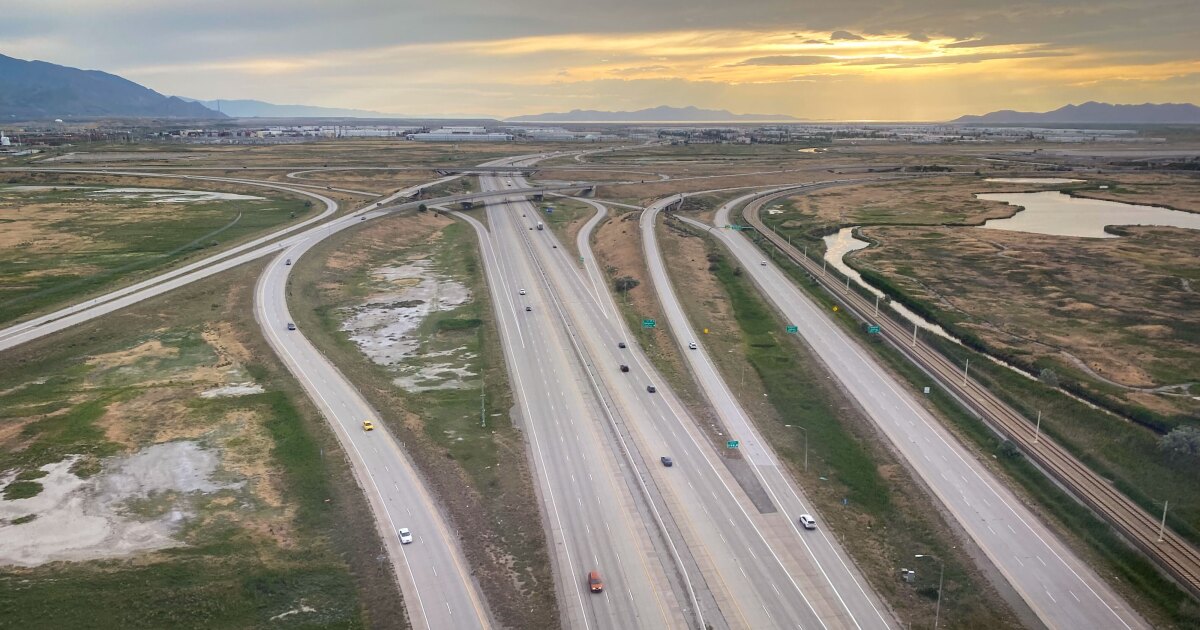
Top Utah officials aren’t happy with federal air quality standards. And their ammunition to fight back could jeopardize the state’s federal highway funding or even the federal government overriding how the state handles air quality to begin with.
In February, Gov. Spencer Cox called the stricter regulations imposed by the Environmental Protection Agency “onerous” and “so stringent” that it will be “impossible” for the state to comply. The EPA reduced the amount of PM2.5 and ozone pollution allowed in the atmosphere, making it harder to fall within the attainment standards, which Utah hasn’t met since 2006. The Utah Attorney General’s Office has filed and joined other states in challenging the agency over its mandates, like the “Good Neighbor Rule,” which targets ozone pollution emitted across state lines.
The majority of the Utah Legislature is so unhappy with the regulations it partly inspired a new state law that aims to push back. Republican Sen. Scott Sandall’s 2024 “Utah Constitutional Sovereignty Act” sets up a process for the state to opt out of federal regulations they deem as overreach.
The first test of the new statute could be the looming air quality battle the state is picking over the updated air quality standards and the Clean Air Act. But it won’t be an easy sell.
“If the state wants to test the red line,” said Brigham Daniels, a law professor at the University of Utah, “this is a risky one.”
During a May 15 Natural Resources, Agriculture, and Environment Interim Committee meeting, Bryce Bird, the director of the Utah Division of Air Quality, said Utah is “still really struggling” to meet EPA ozone standards, especially in Salt Lake, Davis and parts of Weber and Tooele counties. But if the state doesn’t fall within the attainment zone of 70 parts per million, which is considered protective of public health, Utah could face federal funding sanctions.
“That prevents both federal funds being used to expand transportation projects here in that non-attainment area, but it also prohibits state funding from being used for regionally significant projects,” Bird said. “So it really does have that direct impact on the fastest growing metropolitan area in the country.”
If Utah still doesn’t clean up the air after funding is frozen, Bird said the federal government could swoop in and create its own plan for how Utah will meet ozone standards. If that comes to pass, the state “will lose flexibility and input into the plan.”
Utah and the Intermountain West face an uphill battle when it comes to meeting EPA ozone standards. Bird said states like Arizona, Utah and Colorado have “higher natural concentrations of ozone and a greater impact from international transport of the precursor emissions to ozone formation,” which places some of the problem outside of the state’s control.
The fact that Utah isn’t solely responsible for ozone pollution within its boundaries is Sandall’s biggest complaint, calling it “the heart of the heartburn,” and that Utah doesn’t have to “try to comply to an uncontrollable standard.”
“That’s the message that we’ve got to send to the federal government is we can’t do that. There’s no way,” he said during the May 15 meeting. “So whether we do that through legislation, whether we do that through a lawsuit, whatever we do, we have to be the ones to say no.”
Republican Rep. Casey Snider followed Sandall’s comments by stating “perhaps there needs to be a fundamental shift in the key objectives” of the Utah Division of Air Quality centered around “pushing back on this overzealous nature of the federal government rather than simply complying with the impossible.”
Daniels said he’s sympathetic to the predicament the state is in because of what the EPA considers to be “a healthy air quality will be very difficult for the state to obtain,” given the outside exacerbating factors. But challenging the Clean Air Act isn’t that simple.
From his perspective, if Utah does take the steps to challenge the Clean Air Act under the Utah Constitutional Sovereignty Act, the state is likely to fail because of the Supremacy Clause, which says the Constitution and federal statutes are “the supreme law of the land,” trumping any state laws.
Daniels added EPA employees are mandated by federal law to enforce the consequences of a state not complying with standards set by the Clean Air Act and a state sovereignty clause won’t stop them from doing so either.
“Within the realm of environmental law and natural resources law, you almost couldn’t have chosen a worse statute to gamble with,” Daniels said. “Because the federal government doesn’t have any discretion about whether or not it moves forward with sanctions.”


SALT LAKE CITY (KUTV) — A new master’s degree just launched at the University of Utah.
The University of Utah’s David Eccles School of Business Master of Science in Financial Technology program is scheduled to start in the fall of 2026.
The program includes curriculum such as AI, data analytics and financial regulation. According to the university, it will put an emphasis on applied learning and offer flexibility for students working in the field.
This comes as researchers say Utah is gaining momentum as a financial technology hub.
“Utah has emerged as a national hub for financial technology, creating demand for talent that understands both finance and technology,” said Kurt Dirks, Dean of the David Eccles School of Business, in a press release. “This program is designed to prepare students to help companies innovate, grow, and thrive by combining technical fluency, financial expertise, and an understanding of the broader business and regulatory environment.”
Utah’s fintech industry includes 67 companies that support around 8,000 jobs. Careers in these fields average a salary of $131,500, doubling the state average.
The new Master of Science in Financial Technology program is in response to growing demand of finance, data, and technology jobs.
The program includes curriculum like AI, data analytics and financial regulation. It offers flexibility for working professionals as well.
For more information about the program, click HERE.

Last year, a Reddit thread circulated asking the question, “Who is the worst Canadian?” To little surprise, Ted Cruz was among those who were named.
You know Ted, right? That unctuous Texas Senator who revels in appearing smart but who gives off spider vibes? His name being on the list was not a surprise.
Neither was Elon Musk who, while not born in Canada, does bear a Canadian passport since his mother was born there. You know, birthright stuff.
At the time, Elon was dismantling much of the United States infrastructure in the name of DOGE. (Did you ever get your $2,000 check? Do we currently miss USAID in the emerging Ebola zones?) It’s little wonder that Elon scored so well on the dishonor list, never mind that he wasn’t even living in Canada during the polling.
Other prominent names included hockey legend Wayne Gretzky (a living example of the motif ETTD—Everything Trump Touches Dies—if there ever was one), politician and philosopher Jordan Peterson, who affirms that masculinity is under assault while he assaults everything, plus Gavin McInnes, a Proud Boys founder who had relocated to the good ole USA.
The list morphed into an NCAA playoff structure, with brackets that culled the field down to a final winner. I’m going to ask the editors at City Weekly to create a similar bracket that our readers can vote in to find this year’s Worst Utahn.
Can you imagine a showdown between Mike Lee and Trevor Lee in the finals? I can. Or maybe it could be 2024 Spencer Cox against 2026 Spencer Cox—one cusping on bad, the other embracing it.
Utah’s new favorite authority, Kevin O’Leary, might also be on the Worst Utahn list, due to his proximity to all things powerful and secret at the state government level. If Kevin gets his way with the proposed giant data center in Box Elder County, he might even be a full-fledged Utah resident by then. That means, woefully, I’ll have to boycott Box Elder County.
I’m no good at boycotts. I’m weak—so yeah, I lied. I’ll still eat the great peaches and I’ll still eat at Maddox Steak House in Perry. But only when Kevin isn’t around.
We’ve been warned, you know. Along with the other worst Canadians on the Canada list was “Mr. Wonderful” himself, Kevin O’Leary. What kind of snipe would embrace calling himself Mr. Wonderful? Especially one as handsome-reverse as Kevin O’Leary? Well, there’s one, and it’s more apropos—the late, great Paul Orndorff of World Wrestling Federation fame. He had a better run at being Mr. Wonderful than O’Leary ever will.
O’Leary didn’t give himself the name. One of his fellow billionaire panelists on Shark Tank provided that moniker after he tried to mind-wrassle an inventor out of a money-making idea. He even trademarked the name. If that sounds Trumpian, it is.
Among the many dubious qualities that are associated with O’Leary is the recurring one that he often emulates president—and fellow self-proclaimed brilliant businessman—Donald Trump. He does sound like him here and there, in both brashness and bullshit.
Utahns don’t need reminding that one day, we were blissfully unaware that anyone was even purchasing land in Box Elder County, only to awaken the next day to find that an O’Leary-led cabal of Utah political sad sacks had quietly compiled a 40,000-acre aggregation destined to become the largest water and land-use boondoggle known to modern man. We Utah historians correctly note that the floods that floated Noah were of grander scale, but this one is right up there.
The hue and cry from all corners were loud and clear: Utah does not welcome the idea of an interloper coming in with paid-off politicians in arms, selling the prospect of a massive data center and arriving without so much as a local hearing. Utah was blindsided.
When locals protested, O’Leary again donned his Donald Trump costume, marched into the friendly studios of Fox News and spouted off the lies that protesters were bussed in, that we must love our country in this critical time and that China can’t win the data center wars.
The USA has 40% of all data centers worldwide, with more coming. But such information cannot dissuade the average Fox viewer, who is over 65 years old and will be dead when the data center begins siphoning Utah water and cooking the remaining residents of Box Elder County inside their very own Air Fryer.
But O’Leary’s biggest lie was saved for two women—also a Trumpian move. He accused Utah-born Gabi Finlayson and Jackie Morgan (both of Elevate Utah, which is indeed politically aligned toward the Democratic party) as being paid agents of China. Their crime? Exposing O’Leary, Cox and the rest as being as useless as teats on a Box Elder bull.
Finlayson and Morgan took to their own social media, delivering a master class in mockery that accelerated them to social media stardom and exposed O’Leary as a bumbling asshole. Not dissuaded, O’Leary also stupidly punched at Senate candidate Caroline Gleich, who similarly punched back with the reminder that while she has no foreign ties, O’Leary himself is not only Canadian by birth, but is also a citizen of the UAE—who is the foreigner again?
I’m thrilled to no end to see these “masculine” men kneecapped by stronger women.
If they see this, I’ll buy tequila shooters for Gabi, Jackie and Caroline. By the looks of things, all across the entire political spectrum, it will be women who save us from ourselves and from unwelcome political grabs.
We may need data centers. We don’t need Mr. Not-So-Wonderful.

SALT LAKE CITY — Utah football’s first official visit weekend of the 2027 recruiting cycle has already produced a payoff, as Morgan Scalley has landed the commitment of three-star offensive lineman Sire Stewart.
Stewart, a 6-foot-5, 255-pound offensive tackle out of Chandler High School in Arizona, became one of the key names to watch coming into the weekend.
Utah hosted several offensive line targets as part of its first official visit group, and Stewart leaving Salt Lake City committed gives the Utes a tangible recruiting win at a priority position.
A Fast Win For Utah’s New Recruiting Operation
Utah’s first official visit weekend under Scalley was always going to be about more than hosting prospects. It was the first major chance for the new regime to show recruits and families what the program looks like with Scalley as head coach and D’Orazio helping guide the roster-building operation.
Stewart’s commitment gives Utah an early return from that effort.
The Utes need momentum in the 2027 class, and official visit weekends are where that momentum often starts. Landing an offensive lineman from Arizona also reinforces one of Utah’s most important recruiting priorities: continuing to build regionally while identifying prospects who fit the program’s developmental model.
Stewart had official visits scheduled to Washington State and Boise State but elected to give his pledge to the Utes instead.
Utah Got In Early
Utah’s pursuit of Stewart did not begin this weekend. Offensive line coach Jordan Gross offered Stewart in early February, with the Utes becoming his 10th offer and third Power Four opportunity behind Duke and Arizona. Since then, Stewart has added offers from Oklahoma State, Baylor and Cal, while also making an unofficial visit to Arizona State.
Utah was not late to the evaluation. The Utes identified Stewart early, prioritized him and then got him on campus for the first official visit weekend of the cycle. In modern recruiting, that kind of early relationship-building is important.
Gross may be new to college coaching, but this is a good first recruiting win. He gives Utah a unique offensive line pitch. He played at Utah, became one of the program’s best examples of development translating to the NFL, and now gets to sell that same path to recruits. For a prospect like Stewart, Utah can offer both a developmental plan and a real example of what that plan can become.
Building The Class Up Front
Stewart’s commitment also continues a clear early theme for Utah. The Utes are prioritizing the trenches, particularly from the high school ranks.
Utah has long built its program around line-of-scrimmage play, and that identity is not expected to change under Scalley. If anything, it appears to be one of the first pieces of the roster construction plan being emphasized in the 2027 class.
Stewart gives Utah a developmental offensive line prospect with the frame to grow into a Big 12 lineman. Listed by 247Sports at 6-foot-5 and 255 pounds, he still has room to add strength and mass, but the foundation is there.
This commitment gives Utah momentum, but particularly with the offensive linemen they’re in pursuit of. Utah will continue to push for fellow offensive linemen Lincoln Mageo, Ian Aloisio, Tye Kennedy, Damian Anyasodo, Gecova Doyal, and Amaziah Siale.
Mageo and Doyal were also part of the visit with Stewart, giving Utah an added presence to recruit those two. Kennedy and Anyasodo will officially visit the Salt Lake City this weeend, while Siale has been a big priority for Utah and will visit at the end of the month.
The Bottom Line
Sire Stewart’s commitment is not just another name on Utah’s 2027 board. It is the first real proof point from the Utes’ opening official visit weekend under Scalley.
Utah identified him early, got him to campus and closed. That is what good recruiting operations are supposed to do.
For Stewart, the commitment gives him a clear developmental home in a program that has long valued offensive line play. For Utah, it adds another piece to a 2027 class that needs to reflect the new regime’s roster-building vision.
The Utes have always believed in winning up front. Stewart’s commitment shows that message is still central to how Utah plans to build.
Steve Bartle is the Utah insider for KSL Sports. He hosts The Utah Blockcast (SUBSCRIBE) and appears on KSL Sports Zone to break down the Utes. You can follow him on X for the latest Utah updates and game analysis.
Take us with you, wherever you go. Download the new & improved KSL Sports app from Utah’s sports leader. You can stream live radio, video and stay up to date on all of your favorite teams.
-

 Pennsylvania6 minutes ago
Crash in Warminster Township, Pennsylvania, leaves 1 person dead, police say
-

 Rhode Island9 minutes ago
Clergy sex abuse bill passes RI Senate on unanimous vote. What’s next
-

 South-Carolina14 minutes ago
The 3 Democrats vying for SC governor’s seat take jabs at each other in SCETV debate
-

 South Dakota21 minutes ago
Tornado watch in effect as severe storms target South Dakota
-

 Tennessee24 minutes ago
Tennessee Baseball Breakout Star Announces He Won’t Enter the Transfer Portal
-

 Texas29 minutes ago
Central Texas soldier dies in Iraq during training incident, Department of Defense says
-

 Utah36 minutes ago
New program at University of Utah aims to keep up with growing Utah industry
-

 Vermont39 minutes ago
Vermont seeks dynamic pricing for state park access

