Utah
'Cancer can affect anybody': Utah couple processes pancreatic cancer diagnosis


SARATOGA SPRINGS — For Chris and Aimee Tyler, 2023 started as a good year.
“We had just booked our first major family vacation,” Chris Tyler said. “Things were going great.
But then, their lives took a major turn.
“I started having some sporadic kind of pains in my abdomen area,” he said
At first, Chris Tyler shook it off as muscle cramps. But the pain only got worse.
“We went to the ER, and the CT scan came back, and I had a mass on my pancreas,” he said.
Chris and Aimee at their home, talking about their experience. (KSL TV)
In November, Chris Tyler was diagnosed with pancreatic cancer, which, when diagnosed, carries a life expectancy of about three years.
“It’s very, very unusual and very humbling at the same time just to, you know, to realize how serious this is,” he said.
Chris Tyler says he is an active 46-year-old, lives a healthy lifestyle, and has no family history of pancreatic issues, so his doctors don’t know what caused it.
“I don’t know how long I have with him. And it’s terrifying,” said his wife, Aimee Tyler.

The Tyler family. (Courtesy; The Tyler Family)
“Cancer can come out of nowhere. The truth is that cancer can affect anybody,” said Dr. Mark Lewis, the director of Gastrointestinal Oncology at Intermountain Health. “There are other cancers that are far more common, but pancreas cancer is such a threat because it is so deadly.”
Lewis said though more research is being done, risk factors for pancreatic cancer include genetics and poor lifestyle choices. Things like heavy drinking and high-fat diets can put a lot of stress on your pancreas.
He said some warning signs of pancreatic cancer may be unexplained weight loss, jaundice, or changes in stool.
“This is a systemic illness, meaning one that almost always requires chemotherapy,” he said. “But it’s also a disease that’s only cured in the operating room.”
Chris Tyler does chemotherapy every two weeks and said the side effects have been taking a toll.
“It’s a hard way to live,” he said. “My maximum now for being able to kind of go out and enjoy things is a couple of hours, and then I’m either completely wiped out, or cancer pains start kicking in.”
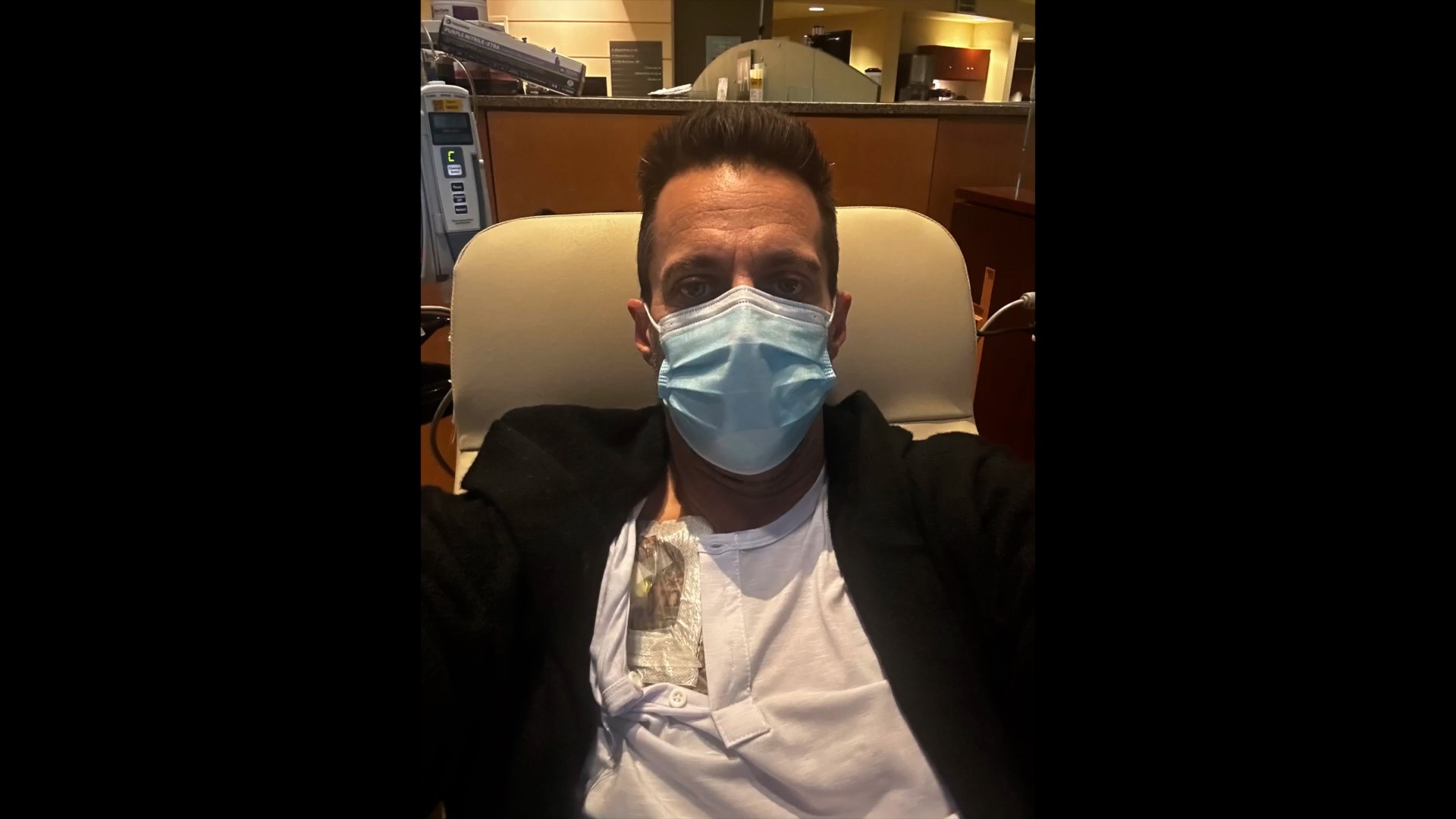
Chris undergoing chemotherapy treatment at the hospital. (Courtesy: Chris Tyler)
The goal of his chemo is to shrink his cancer enough to be able to undergo surgery.
Lewis, a pancreatic cancer survivor himself, said he’s optimistic that more progress will be made in terms of treating this kind of cancer – including earlier detection.
“I think there’s very legitimate hope, more than there’s ever been before,” Lewis said.
It’s that hope that the couple clings on to that keeps them going.
“I can’t live without him,” Aimee Tyler said. “He’s my everything.”
“I’m fighting for every person in my family,” Chris Tyler added. “My wife, my kids, my parents, my in-laws. I just have such a great support structure. But you know, that makes it all worth it.”
Doctors recommend that you stay up to date with your general health screenings and know your hereditary risk. The Tyler family has a GoFundMe* to help pay for Chris’ medical expenses.
*KSL TV does not assure that the money deposited to the account will be applied for the benefit of the persons named as beneficiaries. If you are considering a deposit to the account, you should consult your own advisors and otherwise proceed at your own risk.



EUREKA, Utah (KUTV) — Firefighters protected threatened homes in Eureka as the Iron Fire burned overnight, reporting that no structures were lost.
Officials with the Santaquin City Fire Department said firefighters focused their Saturday night efforts on protecting property from the wildfire after it spread over thousands of acres in Juab County. They released an update at 1:30 a.m. Sunday, saying no structures had been lost during the first part of the night.
“We can all let out a cautious sigh of relief for now. Because of the fire conditions and intensity of this fire, resources were focused mainly on structure protection. Those excellent efforts were successful in protecting the homes in Eureka,” fire officials said.
MORE | Iron Fire:
However, the noted that while the structures survived the night, the fire is still burning and 0% contained.
The human-caused fire was discovered Friday just west of Eureka, on the border of Juab, Tooele and Utah Counties. Since then, it has grown to over 13,000 acres, prompting evacuations for the Town of Eureka and the ranches nearby.
Officials plan to brief the public at 8:30 a.m. on all new developments.
BE THE FIRST TO COMMENT
___

Helicopters and planes were seen dumping water on the fire and flying low over the campus Saturday evening.
(Francisco Kjolseth | The Salt Lake Tribune) A fire breaks out above the University of Utah on Saturday, June 20, 2026.

Utah has spent the past year fighting measles outbreaks — a grim milestone that could affect whether the United States can keep its measles-free designation.
More than 680 people have gotten sick since the state’s first outbreak began on June 20, 2025.
Unlike measles outbreaks in Texas, South Carolina and Arizona, the spread in Utah has been tough to contain to one region — infecting undervaccinated communities in nearly every county.
READ MORE: How health sleuths are watching for threats like measles during the World Cup
Measles popped up in healthcare settings, big-box stores and restaurants, and youth sporting events. In February, an exposure at a state high school wrestling championship sparked at least 46 cases among attendees.
Measles is one of the most contagious diseases known to medicine. It causes a tell-tale rash, high fevers, strong cough, ear infections and diarrhea.
While most recover, some — including young babies, pregnant people and those with weak immune systems — are at higher risk of developing dangerous complications like pneumonia, brain swelling, blindness or even dying. Even healthy people can develop issues years down the road, including a rare but fatal degenerative brain disease that manifests about a decade after infection.
The measles vaccine is safe and 97% protective after two doses.
READ MORE: South Carolina’s measles outbreak is over after sickening nearly 1,000 people
Though Utah’s spread has slowed in recent weeks, state epidemiologist Leisha Nolen sees little opportunity to rest. She’s worried the start of school and arrival of colder weather in the fall will cause measles to surge again.
“It’s still here, it’s still transmitting,” she said. “We just need those few cases to hit the wrong community and it could flare up really big again.”
Utah sees the impacts of dropping vaccination rates
The worst spread has been in the southwestern part of the state, where 265 people have fallen ill with the vaccine-preventable disease since last summer. Overall, measles infections hit 22 of the state’s 29 counties.
READ MORE: Babies too young for MMR vaccine become ‘sitting ducks’ in measles outbreaks
In the state’s rural northeast, the conditions were also ripe for measles to spread. Daggett, Duchesne and Uintah counties — collectively dubbed the “tricounty” health region — has seen the second-largest decline in childhood vaccination rates in the state.
More than 16% of the region’s kindergarteners were missing their measles vaccines in the last school year, according to state data. Statewide, 12.8% were missing their vaccine, putting the state far short of the 95% vaccination rate needed to prevent measles outbreaks.
The TriCounty Health Department logged 74 cases of measles this spring, after people who got sick at the youth wrestling tournament spread the virus in school and later within their households.
The frontier region had seen a rise in vaccine hesitancy for some time, said Sydnee Lyons, the health department’s public information officer.
Despite the large number of cases, local and state health officials consider TriCounty’s measles response a success.
Health officials focused efforts on mitigating the inevitable spread. Unvaccinated students were excluded from in-person school and people who were sick were told to isolate themselves. And their appeal to care for one’s neighbors led to more people coming in to get vaccinated, officials said.
READ MORE: Dr. Mehmet Oz urges public to take the measles vaccine as U.S. cases rise
TriCounty’s infectious disease specialist Cyndie Mattinson recalled a parent who told a school nurse she didn’t want to talk to the health department because “she was worried that we would be angry with her and be judgmental because her children were unvaccinated.”
The nurse vouched for the health department staff, and told the mom to let her know if she felt judged. Mattinson ultimately had a great conversation with the mother.
“The perceptions were changed that we weren’t out there to police, we were there to be a help and a resource to the community,” Mattinson said.
Health experts will meet to decide on U.S. measles status
Utah’s lengthy battle with measles will likely affect whether the U.S. can keep its measles-free designation. Public health officials consider measles to be eliminated from a country when it shows it stopped continuous spread within local communities for at least a year.
The national measles case count was 2,104 as of June 18, nearly surpassing last year’s record total.
READ MORE: A parent’s guide to preventing measles infection and what to look for
Utah has fought measles for a year, but it’s not clear if the earliest clusters are connected with the major outbreak on the Utah-Arizona state line, which was detected in August, Nolen said.
But since then, most of the state’s measles cases have come from within Utah, not from other parts of the country.
International health experts will gather in November to determine if the U.S. and Mexico have lost their measles elimination status. Canada lost its status last year after ongoing outbreaks.
In Utah, doctors continue to reassure scared patients and lobby for better public health policy.
Dr. Ellie Brownstein, president-elect of the state chapter of the American Academy of Pediatrics and a pediatrician in Salt Lake City, spent the height of the outbreak opposing a bill that would have made school vaccine waivers easier to get. It failed, but she says there hasn’t been a clear cultural reckoning over measles’ resurgence.
“I don’t know that we get it to end,” Brownstein said. “I don’t know that we’re going to get this genie back in the box because there’s enough people out there to spread it.”
The Associated Press Health and Science Department receives support from the Howard Hughes Medical Institute’s Department of Science Education and the Robert Wood Johnson Foundation. The AP is solely responsible for all content.
A free press is a cornerstone of a healthy democracy.
Support trusted journalism and civil dialogue.
-

 Detroit, MI15 minutes ago
3 Isaiah Stewart Trade Packages That Would Make Sense for Detroit Pistons
-

 San Francisco, CA27 minutes ago
Giants Reach Franchise Milestone Never Before Seen in San Francisco
-

 Dallas, TX30 minutes ago
Mavericks’ Potential 2026 NBA Draft Trade Down Target Revealed
-

 Miami, FL42 minutes ago
Could the Heat bring Duncan Robinson back in a Deal for Giannis Antetokounmpo?
-

 Boston, MA44 minutes ago
Volunteer rescuer seriously injured Friday helping unresponsive teenage hiker in NH – The Boston Globe
-

 Denver, CO50 minutes ago
7 injured in 3 overnight crashes across Denver, police say
-

 Seattle, WA57 minutes ago
Kraken Acquire Panthers Wing Mackie Samoskevich | Seattle Kraken
-

 San Diego, CA60 minutes ago
How to watch inaugural NASCAR San Diego street race live for free: Start time, lineup

