Utah
Big 12 team preview: Can Utah crack the College Football Playoff in inaugural Big 12 season?


Editor’s note: This story is the 15th in a series previewing each football team in the Big 12 in 2024.
Kyle Whittingham has accomplished a lot during his illustrious 19-year run as the head coach of the University of Utah’s football team.
A Mountain West conference championship? Check.
An undefeated season and BCS bowl win over Nick Saban and Alabama? Check.
Two Pac-12 championships? Check.
There’s only one accomplishment, aside from a Rose Bowl victory, that has eluded Whittingham and his team — a berth in the College Football Playoff.
The Utes have been close before, notably in 2019, when they entered the Pac-12 championship game against Oregon with an 11-1 record and a No. 5 ranking in the CFP poll.
A win against the Ducks would likely have punched the Utes’ ticket to the playoff, but Utah was manhandled along both lines in uncharacteristic fashion, losing 37-15.
While the Utes won back-to-back Pac-12 titles in 2021 and 2022, they didn’t have the sterling regular-season record to be considered one of the top four teams in the nation.
But this season, the College Football Playoff expands to 12, and the five highest-ranked conference champions will receive an automatic bid. The top four highest-ranked conference champions will receive a bye and move directly to the quarterfinals. This means the champion of each of the four major “autonomy conferences” — SEC, Big Ten, ACC and Big 12 — are practically guaranteed a berth — and a bye — in the playoff.
For Utah, it’s simple. Win the Big 12, and the Utes are in the College Football Playoff for the first time in school history.
“Our players were excited about the opportunity. We control our own destiny. If we’re able to win the championship of the Big 12, we are going to the playoffs. We don’t have to hope somebody votes us in,” Whittingham said.
Utah football in 2024
From Whittingham on down, the expectations are high for the Utes in their first season in the Big 12.
The media agrees, voting Utah No. 1 in the preseason conference poll.
“The state of our program right now, where we are, we expect to play for championships every year. That’s just how it should be. That’s the expectation that we’ve created. Certainly, being able to have access to the playoffs like never before is a motivating factor,” Whittingham said.
Whittingham says that Utah’s roster is equipped to compete “right away” in its new conference home, led by quarterback Cam Rising. Rising returns after missing all of the 2023 season due to knee surgery rehab and is the main reason for the optimism in Salt Lake City.
Cam Rising
Over his two seasons as the full-time starter, Rising has thrown for 5,572 yards and 46 touchdowns over his Utes career and led the Utes to back-to-back Pac-12 titles.
The sight of him under center again is a welcome one for Utah’s coaching staff after Bryson Barnes and Nate Johnson largely failed to get the “throw game” going last year. Though Barnes did have a good showing in wins over Florida and USC, the Utes’ passing offense ranked No. 117 in FBS last year (165.8 yards per game) and the offense as a whole mustered just 23.2 points per game — No. 98 in FBS, one spot ahead of rival BYU.
A healthy Rising — he played every minute of spring practice and looked like his old self — should fix Utah’s passing game woes if he plays at the level that he did in 2021 and 2022.
He’s perfectly suited to Andy Ludwig’s offense and has helped elevate it to new heights, as Utah averaged 36.1 points per game in 2021 and 38.6 in 2022.
“He immediately makes us better,” Whittingham said.
He continued, “And Cam has that ‘it’ factor. As much as he does for us in play, it’s his leadership that really is probably the most valuable asset that he brings to the football team. He’s one of those guys that’s able to make everybody around him better. And that’s really what a great player does, is he makes his supporting cast play better.”
Wide receivers
That supporting cast includes a talented group of pass catchers, headlined by USC transfer Dorian Singer, who has already developed chemistry with Rising during the offseason.
That was on display at Utah’s spring game, where Singer led all receivers with 92 yards on five receptions during Rising’s three series, including a 40-yard deep ball.
“He’s such a hard worker. He always wants to go out there and throw, always wants to go catch the football pretty much, and because of that, I think we’ve developed a lot of chemistry in such a short time and it’s just going to keep getting better,” Rising said.
Singer had 66 receptions for 1,105 receiving yards and six touchdowns in 2022 for Arizona, but his production fell after transferring to USC last season. He had 289 yards and three touchdowns on 24 receptions.
After a good spring, Utah is hoping for a 2022-like season out of what could be their new WR1.
While the Utes lost two of their top four receivers from last year, senior Devaughn Vele (43 receptions for 593 yards) and promising Mikey Matthews (29 receptions for 261 yards), Utah reloaded well with the additions of Singer and Syracuse transfer Damien Alford. The 6-foot-5, 210-pound senior was the Orange’s leading receiver last year with 33 receptions for 610 yards and three touchdowns, and is a deep threat.
“We feel really good about the additions we made this offseason with Dorian Singer and Damian Alford. Two really good players, and a couple others as well, and so we’ll see how they end up performing but just going into it we feel like we definitely helped ourselves this year,” Whittingham said.
Key returning receivers include Money Parks (31 receptions for 293 yards), Munir McClain (15 receptions for 269 yards) and Micah Pittman, who returns from season-ending surgery.
Tight ends
Then there’s a tight end room that Whittingham calls “maybe as good as it’s ever been in Utah,” led by preseason All-Big 12 selection Brant Kuithe, who returns from knee surgery rehab that kept him out for last season. He has a pair of 600-plus-yard seasons, including 611 yards on 50 catches in his last fully healthy season, 2021. With a return to that form, he’ll be one of Rising’s primary targets.
Auburn transfer Landen King, who had 14 receptions for 166 yards in his first season in Salt Lake City last year, UCLA transfer Carsen Ryan (13 catches for 205 yards), Snow College transfer Dallen Bentley and blocking tight end Miki Suguturaga round out the room.
Expect Ludwig to return to 12 and 13 personnel this season.
“We like to feature tight ends if the personnel warrants it, but I think this year it should really be a much more prevalent personnel group for us,” Ludwig said.
While quarterback, wide receiver and tight end all look to be set to have good years, there are questions about two of Utah’s historical strengths — running back and offensive line.
Running backs
Unlike in previous seasons, there’s not one clear “every down” running back, position group coach Quinton Ganther said, but there’s plenty of talent.
“Who’s going to emerge as the bell cow running back, if anyone does, maybe it’ll be by committee, which if that’s the case, that’s not a problem as long as we’re getting the production we need,” Whittingham said.
Micah Bernard will likely start the year as RB1 after missing all but two games due to an injury last season. In 2022, Bernard rushed for 533 yards and four touchdowns while adding 314 receiving yards and a score through the air. He’s Utah’s most-versatile back, and its best pass-catching option at the position.
Jaylon Glover, who spent last year as RB2, will start the season in that same slot. After a slow start, he had a strong finish to the 2023 season, capped by his first 100-plus-yard game in the regular-season finale against Colorado. If he continues on that trajectory, he’ll be a viable option for the Utes this season.
Mike Mitchell, who is the power back that the room badly needs, and the speedy Dijon Stanley are other options at the position, and Mitchell especially could see increased time this season.
Offensive line
The offensive line also has to replace three starters — center Kolinu’u Faaiu, who transferred to Texas A&M, left guard Keaton Bills, who is now with the Buffalo Bills, and right tackle Sataoa Laumea, who was drafted by the Seattle Seahawks.
While that’s a lot of lost production, Ludwig is confident in this year’s group after a less-than-stellar performance last year.
“I believe the offensive line will be the strength of the offensive unit. I think that says a lot,” Ludwig said. “That group, in terms of length, athleticism and depth. Depth, that’s one thing across the board. I just feel like you got eight, nine guys that are game ready.”
The retuning starters are Spencer Fano, who started at left tackle as a true freshman but will move over to right tackle this year, and right guard Michael Mokofisi.
Caleb Lomu, who played sparingly last year as a true freshman, turned heads in spring camp and is ready to step up at left tackle.
Tanoa Togiai, who played 355 snaps last year and started two games, will make the jump to full-time starter at left guard, while Jaren Kump and Johnny Maea, both of whom have starting experience at Utah, will battle in fall camp for the starting center position.
Utah football defense
Defensively, Utah brings back the majority of a group that allowed only 19.3 points per game (19th in FBS) and 82.8 rushing yards per game (fourth in FBS), despite being on the field more as a result of Utah’s offense last year.
The defensive line returns all of the major contributors from last year except one, and it’s a big one — defensive end Jonah Elliss.
While one player may not be able to match Elliss’ production — 37 tackles, 12 sacks, 16 tackles for loss, a forced fumble and three pass breakups in 10 games — Utah has one of the most talented defensive lines in the conference.
“Defensive line should be a strong suit for us. Defensive end position is loaded. We’ve got four or five, maybe six guys that we feel really good about. Junior Tafuna and his crew inside are two and three deep,” Whittingham said.
Tafuna, Utah’s lone preseason All-Big 12 selection on defense, started 11 games last year with 17 tackles, three tackles for loss, 1.5 sacks, a forced fumble, a fumble recovery and two pass breakups.
Other returning starters along the defensive line include ends Logan Fano, Connor O’Toole, Van Fillinger and tackle Keanu Tanuvasa. Fano, who had 14 tackles, 3.5 sacks, two forced fumbles and a pass deflection in just five games before suffering a season-ending ACL tear, has “no limitations” according to Whittingham.
Linebackers
The linebacker group should be strong, even with the season-ending injury to Levani Damuni, who was Utah’s leading tackler last year with 87 tackles, 2.5 tackles for loss and 0.5 sacks.
Lander Barton, who had a breakout season last year, is back from a season-ending injury alongside senior Karene Reid, who had 67 tackles, an interception and four pass breakups.
Sione Fotu, who returned to the program last season from a mission for The Church of Jesus Christ of Latter-day Saints and played the most snaps of any linebacker not named Barton, Reid or Damuni in 2023, will be LB3.
Defensive backfield
The defensive backfield will see the most change from last year, as the Utes replace three starters.
At cornerback, Zemaiah Vaughn — who had his best season at the position in 2023 with one interception and seven pass breakups — returns to lead the group.
With Miles Battle (Kansas City Chiefs) and JaTravis Broughton (TCU) gone, the Utes brought in Georgia Tech transfer Kenan Johnson, who had 29 total tackles, three pass deflections, two forced fumbles and an interception for the Yellow Jackets last year.
Smith Snowden, who played 118 snaps at nickel last year, will take over the starting spot with Tao Johnson moving to safety full time.
Utah replaces its two starting safeties from 2023, Cole Bishop and Sione Vaki, who both were drafted this spring. Johnson, who played over 100 snaps at safety at times last year, is set to move into what Whittingham feels is his more natural position after playing nickel last year.
“Speed. He’s got really good speed over the top. He’s got great ball skills. … Cole and Sione were very good, very good safeties, could play on the back end, but Tao just with his ability to cover ground is really pleasant to see back there,” defensive coordinator Morgan Scalley said.
Nate Ritchie, Johnathan Hall and Stanford transfer Alaka’i Gilman will battle for the other starting spot, and Ritchie has the edge coming into fall camp after playing 154 snaps at safety over 11 games (starting three) with 22 tackles and a sack.
Utah football’s special teams
After some shaky years kicking-wise, Colorado transfer Cole Becker stabilized Utah’s kicking game last year, and he returns in 2023. He converted 15 of 18 field goals in 2023 — including a game-winner at USC — and made all 28 extra points; his field goal percentage ranked No. 26 in college football.
One area for improvement is on kickoffs — 17 touchbacks on 35 kickoffs last year — but the Utes should be confident in their kicking game heading into the season.
Ditto for punting with preseason All-Big 12 selection Jack Bouwmeester, who took a big step forward last season. He averaged 45.5 yards on 55 punts, ranking 14th in the country — though the Utes hope that they won’t have to utilize his services as much this season.
If the Utes can stay relatively healthy — especially at key positions like quarterback — they should be in the running for the Big 12 title.
The first two conference games — at Oklahoma State and vs. Arizona — should tell us a lot about this team’s trajectory. If the Utes can win that pair of games, they’ll be in the driver’s seat for a trip to AT&T Stadium for the Big 12 championship game.



SALT LAKE CITY (KUTV) — There have been hundreds of human-caused wildfires this year in Utah, but the legal outcomes are hard to track.
At least two people have been charged recently for starting fires: one for the Memory Grove Fire in Salt Lake and one for the Mountain Road Fire in Ogden.
This year alone, 327 wildfires have been started by people in Utah — an act that should carry consequences, according to some.
“Certainly, if it’s intentional, it’s against the law,” resident David Mastroianni said. “If it’s not intentional, then they weren’t being as careful as they should be with something they should be careful with.”
But, before anyone gets to that point, there’s a lot of work that goes into figuring out what started the fire, let alone who.
“The fire investigator will show up on scene and will look at the scene, collect evidence, and then turn it over to the proper authorities,” said Kelly Wickens with Forestry, Fire, and State Lands.
Tracking which fires end with criminal charges or civil suits is difficult.
Wickens said that once the fire is out and the investigator turns the evidence over, their work is done, and it’s up to the proper authorities to press charges.
“Arson does require — this is what makes it difficult — is that you have to establish someone intentionally started a fire,” said former prosecutor Nathan Evershed.
Evershed said there are more charges than just arson, such as reckless burning.
“So, if it’s not intentional and it’s more accidental, it can still be viewed as being reckless,” Evershed said.
That could mean if a firework accidentally causes a fire.
Evershed said that there’s also a difference between causing a structure fire and a grass fire. A structure fire could result in aggravated arson charges.
But what happens if a fire is completely accidental?
“It’s more difficult to find a criminal sanction on that … still could be a civil sanction on that, where somebody would have to pay restitution,” Evershed said.
So, while there’s no concrete number for how many human-caused fires have led to charges or civil suits, there are a lot of avenues if someone does get caught.
Evershed said you can even be charged if you just abandon a campfire that causes a fire.
_____

Four lifts, 174 acres, night skiing and a concert venue near Logan are up for grabs.
(Photo courtesy of Dylan White |@blanco_photovideo/Cherry Peak Resort)
The entire front side of Cherry Peak Resort, located about half an hour north of Logan, is illuminated for night skiing.

President Donald Trump sharply reduced the size of two national monuments in Utah, undoing protections established by his Democratic predecessors on public lands that are sacred among many Native Americans.
Bears Ears and Grand Staircase-Escalante national monuments in southern Utah have ancient cliff dwellings, petroglyphs and scenic canyons, as well as coal and uranium deposits that state officials want made available for development.
Trump, a Republican, issued proclamations Monday under the Antiquities Act to reduce their size by about 90% each. He took similar actions during his first term, but those were reversed by President Joe Biden, a Democrat.
The latest move comes as Trump and other Republicans have drastically reshaped the management of vast taxpayer-owned lands concentrated in Western states. Trump administration officials and congressional Republicans have sought to expand drilling, mining and logging on public lands, while removing protections for imperiled species and rolling back rules for conservation.
“They took the land from the people quite honestly,” Trump said at a signing event at the White House Monday. “We’re giving it back.”
President Bill Clinton, a Democrat, established Grand Staircase-Escalante National Monument in 1996, and President Barack Obama, also a Democrat, created Bears Ears National Monument in 2016 under the Antiquities Act. The 1906 law gives presidents the powers to protect sites considered historic, archaeologically significant or culturally important.
Davina Smith-Idjesa, a citizen of the Navajo Nation and co-chair of the Bears Ears Inter-Tribal Coalition, said tribal leaders had braced for a reduction since Trump was elected to a second term. She said it was “heartbreaking” and accused federal officials of sidestepping their legal responsibility to consult with tribal nations that would be impacted.
“From a Navajo perspective, Bears Ears is not simply a piece of federal public land,” Smith-Idjesa said. “This is a living cultural site that holds our histories, our ceremonies, our traditional foods and medicines and our ancestors’ footprints.”
‘Big day for Utah’
Utah officials had long fought against the monument designations and argued that the state should be in charge of controlling its own lands. Trump in his first term reduced their size, calling their creation a “massive land grab.” Combined they spanned more than 3.2 million acres (13 million hectares), an area nearly the size of Connecticut.
Trump reduced them Monday to less than 303,000 acres (123,000 hectares) combined.
That’s a greater reduction than his first term, when he left Grand Staircase Escalante at 1 million acres (405,000 hectares) and Bears Ears at 213,000 acres (86,000 hectares).
“This is a big day for Utah,” Utah Gov. Spencer Cox as he stood next to Trump at the White House. “These monument designations are supposed to be the smallest area as possible to protect the antiquities.”
Bears Ears was the first national monument created at the request of tribal nations that consider the land sacred. The landscape contains ancestral villages, ceremonial and burial sites and features in some tribes’ creation and migration stories. Its designation honored five tribes in the region — Navajo, Hopi, Zuni, Ute Mountain Ute and Uintah-Ouray Ute.
Home to hundreds of thousands of objects of cultural and scientific significance, Bears Ears is jointly managed by an agreement between tribal nations and federal agencies.
Rick Bowmer/AP Photo
Rick Bowmer/AP Photo Newspaper Rock, featuring a rock panel of petroglyphs in the Indian Creek Area, is seen near Monticello, Utah, on July 14, 2016.
Grand Staircase-Escalante consists of cliffs, canyons, natural arches and archaeological sites, including rock paintings. It holds large coal reserves, while the Bears Ears area has uranium.
The national monument designation provides sweeping protections not just for significant geological features or artifacts but also for the surrounding landscape, banning drilling, mining and new construction nearby. Proponents of Trump’s move to downsize say the protective boundaries stretch too far and hinder mining for critical minerals.
Trump asserted Monday that people can not hunt, fish or “virtually not even walk” on the monuments. That’s false: Hunting, fishing, camping and other recreation are permitted under state and federal regulations, said Steve Bloch, legal director for the Southern Utah Wilderness Alliance, a conservation group.
Biden designated or expanded more than a dozen monuments and had a goal to conserve at least 30% of U.S. lands and waters by 2030.
Trump’s policies are largely the opposite: He wants to tap into the natural resource wealth of federal lands that total more than 100,000 square miles (260,000 square kilometers) and offshore areas under federal control, such as in the Gulf of Mexico and off Alaska.
That’s drawn backlash from Democrats who warn of the wholesale disposal of treasured landscapes for commercial gain.
“Today’s executive action is another chapter in this administration’s war on the West,” Democratic Sen. Martin Heinrich of New Mexico said Monday. He added that Trump was “turning the Antiquities Act on its head.”
Land sale proposals fell flat
Trump Interior Secretary Doug Burgum said last year that federal officials would review and consider redrawing monument boundaries as part of a push to expand U.S. energy production.
Trump in his current term has used proclamations to lift commercial fishing prohibitions within expansive marine monuments in areas of the Pacific Ocean and in the Atlantic Ocean off the New England coast. Those monuments were created by Democratic and Republican administrations. The effort to boost the fishing industry, which has been challenged in court, marks a dramatic shift in federal policy by prioritizing commercial interests over efforts to allow the fish supply to increase.
Some Republicans have tried to sell or transfer federal lands to states or other entities. Those efforts have largely fallen flat: A push by some GOP lawmakers in the House to sell public lands ran into bipartisan opposition, while another proposal by Sen. Mike Lee of Utah to sell more than 3,200 square miles (8,300 square kilometers) of federal lands was removed from Republicans’ big tax and spending bill.
The U.S. Supreme Court last year turned back a lawsuit from Utah officials who sought to wrest control of vast areas of public land within the state from the federal government.
__
Hannah Schoenbaum reported from Salt Lake City.
-

 Technology20 seconds ago
Insurance breach exposes 7M driver’s licenses
-
Business6 minutes ago
Grocery Outlet restarts expansion with new California branches
-
 Entertainment12 minutes ago
Review: Christopher Nolan’s ‘The Odyssey’ is a mighty Trojan horse of his thematic obsessions
-
 Lifestyle18 minutes ago
They just completed all of L.A. Times’ 101 Best California Experiences — and we’ve got questions!
-
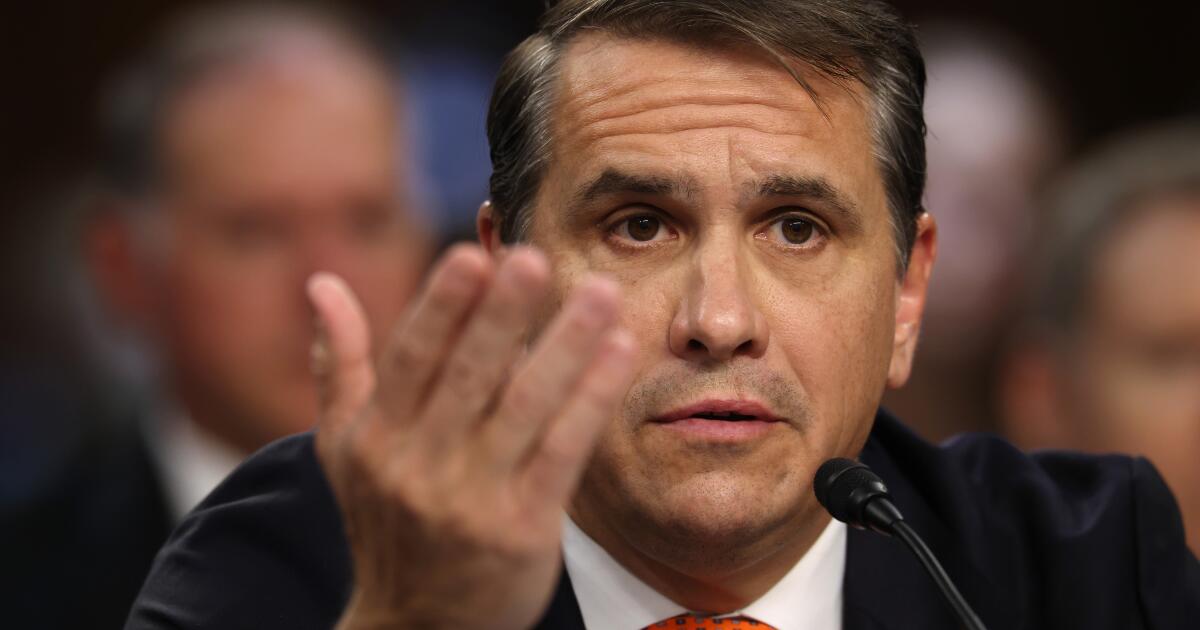 Politics24 minutes ago
Blanche to face questions about his independence at attorney general confirmation hearing
-
 Sports36 minutes ago
How World Cup senior citizens like Lionel Messi have bio-hacked longer careers
-

 World48 minutes ago
Baltic presidents warn of Russian infrastructure attack plans
-
News1 hour ago
ICE should do traffic stops despite recent shootings, Trump says, seeming to oppose new suspension


