Utah
A student orchestra experience rooted in rural Utah is here to ‘bring the music’

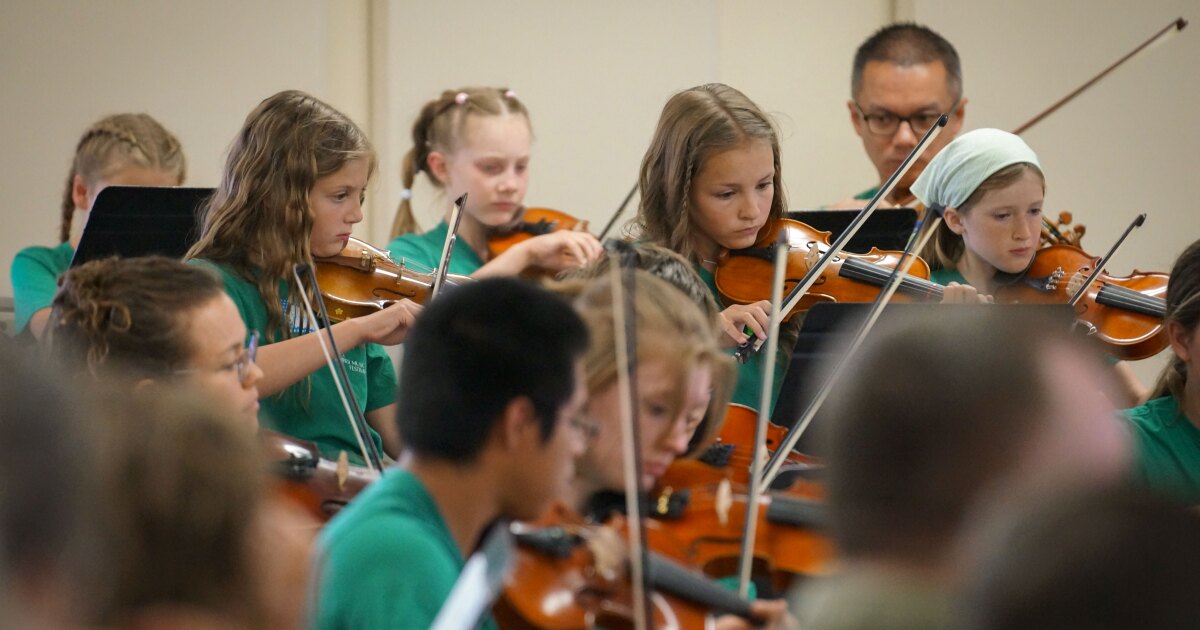
Wayne County is nearly 2,500 square miles of alpine peaks, green farm fields and red rock deserts in south-central Utah. The scenery is plentiful, but people are not — especially if you’re looking for orchestra kids.
“There’s probably three or four people that play violin, and we all have to drive down to Torrey to go to the same teacher,” 11-year-old violin student Journee Pace said of her hometown of Lyman.
These kids come from very small towns. Lyman and Torrey have around 200 residents each, and unlike many urban or suburban school districts, Wayne County doesn’t offer an orchestra program.
That’s why, for kids like Pace, getting to take part in a one-day youth strings workshop in their backyard is a big deal. Two dozen students came together at the county community center in Bicknell, population 323, to learn from world-class symphony musicians from as far away as England and Germany.
“They’re professional violin players, and just seeing how far they went makes me want to do it, too,” Pace said.
Opening small-town kids’ eyes to those types of big dreams matters, said the county’s only local strings instructor, Lynsey Shelar. She started to teach private lessons in 2011, and her Sleeping Rainbow School of Music now has 12 students from all over the county.
“The best part for me is when I see my own students … to see that ‘A-Ha’ moment on their face,” Shelar said. “This is what music is about.”
The workshop is part of the Torrey Chamber Music Festival, which has used donations and grant money to host similar classes and camps for strings students since 2017. Even though the kids may not grow up to play in a symphony, the lessons they learn now about connecting with themselves and with others can have far-reaching ripple effects.
“Music is about playing with emotion and expressing and having that ability to communicate beyond words,” Shelar said. “So if we can get kids to feel that, we are building empathy in our communities — and compassion. I feel like we need a lot of that right now.”
There are plenty of barriers when it comes to picking up strings in rural areas like Wayne County, she said. First, there’s often a lack of exposure to these instruments and this type of music.

Geographic isolation plays a factor, too. The nearest music store that sells, rents or repairs string instruments is a 2.5-hour drive away, Shelar said. There are also financial barriers. Students often borrow their first violin or cello from school to try it out, but Wayne County’s district doesn’t give them that option.
Even for those who can get the right equipment and learn to play, there aren’t many chances to perform as a group, which Shelar said is vital for keeping kids engaged and helping them see the progress they’ve made.
“They love playing together,” Shelar said. “It’s exciting to see the light in their faces.”
Viola student Brigette Winters from the nearby town of Loa, population 595, agreed isolation can be a downside of learning these instruments in a community where there aren’t many other people your age who play. But that also makes the rare occasions when they come together all the more special.
“Sometimes I think it’d be nice to go out and be with people who are really good to help push me, but I really enjoy doing it here,” Winters said. “It’s just fun to think, ‘Oh, this small town that has not much of anything has a pretty awesome orchestra group.’”

The challenges strings students in Wayne County face can be seen statewide. Utah State Board of Education Fine Arts Coordinator Laurie Baefsky said small-town schools deal with several obstacles when it comes to adding string music programs.
First, there’s a lack of orchestra instructors broadly. The typically smaller salaries for teachers in small towns also make it harder to keep them in those positions for the long term.
“We’re very aware, statewide, of a teacher shortage, and that is not exclusive to rural areas. Although we see it more acutely in the rural areas.”
Demand for music education in small towns is not the problem, she said. As a matter of percentage, participation in the secondary school band in Wayne County outpaces that of much more populous Salt Lake City or Utah County. The smaller tax bases in sparsely populated places, however, can make ongoing funding for extra programs hard to come by.
“If something gets cut, are they going to cut the football team or the strings program?” Baefsky said. “So I think there’s a sense of insecurity with our arts educators in Utah, where we always have to make a case for the arts.”
This can be especially challenging, she said, because some small-town residents may not see the value of teaching kids an instrument when the local economy is based on something different.

While each elementary school in the Salt Lake City School District has a dedicated music education specialist, Wayne County only has one fine arts teacher — the local strings instructor, Shelar. In that role, she splits her time between music and visual art and doesn’t teach strings at all.
Festival Chair Ada Mae Crouse, who grew up in a musical family, said passing these opportunities on to the next generation — as well as making classical music more accessible to the public — is central to the workshop’s mission.
“We wanted to not just bring the music, but also bring people together with music.”
The workshop culminates in a concert where the students perform side-by-side with the professionals. The setlist featured the kids on seven songs, including classical mainstays like “Ode to Joy” and the “William Tell Overture.” The students even requested “How Far I’ll Go” from the Disney movie Moana and the workshop had it arranged especially for their skill levels.
In the community center lobby, 9-year-old violinists Seffie Fullerton and Bethany Wing ran through William Tell’s opening bars.
“I’m nervous because I get stage fright a lot, and my mom usually puts it on video,” Fullerton said, “and it gets me super nervous.”
Fullerton made a few attempts but still couldn’t quite land the melody’s progression — adding frustration to her nerves. Fortunately, she’s learned that the instrument she’s holding can help.
“When I’m sad and I play it — like, yesterday, I got super sad … so I played the violin — and it helped me. If I’m angry, I can play it, and it will make me calm.”

Another of Shelar’s students from Lyman, 11-year-old Cru Peterson, felt a common mixture of excitement and nerves. Getting to sit next to a professional cellist, however, helped him remember why he was there.
“I just want to play cello as long as I can,” Peterson said. “I love it.”
As families crowded the community center’s main room for the performance, Keri Pace watched her daughter, Journee, in the violin section.
“It’s amazing to see it all come together,” she said. “I mean, people that are as talented as you’ll find anywhere in the world are here playing with them in Bicknell at a community center. It’s amazing.”
This one workshop and concert may not be able to erase all the geographic barriers these students face. But it can help them feel less alone, Shelar said, and give them a chance to perform together, which is vital to helping them build confidence.
“For me, to see them in this setting where they get to take the stage and they get to be first chair of their section, and they get to lead the entire orchestra for starting the piece — that is a really big deal. … It brings tears to my eyes.”
So at least for a few hours in this community center, the string students of Wayne County got to feel what it’s like to be a real orchestra.



SALT LAKE CITY (KUTV) — A man died after he was caught in an avalanche in Big Cottonwood Canyon over the weekend.
A spokesperson for the Salt Lake County Sheriff’s Office confirmed on Thursday that Kevin Williams, 57, had died.
He, along with one other person, was hospitalized in critical condition after Saturday’s avalanche in the backcountry.
MORE | Big Cottonwood Canyon Avalanche
In an interview with 2News earlier this week, one of Williams’ close friends, Nate Burbidge, described him as a loving family man.
“Kevin’s an amazing guy. He’s always serving, looking for ways that he can connect with others,” Burbidge said.
A GoFundMe was set up to help support Williams’ family.
BE THE FIRST TO COMMENT
_____

CONTENT WARNING: This report discusses suicide and includes descriptions of audio from 911 calls that some viewers may find disturbing.
LAS VEGAS — Exclusively obtained 911 recordings detail the hours leading up to the discovery of an 11-year-old Utah girl and her mother dead inside a Las Vegas hotel room in an apparent murder-suicide.
Addi Smith and her mother, Tawnia McGeehan, lived in West Jordan and had traveled to Nevada for the JAMZ cheerleading competition.
The calls show a growing sense of urgency from family members and coaches, and several hours passing before relatives learned what happened.
MORE | Murder-Suicide
Below is a timeline of the key moments, according to dispatch records. All times are Pacific Time.
10:33 a.m. — Call 1
After Addi and her mother failed to appear at the cheerleading competition, Addi’s father and stepmother called dispatch for a welfare check.
Addi and her mother were staying at the Rio hotel. The father told dispatch that hotel security had already attempted contact.
“Security went up and knocked on the door. There’s no answer or response it doesn’t look like they checked out or anything…”
11:18 a.m. and 11:27 a.m. — Calls 2 and 3
As concern grew, Addi’s coach contacted the police two times within minutes.
“We think the child possibly is in imminent danger…”
11:26 a.m. — Call 4
Addi’s stepmother placed another call to dispatch, expressing escalating concern.
“We are extremely concerned we believe that something might have seriously happened.”
She said that Tawnia’s car was still at the hotel.
Police indicated officers were on the way.
2:26 p.m. — Call 5
Nearly three hours after the initial welfare check request, fire personnel were en route to the scene. It appeared they had been in contact with hotel security.
Fire told police that they were responding to a possible suicide.
“They found a note on the door.”
2:35 p.m. — Call 6
Emergency medical personnel at the scene told police they had located two victims.
“It’s going to be gunshot wound to the head for both patients with notes”
A dispatcher responded:
“Oh my goodness that’s not okay.”
2:36 p.m. — Call 7
Moments later, fire personnel relayed their assessment to law enforcement:
“It’s going to be a murder suicide, a juvenile and a mother.”
2:39 p.m. — Call 8
Unaware of what had been discovered, Addi’s father called dispatch again.
“I’m trying to file a missing persons report for my daughter.”
He repeats the details he knows for the second time.
3:13 p.m. — Call 9
Father and stepmother call again seeking information and continue to press for answers.
“We just need some information. There was a room check done around 3:00 we really don’t know where to start with all of this Can we have them call us back immediately?”
Dispatch responded:
“As soon as there’s a free officer, we’ll have them reach out to you.”
4:05 p.m. — Call 10
More than an hour later, Addi’s father was put in contact with the police on the scene. He pleaded for immediate action.
“I need someone there I need someone there looking in that room”
The officer confirmed that they had officers currently in the room.
Addi’s father asks again what they found, if Addi and her mother are there, and if their things were missing.
The officer, who was not on scene, said he had received limited information.
5:23 p.m. — Call 11
Nearly seven hours after the first welfare check request, Addi’s grandmother contacted police, describing conflicting information circulating within the family.
“Some people are telling us that they were able to get in, and they were not in the hotel room, and other people saying they were not able to get in the hotel room, and we need to know”
She repeated the details of the case. Dispatch said officers will call her back once they have more information.
Around 8:00 p.m. — Press Conference
Later that evening, Las Vegas Metropolitan Police held a news conference confirming that Addi and her mother, Tawnia McGeehan, were found dead inside the hotel room.
The investigation remains ongoing.
______

SALT LAKE CITY (KUTV) — AI glasses could allow you to get answers, snap photos, access audio and take phone calls—and now a proposal moving through the legislature would ban the glasses from Utah school classrooms.
“I think it’s a great idea,” said Kizzy Guyton Murphy, a mother who accompanied her child’s class on a field trip to the state Capitol on Wednesday. “You can’t see inside what the student is looking at, and it’s just grounds for cheating.”
Mom Tristan Davies Seamons also sees trouble with AI glasses.
“I don’t think they should have any more technology in schools than they currently have,” she said.
Her twin daughters, fourth graders Finley and Grayson, don’t have cell phones yet.
“Not until we’re like 14,” said Grayson, adding they do have Chromebooks in school.
2News sent questions to the Utah State Board of Education:
- Does it have reports of students using AI glasses?
- Does it see cheating and privacy as major concerns?
- Does it support a ban from classrooms?
Matt Winters, USBE AI specialist, said the board has not received reports from school districts of students with AI glasses.
“Local Education Agencies (school districts) have local control over these decisions based on current law and code,” said Winters. “The Board has not taken a position on AI glasses.
MORE | Utah State Legislature:
Some districts across the country have reportedly put restrictions on the glasses in schools.
“I think it should be up to the teachers,” said Briauna Later, another mother who is all for preventing cheating, but senses a ban could leave administrators with tired eyes.
“It’s one more thing for the administration to have to keep track of,” said Later.
The proposal, HB 42, passed the House and cleared a Senate committee on Wednesday.
BE THE FIRST TO COMMENT
___

Popn’ Off Gourmet Popcorn opens on Broad Street in Augusta

Pleasant, spring-like weekend for Virginia, Maryland, DC ahead of active start to March

House explosion in Cleveland’s Slavic Village neighborhood catches neighboring houses on fire

A total lunar eclipse will turn the moon blood red on Tuesday

Alabama ‘Fully Aware’ of Losing Streak to Tennessee Ahead of Road Rematch

Florida High School Football Rankings: Top 25 teams – Oct. 21

Cleary's 21 help Le Moyne down Central Connecticut State 69-64 in OT

How old is Bo Nix? What to know about Oregon quarterback ahead of 2024 NFL Draft

99th annual Pony Swim held in Virginia

Indiana Members Credit Union announced as new anchor tenant at Bottleworks District

Where Iran’s ballistic missiles can reach — and how close they are to the US

Has India’s influence in Afghanistan grown under the Taliban?

Bill Clinton to testify before House committee investigating Epstein links

Read Judge Schiltz’s Order

Vulnerable House Dem lashes out at Trump’s ‘racist’ SOTU challenge: ‘That was uncomfortable’
-

 World2 days ago
Exclusive: DeepSeek withholds latest AI model from US chipmakers including Nvidia, sources say
-

 Massachusetts2 days ago
Mother and daughter injured in Taunton house explosion
-

 Montana1 week ago
2026 MHSA Montana Wrestling State Championship Brackets And Results – FloWrestling
-

 Oklahoma1 week ago
Wildfires rage in Oklahoma as thousands urged to evacuate a small city
-

 Louisiana5 days ago
Wildfire near Gum Swamp Road in Livingston Parish now under control; more than 200 acres burned
-

 Denver, CO2 days ago
10 acres charred, 5 injured in Thornton grass fire, evacuation orders lifted
-

 Technology6 days ago
YouTube TV billing scam emails are hitting inboxes
-

 Technology6 days ago
Stellantis is in a crisis of its own making