Utah
A student orchestra experience rooted in rural Utah is here to ‘bring the music’

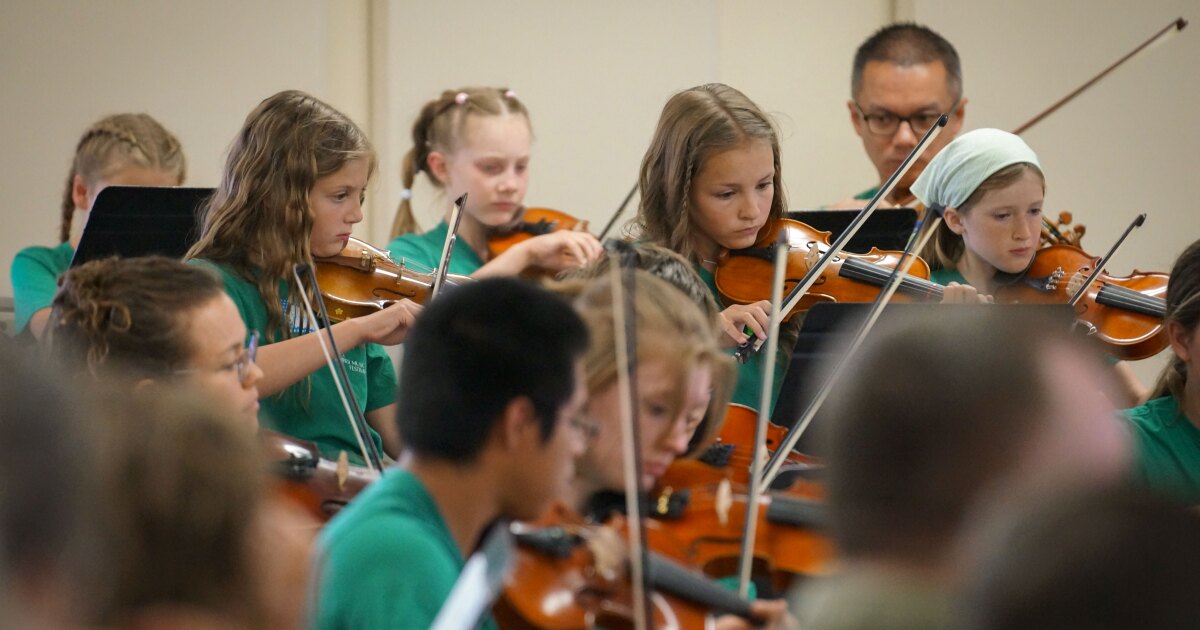
Wayne County is nearly 2,500 square miles of alpine peaks, green farm fields and red rock deserts in south-central Utah. The scenery is plentiful, but people are not — especially if you’re looking for orchestra kids.
“There’s probably three or four people that play violin, and we all have to drive down to Torrey to go to the same teacher,” 11-year-old violin student Journee Pace said of her hometown of Lyman.
These kids come from very small towns. Lyman and Torrey have around 200 residents each, and unlike many urban or suburban school districts, Wayne County doesn’t offer an orchestra program.
That’s why, for kids like Pace, getting to take part in a one-day youth strings workshop in their backyard is a big deal. Two dozen students came together at the county community center in Bicknell, population 323, to learn from world-class symphony musicians from as far away as England and Germany.
“They’re professional violin players, and just seeing how far they went makes me want to do it, too,” Pace said.
Opening small-town kids’ eyes to those types of big dreams matters, said the county’s only local strings instructor, Lynsey Shelar. She started to teach private lessons in 2011, and her Sleeping Rainbow School of Music now has 12 students from all over the county.
“The best part for me is when I see my own students … to see that ‘A-Ha’ moment on their face,” Shelar said. “This is what music is about.”
The workshop is part of the Torrey Chamber Music Festival, which has used donations and grant money to host similar classes and camps for strings students since 2017. Even though the kids may not grow up to play in a symphony, the lessons they learn now about connecting with themselves and with others can have far-reaching ripple effects.
“Music is about playing with emotion and expressing and having that ability to communicate beyond words,” Shelar said. “So if we can get kids to feel that, we are building empathy in our communities — and compassion. I feel like we need a lot of that right now.”
There are plenty of barriers when it comes to picking up strings in rural areas like Wayne County, she said. First, there’s often a lack of exposure to these instruments and this type of music.

Geographic isolation plays a factor, too. The nearest music store that sells, rents or repairs string instruments is a 2.5-hour drive away, Shelar said. There are also financial barriers. Students often borrow their first violin or cello from school to try it out, but Wayne County’s district doesn’t give them that option.
Even for those who can get the right equipment and learn to play, there aren’t many chances to perform as a group, which Shelar said is vital for keeping kids engaged and helping them see the progress they’ve made.
“They love playing together,” Shelar said. “It’s exciting to see the light in their faces.”
Viola student Brigette Winters from the nearby town of Loa, population 595, agreed isolation can be a downside of learning these instruments in a community where there aren’t many other people your age who play. But that also makes the rare occasions when they come together all the more special.
“Sometimes I think it’d be nice to go out and be with people who are really good to help push me, but I really enjoy doing it here,” Winters said. “It’s just fun to think, ‘Oh, this small town that has not much of anything has a pretty awesome orchestra group.’”

The challenges strings students in Wayne County face can be seen statewide. Utah State Board of Education Fine Arts Coordinator Laurie Baefsky said small-town schools deal with several obstacles when it comes to adding string music programs.
First, there’s a lack of orchestra instructors broadly. The typically smaller salaries for teachers in small towns also make it harder to keep them in those positions for the long term.
“We’re very aware, statewide, of a teacher shortage, and that is not exclusive to rural areas. Although we see it more acutely in the rural areas.”
Demand for music education in small towns is not the problem, she said. As a matter of percentage, participation in the secondary school band in Wayne County outpaces that of much more populous Salt Lake City or Utah County. The smaller tax bases in sparsely populated places, however, can make ongoing funding for extra programs hard to come by.
“If something gets cut, are they going to cut the football team or the strings program?” Baefsky said. “So I think there’s a sense of insecurity with our arts educators in Utah, where we always have to make a case for the arts.”
This can be especially challenging, she said, because some small-town residents may not see the value of teaching kids an instrument when the local economy is based on something different.

While each elementary school in the Salt Lake City School District has a dedicated music education specialist, Wayne County only has one fine arts teacher — the local strings instructor, Shelar. In that role, she splits her time between music and visual art and doesn’t teach strings at all.
Festival Chair Ada Mae Crouse, who grew up in a musical family, said passing these opportunities on to the next generation — as well as making classical music more accessible to the public — is central to the workshop’s mission.
“We wanted to not just bring the music, but also bring people together with music.”
The workshop culminates in a concert where the students perform side-by-side with the professionals. The setlist featured the kids on seven songs, including classical mainstays like “Ode to Joy” and the “William Tell Overture.” The students even requested “How Far I’ll Go” from the Disney movie Moana and the workshop had it arranged especially for their skill levels.
In the community center lobby, 9-year-old violinists Seffie Fullerton and Bethany Wing ran through William Tell’s opening bars.
“I’m nervous because I get stage fright a lot, and my mom usually puts it on video,” Fullerton said, “and it gets me super nervous.”
Fullerton made a few attempts but still couldn’t quite land the melody’s progression — adding frustration to her nerves. Fortunately, she’s learned that the instrument she’s holding can help.
“When I’m sad and I play it — like, yesterday, I got super sad … so I played the violin — and it helped me. If I’m angry, I can play it, and it will make me calm.”

Another of Shelar’s students from Lyman, 11-year-old Cru Peterson, felt a common mixture of excitement and nerves. Getting to sit next to a professional cellist, however, helped him remember why he was there.
“I just want to play cello as long as I can,” Peterson said. “I love it.”
As families crowded the community center’s main room for the performance, Keri Pace watched her daughter, Journee, in the violin section.
“It’s amazing to see it all come together,” she said. “I mean, people that are as talented as you’ll find anywhere in the world are here playing with them in Bicknell at a community center. It’s amazing.”
This one workshop and concert may not be able to erase all the geographic barriers these students face. But it can help them feel less alone, Shelar said, and give them a chance to perform together, which is vital to helping them build confidence.
“For me, to see them in this setting where they get to take the stage and they get to be first chair of their section, and they get to lead the entire orchestra for starting the piece — that is a really big deal. … It brings tears to my eyes.”
So at least for a few hours in this community center, the string students of Wayne County got to feel what it’s like to be a real orchestra.


BEAVER COUNTY, Utah — A massive community effort is underway as volunteers and Beaver County crews distribute thousands of sandbags to protect homes from the potential path of floodwaters.
After the Cottonwood Fires, residents have been waiting for weeks for relief to come in the form of rain, though officials now warn it may come all at once with an increased risk of flooding and debris flow.
Emergency Service Director Les Whitney believes that the fire has left plenty of debris to bring trouble for residents.
“We got a lot of water. We’re bringing debris with it, so tree branches, tree limbs, logs, lots of different size firewood, and that’s all in the creeks. We’re worried about that plugging up our bridges and stuff, so we have heavy equipment and excavators located in strategic places so that we can keep those bridges open,” said Whitney.
An estimated 140 homes and condominiums were spared from the flames, but remain in the paths of floodwaters.
Residents can also pick up sandbags at the Beaver County Sheriff’s Office or at the Beaver County Rodeo Fairgrounds.

EAGLE MOUNTAIN — An Eagle Mountain man currently on pretrial release in 4th District Court who is accused of abusing his dog has been arrested again for allegedly punching the same animal.
Keith Reaves Davis, 43, was booked into the Utah County Jail on Wednesday for investigation of aggravated cruelty to an animal.
Utah County sheriff’s deputies were called Wednesday afternoon to a grocery store on a report that a man was beating his dog after it had gotten off its leash and was stopped by a bystander, according to a police booking affidavit.
“I reviewed security camera footage from the grocery store, and an individual matching the description of the suspect was seen holding the dog in the air by one paw and repeatedly striking the dog on the right hind leg area. I observed the male strike the dog several times before dropping the dog from approximately 1-2 feet. The strikes appeared to be as hard as the male could hit,” the arresting deputy wrote in the affidavit. “The dog did not cry out or whimper as if the dog was accustomed to the abuse.”
When questioned, Davis “admitted to striking the dog because it was not behaving,” the affidavit states.
An animal control officer who responded to the scene to take custody of the dog noted it was the same dog he had taken from Davis exactly three months earlier during another animal abuse investigation.
In that case, Davis was charged in 4th District Court with aggravated cruelty to an animal, a class A misdemeanor; and public intoxication, a class C misdemeanor, after deputies received a tip from a neighbor that a dog was being abused at Davis’ home, according to charging documents. When questioned, Davis “acknowledged hitting his dog as punishment,” the charges state.
Deputies also reviewed videos that the neighbor had filmed. The neighbor told investigators “there was blood from the dog on the ground of the garage and (the neighbor) can hear the dog screaming as if it’s being hurt. Deputies got the videos from the (neighbor) and you can hear very loudly the dog screaming and crying with a lot of loud banging noises. In one of the videos, you can hear the dog sounding like it is being choked by a collar and is grasping for air,” a police booking affidavit states.
Davis’ next court hearing in the April case is scheduled for July 28.
In their latest booking report, sheriff’s deputies note that they “believe further harm will be inflicted on this dog if it is released back to the male a second time,” and have recommended the dog not be returned to Davis.
The Key Takeaways for this article were generated with the assistance of large language models and reviewed by our editorial team. The article, itself, is solely human-written.


Two years after October 7th attacks, Gaza war reshapes global politics
Two years after Hamas attacked Israel, Gaza lies in ruins and global alliances have shifted. Correction: A previous version of this video incorrectly identified the conflict. The conflict is between Israel and Hamas.
A man was arrested in Utah after allegedly stabbing a Muslim employee at a mall multiple times and telling investigators he targeted the victim because of his religion, according to court records.
Peter Michael Larsen, 48, was booked into the Salt Lake County Jail on suspicion of attempted murder and prohibited dangerous weapon conduct following the attack on July 13 at the Valley Fair Mall in West Valley City, Utah, court and online jail records show. West Valley City is a suburb of Salt Lake City.
The West Valley City Police Department said the incident occurred shortly before 3 p.m. local time, when Larsen approached a man working at a kiosk at the mall.
“After a brief interaction, the suspect pulled out a knife and began stabbing him multiple times,” police said in a statement on X. “A few bystanders interfered, and were able to separate the suspect from the victim and subdue the suspect until police arrived.”
The victim, who was not identified by authorities, sustained multiple stab wounds and was taken to a hospital in critical condition, according to police and court records.
Larsen told investigators that he had “targeted the victim with intent to kill him because of his religion (Muslim),” police said in an affidavit obtained by USA TODAY. The affidavit also states Larsen said he believes he is “a catalyst” and “intends to kill Muslims.”
The incident remains under investigation, and police said they were looking into any possible relationship between the suspect and victim. USA TODAY reached out to the West Valley City Police Department for comment.
Police: Suspect poses a ‘substantial danger to the public’
The suspect approached the Muslim man, asked for his name, asked about his religion, and indicated he wanted a bottle of water, The Salt Lake Tribune reported, citing comments from Imam Shuaib Din, who leads the Utah Islamic Center and had been in contact with the victim’s family.
As the victim turned to get the water, the attacker began stabbing him, Din told the newspaper. Police said in the affidavit that they received multiple 911 calls at around 2:30 p.m. local time reporting two men “involved in a physical altercation where one male was stabbing the other.”
When officers arrived at the scene, they observed bystanders pinning the suspect to the ground and “had already removed the knife from his hand,” according to the affidavit. Police said the victim was “bleeding profusely” and was then transported to the hospital.
The victim was identified by friends as Syed Sohail Uddin, local television station FOX 13 and The New York Times reported. A GoFundMe fundraiser organized on his behalf said he was stabbed 15 times and required multiple surgeries.
Larsen was also transported to the hospital “due to being punched in the head from bystanders trying to get the knife out of his hand,” according to the affidavit. He was later medically cleared and taken to the police station for an interview.
Police said in the affidavit that Larsen posed “a substantial danger to the public if released based on his violent actions today, ideologies and pre-planned mass casualty events.”
Advocates condemn stabbing attack at Utah mall
Muslim advocacy groups, including the Council on American-Islamic Relations (CAIR), condemned the attack.
“This horrific attack is yet another reminder that anti-Muslim rhetoric has real-world consequences. When Muslims are routinely demonized, portrayed as threats, or treated as less deserving of equal rights and dignity, some twisted individuals inevitably act on that hatred,” CAIR National Executive Director Nihad Awad said in a statement on July 14.
Civil rights advocates have noted a rise in Islamophobia in the United States over the last two-plus decades following the Sept. 11, 2001, attacks, and more recently because of immigration policies and the fallout of the Israel-Hamas war, according to Reuters.
CAIR, which is the nation’s largest Muslim civil rights and advocacy organization, reported last year that it received a record number of complaints of discrimination and Islamophobic attacks amid the war.
The organization received more than 8,650 complaints in 2024, the highest number since CAIR began publishing its annual civil rights report in 1996, according to the report released in March 2025. Complaints rose more than 7%, breaking the previous record set in 2023.
The Utah attack follows several high-profile incidents targeting Muslims in recent years, including the fatal stabbing of a 6-year-old Palestinian American boy in Illinois in 2023 and a deadly shooting at a San Diego mosque earlier this year.
Contributing: N’dea Yancey-Bragg, USA TODAY; Reuters
-

 Montana3 minutes ago
Missoula and Western Montana neighbors: Obituaries for July 17
-

 Nebraska9 minutes ago
Obituary | Stephen C. Mason
-

 Nevada15 minutes ago
Nevada Attorney Gen. Aaron Ford responds to what he calls President Trump’s ‘misleading speech on elections’
-

 New Hampshire21 minutes ago
Woman Taken To Concord Hospital On A Trauma Alert After A Rollover Crash On South Main Street
-

 New Jersey27 minutes ago
NY-NJ World Cup host group failed to register with state | Exclusive
-

 New Mexico33 minutes ago
Expectations Have Changed: UNM enters 2026 as a Mountain West title contender
-

 North Carolina39 minutes ago
North Carolina’s Republican-led election board makes it easier to reject ballots
-

 North Dakota45 minutes ago
Icelandic State Park to host astronomy shows

