West
US Supreme Court upholds controversial anti-camping laws used against homeless people in Oregon city

- The U.S. Supreme Court upheld anti-camping laws in Grants Pass, Oregon, allowing authorities to prevent homeless individuals from sleeping in public parks and streets.
- The court’s 6-3 decision reversed a lower court ruling that enforcing these laws without available shelter violated the Eighth Amendment’s prohibition on cruel and unusual punishment.
- Grants Pass ordinances prohibit sleeping on public streets with blankets or bedding, imposing fines and possible jail time.
The U.S. Supreme Court upheld on Friday anti-camping laws used by authorities in an Oregon city to stop homeless people from sleeping in public parks and public streets – a ruling that gives local and state governments a freer hand in confronting a national homelessness crisis.
The justices ruled 6-3 to overturn a lower court’s decision that found that enforcing the ordinances in the city of Grants Pass when no shelter space is available for the homeless violates the U.S. Constitution’s Eighth Amendment prohibition on “cruel and unusual” punishments. Various jurisdictions employ similar laws.
The court’s conservative justices were in the majority, while its three liberal members dissented.
TRUST IN SUPREME COURT PLUNGES AHEAD OF KEY DECISIONS ON PRESIDENTIAL IMMUNITY, JAN. 6
Homelessness remains a complex problem for public officials in the United States as many municipalities experience chronic shortages of affordable housing. On any given night, more than 600,000 people are homeless, according to U.S. government estimates.
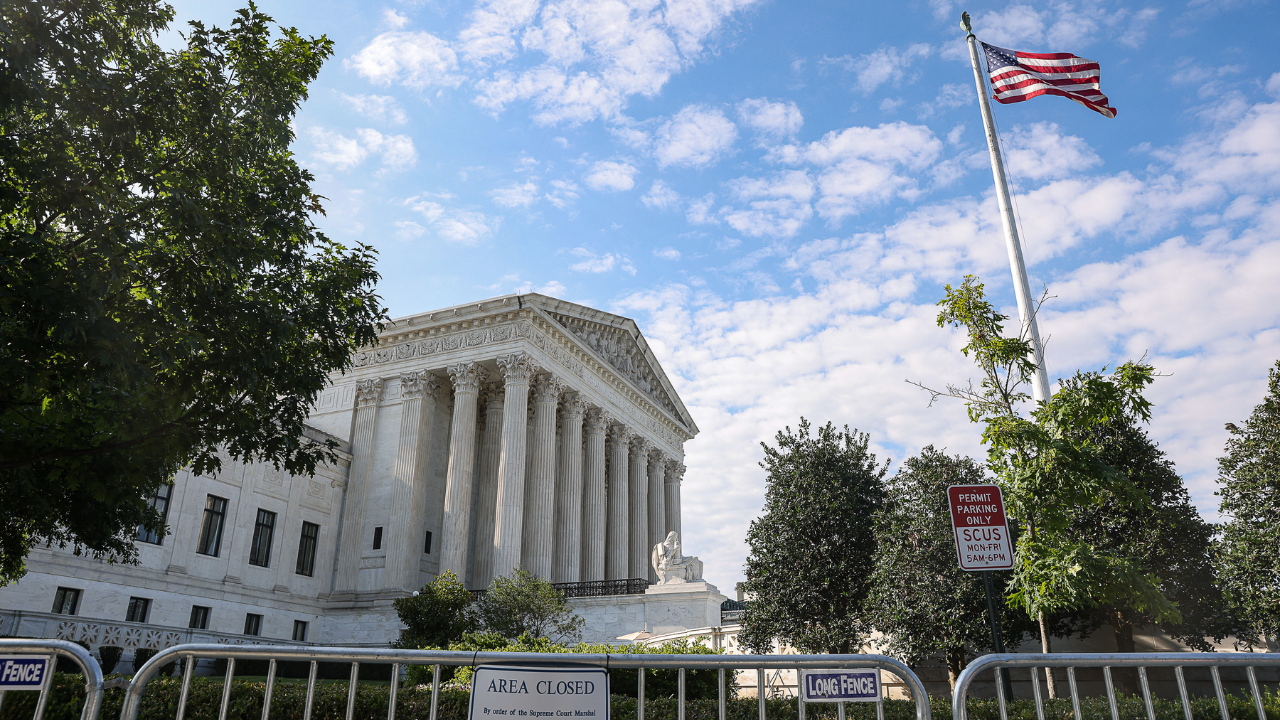
The U.S. Supreme Court is seen in Washington, DC, on June 28, 2024. The U.S. Supreme Court upheld on Friday anti-camping laws used by authorities in an Oregon city to stop homeless people from sleeping in public parks and public streets – a ruling that gives local and state governments a freer hand in confronting a national homelessness crisis. (Valerie Plesch/Bloomberg via Getty Images)
The case focused on three ordinances in Grants Pass, a city of roughly 38,000 people in southwestern Oregon, that together prohibit sleeping in public streets, alleyways and parks while using a blanket or bedding. Violators are fined $295. Repeat offenders can be criminally prosecuted for trespass, punishable by up to 30 days in jail.
Advocates for the homeless, various liberal legal groups and other critics have said laws like these criminalize people simply for being homeless and for actions they cannot avoid, such as sleeping in public. They point to a 1962 Supreme Court ruling that the Eighth Amendment barred punishing individuals based on their status rather than their conduct.
SUPREME COURT RULES ON CHALLENGE TO BIDEN ADMIN’S EFFORT TO INFLUENCE SOCIAL MEDIA
A point of contention during the Supreme Court’s arguments in the case in April was whether homelessness can be deemed a status that would prohibit enforcing local laws.
President Joe Biden’s administration agreed with the plaintiffs that Grants Pass cannot enforce an “absolute ban” on sleeping in the city – which effectively criminalizes homelessness – but suggested the rulings by the lower courts against the city were too broad and should be reconsidered.
Proponents, including various government officials, have called such laws a necessary tool for maintaining public safety.
The case, which began in 2018, involved three homeless people who filed a class-action lawsuit seeking to block the measures impacting them in Grants Pass. One of the plaintiffs has since died.
U.S. Magistrate Judge Mark Clarke ruled that the city’s “policy and practice of punishing homelessness” violates the Eighth Amendment and barred it from enforcing the anti-camping ordinances. The San Francisco-based 9th U.S. Circuit Court of Appeals upheld Clarke’s injunction against the ordinances.
The city had defended itself in the case in part by noting that homeless people have alternatives outside the city, including nearby undeveloped federal land, county campsites or state rest stops. The judge said that argument “sheds light on the city’s attitude towards its homeless citizens” by seeking to drive them out or punish them if they stay.
Read the full article from Here

The Oregon Lottery offers several draw games for those aiming to win big.
Here’s a look at July 14, 2026, results for each game:
Winning Mega Millions numbers from July 14 drawing
02-04-10-48-56, Mega Ball: 22
Check Mega Millions payouts and previous drawings here.
Winning Pick 4 numbers from July 14 drawing
1PM: 6-3-6-3
4PM: 7-0-0-9
7PM: 2-0-6-0
10PM: 2-5-1-5
Check Pick 4 payouts and previous drawings here.
Feeling lucky? Explore the latest lottery news & results
When are the Oregon Lottery drawings held?
- Powerball: 7:59 p.m. on Monday, Wednesday and Saturday.
- Mega Millions: 7:59 p.m. on Tuesday and Friday.
- Pick 4: 1 p.m., 4 p.m., 7 p.m. and 10 p.m. daily.
- Win for Life: 7:30 p.m. on Monday, Wednesday, and Saturday.
- Megabucks: 7:29 p.m. on Monday, Wednesday, and Saturday.
This results page was generated automatically using information from TinBu and a template written and reviewed by an Oregon editor. You can send feedback using this form.

SALT LAKE CITY (KUTV) — There have been hundreds of human-caused wildfires this year in Utah, but the legal outcomes are hard to track.
At least two people have been charged recently for starting fires: one for the Memory Grove Fire in Salt Lake and one for the Mountain Road Fire in Ogden.
This year alone, 327 wildfires have been started by people in Utah — an act that should carry consequences, according to some.
“Certainly, if it’s intentional, it’s against the law,” resident David Mastroianni said. “If it’s not intentional, then they weren’t being as careful as they should be with something they should be careful with.”
But, before anyone gets to that point, there’s a lot of work that goes into figuring out what started the fire, let alone who.
“The fire investigator will show up on scene and will look at the scene, collect evidence, and then turn it over to the proper authorities,” said Kelly Wickens with Forestry, Fire, and State Lands.
Tracking which fires end with criminal charges or civil suits is difficult.
Wickens said that once the fire is out and the investigator turns the evidence over, their work is done, and it’s up to the proper authorities to press charges.
“Arson does require — this is what makes it difficult — is that you have to establish someone intentionally started a fire,” said former prosecutor Nathan Evershed.
Evershed said there are more charges than just arson, such as reckless burning.
“So, if it’s not intentional and it’s more accidental, it can still be viewed as being reckless,” Evershed said.
That could mean if a firework accidentally causes a fire.
Evershed said that there’s also a difference between causing a structure fire and a grass fire. A structure fire could result in aggravated arson charges.
But what happens if a fire is completely accidental?
“It’s more difficult to find a criminal sanction on that … still could be a civil sanction on that, where somebody would have to pay restitution,” Evershed said.
So, while there’s no concrete number for how many human-caused fires have led to charges or civil suits, there are a lot of avenues if someone does get caught.
Evershed said you can even be charged if you just abandon a campfire that causes a fire.
_____

TETON COUNTY, Wyo. — The Wyoming Department of Health recently confirmed two additional cases of measles in Teton County, bringing the statewide total to six cases, with five cases having occurred in Teton County.
A release from the WDH states that one recently-confirmed case is an adult with no identified links to the previous three Teton County cases, while the other case is also an adult, who had direct exposure to a previously identified case.
“This underscores the highly contagious nature of the measles virus,” the release states.
According to the release, the public may have been exposed to measles at the following locations and times:
Target Jackson Hole, 510 S Highway 89, Jackson, Wyoming 83001
- July 5, 2026, 7:00 AM through 7:00 PM
- July 6, 2026, 7:00 AM through 7:00 PM
- July 7, 2026, 7:00 AM through 7:00 PM
Smith’s Food and Drug, 1425 South Highway 89, Jackson, Wyoming 83001
- July 8, 2026, 9:00 AM through noon
“Measles is very contagious and can cause serious illness, including pneumonia, encephalitis, hospitalization, and death,” the release states. “Vaccination is the best way to prevent measles infection.”
For more information on measles, including case counts, exposure locations, and guidance on what to do if exposed, visit the Wyoming Department of Health website.
Related
-

 Oklahoma2 minutes ago
Farmers, environmental group react to Oklahoma poultry litter settlement
-
Oregon8 minutes ago
Oregon Lottery Mega Millions, Pick 4 results for July 14
-

 Pennsylvania14 minutes ago
12-year-old boy on e-bike killed in crash with pickup truck in Pennsylvania
-
Rhode Island20 minutes ago
RI Lottery Mega Millions, Numbers Midday winning numbers for July 14, 2026
-

 South-Carolina26 minutes ago
Lindsey Graham’s sister sworn in as the South Carolina senator’s successor
-
South Dakota32 minutes ago
SD Lottery Mega Millions, Millionaire for Life winning numbers for July 14, 2026
-

 Tennessee38 minutes ago
Double rainbows spotted over Middle Tennessee — what causes them
-

 Texas44 minutes ago
Texas Makes Announcement Featuring Arch Manning

