West
UCLA locks doors on conservative students, preventing them from hosting pro-Israel event: YAF

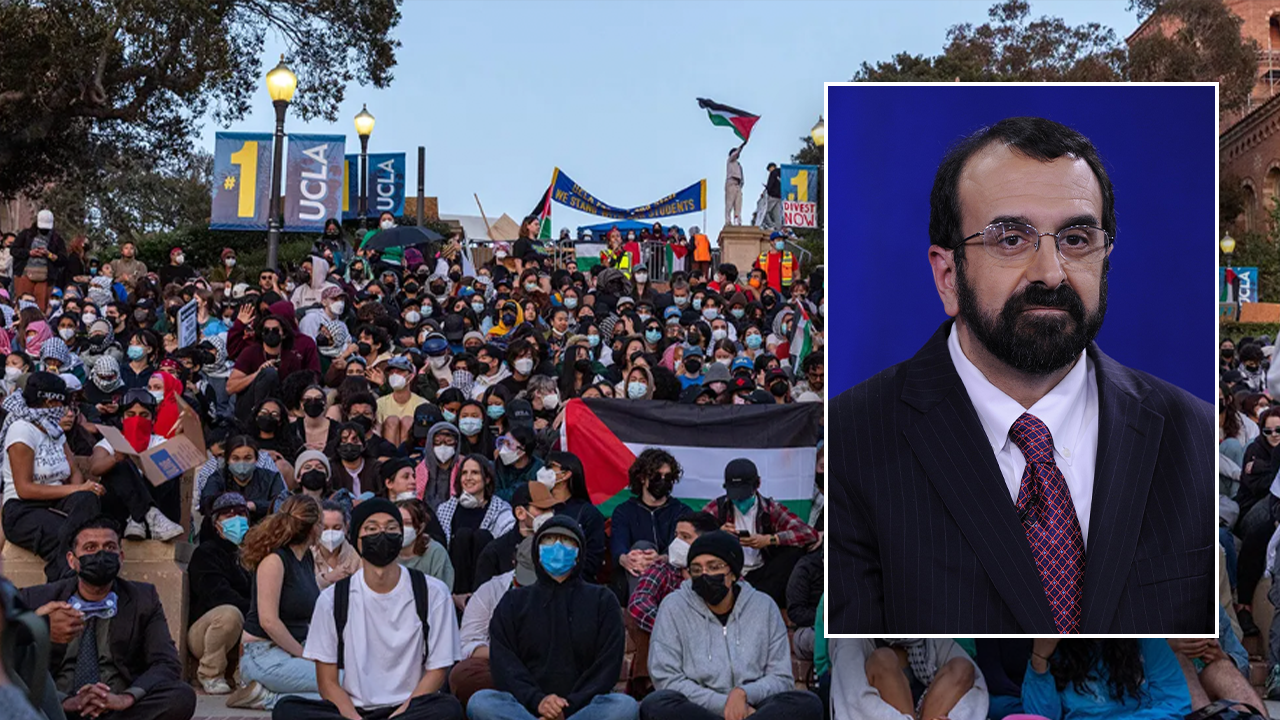
UCLA prevented conservative students on campus from hosting the founder of Jihad Watch, Robert Spencer, for a pro-Israel event, according to the student group.
“I am deeply disappointed in UCLA’s failure to protect our First Amendment rights,” Matthew Weinberg, chairman of UCLA Young Americans for Freedom chapter, said in a YAF press release. “All we wanted was a successful Pro-Israel event where people of all backgrounds and viewpoints can engage in the free exchange of ideas and hear a different perspective not heard across university campuses, and the school made that impossible. This is nothing but an act of pure cowardice.”
The Young American’s Foundation, a nonprofit conservative youth organization, invited Spencer to deliver a speech on Wednesday, but “the doors of the Bruin Viewpoint Room were locked,” according to YAF.
Fox News Digital previously reported that UCLA has not responded to the YAF chapter’s request to host Spencer, despite filing for approval weeks prior.
‘AN ACTUAL REVOLUTION’: COMMUNIST PARTY ORGANIZER REVEALS TRUE MISSION AT UCLA ANTI-ISRAEL RALLY
Police arrest multiple protesters who gathered in a UCLA campus parking garage on May 6, 2024, in Los Angeles. (Brian van der Brug/Los Angeles Times via Getty Images)
Weinberg told Fox News Digital earlier this month that he initially did not receive any word regarding the application from school leaders. He did eventually meet with administrators overseeing student engagement, but was told “there is no timeframe” for approving Spencer as a speaker.
UCLA SILENT ON APPROVING ANTI-JIHAD CAMPUS SPEAKER EVENT AMID CAMPUS PROTESTS
“The fact that the school prioritizes agitators, some who aren’t even students, that are clearly violating campus policy and have been physically assaulting Jewish students, over students who engage in the free exchange of ideas like people in our chapter to me is absurd and demonstrates cowardice. It demonstrates a lack of moral clarity and this needs to be addressed,” Weinberg said earlier this month.
Weinberg said he was planning to carry on with the event and was hoping “for the best.”
Anti-Israel students set up an encampment in support of Gaza on the UCLA campus in Los Angeles on May 1, 2024. (Grace Yoon/Anadolu via Getty Images)
On Wednesday, however, university officials told the chapter “that the event would need to be moved to a low-traffic, remote location – an unacceptable last minute change that would have significantly impacted the event’s attendance and impact,” according to YAF’s press release, which said the ordeal is “a clear violation of students’ constitutional rights.”
The group’s press release added that “for weeks, UCLA administrators have stalled the approval process in a clear attempt to ensure the event would not happen.”
JEWISH STUDENT DEFIES ANTI-ISRAEL RADICALS WHO ‘STALKED’ HIM ON CALIFORNIA CAMPUS: WON’T BE ‘SILENCED’
University officials reportedly initially told the group that “it would be too dangerous to host an event” that holds contrary views to agitators on campus who had established an anti-Israel encampment on campus. YAF and Mountain States Legal Foundation pushed back on the school that not granting permission to host Spencer was an “unconstitutional use of the heckler’s veto.”
Robert Spencer, founder of Jihad Watch (Ida Mae Astute/Disney General Entertainment Content via Getty Images)
The conservative student group argued that legal pressure appeared to “prompt the university to reconsider” their plan to stall the event, but “unfortunately, this did not turn out to be the case.”
“While the chapter boldly withstood these attacks, and things appeared to be moving forward, there was simply nothing they could do about the locked door, which administrators refused to open.”
Fox News Digital reached out to UCLA for comment on Sunday, but did not immediately receive a reply. A school official did tell the College Fix that “there is misinformation circulating that the Young America’s Foundation event at UCLA on Wednesday evening was canceled by the university.”
USC STUDENT RECOUNTS DISAPPOINTMENT AFTER GRADUATION COMMENCEMENT WAS CANCELED DUE TO ANTI-ISRAEL PROTESTS
“This is incorrect,” the spokeswoman said. “The event took place in the designated location after it shifted to a closed, recorded event as proposed by the organizer and agreed to by UCLA.”
Weinberg pushed back on the school’s response, saying the event never took place, while lamenting to the outlet that UCLA’s campus has become hostile to Jewish students.
Anti-Israel students rally on the UCLA campus on Oct. 12, 2023. (Luis Sinco/Los Angeles Times via Getty Images)
“The beauty of this event is that all are welcome, and we highly encourage students with opposing viewpoints to come and ask Robert any questions they would like. After all, the only way to move forward and create peace is to have an open dialogue,” he told the College Fix.
UCLA FINALLY ASKS FOR FBI HELP — BUT TO INVESTIGATE PRO-ISRAEL SUPPORTERS
“Bringing Robert Spencer allows us to present an alternative perspective on the Israel-Palestine conflict as well as the Israel-Hamas war that is not typically heard on college campuses,” Weinberg said.
Spencer said in YAF’s press release that schools such as UCLA are “radioactive wastelands” of left-wing politics.
“UCLA and other universities today are not institutions of higher learning; they are radioactive wastelands of hard-left indoctrination,” Spencer said.
Graffiti at the Powell Library on the UCLA campus on April 29, 2024, in Los Angeles. (Brian van der Brug/Los Angeles Times via Getty Images)
Anti-Israel protests have broken out on college campuses nationwide, notably in New York City and at UCLA and USC in Los Angeles. Anti-Israel protests on Columbia University’s campus spiraled last month, when agitators were seen on camera with a poster outlining that Jewish students on campus would become Al-Qasam’s “next targets,” referring to terrorist organization Hamas’ military wing. That same weekend, a rabbi at Columbia warned Jewish students to leave campus immediately until the situation was quelled.
UCLA STUDENT SLAMS UNIVERSITY FOR ‘ENCOURAGING VIOLENCE,’ TURNING CAMPUS INTO ‘WAR ZONE’: ‘THIS IS A DISGRACE’
Protests also broke out on UCLA’s campus last month, including agitators establishing an encampment demanding the elite public school cut financial ties with Israel. Following a nine-hour standoff between radicals on campus, police were able to clear the encampment earlier this month and made hundreds of arrests.
CALIFORNIA STATE OFFICIALS CONDEMN VIOLENT ANTI-ISRAEL PROTESTS AT UCLA
Weinberg joined “Fox & Friends” following police dismantling the encampment, saying the school was “encouraging students to engage in violence.”
“This is a disgrace. To me, this looks like a war zone,” Weinberg said. “It demonstrates to me that the school is run by a bunch of cowards… It demonstrates to me the lack of moral clarity, and it also demonstrates to me the degradation of our society.”
“They are encouraging students to engage in violence,” he said. “I know some students on the undergraduate level whose professors said, ‘Don’t worry about class. Just go to the protests and stand against Israel.’”
Fox News Digital’s Lindsay Kornick contributed to this report.
Read the full article from Here


For months, high-ranking Russian officials insisted that a path to ending the war in Ukraine – largely on Moscow’s maximalist terms – had been decided at a meeting between President Vladimir Putin and President Donald Trump last August in Anchorage. Only Ukraine’s intransigence stood as an obstacle.
But that narrative has unraveled – perhaps because the only way to get the United States to help broker a new deal is admitting there never was a previous one.
In recent days, three top Russian officials accused the White House of not honoring the Alaska agreement. Foreign Minister Sergei Lavrov even speculated that the summit was a U.S. “ploy to buy time to rearm the Kyiv regime.”
Secretary of State Marco Rubio, however, pushed back. “If there had been an agreement, we would have had an end of the war,” Rubio told reporters.
“Russia wants the entirety of Donetsk to be turned over to them, among some other things,” he said, explaining Russia’s demand for more Ukrainian territory.
After days of back-and-forth, Putin conceded the point, saying on Sunday that “there were indeed no agreements reached in Anchorage.”
“The spirit of Anchorage – although it wasn’t expressed in any formal documents, and no one put any signatures down – in Anchorage we discussed certain possibilities for ending the crisis in Ukraine,” Putin told a state television reporter Sunday. “And the compromises discussed were precisely the proposals the American side made to us.”
The contradictions started in Alaska immediately after the summit. Putin said an agreement that will “pave the path toward peace in Ukraine” was reached, while Trump said that while the meeting was “extremely productive … there’s no deal until there’s a deal.” Trump also told Fox News afterward that it was “up to Zelensky” now to get a deal done, referring to Ukrainian President Volodymyr Zelensky.

The Russian leader’s decision now effectively to bury the Alaska summit, which the Kremlin and its propagandists had mythologized as a turning point, comes as Russian forces are largely stalled on the battlefield in Ukraine – a sharp change from the previous four summers when they made gains.
Instead, the skies over Russia and the Ukrainian territory it occupies are increasingly crowded with advanced Ukrainian drones, signaling a new phase in which Russia is playing technological catch-up and regular Russian citizens are feeling the war intrude on their lives with gasoline shortages and disruptions to summer travel, including to occupied Crimea.
Russian political analysts have interpreted the indirect spat between Rubio and Lavrov over the alleged deal as a sign that Ukraine has convinced Trump it can keep fighting – and that it can pose a serious threat to Crimea, which Russia illegally annexed in 2014, rather than surrendering the Donbas region, as Russia has demanded.
Trump probably arrived in Anchorage believing that Ukraine’s defeat was inevitable and that the sooner it accepted terms, the better for everyone, Fyodor Lukyanov, a prominent foreign policy analyst who advises the Kremlin, wrote in an op-ed in a Russian publication.
“The goal of Kyiv and the collective Brussels was to convince Trump that the belief in Ukraine’s inevitable defeat was mistaken,” Lukyanov wrote. “Ten months after the Anchorage summit, they succeeded in persuading him.”
Since Alaska, no major breakthrough has materialized in Russia’s favor, Europe so far has managed to sustain its military and economic aid to Ukraine, and Trump has become distracted by Iran.
“Diplomacy in the midst of hostilities is shaped by their outcome,” Lukyanov wrote. “If the balance of power – or the perception thereof – shifts, the understandings reached at an earlier stage lose their validity.”
Ukraine’s push to impose a “logistical lockdown” on Crimea and Kyiv’s growing capability to strike deep inside Russia seem to be part of a 40-day blitz declared by Zelensky to “influence” Moscow to end the war.
Continuing that pressure, Ukraine overnight launched dozens of drones at the Moscow region and struck Russia’s Dubna satellite communications center north of the capital. Zelensky said Russia uses the Dubna site for reconnaissance and coordination of its military activities in Ukraine.
Andrei Vorobyov, governor of the Moscow region, confirmed the attack had occurred but said that an “administrative building was damaged by drone debris.”
Amid chaotic scenes in Crimea, the Russia-installed authorities imposed a state of emergency in response to strikes on highways and bridges. There have also been blackouts that have prompted many summer visitors to return home.
“He’s holding his own at least,” Trump said of Zelensky last week, speaking to reporters at the White House. “A lot of people dying on both sides, but I think he’s doing pretty well. You have to say he’s courageous, he’s got great equipment, he’s got great men, he’s got fighters.”
Ukraine seems to have scaled drone production to a level that can sustain strikes on Russian cities hundreds of miles from the border and that keeps the frontline kill zone stable. This means that ground action is drying up.
“The war has markedly changed this year,” said Ruslan Leviev, an analyst with the Conflict Intelligence Team, a group that uses open-source data to track the Russian military.
“It’s hard to say the battle initiative is on the Ukrainian side,” Leviev said, “but time is on Ukraine’s side – more problems keep arising for Russia, economically, politically and militarily, and it’s all adding up.”
Russian budget data indicates that its military recruited 71,216 men during the first quarter of 2026, compared with 89,601 over the same period last year, according to Janis Kluge, a Russia expert at the Berlin-based German Institute for International and Security Affairs.
Recruitment stabilized somewhat in the second quarter, returning to around 30,000 contracts per month. But local media reports suggest the overall stream of recruits has slowed compared with previous years as the pool of men drawn by the enormous pay packages that eclipse regional Russian salaries appears to be shrinking.
Rumors have circulated that Russia may declare a fresh mobilization after key parliamentary elections in the fall – the first since the war began – but politically that move could prove extremely costly for the Kremlin. The “partial mobilization” in 2022 drove tens of thousands of men to flee Russia. After four years of war, and mounting economic strain, the mood has soured considerably.
Leviev and other analysts said that they doubt Moscow would call for full mobilization, since this would require significant financial resources to set up new formations, and train and equip them, and that such a move fundamentally wouldn’t unfreeze the line of contact. “At this pace, the war on the ground looks to us as a dead end,” Leviev said.
This poses several challenges for Russia.
Russia still holds an advantage in manpower, conventional arms and ballistic missiles, which it continues to use against Ukrainian cities and infrastructure. But Ukraine’s relentless drone campaign, especially its use of medium-range drones, has chipped away at this advantage, complicating frontline logistics and driving up the costs for Moscow of supplying the front.
Russia’s flagship air defense systems were designed for high-altitude targets like jets and ballistic missiles, not slow, low-flying drones. Interceptor missiles also cost many times more than the drones they shoot down, draining stocks at a rate Western officials have said may be unsustainable.
In his remarks Sunday, Putin commented on the deteriorating situation in Crimea and the wider fuel shortage in Russia after weeks of silence.
Addressing Ukraine’s drone campaign, Putin said that Russia needed to “significantly ramp up production of air defense systems.” He also pledged to ensure the supply of fuel to Crimea by land and sea but did not say how this would be accomplished.
Putin also asserted that Kyiv had put forward what he called “new proposals” to curtail hostilities in four regions of eastern Ukraine – Kherson, Zaporizhzhia, Donetsk and Luhansk – and agree to mutually halt long-range strikes.
Putin, however, cast the offer as a distraction that would allow Ukraine to redeploy units from other regions to these four areas, relieving pressure along the nearly 800-mile frontline. He reiterated that Moscow aims to fight on.
“We have some certainty regarding the challenges facing Putin, but what we can expect from him in response to these challenges remains unclear,” said Vladimir Pastukhov, a Russian political scientist and honorary senior research fellow at University College London.
According to Pastukhov, Putin has several options to escalate the war, all fraught with risk. These include an attack on a NATO nation in the Baltics, the detonation of a tactical nuclear weapon in Ukraine or a mass mobilization of Russian soldiers. Moscow could also adopt a hybrid strategy, potentially striking European military facilities supporting Ukraine.
That would effectively be a limited, undeclared war on Europe, testing Trump’s loyalty to NATO allies.
Putin could also pressure its ally Belarus to allow Russian forces to attack Ukraine from its territory, opening a new northern front.
Putin on Sunday said Russia was expecting a resumption of U.S.-led peace talks and a visit to Moscow by U.S. envoys Steve Witkoff and Jared Kushner – once the “hot phase” of the Iran war is resolved.
Lukyanov, the analyst, said Russia believes that Trump’s position on the war in Ukraine will shift again – as it has many times. “But first,” he wrote, “the White House must be brought to the understanding that a military victory for Russia’s adversaries is impossible.”


The Arizona Republic. Here for it. Are you?
You can play a vital role in supporting local journalism that you and your community can trust. Subscribe today.
Arizona Republic
Flags were lowered in Arizona on Tuesday, June 30, in honor of the 19 Granite Mountain Hotshots who died fighting the Yarnell Hill Fire in 2013.
Gov. Katie Hobbs ordered flags be flown at half-staff from sunrise through sunset on Tuesday to honor them on the 13th anniversary of their death.
Sparked by a lighting strike, the Yarnell fire became nationally known as an emblem of tragedy. The crew, which was part of a unique municipal-level firefighting effort, was encircled by flames reaching 2,000 degrees with no way out. All but one of them died.
The blaze was the deadliest for U.S. firefighters since 1933 and the greatest loss of U.S. firefighter life since the Sept. 11, 2001 terrorist attacks.
“Hotshot crews take on dangerous and difficult firefighting to keep Arizona communities safe,” Hobbs wrote in her a statement. “We recognize and honor the sacrifice and bravery of the Granite Mountain Hotshots. This will always be a day we mark with mourning, reflection, and deep admiration for the members of this crew, their families, and the wildland firefighting community.”
Here’s when flags are traditionally lowered in the United States and the difference between half-mast and half-staff.
What is the difference between half-mast and half-staff?
The terms “half-mast” and “half-staff” both refer to lowering a flag to honor or mourn someone, but they are used in different settings.
“Half-mast” traditionally refers to flags flown on ships or at naval stations, while “half-staff” is used for flags flown on land. In the United States, “half-staff” is the term most commonly used for government buildings and public flag displays.
When are flags flown at half-staff in the US?
In the United States, flags are lowered to half-staff on certain national observances and following the deaths of notable public officials.
According to the Arizona state website, the U.S. flag is flown at half-staff on these days:
- Memorial Day, when the flag should be displayed at half-staff until noon only, then raised to the top of the staff.
- Peace Officers Memorial Day, unless that day is also Armed Forces Day.
- Patriot Day.
- National Pearl Harbor Remembrance Day.
- National Firefighters Memorial Day.
The president of the United States may also order flags to be flown at half-staff after the death of a notable public figure. In those cases, the length of time depends on the person’s role:
- 30 days from the death of the president or a former president.
- 10 days from the day of death of the vice president, the chief justice or a retired chief justice of the United States, or the speaker of the House of Representatives.
- From the day of death until the interment of an associate justice of the Supreme Court, a secretary of an executive or military department, a former vice president or the governor of a state.
- The day of death and the following day for a member of Congress.
The governor may also order flags lowered to half-staff after the death of notable current or former government officials or members of the armed forces who die while on active duty.
In Arizona, the governor can also require that the state flag be lowered at all state, institutional and educational buildings. The law also allows the state flag to be lowered on the death of an incumbent elected state officer for seven days beginning on the day following the death of the officer.
Arizona Republic reporter Laura Gersony contributed to this article.

WASHINGTON (TNND) — Residents in a neighborhood in Southern California said that their homeowners association has threatened to fine them if they don’t take down the American flags displayed outside their homes.
Amy and Chris Cooke and their neighbor Terri Collins live in San Marcos, which is located in San Diego County.
They said that they could potentially face a $100 fine if they keep the flags displayed outside their homes, according to the Daily Wire.
“I’m not taking my flag down,” Collins said. “They can fine me, $100, $200, $1,000, I’m not paying it.”
Collins said that the neighborhood is very patriotic because it is located close to the former Miramar Navy Air Station.
She said that “all the Top Gun pilots lived here.”
The neighbors said that ever since President Donald Trump won the 2024 election, the HOA has enforced the rule about flags.
“Once the members allow use of a common property by an owner to express what is essentially a political or affiliative view in a flag, other owners will want to do the same and the common area will degrade,” a letter from the HOA reads.
Homeowners were told that flags displayed in “exclusive use” areas like backyards.
An HOA attorney told the Daily Wire HOAs “count on the fact that homeowners don’t know better and might be scared.”
BE THE FIRST TO COMMENT
“I would tell these people to stand firm and under no circumstances should they remove that flag,” he told the outlet.
-

 Alaska47 seconds ago
As war stalls, Putin concedes he never cut a deal with Trump in Alaska
-

 Arizona7 minutes ago
Flags are at half-staff today in Arizona. Here’s who is being honored
-

 Arkansas11 minutes ago
What Is The Arkansas Razorbacks Toughest Stretch of the 2026 Season?
-

 California16 minutes ago
Southern California residents say HOA made them take down American flags
-

 Colorado23 minutes ago
Colorado’s Most Beautiful State Parks, Ranked By A Colorado Local
-

 Connecticut26 minutes ago
CT poised to invest again in childcare, pay down pension debt
-

 Delaware31 minutes ago
Delaware on Main Street Program Grows as 17 Communities Earn National Designations – State of Delaware News
-

 Florida38 minutes ago
Fast-growing South Florida wildfire consumes over 4,000 acres

