West
Supreme Court ruling on secretive California gender policy could reshape parent rights fights nationwide


NEWYou can now listen to Fox News articles!
Parental rights advocates celebrated Monday after the Supreme Court temporarily stopped California from blocking school policies requiring parents to be told when their child identifies as transgender.
Corey DeAngelis, a research fellow at the conservative Heritage Foundation, told Fox News Digital the high court’s order, in which the three liberal justices dissented, was a “huge win.” The decision marks the latest in a string of victories for conservatives seeking to tighten policies surrounding transgender people, though DeAngelis noted it only applies to California at this stage.
“Parents in California should be very excited that the law that they have on the books to keep secrets from parents will no longer be in effect,” DeAngelis said, adding, “This precedent is surely a sign of good things to come. If there’s a lawsuit that arises in another state, you can be pretty sure that the Supreme Court is going to rule on the side of families.”
The case, Mirabelli v. Bonta, arose from a lawsuit brought by California parents and teachers who argued that the state’s policy violated their rights under the Fourteenth Amendment and religious freedom rights under the First Amendment. The parents said the policy prevented school administrators from telling them about their child’s potential efforts to engage in gender transitioning unless the child consented to it. The policy also required school staff to use a student’s preferred name and pronouns regardless of the parents’ wishes.
A protester holds a transgender pride flag outside the Supreme Court as it hears arguments in 2026. (Julia Demaree Nikhinson/AP)
After the U.S. Court of Appeals for the 9th Circuit sided with California Attorney General Rob Bonta, an elected Democrat, the parents and teachers appealed to the Supreme Court, and on an expedited and temporary basis, the high court vacated that order while the case proceeds through the lower courts.
“The State argues that its policies advance a compelling interest in student safety and privacy,” the high court wrote in the unsigned order. “But those policies cut out the primary protectors of children’s best interests: their parents.”
California Attorney General Rob Bonta speaks during a news conference. (Justin Sullivan/Getty Images)
Justice Elena Kagan, an Obama appointee, wrote in a dissent that the temporary order was a sign that the Supreme Court’s emergency docket, sometimes known as a shadow docket, continued to “malfunction.”
Attorneys for California argued that balancing the interests of parents and the “needs of transgender students” presented complex questions.
“In this case, the district court entered a sweeping permanent injunction that would require instant, dramatic changes from the status quo,” California attorneys wrote. “Currently, under California’s laws and constitutional provisions on privacy and antidiscrimination, schools may balance parental interests with students’ particular needs and circumstances, such as the risk of harm upon disclosure of the student’s gender identity without student consent.”
DeAngelis said the Supreme Court’s ruling also bolstered the case for school choice, which allows the government to funnel public education funds to schools parents want to send their children to that are not necessarily the designated public school in their neighborhood.
CALIFORNIA SCHOOL DISTRICT LETS STUDENTS CHANGE NAMES AND GENDER IDENTITY IN SECRET FROM PARENTS
Facade of the Supreme Court on Oct. 3, 2024. (Valerie Plesch/picture alliance via Getty Images)
“It would be great if more areas, like California, that are controlled by Democrats had policies like school choice. … You should be able to take your child’s education dollars somewhere else, to a private school that’s more aligned with your values, maybe a charter school,” DeAngelis said.
He added that Monday’s decision was a “wake-up call for school choice policy as well, because parents may be upset about a lot of things in the public schools. Transparency is just the very bare minimum that the public schools in too many places aren’t getting right.”
Carrie Severino, president of the conservative JCN Network, said the 9th Circuit appeared to disregard the Supreme Court’s key ruling last year in Mahmoud v. Taylor, which allowed parents to opt their children out of lessons that involved gender ideology or other sensitive topics based on religious beliefs.
CLICK HERE TO DOWNLOAD THE FOX NEWS APP
“The liberal Ninth Circuit disregarded the Court’s ruling in Mahmoud,” Severino wrote. “Today, the justices reaffirmed the principles of its landmark ruling and said that California’s law substantially interferes with the ‘right of parents to guide the religious development of their children.’”
New York Times columnist David French also agreed with the high court’s decision.
“The idea that a school could withhold such key information about a child from the child’s parents (in the absence of evidence of abuse) was ludicrously unconstitutional from the beginning,” French wrote on X.
Related Article

Read the full article from Here



Alaska
New Partnerships With State of Alaska & University of Alaska Fairbanks Expand on Critical Minerals & Energy Innovation – CleanTechnica

Support CleanTechnica’s work through a Substack subscription, on Patreon, or on Stripe. Help us produce all of the high-quality, original content we publish week after week despite the challenges of content-scraping AI, antisocial media, inflation, and other hurdles.
NLR Laboratory Director Jud Virden Signs Partnership Agreements at Alaska Sustainable Energy Conference in Anchorage
The National Laboratory of the Rockies (NLR) signed two new memorandums of understanding (MOUs) on May 19 that aim to increase research and innovation in critical minerals, energy, and buildings in Alaska and the Arctic. These partnerships build on longstanding collaborations and are designed to tap into Alaska’s resources in a way that benefits both the state and the nation.
“Alaska faces unique challenges,” NLR Director Jud Virden said. “NLR is proud to partner with the state and its flagship university to develop and accelerate innovative solutions to Alaskan challenges and address our nation’s pressing needs in critical minerals, energy, and buildings.”
At the Alaska Sustainable Energy Conference, joined by U.S. Department of Energy (DOE) Assistant Secretary Audrey Robertson, Alaska’s governor Mike Dunleavy, and University of Alaska Fairbanks (UAF) leadership, Virden signed agreements that will make it easier for NLR to work with these key partners to scale solutions for the real world.
NLR is the only DOE national laboratory with a physical presence in Alaska, located adjacent to the University of Alaska Fairbanks campus. NLR’s Alaska research focuses on energy and building technologies in extreme climates and remote locations, as well as support for military, government, and communities in decreasing energy costs and improving reliability. Recent projects include an analysis of the state’s power grid to address declining natural gas supply within Alaska, an evaluation of methods to stabilize permafrost on military sites, and support for designing a secure, resilient facility on the Alaska-Canada border.
Through the MOU with the university, NLR gains access to UAF expertise in microgrids, engineering, and critical minerals—such as the Alaska Critical Minerals Collaborative, a research unit at UAF connecting government, industry, and researchers to advance critical mineral development across Alaska. The laboratory may also host students and fellows from UAF’s College of Engineering and School of Mines, Arctic engineering, geosciences, and other relevant programs, offering a training ground for the critical mineral workforce of the future.
On the flip side, NLR can provide access to advanced analysis tools, such as the ability to create digital twins of mines and microgrids with its Advanced Research on Integrated Energy Systems (ARIES) platform, and a wide range of capabilities in its new Energy Materials and Processing at Scale (EMAPS) facility that offers partners an entirely new model for “market-first” research: the ability to grow laboratory-scale innovations into scalable and validated market-relevant prototypes under a single roof.
“This partnership leverages the unique strengths of each of our organizations to create something that is greater than the sum of two parts,” UAF Interim Chancellor Mike Sfraga said.
NLR’s agreement with the state is complementary in approach, paving the way for NLR and the state to coordinate resources, share research, and boost Alaska energy and critical mineral production.
“This agreement helps turn Alaska’s resources and know-how into practical solutions,” Gov. Dunleavy said. “By formally partnering with federal researchers who are already based in Alaska, we can lower energy costs, build infrastructure that works in Arctic conditions, strengthen domestic supply chains, and create good-paying jobs, especially in rural and remote communities. It puts Alaska at the center of solutions that matter to both our state and the nation.”
Learn more about NLR critical minerals research and collaborations.
By Molly Rettig, NLR
Sign up for CleanTechnica’s Weekly Substack for Zach and Scott’s in-depth analyses and high level summaries, sign up for our daily newsletter, and follow us on Google News!
Have a tip for CleanTechnica? Want to advertise? Want to suggest a guest for our CleanTech Talk podcast? Contact us here.
Sign up for our daily newsletter for 15 new cleantech stories a day. Or sign up for our weekly one on top stories of the week if daily is too frequent.


CleanTechnica uses affiliate links. See our policy here.
CleanTechnica’s Comment Policy

Stunning places every Arizonan should visit at least once
From the Grand Canyon to Sedona’s red rocks to dramatic views of Havasupai Falls, here are some must-see places every Arizonan should check out.
Arizona is always making headlines for its breathtaking scenery, top travel destinations and highly ranked cities. Now, another Arizona gem is earning national recognition, with this famous city ranking No. 14 on Y Travel’s list of the 23 small towns in the USA to visit.
Y Travel, also known as Y Travel Blog, is an independent travel publication. The site has built a reputation for publishing firsthand destination guides, road-trip itineraries and family travel advice based on places the couple behind it has personally visited.
The ranking celebrates small towns that offer memorable travel experiences. According to Y Travel, the towns were selected based on their unique character, scenic beauty, walkable downtowns, local culture, history, outdoor recreation, food and the authentic experiences they provide to visitors rather than simply their popularity.
Here’s which city ranked top in Arizona.
Sedona named a small town to visit by Y Travel
Coming in at No. 14, Sedona stood out for its colorful blend of desert landscape, luxury resorts and spas, red rock formations, Bell Rock and Cathedral Rock
The website mentioned how the city has natural vortices and 300+ miles of hiking and biking trails nearby, with lots of outdoor activities to explore.
Got a story you want to share? Reach out at Tiffany.Acosta@gannett.com. Follow @tiffsario on Instagram.
Looking for the best things to do in Arizona? Sign up for our newsletter.
It lurks ominously beneath California’s many natural wonders, a reminder that nothing in this landscape is truly permanent.
It’s been described as “the mother of all earthquake faults,” the source of both our geological birth and, perhaps, our ultimate undoing.
But the most unnerving thing about the San Andreas fault these days may be its silence. It’s a mystery scientists are still trying to unlock.
The San Andreas is central to any discussion of California. It’s the massive 800-mile spine of the state, trundling up the Coachella Valley to the San Gabriel Mountains, and pushing along the edge of Silicon Valley to beyond the Golden Gate.
There is no simple answer for why California’s longest fault, responsible for some of America’s most powerful earthquakes, has produced so few in the last century.
But it is clear that the quiet period is only increasing strain on the San Andreas, as well as on the state’s second-longest fault, the San Jacinto.
A new study underscores the concern. Researchers estimated that key sections of the fault in Southern California are at their highest level of tectonic strain in the last 1,000 years.
The San Andreas, in other words, is locked, loaded and inevitable.
A red-hot San Andreas
Tectonic stress on these sections of the San Andreas and San Jacinto faults is high — shown in red — a product of no significant quakes on them for more than a century. At the Cajon Pass, sections of the faults are at their highest strain in 1,000 years, calculations suggest.
Average tectonic stress, in megapascals
Liliane Burkhard / University of Bern / University of Hawai’i at Manoa; Statewide California Earthquake Center Community Fault Model
Sean Greene LOS ANGELES TIMES
Ticking tectonics
There are generations of Californians who have never experienced the fury of the San Andreas.
The fault was responsible for a megaquake that ripped through the then-sparsely populated state in 1857 — an event that, if repeated today, would reap mass destruction.
In 1906, “a crack in the edge of the world,” as author Simon Winchester described it, flattened San Francisco.
Modern Californians have been forced to make do with Hollywood’s CGI versions of the fault, which cast it as one of our state’s darkest villains.
But sooner or later, scientists say, California’s earthquake faults will rupture in a way not seen in the modern era. While California has seen sizable temblors since the great San Francisco quake of 1906, the state’s faults are capable of producing intense shaking over a much larger area than seen during more modern events such as the Sylmar, Loma Prieta or Northridge quakes.
“We keep accumulating that earthquake energy, and it has to be released. And the only way it gets released is through large earthquakes,” said U.S. Geological Survey geologist Kate Scharer, one of the new study’s co-authors. “The small ones don’t really do it.”

A section of the California Aqueduct crisscrosses the San Andreas fault dozens of times.

-
Share via
The latest study, published last month in the Journal of Geophysical Research: Solid Earth, set out to create a model that calculated the seismic strain on three key segments of the San Andreas and San Jacinto faults where they intersect at the Cajon Pass in San Bernardino County.
The model is based on a number of factors: the estimated timing of earthquakes on the faults over a record of the last 1,000 years; satellite observations of how fast tectonic plates are moving; and estimates of how rigid Earth’s crust is, which determines how much stress can be accommodated and then released, Scharer said.
The computer model “found that tectonic stress has now reached higher levels than at any point in that entire record. From the model, we see that the conditions that historically preceded large joint ruptures crossing both fault systems are now approaching,” said Liliane Burkhard, the lead author of the study and a scientist at the University of Bern in Switzerland and the Hawaii Institute of Geophysics and Planetology at the University of Hawaii.
The last major temblor to strike urban Southern California, the magnitude 6.7 Northridge earthquake of 1994, resulted in severe damage and the deaths of about 60 people. But it was also mostly limited to a relatively small area of Los Angeles County.
By comparison, a hypothetical magnitude 7.8 earthquake on the southern San Andreas would simultaneously bring violent shaking to L.A., Orange, Riverside, San Bernardino, Ventura and Imperial counties and could result in 1,800 deaths, according to a U.S. Geological Survey estimate published in 2008.
The findings of the latest study don’t change the overall expectation of a big earthquake hitting Southern California. But they underscore the persistent risk — as well as the possible scale of the disaster.
There’s a 60% chance of a magnitude 6.7 or greater earthquake striking the Los Angeles region by 2045, according to USGS estimates published in 2015. There’s about a 1 in 5 chance of such a quake striking on the San Andreas fault within L.A. County and the Inland Empire.
Why the drought?
The decades-long relative earthquake drought “is an unusually long interseismic period, and stress has been accumulating continuously throughout,” Burkhard said.
The authors created a 28-second animation, showing how tectonic strain increased along the faults over the last 1,000 years. Big earthquakes then release that strain, before the cycle starts again.

This animation condenses 1,000 years of the Cajon Pass’s earthquake history into 28 seconds. Tectonic stress, shown in shades of orange and red, builds up along three fault segments. Following an earthquake, that stress is released. (Liliane Burkhard / University of Bern / University of Hawai’i at Manoa)
The study calculated that the San Andreas fault just northwest of the Cajon Pass and the San Jacinto fault just southeast of the pass are at their highest tectonic strain since the year 1100.


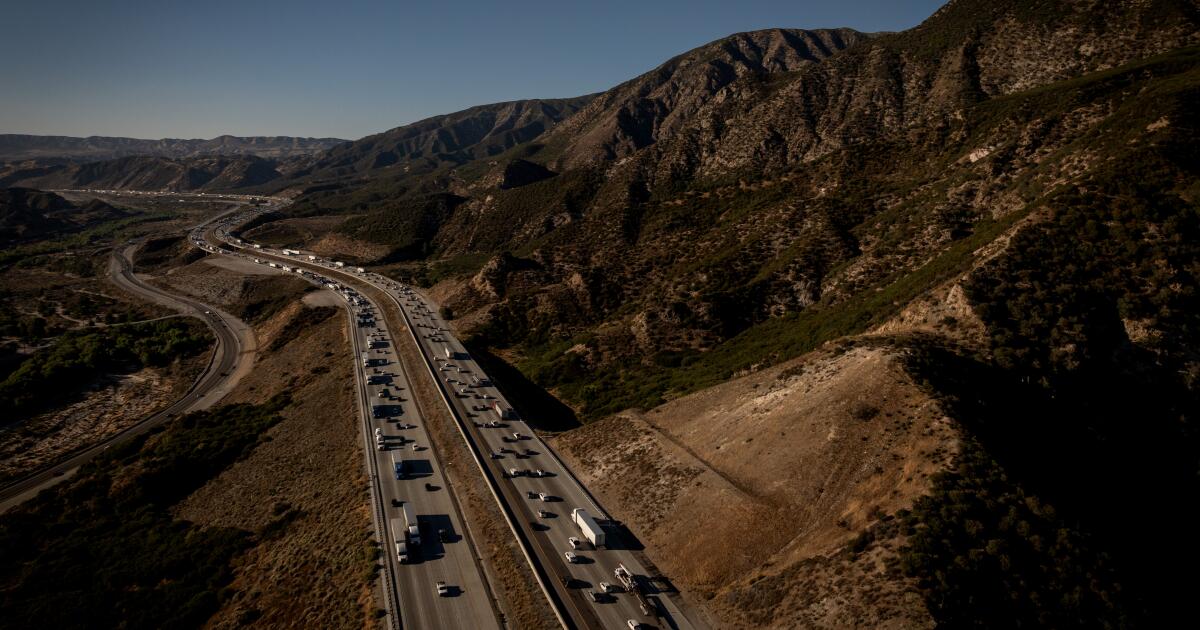
The pass, located roughly 50 miles northeast of downtown Los Angeles, marks the dividing line between the San Gabriel Mountains to the west and the San Bernardino Mountains to the east.
Specifically, the study’s authors calculated that the current tectonic stress was 2.8 megapascals on the San Andreas northwest of the pass, surpassing the previous highs of 2.7 just before big quakes in 1469 and 1691.
For the San Jacinto, the authors calculated a current seismic stress of 3.6 megapascals, surpassing the previous high of 2.9 before an earthquake in the year 1249.
The study noted that it has been an unusually long time since a megaquakes has hit Southern California. The San Andreas fault northwest of the Cajon Pass usually has big quakes every 100 to 150 years, Scharer said, though intervals of about 200 years are not unheard of.
On the San Andreas southeast of the pass, big quakes usually happen every 200 to 250 years. But the most recent quake on the San Andreas along the Salton Sea, close to the Mexican border, was about 300 years ago.
There are some limitations to the study’s model, scientists acknowledge. For instance, the model presumes that when large earthquakes hit, all the tectonic stress that had been accumulated in the fault gets released, “so you start at a ground state of zero and then you accumulate back up until you have that next big event,” Scharer said.
But whether all that stress actually gets released during a big quake is not definitively known.

The Mormon Rocks in Phelan, Calif.
Tectonic risks
Whenever it strikes, a supersized earthquake on the southern San Andreas would be like no earthquake seen in living memory in California.
The 1857 quake, estimated to be a magnitude 7.9, produced 63 times more shaking energy than the 1994 Northridge earthquake, and across a much larger swath of the state.
In 1994, “violent shaking,” or Level 9 on the Modified Mercalli Intensity Scale, causing great damage in substantial buildings, affected only part of the San Fernando Valley.

But a magnitude 7.8 San Andreas quake hypothesized by the USGS in its 2008 ShakeOut scenario would cause that kind of shaking across Southern California.
In 1994, emergency responders from across Southern California were able to focus the bulk of their efforts on especially hard-hit areas. That wouldn’t be possible in a regionwide disaster.


It might be tempting for Californians to tune out talk of the “Big One” after hearing about it for most of their lives. But generational catastrophes do strike — be they an earthquake in San Francisco in 1906, a hurricane in New Orleans in 2005 or tsunamis in the Indian Ocean in 2004 or Japan in 2011.
Tectonic rewards
Earthquakes are part of the bargain of living in California, a product of the same forces that allow people to ski and surf on the same day. The same tectonics that drive earthquakes act as the state’s landscape artists, said Julian Lozos, associate professor of geological sciences at Cal State Northridge.
“Because we are on the edge of the continent, we’re on a plate boundary, and have been a plate boundary for a couple hundred million years. There’s constantly been stuff crashing into North America, and getting stuck to it, and getting uplifted, and erupted through, and slid around,” Lozos said.
The Sierra Nevada, California’s mightiest mountain range, “are the guts of the volcanoes that used to be there when there was a subduction zone … and then when those volcanoes stopped erupting, the guts of them lifted up through the crust,” Lozos said.

Big Pines Highway rises out of a valley to ride a ridge created by the tectonic forces of the San Andreas fault, two miles southeast of the unincorporated Mojave Desert community of Valyermo, home to about 450 residents.
The same forces that produce earthquakes are also what led gold to form in the Sierra foothills, inciting the state’s famous rush.
Tectonic movement also created today’s Central Valley, a highly productive agricultural area that was once part of the ocean, then an inland sea, and then a freshwater lake, Lozos said.
“Everything about what we see here is stuff that formed because of that plate boundary then, and it’s getting moved around by the plate boundary now,” Lozos said. “And so if we didn’t have anything like that, we would be Nebraska.”
But the risks, like the rewards, are significant. The San Andreas runs right through cities in the Inland Empire. The Los Angeles Basin is also at risk.
If an earthquake on the San Andreas comes from the south and heads north, it would shuttle all that shaking energy “right into downtown,” Lozos said, causing shaking that could last two to three minutes.
“Geologically, L.A. is a bowl of Jell-O. It is a hard rock bowl full of really soft, squishy stuff that shakes very easily,” Lozos said.

It is business as usual at the Wrightwood Inn on a recent Tuesday night. According to a recent study, seismic pressure has been gradually building in the area for more than a century.
It’s not certain why it’s been so quiet between earthquakes, said Scharer. Another study, published in 2023, suggested the lack of sudden, major floodwaters funneling into Lake Cahuilla, the larger historical predecessor to the Salton Sea, may have something to do with it.
Scharer said the study’s results are a good reminder to prepare for the next big earthquake.
To be sure, the computer model’s results are not a prediction, and all models have their limitations and uncertainties. Still, its suggestion that the fault systems are “more loaded than at any point in the 1,000-year record,” Burkhard said, “is a finding worth taking seriously.”
“In the end, the most important message is a simple one: Let’s make sure we are prepared,” she said.
-
 Minneapolis, MN5 minutes ago
Roho Collective opens a gallery and business hub for artists of color
-

 Indianapolis, IN11 minutes ago
See inside Indianapolis Public Library’s upgraded, accessible bookmobiles
-

 Pittsburg, PA18 minutes ago
Pittsburgh’s air quality considered “unhealthy for everyone” on Friday due to wildfire smoke
-

 Augusta, GA23 minutes ago
VA Augusta launches new ambulance service
-

 Cleveland, OH36 minutes ago
Ohio air quality alert: Wildfire smoke drives demand for masks, air filters
-

 Austin, TX42 minutes ago
Texas expands flood response as Abbott warns of more life-threatening rain
-

 Alabama47 minutes ago
Alabama Deep Sea Fishing Rodeo kicks off on Dauphin Island
-

 Alaska54 minutes ago
New Partnerships With State of Alaska & University of Alaska Fairbanks Expand on Critical Minerals & Energy Innovation – CleanTechnica

