
The apparently illegal demolition of two of San Francisco’s few remaining earthquake shacks has been stopped by city building inspectors, but not before they had been reduced to the roofs and some framing.
San Francisco, CA
‘Worst fears’: Historic S.F. earthquake shacks destroyed without permits, neighbors say


The roofs and frames are all that remain of a pair of 1906 earthquake refugee shacks at 369 Valley St. in Noe Valley after the rest of the structures was demolished last week. The shacks were joined to form one cottage.
The historic structures, at 369 Valley St. on a steep block of Noe Valley, have been at the root of preservationist and neighborhood fights against a residential developer for more than 10 years. According to neighbors, a building permit had been issued that required preservation of the two shacks, which were joined to form one cottage, while a single-family home behind the two shacks was approved for demolition and reconstruction. But that permit allowed only for the shacks to be lifted and moved forward on the lot, not the near-total demolition that happened before the project was red-tagged late last week.
Neighborhood preservationists who are organized enough to have a website called savetheshack.net are demanding that the shacks be reassembled using as much of the historic debris that was left on-site in the demolition as possible.
Article continues below this ad
“After a 10-year struggle to preserve the cottages, we now see that our worst fears may be coming true, that the cottages may be destroyed,” said Marc Norton, a retired hotel worker who has lived across the fence from the shacks since 1984. “We always feared that the developer would destroy the cottages in the process of development and act like it was an accident. It looks like that is what happened.”
Norton said the original developer, John Schrader, who saw the project through to the permit stage, recently sold it. The new owner is not adhering to the agreed upon plan to conserve the shacks as part of the development. The violation notice posted by the Department of Building Inspection states that work is being done “that is beyond the scope of the permit.”
Make us a Preferred Source on Google to see more of us when you search.
Add Preferred Source
After the stoppage, Norton emailed Kelly Wong, enforcement officer for the planning staff, stating that “the only proper course of action is a thorough reassembly of the historic resource. Without such reassembly there is an environmental impact that cannot be mitigated.”
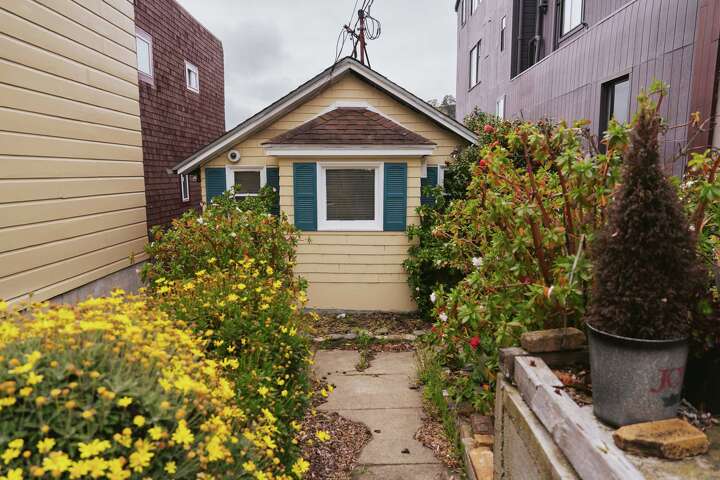
A 1906 earthquake shack in San Francisco’s Noe Valley, shown in 2023, was reduced to a roof and frame last week.
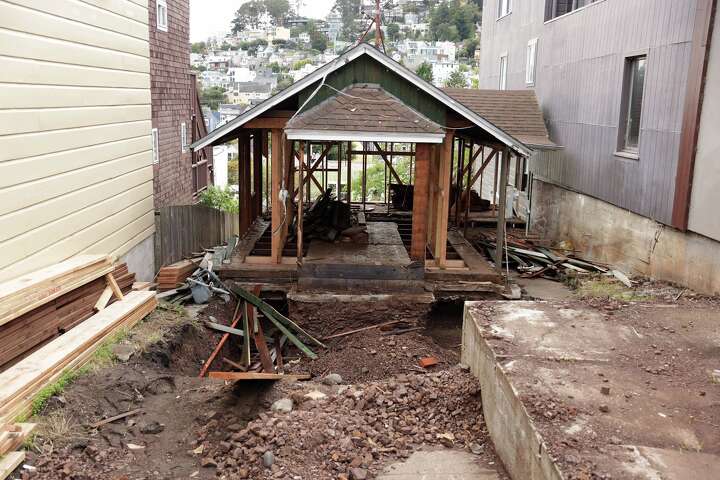
The roofs and frames are all that remain of a pair of 1906 earthquake refugee shacks at 369 Valley St. in Noe Valley after the rest of the structures was demolished last week. The shacks were joined to form one cottage.
The two shacks in question have been empty since the property sold in 2014. They are set back to the rear of the lot and pinned between taller residential buildings on both sides. The building at the back of the lot was unpermitted construction and was already demolished by the developer, Benjamin Steiner. From Norton’s property, he can see the weather vane of a rooster, though that is about all that is still standing.
Article continues below this ad
But the rubble from demolition is just as important.
“The debris is essential to any reassembly of the cottages,” Norton said. “We are demanding that the planning staff order the developer to leave everything as is, until a plan can be made to reassemble the cottages, under the supervision of a qualified preservation architect.”
On Friday, a next door neighbor sent photos to planning staff, complaining that the shacks were being destroyed. Agents from the Department of Building Inspection were sent out to stop work.
The developer, Benjamin Steiner, did not respond to requests for comment Sunday. San Francisco Supervisor Rafael Mandelman, who represents the district, also did not respond to a request for comment.
Jane Cryan, a preservationist known as the Cottage Lady, estimates there are now fewer than 20 earthquake cottages left in the city out of 5,610 built in the aftermath of the 1906 earthquake and fire. She took a census in 1983 and has been fighting for the dwindling supply, even after she was priced out of the city and living in Oshkosh, Wis.
Article continues below this ad
Cryan said the cottage at 369 Valley was made up of two shacks, one 10 by 14 feet and the other 14 by 18, and they were attached, as was the norm. Cryan, who has written two books on the shacks, said they were most likely hauled out of their original quake refugee camps in Precita Park and dragged up onto the 369 Valley by their owner, as was allowed once the camps closed in 1908. The third structure in the compound was built to mimic an earthquake shack but was not historic, and that’s why it was allowed to be demolished previously, she said.
“A whole lot of people became homeowners because of these shacks being built with the idea that people who paid $2 installments on them could take them to a lot and join two or three of them together and make a cottage out of them,” said Cryan, who lived in a cluster of three shacks in the Sunset District and was able to get them declared a city landmark. Cryan said a survey mounted in 2015 identified only 43 quake cottages in the city, with two sets in Noe Valley.
“Earhquake shacks were the greatest act of charity the world has ever known, and they’ve been mowed down by developers,” she said. “They are very endangered, and it is a terrible thing the city allowed to happen in Noe Valley.”



San Francisco, CA
Man convicted in the deadly 2021 assault of a Thai grandfather in San Francisco avoids prison

SAN FRANCISCO (AP) — The man convicted in the fatal 2021 attack of an older Thai man in San Francisco, which galvanized a movement against anti-Asian hate, will be able to avoid prison time, a judge ruled Thursday.
Antoine Watson, 25, was sentenced to eight years for manslaughter in the death of Vicha Ratanapakdee, 84. But, having already spent five years in jail awaiting trial, Watson received credit for time served, and San Francisco Superior Court Judge Linda Colfax said he could have the remaining three years suspended if he follows the rules of his probation.
Ratanapakdee’s daughter, Monthanus, expressed her family’s disappointment in a statement shared by Justice For Vicha, the foundation named for her father.
“We respect the court process. However, this is not about revenge — it is about accountability,” she said. “When consequences do not reflect the seriousness of the harm, it raises concerns about how we protect our seniors and public safety.”
Vicha Ratanapakdee was out for his usual morning walk in the quiet neighborhood he lived in with his wife, daughter and her family when Watson charged at him and knocked him to the ground. Ratanapakdee never regained consciousness and died two days later.
Watson testified on the stand that he was in a haze of confusion and anger at the time of the unprovoked attack, according to KRON-TV. He said he lashed out and didn’t know that Ratanapakdee was Asian or older.
San Francisco Public Defender Mano Raju, whose office defended Watson, also said at his trial that the defendant is “fully remorseful for his mistake.”
The Office of the San Francisco Public Defender did not immediately respond to an email requesting comment on Watson’s sentencing.
Footage of the attack was captured on a neighbor’s security camera and spread across social media, prompting a surge in activism over a rise in anti-Asian crimes driven by the COVID-19 pandemic. Hundreds of people across several U.S. cities commemorated the anniversary of Ratanapakdee’s death in 2022, seeking justice for Asian Americans who have been harassed, assaulted and even killed in alarming numbers.
Asians in America have long been subject to prejudice and discrimination, but the attacks escalated sharply after COVID-19 first appeared in late 2019 in Wuhan, China. More than 10,000 hate incidents against Asian Americans and Pacific Islanders were reported to the Stop AAPI Hate coalition from March 2020 through September 2021.
While the Ratanapakdee family asserts he was attacked because of his race, hate crime charges were not filed and the argument was not raised in trial. Prosecutors have said hate crimes are difficult to prove absent statements by the suspect.
San Francisco, CA
Authors gathering in San Francisco to raise awareness and money for the National Kidney Foundation

A number of notable authors are set to take part in a special event in San Francisco this Sunday, celebrating a shared love of reading while shining a light on an often overlooked health issue. The National Kidney Foundation Authors Luncheon brings together writers and community members to support kidney health awareness and raise funds for critical programs.

Aaron Judge went hitless on opening day for the first time and struck out four times for the first time since September 2024, but the New York Yankees still produced plenty of offense and beat San Francisco 7-0 Wednesday night in the debut of Giants manager Tony Vitello as the major league season began.
José Caballero drove in the go-ahead run with an RBI single in a five-run second and also lost the first challenge taken to Major League Baseball’s so-called robot umpire, unsuccessfully appealing a strike by Logan Webb in the fourth.
Max Fried (1-0) allowed two hits in 6 1/3 innings to became just the fifth Yankees pitcher since 1969 with at least 6 1/3 shutout innings on opening day, joining Catfish Hunter (1977), Ron Guidry (1980), Rick Rhoden (1988) and David Cone (1996). New York won an opener with a shutout on the road for the first time since 1967.
Webb (0-1) started the fourth inning with a 90.7 mph sinker on the upper, inner corner that was called a strike by Bill Miller, a major league umpire since 1997. Caballero tapped his helmet, and the 12 Hawk-Eye cameras of the Automated Ball-Strike System upheld Miller’s decision in a graphic shown on the Oracle Park scoreboard.
Caballero singled in the second and Ryan McMahon followed with a two-run single before Austin Wells’ single prompted a mound visit for Webb. Trent Grisham hit a two-run triple and was checked by medical staff after a hard slide into third.
Judge was booed before the game and during each at-bat as he began his 11th big league season. The California native had been pursued by the Giants during free agency in 2022 but he ultimately chose the Yankees’ $360 million, nine-year contract offer.
Webb, a 15-game winner last season making his fifth start on opening day, was tagged for six earned runs — seven in all — and nine hits over five innings.
The 47-year-old Vitello made the big jump from coaching the University of Tennessee.
The teams resum3 the series Friday afternoon, with RHP Cam Schlittler starting for New York opposite lefty Robbie Ray.
___
AP MLB: https://apnews.com/mlb

Oklahoma57 seconds ago
Oklahoma City Comets preliminary 2026 roster

Oregon7 minutes ago
Merkley Announces Additional Oregon Town Halls April 2-4

Pennsylvania13 minutes ago
Pennsylvania-born indie rockers Tigers Jaw return with new album release

Rhode Island19 minutes ago
A new safety role at Rhode Island College comes into sharper focus after Brown shooting – The Boston Globe

South-Carolina25 minutes ago
NFL Draft Injury Analysis: Jalon Kilgore, S – South Carolina

Florida1 year ago
Florida High School Football Rankings: Top 25 teams – Oct. 21

Oregon2 years ago
How old is Bo Nix? What to know about Oregon quarterback ahead of 2024 NFL Draft

Connecticut2 years ago
Cleary's 21 help Le Moyne down Central Connecticut State 69-64 in OT

Virginia2 years ago
99th annual Pony Swim held in Virginia

Indiana2 years ago
Indiana Members Credit Union announced as new anchor tenant at Bottleworks District

News2 hours ago
Video: Will ICE Change Under Its New Leader?

Politics3 hours ago
DHS shutdown breakthrough comes at cost for Republicans as funding fights nears end

World4 hours ago
Rubio joins crucial G7 talks as Iran war set to dominate second day

News5 hours ago
A surprise resignation could open the door for an independent to win a Montana Senate seat

News14 hours ago
Video: Savannah Guthrie Says She Believes Her Mother Was Taken for Ransom
-

 Detroit, MI1 week ago
Drummer Brian Pastoria, longtime Detroit music advocate, dies at 68
-

 Science1 week ago
How a Melting Glacier in Antarctica Could Affect Tens of Millions Around the Globe
-

 Movie Reviews1 week ago
‘Youth’ Twitter review: Ken Karunaas impresses audiences; Suraj Venjaramoodu adds charm; music wins praise | – The Times of India
-
 Science1 week ago
I had to man up and get a mammogram
-

 Sports6 days ago
IOC addresses execution of 19-year-old Iranian wrestler Saleh Mohammadi
-

 New Mexico5 days ago
Clovis shooting leaves one dead, four injured
-
 Business1 week ago
Disney’s new CEO says his focus is on storytelling and creativity
-

 Texas1 week ago
How to buy Houston vs. Texas A&M 2026 March Madness tickets