San Francisco, CA
Declaring the end of progressive San Francisco is a bit premature – 48 hills


The San Francisco Chronicle and The San Francisco Standard have both declared that this is no longer a progressive city.
That seems a bit premature to me.
The early results from last night’s election do, indeed, mostly favor the wing of the Democratic Party that calls itself “moderate” but is actually, on economic issues, pretty conservative. (I call neoliberals conservatives.)
Ballot measures supported by the mayor that do things like give the police more authority to spy on us all and require drug screening for welfare recipients are passing easily.
The conservatives are heading for control of the Democratic County Central Committee.
But let’s hold on a moment here before we pronounce a dramatic shift in local politics.
These results are based on a turnout of 20.9 percent. Four out of every five registered voters have not had their votes counted. There are, as of Wednesday, more ballots still outstanding (110,000) than have been counted so far.
And according to all the maps I have seen, the early ballots, the ones they count first, are overwhelmingly from the most conservative parts of the city.
Look at the data: 22.5 percent of the Democratic votes have been counted. But almost 29 percent of the Republican votes are in. One out of every ten votes counted so far was cast by a Republicans, who represent 7.4 percent of the registered voters.
The early returns always skew conservative, since the more conservative voters tend to turn their ballots in early.
I’m not suggesting that the final results will change dramatically—but only a few hundred votes separate the winners and losers in the DCCC, and it’s likely that at least a few more progressives will make the cut.
In the end, though, we will have a fairly conservative outcome—largely because of who voted. The Chron noted that in an update this afternoon. The Department of Elections will release more results Thursday at 4pm.
As I said last night, many of the conservative voters turn out anyway, and the mayor’s attacks on the poor and promotion of the police brought out more of those voters. And the billionaire money made a huge difference, particularly in the DCCC race.
The biggest problem for the progressives, particularly younger voters, was the lack of anything at the top of the ticket to inspire them to vote.
People on the left in San Francisco, by and large, are not happy with Joe Biden. So, either as a protest or as a matter of disinterest, some of then stayed home.
Check out this chart, from the Department of Elections. Turnout is highest when there’s something at the top of the ticket—and that is also when progressives do best.
In November, if there’s a candidate progressives can support running for mayor, there’s a good chance that the presidential race and the mayor’s race will bring out enough voters on the left to make a big difference in the supes races and on ballot measures.
The impact of the tech workers who have moved to town in the past ten years is becoming real. At first, they weren’t voting; now, apparently, they are. We all knew this was going to happen; as longtime activist Calvin Welch likes to say, “who lives here, votes here,” and as displacement forces out the working class and communities of color, the city gets more conservative. The Yimby pro-market approach to issues like housing, and the pro-police approach to social problems, has become more appealing to the wealthier residents.
Maybe wave after wave of gentrification will ultimately usher in a neoliberal majority on the Board of Supes and a more conservative body politic.
But I’ve been around a long time. In the 1980s, the city was run almost entirely by economic (and often social) conservatives like Mayor Dianne Feinstein, who had more than six call-up votes on an at-large board. Frank Jordan, a former police chief, was elected mayor in 1991. In the later 1990s, Mayor Willie Brown controlled the supes and his pro-developer politics dominated the city. The left was always in the minority and on the ropes.
Gavin Newsom get elected mayor by attacking poor people with a ballot measure called “Care not Cash,” which passed with a clear majority.
The DCCC used to be controlled by the old Brown-Burton Machine, which made sure that progressive Harry Britt, the heir to Harvey Milk’s supervisorial seat, lost a generational, defining Congressional race to machine candidate Nancy Pelosi.
Conservative election outcomes are not new. Neoliberal mayors have run San Francisco for much of past half century.
But recent years have shown a remarkable uprising of progressive candidates and causes. The young, organized, diverse left in this city is as strong as I’ve seen it.
So after all this time, I’m not ready to write the obituary for the progressive city.



SAN FRANCISCO (KRON) — San Francisco District Attorney Brooke Jenkins announced multiple hate crime charges, as well as assault and vandalism charges against an Oakland man for an incident that happened in the Castro District last month.
On Thursday afternoon, Hans Haken pleaded not guilty to one felony count of assault with a deadly weapon, one count of assault with force likely to cause great bodily injury, one count of vandalism, one count of hit-and-run, and one count of reckless driving.
Prosecutors also allege each of the felony assault counts was a hate crime.
“In San Francisco, we have zero tolerance for any hate, hateful acts, certainly that cross the criminal line, and we will do everything that we can to protect our residents from these types of incidents,” said Jenkins at a Thursday afternoon news conference.
It was on May 16, around 5:30 p.m., when prosecutors say Haken spray-painted a homophobic slur on the wall next to Chartreuse by Roje, a gay-owned floral boutique in San Francisco’s Castro District.
“It was a reminder that even though we’re here in Castro, San Francisco, we live in this well-protected bubble that we have created very passionately and strongly, that that can still happen,” said Jeffrey Dumlao, the owner of Chartreuse by Roje. “If anything, that is what’s scary, that it happened here in broad daylight of all times.”
Dumlao says his store had already closed by that time, but Justin Donnelly, who lives above the store, heard the spray-painting and came down to confront the man and tell him to stop.
“He just became very agitated,” Donnelly said. “I tried to remain calm and just tell him, like, sir, you know, I don’t, I don’t, I’m not involved in any of that. I’m just, I live here, right, and this is, this is my home, and you know, this is vandalism.”
Donnelly says when he took a picture of Haken’s license plate, Haken got in the car and tried to run him over. Then, prosecutors say he got out of the car and punched Donnelly in the jaw while uttering homophobic slurs.
“I’m definitely doing a lot better than I was. It’s been, I don’t know, a month or so,” Donnelly said.
He says the incident has shaken him, but he’s been lifted up by the community’s support and law enforcement.
“A lot of people have said, ‘oh my god, I can’t believe something like this could happen in San Francisco, of all places.’ And the fact is that something like this can happen anywhere, but in San Francisco, we don’t stand for it, and we deal with it, so, so that makes me feel good,” Donnelly said.
In announcing the charges, Jenkins pointed out the climate in this country has become more hostile to the LGBTQ community. She says that makes it even more important for elected officials to protect that community, just like they do every other community.

McKivitz Sends Clear Message on 49ers Future: ‘I Want to Be on That 10-Year Wall’
As Colton McKivitz enters his seventh season with the 49ers, he has his sights set on a milestone that represents trust and commitment to the organization: reaching the organization’s 10-year wall and joining a list of names that includes legends Joe Montana and Bryant Young.
George Kittle Catches FIFA World Cup Action | Off the Field
The 2026 FIFA World Cup is underway, and tight end George Kittle is showing his support for Team USA. Following the 4-1 USA win over Paraguay, Kittle shared his excitement on social media tweeting “4 is good right?”
5 Things to Know: Offensive Lineman Enrique Cruz Jr.
The Chicago native adds size, athleticism, and versatility to the 49ers competitive offensive line room. Here are five things to know about Enrique Cruz Jr.
San Francisco, CA
Artwork quilt unveiled at San Francisco dirt alley that was mistakenly bought at auction

In the fall of 2025, CBS News Bay Area first brought you the story of a Sunset couple that had the winning bid for a piece of property next to their home. They thought they were getting the duplex next door. Instead, they got a small patch of land known as Dirt Alley.
This story has many chapters, but it ended with a community celebration.
The final chapter in the story of Dirt Alley was written Wednesday night as they unveiled the tiles of artwork on the pavement.
“I’m very happy today,” JJ Hollingsworth said. “It’s just amazing that these artists that I’ve been working with and sold the alley to have come through with this incredible art.”
JJ Hollingsworth was the original property owner. She took out $25,000 from her retirement to pay for this parcel in a city auction. She thought she got a bargain for the duplex next door. When she found out it was actually the alley, the stress led to health problems and a lot of anxiety.
“I’m trying to forget, but I caused all this,” she said. “That’s what happened. I caused all this.”
Then came an email that would help her get out of the Dirt Alley nightmare. A group of friends from San Francisco was interested in buying this 82-foot-long alley.
“I know she was really stressed out when she first bought this and kind of didn’t know what she was going to do with it,” Theo Bleier said. “It’s really lucky. We were going to buy a different parcel, and we lost the auction. It was more than we wanted to spend. We felt really lucky the coincidence worked out, and we were able to help out JJ.”
The new owners then had the idea of laying an artwork quilt on the pavement and took submissions online.
“I think we had about one million people visit the website at least,” owner Patrick Hultquist said. “1.2 million, I think is the number of people that visited the website.”
The tiles with the most votes made it onto what is now called Notion way.
“Now, it’s not an official name of the street. It’s an unofficial name, but we did get an official-looking sign,” he said.
JJ Hollingsworth, who is a music composer, wrote a ballad called Notion Way for the special occasion. What started as a horrible mistake ended up bringing the community together.
“It’s really beautiful,” neighbors Tom Goslinga & Nesha Niezrecki said. “It’s how culture gets created in a lot of ways. People kind of being creative with an interesting situation. It’s really cool.”
While Hollingsworth is grateful for how this story ended, she says she learned a valuable lesson from this whole experience.
“Read the fine print and ask a lot of questions,” she said.
-

 Technology9 minutes ago
Barret Zoph is out at OpenAI again after just five months
-

 World15 minutes ago
Iran hardliner behind US deal warns Tehran won’t honor agreement if Trump fails to deliver
-

 Politics22 minutes ago
Top GOP lawmaker rallies around conservative school board member facing calls to resign
-

 Sports30 minutes ago
2026 World Cup Odds: How Far Can Mexico Go After Winning Group A?
-

 Technology37 minutes ago
6 in 10 identity crimes now begin with a new account
-
 Business40 minutes ago
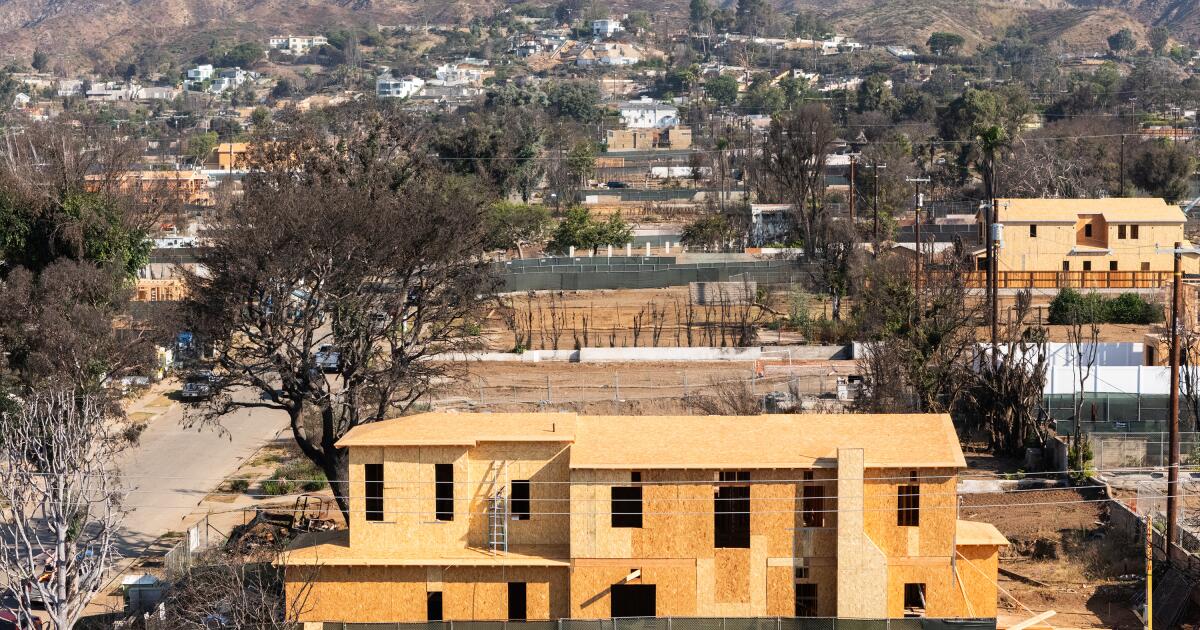
January 2025 wildfire victims seek tougher penalties against State Farm over claims handling
-
 Entertainment45 minutes ago
Review: ‘Sugar,’ with Colin Farrell as an alien private eye, gets a new and improved second season
-
 Politics55 minutes ago
Political watchdog fines Newsom for failing to report $5.5M in solicited donations on time

