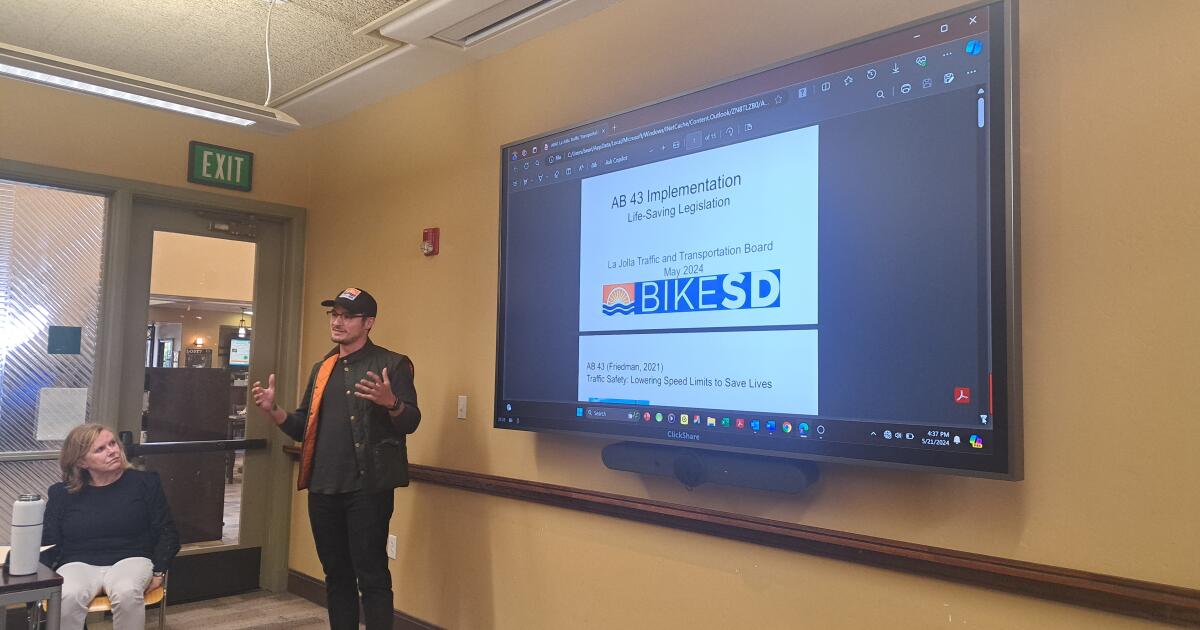
An initiative that could lead to lower speed limits in parts of San Diego has unanimous support from the La Jolla Traffic & Transportation Board.
At its meeting May 21, the board considered a request to advise the city to adopt actions laid out in state Assembly Bill 43, which gives municipalities the authority to reduce speed limits on roads contiguous to a business district and others that are deemed particularly unsafe for pedestrians and cyclists. They already were authorized to lower the speed limit in school zones.
The request was presented by Anar Salayev, executive director of BikeSD, a nonprofit that promotes bicycling and cycling infrastructure and safety measures. Salayev said reduced speed limits would be the first step in achieving traffic calming as well as improving road safety.
Supporters of AB 43 cite National Highway Traffic Safety Administration data that says if a person is struck by a vehicle traveling 20 mph, the person has up to a 95 percent chance of surviving, vs. a 20 percent chance if the vehicle is traveling 40 mph.
Advertisement
“On the surface, [the speed] doesn’t seem like that much of a difference, but it’s actually exponential in the potential consequences and outcomes,” Salayev said. “Slower vehicle speeds make for a more comfortable and safer experience, not only for pedestrians but also for cyclists, for anyone in a wheelchair, for really anyone else on that road.”
AB 43 was signed into law in fall 2021, and since then, several California cities have taken a cue from the bill to reduce speed limits across hundreds of miles of roadway. Salayev said San Diego is “ripe” to follow suit, citing a memo in November 2022 from Councilman Stephen Whitburn calling for the city Transportation Department to use AB 43 to develop a list of streets recommended for speed limit reduction.
The memo asked that priority be given to “streets with a history of fatal and severe injury collisions” and that the department “conduct an outreach effort to hear directly from community members regarding suggestions for speed limit reductions.”
A city news release in February 2023 announced that San Diego — aided by a $680,000 grant from the U.S. Department of Transportation — would develop a speed management plan identifying areas where lower speeds would most benefit pedestrians and cyclists.
“Cities have been adopting this,” Salayev said at the T&T Board meeting, “and it’s about time that San Diego does, too.”
Advertisement
“The council members want a list of five corridors from every district where they can start rolling this out immediately,” Salayev said. “You all live and work and commute in La Jolla. You are the right people to let … the council know where you think speeds could be reduced.”
La Jolla is represented by District 1 Councilman Joe LaCava.
Salayev also suggested that the La Jolla Community Planning Association write a letter to the mayor’s office outlining specific streets the group feels would best be served by lowered speed limits.
When asked about the effectiveness and fiscal impact of the implementation of AB 43 in other cities, Salayev acknowledged that the programs are relatively new and that not enough substantial data has been produced to make firm conclusions.
Some Traffic & Transportation Board members said any speed limit changes need to be accompanied by active enforcement.
Advertisement
“If it’s not going to get enforced, or if there is no mechanism to enforce it … it’s just not going to change the behavior of people who don’t care anyway,” member John Bauer said.
Board Chairman Brian Earley said there is a relative lack of police presence in La Jolla compared with the speeding violations that happen regularly.
“We’re missing enforcement,” Earley said. “We’d really like to see enforcement of surface street speeds, and I don’t know why they can’t park the car, pull out a radar gun and pull people over. We all know the Police Department needs funding. They could increase their revenue and solve a lot of their financial issues in a week.”
California has based speed limits on a process known as the 85th percentile, in which speed surveys conducted by local governments on busy streets every 10 years or so measure the speed at which drivers were traveling, and speed limits are set to reflect what 85 percent of motorists were driving at on a given section of road.
However, in many cases when the 85th-percentile method called for raising speed limits, local officials in San Diego declined to update the limits because of neighborhood opposition and concerns about pedestrian injuries and deaths.
Advertisement
That made the existing speed limit unenforceable, meaning the city had to give up issuing tickets using radar or other electronic devices.
In 2019, The San Diego Union-Tribune, citing data obtained through a public records request, reported that of the 656 streets where the city was responsible for setting speeds, 103 had stretches where police were not allowed to enforce the speed limit by radar — totaling more than 110 miles of roadway.
Streets in La Jolla where that applied included parts of Calle de Oro, La Jolla Parkway, La Jolla Boulevard, Nautilus Street and Via Capri.
San Diego police Officer Jason Costanza said at the time that “complaints about traffic safety are one of the forefront complaints. When we don’t have the ability to enforce the speed, it’s difficult to explain the situation to the public. That’s frustrating for us and the community.”
AB 43 modifies the 85th-percentile method so that motorists’ driving behavior doesn’t need to be the dominant factor in establishing speed limit recommendations.
Advertisement
Board member Tom Hardy brought up automated cameras as a way to get motorists to obey speed limits.
“The streets aren’t safe,” Hardy said. “When pedestrians and cyclists go out in this neighborhood, they’re taking their lives into their own hands.”
Salayev said enforcement likely would come after the establishment of corridors in need of traffic calming.
“This would be a first step to help identify those corridors and roll out this program while working on creative long-term changes down the line that would actually reduce speeds in a significant way,” Salayev said. “What we want to see from there is self-enforcing streets. That could be anything from cameras to … other sorts of infrastructure later down the line.”
Salayev pointed to Assembly Bill 645, a law signed by the governor in October that established a speed camera pilot program in six California cities.
Advertisement
Resident Michael McCormack expressed a desire for reduced speed limits in La Jolla Shores.
“This is just like cigarettes in bars in 2000,” McCormack said. “Everyone used to say ‘That’s just the way it is.’ Well, we’re the same way with speed as a community. The speeds are too fast.”
Board member Bill Podway asked about the cost of implementing lower speed limits, adding that the city of San Diego is “dead broke.”
Salayev said the cost of changing speed limit signs would be minimal and could be bundled with another project.
Following the discussion, the board voted to support use of AB 43 by the city. The decision is expected to be reviewed by the Community Planning Association at its meeting in June.
Advertisement
Meanwhile, the San Diego Association of Governments, the county’s regional planning agency, is working to pinpoint high-risk areas for cyclists and pedestrians in its first regionwide “Vision Zero” action plan.
Vision Zero is a road safety concept adopted by 90 U.S. cities, including San Diego, that aims to reduce traffic deaths to zero, even if it slows traffic.
SANDAG is creating two maps as part of its plan. One shows where crashes typically have happened in the past, while the other tries to guess where they will happen in the future.
The first map indicates that 6.1 percent of non-freeway local roadways account for more than half of fatal crashes involving pedestrians and cyclists.
The second map shows locations with the most risk factors that typically predict crashes — such as number of lanes and proximity to apartment complexes or commercial districts.
Advertisement
Sam Sanford, a SANDAG senior regional planner, said the agency also is gathering public input, including through an online survey where nearly 3,000 people singled out potentially dangerous intersections.
He said that could help cities discover problem areas that local officials aren’t aware of.
Other T&T news
Event chairman Howard Zatkin (standing) presents proposed parking space closures for this summer’s Concerts by the Sea at La Jolla’s Scripps Park.
(Tyler Faurot)
Advertisement
Concerts by the Sea: The board also voted unanimously to support the closure of six parking spaces along Coast Boulevard at Scripps Park during the Kiwanis Club of La Jolla’s Concerts by the Sea series this summer.
The spaces will be reserved for musicians to unload and load their equipment.
Four free Sunday concerts are slated for the series, all from 3:30 to 5:30 p.m. at Scripps Park.
The schedule:
• July 14: Atomic Groove (variety dance band)
Advertisement
• July 21: Jimmy Buffett cover band
• July 28: Betamaxx (‘80s music)
• Aug. 4: Big Time Operator (big band music)
Next meeting: The La Jolla Traffic & Transportation Board next meets (pending items to review) at 4 p.m. Tuesday, June 18, at the La Jolla/Riford Library, 7555 Draper Ave.
— San Diego Union-Tribune staff writer David Garrick contributed to this report. ◆
Two families were displaced from their Carmel Valley townhome after it went up in flames earlier this afternoon.
This happened just before 3 p.m. on Moratalla Terrace. Fire investigators said the fire started inside a garage unit because of faulty electrical equipment and robotics projects. One neighbor said she’s thankful for the quick response.
“The people that own the house were in the driveway calling 911, and within, I think within five minutes of me smelling the smoke the fire trucks were here,” said Nikki Briggs. I’m just thankful that everyone was okay, and that it didn’t keep spreading. Like if it would have been a wildfire, that would have been terrible.”
Firefighters say most of the damage was contained in the garage. A total of nine people were displaced by the fire. Five people lived inside the unit that burned. Thankfully all of them made it out safely without any injuries.
Shares of Gossamer Bio, Inc. (NASDAQ:GOSS) have received a consensus ‘Hold’ rating from the 10 research firms currently covering the company, according to a report from MarketBeat. The average 12-month price target among analysts is $5.43.
Why it matters
Gossamer Bio is a clinical-stage biotech company focused on developing therapies for immune-mediated and inflammatory diseases, as well as oncology. The ‘Hold’ rating and mixed analyst views could impact investor sentiment and the company’s ability to raise capital for further drug development.
The details
The analyst ratings for Gossamer Bio include two ‘Sell’ recommendations, four ‘Hold’ ratings, and four ‘Buy’ recommendations. Some firms have lowered their price targets on the stock, with HC Wainwright decreasing its target from $10 to $5.
Advertisement
Gossamer Bio released its latest quarterly earnings report on March 17, 2026.
The players
Gossamer Bio, Inc.
A clinical-stage biopharmaceutical company headquartered in San Diego, California that is focused on developing oral, once-daily therapies for immune-mediated and inflammatory diseases, as well as oncology.
Got photos? Submit your photos here. ›
The takeaway
The mixed analyst views on Gossamer Bio highlight the challenges facing the company as it seeks to advance its pipeline of drug candidates through clinical trials and regulatory approvals. The ‘Hold’ rating could make it more difficult for the company to raise capital and fund its operations.
Oceanside Harbor Beach. (File photo courtesy of @CityofOceanside via X)
A man apparent drowned in the waters near the Oceanside Pier Saturday morning, despite efforts by lifeguards and paramedics to revive him.
The Oceanside Fire Department’s Lifeguard Division and the Oceanside Police Department responded to a report of a missing man at about 4:30 a.m.. Officials said the man was last seen swimming in the ocean about a half-hour earlier.
Lifeguards and police immediately initiated a coordinated search effort using pier vantage points, surveillance cameras and watercraft, but the search was suspended at approximately 5:30 a.m. after no one was found, fire officials said.
“At approximately 10:50 a.m., lifeguards discovered an unresponsive adult male, matching the earlier description, in the water near Lifeguard Tower 12, at Oceanside Harbor Beach,” Division Chief Blake Dorse said in a statement. “The individual was removed from the water, and cardiopulmonary resuscitation was immediately initiated.”
Advertisement
Fire and rescue personnel continued efforts to resuscitate the man on the way to a hospital, where he was pronounced dead. He is believed to be the one who was reported missing near the pier.
Authorities did not release the man’s name.
“The Oceanside Lifeguard Division reminds the public to exercise caution when entering the ocean, especially during early morning hours or when lifeguards are not actively monitoring the water,” Dorse said. “Always swim near an open lifeguard tower and avoid entering the water alone.”