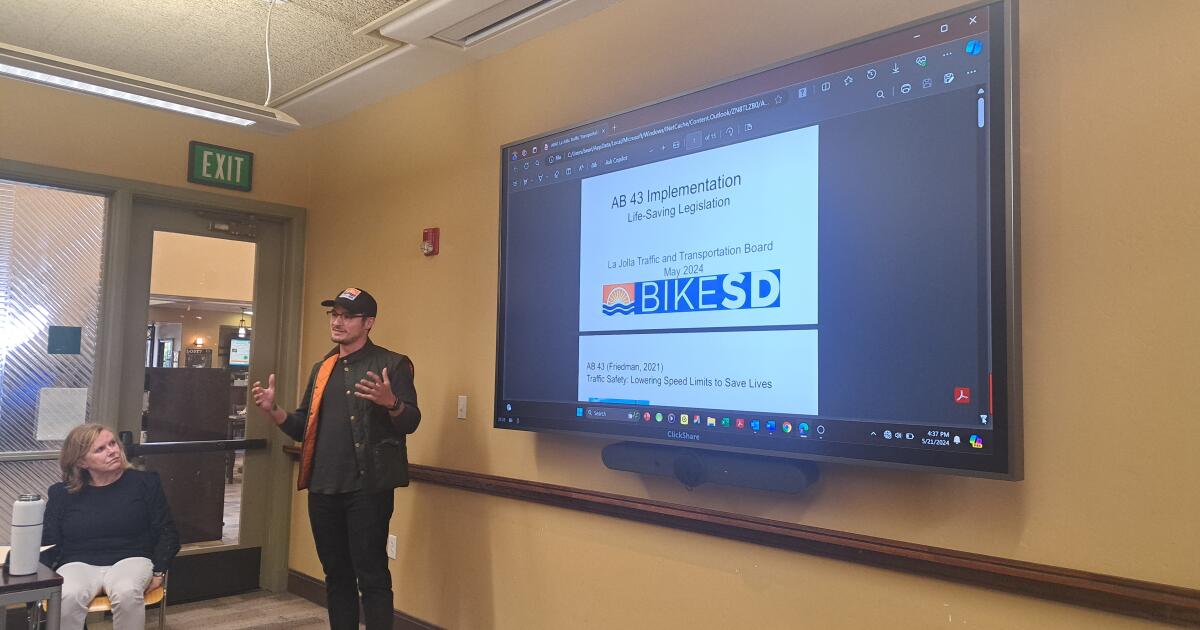
An initiative that could lead to lower speed limits in parts of San Diego has unanimous support from the La Jolla Traffic & Transportation Board.
At its meeting May 21, the board considered a request to advise the city to adopt actions laid out in state Assembly Bill 43, which gives municipalities the authority to reduce speed limits on roads contiguous to a business district and others that are deemed particularly unsafe for pedestrians and cyclists. They already were authorized to lower the speed limit in school zones.
The request was presented by Anar Salayev, executive director of BikeSD, a nonprofit that promotes bicycling and cycling infrastructure and safety measures. Salayev said reduced speed limits would be the first step in achieving traffic calming as well as improving road safety.
Supporters of AB 43 cite National Highway Traffic Safety Administration data that says if a person is struck by a vehicle traveling 20 mph, the person has up to a 95 percent chance of surviving, vs. a 20 percent chance if the vehicle is traveling 40 mph.
Advertisement
“On the surface, [the speed] doesn’t seem like that much of a difference, but it’s actually exponential in the potential consequences and outcomes,” Salayev said. “Slower vehicle speeds make for a more comfortable and safer experience, not only for pedestrians but also for cyclists, for anyone in a wheelchair, for really anyone else on that road.”
AB 43 was signed into law in fall 2021, and since then, several California cities have taken a cue from the bill to reduce speed limits across hundreds of miles of roadway. Salayev said San Diego is “ripe” to follow suit, citing a memo in November 2022 from Councilman Stephen Whitburn calling for the city Transportation Department to use AB 43 to develop a list of streets recommended for speed limit reduction.
The memo asked that priority be given to “streets with a history of fatal and severe injury collisions” and that the department “conduct an outreach effort to hear directly from community members regarding suggestions for speed limit reductions.”
A city news release in February 2023 announced that San Diego — aided by a $680,000 grant from the U.S. Department of Transportation — would develop a speed management plan identifying areas where lower speeds would most benefit pedestrians and cyclists.
“Cities have been adopting this,” Salayev said at the T&T Board meeting, “and it’s about time that San Diego does, too.”
Advertisement
“The council members want a list of five corridors from every district where they can start rolling this out immediately,” Salayev said. “You all live and work and commute in La Jolla. You are the right people to let … the council know where you think speeds could be reduced.”
La Jolla is represented by District 1 Councilman Joe LaCava.
Salayev also suggested that the La Jolla Community Planning Association write a letter to the mayor’s office outlining specific streets the group feels would best be served by lowered speed limits.
When asked about the effectiveness and fiscal impact of the implementation of AB 43 in other cities, Salayev acknowledged that the programs are relatively new and that not enough substantial data has been produced to make firm conclusions.
Some Traffic & Transportation Board members said any speed limit changes need to be accompanied by active enforcement.
Advertisement
“If it’s not going to get enforced, or if there is no mechanism to enforce it … it’s just not going to change the behavior of people who don’t care anyway,” member John Bauer said.
Board Chairman Brian Earley said there is a relative lack of police presence in La Jolla compared with the speeding violations that happen regularly.
“We’re missing enforcement,” Earley said. “We’d really like to see enforcement of surface street speeds, and I don’t know why they can’t park the car, pull out a radar gun and pull people over. We all know the Police Department needs funding. They could increase their revenue and solve a lot of their financial issues in a week.”
California has based speed limits on a process known as the 85th percentile, in which speed surveys conducted by local governments on busy streets every 10 years or so measure the speed at which drivers were traveling, and speed limits are set to reflect what 85 percent of motorists were driving at on a given section of road.
However, in many cases when the 85th-percentile method called for raising speed limits, local officials in San Diego declined to update the limits because of neighborhood opposition and concerns about pedestrian injuries and deaths.
Advertisement
That made the existing speed limit unenforceable, meaning the city had to give up issuing tickets using radar or other electronic devices.
In 2019, The San Diego Union-Tribune, citing data obtained through a public records request, reported that of the 656 streets where the city was responsible for setting speeds, 103 had stretches where police were not allowed to enforce the speed limit by radar — totaling more than 110 miles of roadway.
Streets in La Jolla where that applied included parts of Calle de Oro, La Jolla Parkway, La Jolla Boulevard, Nautilus Street and Via Capri.
San Diego police Officer Jason Costanza said at the time that “complaints about traffic safety are one of the forefront complaints. When we don’t have the ability to enforce the speed, it’s difficult to explain the situation to the public. That’s frustrating for us and the community.”
AB 43 modifies the 85th-percentile method so that motorists’ driving behavior doesn’t need to be the dominant factor in establishing speed limit recommendations.
Advertisement
Board member Tom Hardy brought up automated cameras as a way to get motorists to obey speed limits.
“The streets aren’t safe,” Hardy said. “When pedestrians and cyclists go out in this neighborhood, they’re taking their lives into their own hands.”
Salayev said enforcement likely would come after the establishment of corridors in need of traffic calming.
“This would be a first step to help identify those corridors and roll out this program while working on creative long-term changes down the line that would actually reduce speeds in a significant way,” Salayev said. “What we want to see from there is self-enforcing streets. That could be anything from cameras to … other sorts of infrastructure later down the line.”
Salayev pointed to Assembly Bill 645, a law signed by the governor in October that established a speed camera pilot program in six California cities.
Advertisement
Resident Michael McCormack expressed a desire for reduced speed limits in La Jolla Shores.
“This is just like cigarettes in bars in 2000,” McCormack said. “Everyone used to say ‘That’s just the way it is.’ Well, we’re the same way with speed as a community. The speeds are too fast.”
Board member Bill Podway asked about the cost of implementing lower speed limits, adding that the city of San Diego is “dead broke.”
Salayev said the cost of changing speed limit signs would be minimal and could be bundled with another project.
Following the discussion, the board voted to support use of AB 43 by the city. The decision is expected to be reviewed by the Community Planning Association at its meeting in June.
Advertisement
Meanwhile, the San Diego Association of Governments, the county’s regional planning agency, is working to pinpoint high-risk areas for cyclists and pedestrians in its first regionwide “Vision Zero” action plan.
Vision Zero is a road safety concept adopted by 90 U.S. cities, including San Diego, that aims to reduce traffic deaths to zero, even if it slows traffic.
SANDAG is creating two maps as part of its plan. One shows where crashes typically have happened in the past, while the other tries to guess where they will happen in the future.
The first map indicates that 6.1 percent of non-freeway local roadways account for more than half of fatal crashes involving pedestrians and cyclists.
The second map shows locations with the most risk factors that typically predict crashes — such as number of lanes and proximity to apartment complexes or commercial districts.
Advertisement
Sam Sanford, a SANDAG senior regional planner, said the agency also is gathering public input, including through an online survey where nearly 3,000 people singled out potentially dangerous intersections.
He said that could help cities discover problem areas that local officials aren’t aware of.
Other T&T news
Event chairman Howard Zatkin (standing) presents proposed parking space closures for this summer’s Concerts by the Sea at La Jolla’s Scripps Park.
(Tyler Faurot)
Advertisement
Concerts by the Sea: The board also voted unanimously to support the closure of six parking spaces along Coast Boulevard at Scripps Park during the Kiwanis Club of La Jolla’s Concerts by the Sea series this summer.
The spaces will be reserved for musicians to unload and load their equipment.
Four free Sunday concerts are slated for the series, all from 3:30 to 5:30 p.m. at Scripps Park.
The schedule:
• July 14: Atomic Groove (variety dance band)
Advertisement
• July 21: Jimmy Buffett cover band
• July 28: Betamaxx (‘80s music)
• Aug. 4: Big Time Operator (big band music)
Next meeting: The La Jolla Traffic & Transportation Board next meets (pending items to review) at 4 p.m. Tuesday, June 18, at the La Jolla/Riford Library, 7555 Draper Ave.
— San Diego Union-Tribune staff writer David Garrick contributed to this report. ◆
SAN DIEGO – California Department of Corrections and Rehabilitation officials are searching for an incarcerated person who walked away from the Male Community Reentry Program in San Diego on July 2, 2026.
At approximately 3:50 p.m., staff received a tamper alert indicating incarcerated person Randy Seitzinger had removed his GPS device while on an approved community medical pass. Staff immediately launched an emergency count, which confirmed Seitzinger was missing. CDCR’s Office of Correctional Safety and local law enforcement have been notified and are assisting in the search.
Seitzinger, 70, is 5 feet 8 inches tall and weighs approximately 191 pounds. He has a light complexion and was last seen wearing blue jeans and a light-colored short-sleeved shirt.
Seitzinger was received from Orange County on May 22, 2019. He was sentenced to 15 years for second-degree robbery and false imprisonment with violence.
Advertisement
Anyone who sees Seitzinger or has knowledge of his whereabouts should contact any law enforcement agency, call 911, or contact the Office of Correctional Safety staff at 760-550-8782.
The Male Community Reentry Program is a voluntary program for eligible male incarcerated persons. Approved participants serve the end of their sentences in the community in lieu of confinement in state prison. Since 1977, 99 percent of the incarcerated people who have escaped or walked away from an adult institution, camp, in-state contract bed, or community rehabilitative program placement have been apprehended.
The victim was smoking outside the business when a 35-year-old man approached him, threatened to kill him and pulled a knife at around 10 p.m. Monday in the 900 block of Cardiff Street, according to the San Diego Police Department.
Police said the attacker stabbed the man twice in the chest and twice in the arm. It was unclear what prompted the stabbing.
SAN DIEGO (KGTV) — Fans packed Fairplay in North Park to cheer on the U.S. Men’s National Team’s dominant World Cup win over Bosnia and Herzegovina on Wednesday, with more than 400 people filling the venue before kickoff.
The crowd reached max capacity with ease, with some fans arriving as early as 8:45 a.m.
Brittney Slack was among those who showed up ready to go bright and early, with a blue sequin shirt and her laptop to “work from home” — or something like that.
ABC 10News
Advertisement
“Does your boss know this is happening?” ABC 10News asked.
“You know, I was in a virtual meeting this morning in the full garb, so I think they’re aware. But you know what? Americans are great at multitasking. I think we’re one of the most competitive nations, not only in sports but in the business world as well. So, here we are,” Slack said.
The U.S. men fought hard for their first knockout-stage win since 2002, beating Bosnia and Herzegovina 2-0, drawing fans of all levels of soccer fandom.
“To me, it doesn’t matter if it’s ping pong, if it’s foosball, if it’s soccer, if it’s baseball. I’m going to root for America no matter what. Obviously, this is an amazing event on a world stage, so it’s a lot of fun,” Nick Montesano said.
Indiana Rockwell, perhaps the youngest fan in the bar, summed up the energy.
Advertisement
“It’s really loud, but I’m really proud of the USA,” Rockwell said.
ABC 10News
Fairplay owner Adam Cook took it a step further — turning the bar into a stage to lead a USA chant after the win was secured.
The U.S. takes on Belgium on Monday at 5 p.m. PT at Lumen Field, referred to as Seattle Stadium during the tournament.
Follow ABC 10News Anchor Max Goldwasser on Instagram, Facebook and Twitter.
Advertisement
This story was reported on-air by a journalist and has been converted to this platform with the assistance of AI. Our editorial team verifies all reporting on all platforms for fairness and accuracy.