West
Runner fought off mountain lion with stick just weeks before fatal attack on same Colorado trail

NEWYou can now listen to Fox News articles!
Weeks before a hiker was killed in a suspected mountain lion attack in Colorado, a man was nearly attacked by another big cat on the same trail.
Gary Messina said he was rushed by a mountain lion while running along the same northern Colorado trail on a dark morning in November.
Messina said he threw his phone at the animal while it kept circling behind him and was able to get away after a couple of minutes when he broke a stick off of a log and hit the mountain lion over the head with it.
“I had to fight it off because it was basically trying to maul me,” Messina told The Associated Press. “I was scared for my life, and I wasn’t able to escape. I tried backing up, and it would try to lunge at me.”
OREGON CHILD ATTACKED BY COYOTE DURING GAME OF HIDE-AND-SEEK IN BACKYARD, STATE OFFICIALS SOUND ALARM
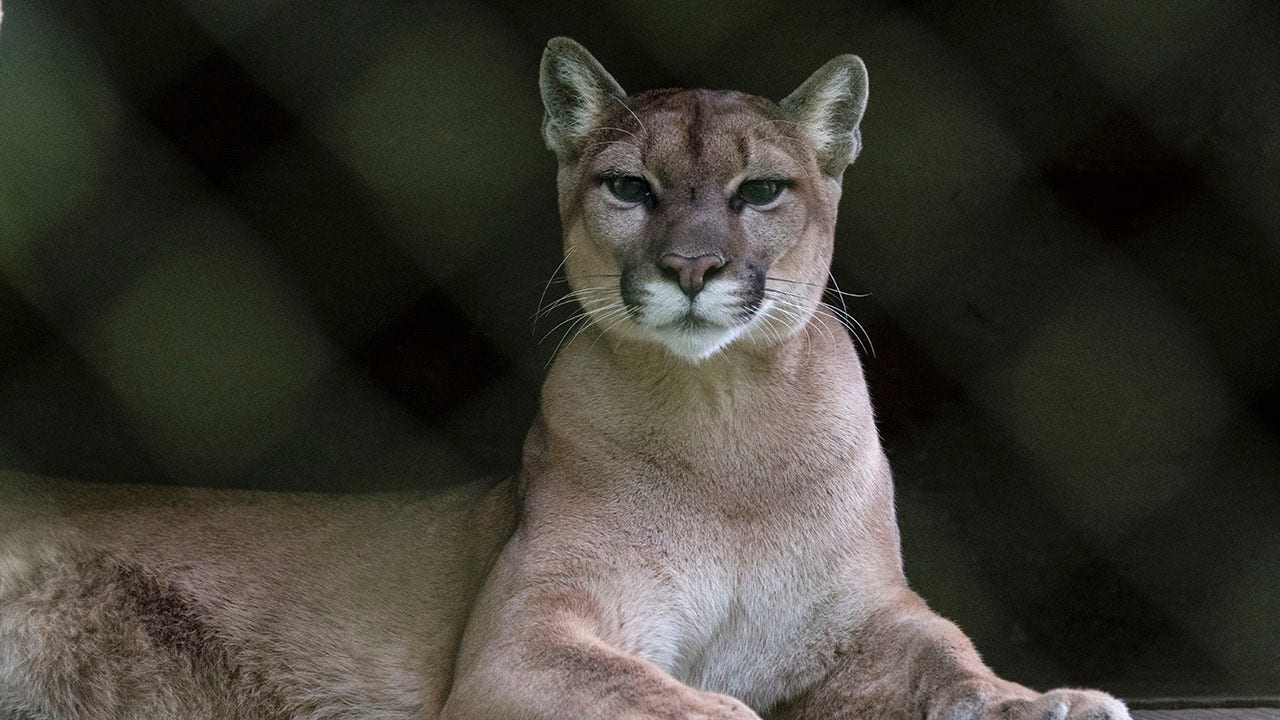
A mountain lion at the Wildlife Rescue Center in Alajuela, Costa Rica, Sept. 16, 2024. (Ezequiel Becerra/AFP via Getty Images)
A woman who was found dead on the same trail on New Year’s Day had “wounds consistent with a mountain lion attack,” a Colorado Parks and Wildlife spokeswoman said.
“Around 12:15 this afternoon, hikers on the Crosier Mountain trail in Larimer County observed a mountain lion near a person lying on the ground from about 100 yards away,” Kara Van Hoose said during a news conference Thursday.
After the suspected attack, wildlife officials killed two mountain lions and are searching for a third to determine if the animal had rabies or another disease.
BEAR REMAINS UNDER CALIFORNIA HOME AFTER WEEKS OF FAILED REMOVAL ATTEMPTS
The attack was the first suspected fatal mountain lion mauling in more than 25 years, with the last one occurring in 1999.
This photo provided by Gary Messina shows a mountain lion in the brush between two trees along the Crosier Mountain trail in the Arapaho and Roosevelt National Forests near Glen Haven, Colo., Nov 11, 2025. (Gary Messina via AP)
Messina said he reported his incident days later, and officials posted warning signs about mountain lions that were later taken down.
He said he believes the animal that attacked him may have been the same one that killed the New Year’s hiker.
Mountain lion sightings in that area of Rocky Mountains National Park are common, but the animals are rarely aggressive.
The New Year’s Day attack would be the fourth fatal one in North America in the last decade and the 30th since 1868, according to the Mountain Lion Foundation.
“As more people live, work and recreate in areas that overlap wildlife habitat, interactions can increase, not because mountain lions are becoming more aggressive, but because overlap is growing,” the organization’s chief conservation officer, Byron Weckworth, said.
Authorities suspect a lone woman hiker in Colorado was killed in a rare mountain lion attack on New Year’s Day. (AP Digital Embed)
CLICK HERE TO DOWNLOAD THE FOX NEWS APP
To avoid risk of an attack, experts tell nature seekers to avoid dawn and dusk, when mountain lions are most active and to travel in groups.
During an encounter, experts suggest maintaining eye contact with the animal, trying to appear as large as possible, slowly backing away without turning your back on the animal and not running.
The Associated Press contributed to this report.
Read the full article from Here



The Alaska Senate plans to vote today on a new draft of a bill that would reduce taxes on the Alaska LNG project. It’s the last day of a special session Gov. Mike Dunleavy called to consider the issue.
Dunleavy and pipeline developer Glenfarne, which owns a 75% stake in the project, say a measure replacing a 2% annual property tax with a much smaller tax on gas throughput is essential to allowing the project to attract investors and court lenders. Dunleavy and Glenfarne applauded the version of the bill that passed the House a week ago.
The Alaska LNG project, estimated by the developer to cost up to $54.5 billion, includes an 807-mile pipeline, a conditioning facility on the North Slope to remove gas impurities such as carbon dioxide, and a liquefaction plant on the shores of Cook Inlet to export the gas to Asia. The project would be split into two phases: first, a shorter in-state pipeline to provide gas to Alaskans, and then the much more expensive — and much more lucrative — export infrastructure.
The Senate’s new draft retains many of the House’s provisions with some important changes.
Perhaps the most significant changes are to the project’s timeline: to be eligible for tax relief, the developer must commit to a final investment decision for the first phase by Jan. 1, 2028, and construction of the in-state pipeline would need to be complete by the end of 2032.
The House’s version required only that construction begin by Jan. 1, 2032.
The faster timeline is an effort to address Southcentral’s looming shortage of natural gas, said Sen. Bert Stedman, a Sitka Republican and a co-chair of the Senate Finance Committee. The Department of Natural Resources’ production forecast envisions demand outstripping Cook Inlet gas production by 2032, requiring producers to dip into storage.
“There’s been a lot of concern out of the Railbelt with the declining volume in Cook Inlet,” Stedman said.
But the more aggressive timeline sparked concerns from minority Republicans on the committee; it increases the risk on an already risky, marginal project, they said.
“That’s very damaging,” said Sen. Mike Cronk, a Tok Republican and the Senate minority leader. “There’s so many factors that we don’t control.”
Putting a “hard construction date” in the bill may be a “poison pill,” Cronk said.
Glenfarne and Gov. Mike Dunleavy did not immediately respond to requests for comment on the new version of the bill.
Stedman suggested future legislatures could revise the date to account for “unforeseen black swan events.”
“We can change these and modify these going forward,” Stedman said. “This is not in the Constitution, so I think there’d be some consideration under good faith trying to get the project constructed.”
The tax rate at the heart of the bill — the so-called alternative volumetric tax on gas flowing through the pipeline from the North Slope to Southcentral Alaska — would be fixed, rather than a weighted average tied to the cost of each component of the project.
The Senate draft sets the tax initially at 6.2 cents per 1,000 cubic feet of gas throughput, starting five years after gas begins to flow through the pipeline. The tax would take effect sooner if throughput reaches 500 million cubic feet per day, which is more than double what Southcentral Alaska uses now.
The tax would rise to 10.6 cents per 1,000 cubic feet once Phase 2 of the project, which includes the liquefied natural gas export facility, is up and running. The tax revenue from that mirrors what the Department of Revenue estimates the weighted tax that passed the House would yield.
The rates would rise between 1% and 3% each year, depending on inflation.
The House backed 30-plus years of tax breaks. Some senators were skeptical of that, so their version doubles the tax rate ten years after exports begin, then doubles them again in 2060.
The new bill retains key conditions for the tax relief included in the House’s version: the developer must commit to building a spur line to Fairbanks and negotiate project labor agreements with unions. It also includes up to $80 million in community impact funding for municipalities: $40 million due shortly after the final investment decision for each project phase.
It also includes House-passed price controls on in-state gas. Utilities would pay no more than $16 per million British thermal units, adjusted for inflation. That’s roughly $16.60 per 1,000 cubic feet, substantially higher than current Southcentral gas rates — about $10 — but likely cheaper than imported gas, according to Southcentral’s gas utility.
Also notable is an omission from the bill. It does not include a measure that had been under discussion that would subject large so-called S corporations and other pass-through entities in the oil and gas business, like LLCs, to the state’s corporate income tax.
Glenfarne, in its only comments so far on the new bill, urged lawmakers not to include that tax in the final version.
“If the Senate passes a bill with the proposed S Corp tax, it will introduce major hurdles for Alaska LNG to secure the right financing to build the project,” the company said in a statement provided by spokesperson Tim Fitzpatrick.
Senators are due to amend the bill and take a final vote later today.
The special session expires at midnight tonight, but Gov. Mike Dunleavy has already signed a proclamation calling another special session to begin Saturday.
Asked whether the new special session represented a contingency plan in an event the bill failed to pass, Dunleavy spokesperson Jeff Turner declined to say.
“We will see what happens,” Turner said.
This is a developing story. Check back for updates.


Top universities reject Trump’s ‘compact’ over academic freedom
Massachusetts Institute of Technology, Brown University, University of Pennsylvania, and University of Southern California rejected Trump’s “compact.”
To the surprise of perhaps no Californians, several California universities appeared in the top rankings of the world’s best universities in the latest U.S. News and World Report rankings released on June 16.
Of the more than 2,250 worldwide research institutions that U.S. News & World Report evaluated for this list, six California universities ranked in the top 50 globally, with an even split among Northern and Southern California institutions.
The 2026 list includes universities from more than 100 countries, with the following countries receiving the most schools in the overall rankings:
- China: 409
- United States: 275
- India: 123
- United Kingdom: 93
- Japan: 86
Did your California alma mater appear among the top global universities?
U.S. News and World Report methodology
When determining a university’s placement on the list, U.S. News & World Report considered factors more relevant to research-oriented institutions than to undergraduate-focused metrics like bachelor’s degree graduation rates.
It focused on aspects like academic institutions’ research and reputation, number of publications, the quality of publications and citations. It considers other factors, including location, campus culture, the strength of particular programs, and cost, which are also very important.
“For students seeking universities with strong academic excellence and global recognition, the Best Global Universities rankings offer an essential comparative resource,” said LaMont Jones, Ed.D., managing editor for Education at U.S. News.
“Our methodology focuses on a school’s research mission and scholarly impact, helping students identify institutions that are truly at the forefront of global knowledge creation.”
Out of the top 10 global universities, two California institutions made the list:
- Harvard University
- Massachusetts Institute of Technology (MIT)
- Stanford University
- University of Oxford
- University of Cambridge
- Tsinghua University
- University of California Berkeley
- Yale University
- University College London
- Columbia University
How did California colleges rank in U.S. News and World Report’s Best Global Universities 2026 list?
Outside of the top 10 universities, California saw a handful of other institutions rank highly on U.S. News & World Report list.
Notably, the University of California – Los Angeles just missed the top 10 list, ultimately ranking as the 11th-best global university and the second-best public institution on the list. It was beaten out as the best public institution by its academic counterpart, the University of California, Berkeley, which was ranked the 7th-best global university.
Additionally, a number of University of California schools made the top of the list, ultimately reaffirming the quality of the institutions’ public campuses across the state.
“Research from the University of California is vital to work that benefits all Americans, from breakthroughs in the treatment of Parkinson’s to the science behind previously unimagined successes in fighting cancer and the development of quantum computers that will enable the critical advances of the 21st century,” the University of California said in a press release about its rankings.
Here’s the list of California universities that made the top 100 list:
- 3. Stanford University
- 7. University of California Berkeley
- 11. University of California – Los Angeles
- 22. University of California – San Francisco
- 23. (Tied) California Institute of Technology
- 23. (Tied) University of California – San Diego
- 74. University of Southern California
- 95. University of California – Davis
- 99. University of California – Irvine
- 100. University of California – Santa Barbara
Noe Padilla is a Northern California Reporter for USA Today. Contact him at npadilla@usatodayco.com, follow him on X @1NoePadilla or on Bluesky @noepadilla.bsky.social. Sign up for the TODAY Californian newsletter or follow us on Facebook at TODAY Californian.
-

 Washington, D.C4 minutes ago
Dupont Circle closed for Pride weekend as National Park Service erects fences
-

 Cleveland, OH7 minutes ago
Woman killed, several children injured in Ohio Turnpike crash in Lorain County
-

 Austin, TX12 minutes ago
Screwworm medications straining animal shelter budgets across Texas
-

 Alabama13 minutes ago
Late nights, Father’s day deals and fireworks at Alabama Adventure
-
Alaska19 minutes ago
It’s the Alaska Legislature’s last day in special session. Here’s the latest.
-

 Arizona27 minutes ago
New tractors help University of Arizona modernize farming in Yuma
-

 Arkansas34 minutes ago
Authorities report 2 Tulsa residents found dead in Arkansas from apparent murder-suicide
-

 California37 minutes ago
2 Northern California universities made U.S. News ‘Best Global’ list

