Oregon
Portland’s Urban Tree Plans May Face a Withering in Federal Funds – Inside Climate News


For decades, Portland, Oregon has been a pivotal place to study the relationship between trees and related health benefits; now, with the Trump administration funding cuts in play, it may be a window into how broken federal promises will weaken critical urban tree canopies.
President Donald Trump’s executive order “Unleashing American Energy,” signed on his first day in office, ordered federal agencies to immediately pause the disbursement of funds appropriated by the Inflation Reduction Act, the flagship climate law passed by Congress and signed by former President Joe Biden.
Oregon was poised to benefit from $58.2 million to be distributed by the U.S. Department of Agriculture’s Forest Service to plant trees, particularly in low-income areas lacking shade and vegetation. The funds, to be distributed from 2023 to 2028, were part of a $1.5 billion cache allotted through the IRA to develop urban canopies in underserved communities across the United States.
The money for Oregon, allocated through a competitive process, was set to be distributed this way: $22.85 million to the Oregon Department of Forestry, $19 million to Portland-based organizations, $12 million to a Eugene-based organization, $2 million to the city of Pendleton, $1 million to the city of Hermiston, $1 million to the city of Salem and $345,000 to the city of Hillsboro.
We’re hiring!
Please take a look at the new openings in our newsroom.
See jobs
While some grantees declined to comment, Inside Climate News confirmed in interviews that at least $40 million has not yet been paid—68 percent of the promised funds.
When asked to comment on the IRA funding freeze, a U.S. Department of Agriculture spokesperson replied in an email: “The Trump administration rightfully asked for a comprehensive review of all contracts, work and personnel across all federal agencies. The Forest Service is following direction provided by USDA with regards to the President’s Executive Orders to ensure full compliance.”
A Pause in Grant Reimbursements
Joy Krawczyk, public affairs director for the Oregon Department of Forestry, said in an email the department has been informed that IRA reimbursements are paused and under review.
According to Krawczyk, Oregon’s forestry department had yet to receive any funds from the $22.85 million grant. She said the department so far has incurred $216,085 in costs since the start of 2024 associated with the grant. The department had not yet submitted a reimbursement request, she said in an email, because it had planned to bundle reimbursement requests in a single package to save time.
Leadership at several organizations provided details about the federal money that has not materialized and what it could mean for their operations. One nonprofit that asked for anonymity said the organization had received $1.5 million of a $12 million grant to plant trees in low-income areas across Oregon. The organization submitted an additional invoice in early January of $850,000 for work performed from July to December 2024. The invoice was processed, according to senior personnel, but the bill has not been paid due to Trump’s freeze of IRA funds.
“We have no idea if we will be paid for work dutifully done under the terms of the agreement,” said the employee with access to financial data at the nonprofit and who declined to be identified in fear of angering federal officials. “We’ve had a 40-year relationship with the federal government. It’s how we do our business. The government—up until January 21—was a good business partner.”
Because of the funding freeze, the employee said the department will have to cut programming and staff.
Similarly, a Portland-based organization that requested anonymity said that it was set to receive $7 million in IRA funds and has so far been paid about $617,000. Staff knowledgeable about the organization’s spending said funds from the $7 million grant were intended to cover 40 percent of their budget this fiscal year. With funding paused, leadership said they will have to cut the overall operating budget—including the budget for new trees—and reduce staff by 20 percent.
Portland’s Canopy in Decline
Researchers at Portland State University have long been vigilant in examining the importance of green space and assessing tree loss in Portland. Professor Vivek Shandas, who sits on the National Urban Community Forestry Advisory Council, began researching the environmental impact of trees in the late 1990s while working on his dissertation. Since then, he and a team of colleagues have pursued a multi-decade project to examine the relationship between human health and trees and the causes of canopy decline.
Portland’s canopy cover—measured by the layer of leaves, branches and stems of trees that cover the ground when viewed from above—receded one percent from 2015 to 2020, or about 820 acres, according to a city department survey from 2022. That’s equal to 620 football fields of leafy cover.
If the federal funds for tree planting disappear, Shandas said, Portland’s canopy will further winnow. That means “we’ve likely hit peak canopy,” he said.

Shandas and his team recently corroborated the city survey of tree loss and went further to examine where and why the canopy was shrinking. In a study last year, they found that low-income neighborhoods in Portland experienced the greatest decline and determined that development, notably commercial residential building, was driving overall tree loss in the city.
“Developers are the primary landscape agents in Portland,” Shanda said. “It’s a very developer-friendly moment, and they are going farther and farther into different reaches to the region that used to have thick canopy but are quickly losing it.”
Inequitable Tree Canopies
According to Shandas, low-income neighborhoods in Portland, primarily east of the Willamette River, have long experienced inequities in tree investment.
East Portland, where income per capita is lowest citywide, has urban canopies nearly three times smaller than west Portland, where income per capita is greatest. East Portland is more diverse and low-income with the residents earning $33,000 less per year than residents on Portland’s west side.
West Portland has 56 percent urban tree canopy cover, whereas east Portland has 21 percent cover, according to Jenn Cairo, the Portland City Forester. Portland’s baseline urban tree canopy target is 33.3 percent citywide, according to Shandas.


Portland may be a case study, but inequitable urban canopies exist across the United States. In 92 percent of U.S. cities, low-income neighborhoods have fewer trees than high-income neighborhoods.
The Tree Equity Score map, a project by the American Forests nonprofit, shows that U.S. neighborhoods with a majority of people of color have 33 percent less tree canopy, on average, than majority-white neighborhoods. The nonprofit’s analysis also found that the poorest U.S. communities, where 90 percent of the residents live in poverty, have 41 percent less tree canopy than the wealthiest communities.
Health Benefits of Trees
Portland, the state’s most populous city and one of the country’s greenest, has attracted scientific studies over the past decades, including a 2022 cost-benefit analysis conducted by researchers at the U.S. Forest Service that cited lower mortality risk for people living in Portland neighborhoods with enhanced tree planting.
Urban tree canopies provide critical ecosystem benefits including shade, purifying area and water, sequestering carbon, reducing energy consumption, capturing stormwater and mitigating urban heat.
This story is funded by readers like you.
Our nonprofit newsroom provides award-winning climate coverage free of charge and advertising. We rely on donations from readers like you to keep going. Please donate now to support our work.
Donate Now
During a record-breaking heatwave in 2021, Shandas drove across the city with a thermal camera and compared how high and low-canopy Portland neighborhoods fared. He found that Lents, one of the city’s poorest neighborhoods in the southeast that had 18 percent canopy cover, reached 124 degrees Fahrenheit. Across the Willamette River, neighborhoods in Portland’s leafy northwest including Willamette Heights peaked at 99 degrees Fahrenheit. The 25-degree difference could be a matter of life or death, Shandas said.
Shandas has also found that areas with more trees have lower incidences of respiratory problems.
Attempting to Grow Portland’s Canopy
Not all of Portland’s funding for urban trees is tied to federal grants, providing alternative pathways to canopy growth and preservation. In May 2024, the Portland City Council approved a $65 million investment over five years for tree protection and care through the Portland Clean Energy Community Benefits Fund (PCEF). Jenn Cairo, the Portland city forester, said more requests will follow. Portland’s urban forestry division planted 53,311 trees from 2015 to 2024, with 11,311 trees in 2024, she said.
On Feb. 20, the city submitted a draft of the Portland Urban Forest Plan for public review. According to the city’s website, government officials decided to update the current forest plan—published in 2004—in light of the research showing Portland’s declining tree canopy and the health and ecosystem benefits of trees.
The new draft plan calls for achieving at least 35 percent canopy cover citywide in 20 years and 45 percent canopy cover citywide in 40 years, which would require 660,000 new trees—nearly one tree for every Portland resident.
With those targets in mind, the city and local organizations aim to plant as many trees as they can afford. According to Shandas, it costs, on average, $1,000 to plant a tree. Friends of Trees, a Portland-based nonprofit, plants more than a hundred different species of trees, the most common being oaks, ginkgos, tupelos and cascaras, said Megan Van de Mark, the organization’s deputy director.

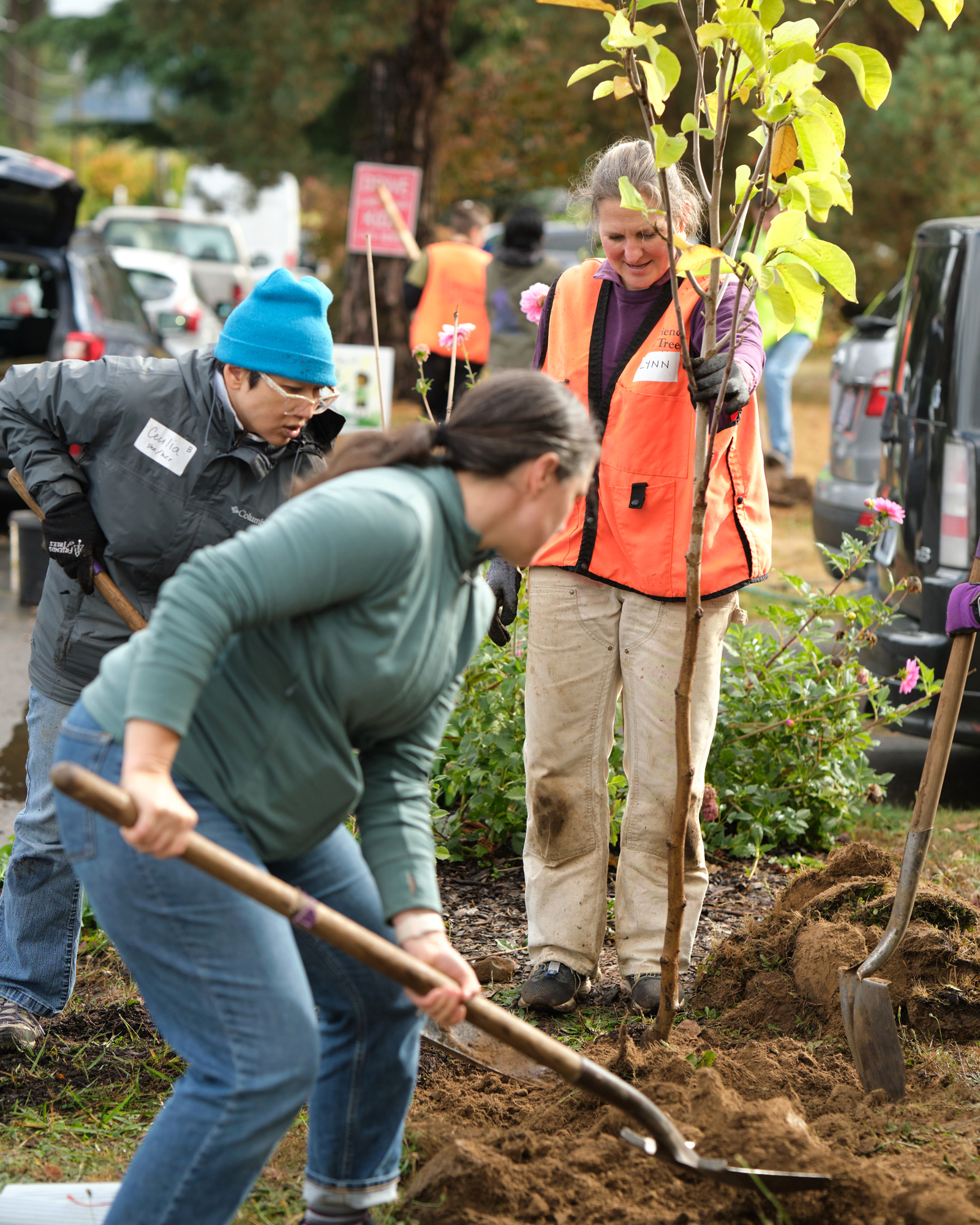
Friends of Trees, which relies on a corps of volunteers, will celebrate its one-millionth tree planting in April. The organization started planting trees in Portland in 1989 and has since expanded into six counties across Portland and Oregon. Shandas estimated that at least two-thirds of the Friends’ trees are in Portland.
But he pointed out that canopy loss outpaces canopy growth, and new trees don’t provide the same health and ecosystem service benefits as mature trees amid full canopies, which can take 15 to 30 years to develop. The size of canopies will make a difference in the quality of life in American cities, he said.
“2040 will be a very different world than 2025,” Shandas said. “It will be considerably warmer in most places and heat waves will be very intense.”
About This Story
Perhaps you noticed: This story, like all the news we publish, is free to read. That’s because Inside Climate News is a 501c3 nonprofit organization. We do not charge a subscription fee, lock our news behind a paywall, or clutter our website with ads. We make our news on climate and the environment freely available to you and anyone who wants it.
That’s not all. We also share our news for free with scores of other media organizations around the country. Many of them can’t afford to do environmental journalism of their own. We’ve built bureaus from coast to coast to report local stories, collaborate with local newsrooms and co-publish articles so that this vital work is shared as widely as possible.
Two of us launched ICN in 2007. Six years later we earned a Pulitzer Prize for National Reporting, and now we run the oldest and largest dedicated climate newsroom in the nation. We tell the story in all its complexity. We hold polluters accountable. We expose environmental injustice. We debunk misinformation. We scrutinize solutions and inspire action.
Donations from readers like you fund every aspect of what we do. If you don’t already, will you support our ongoing work, our reporting on the biggest crisis facing our planet, and help us reach even more readers in more places?
Please take a moment to make a tax-deductible donation. Every one of them makes a difference.
Thank you,



The Oregon Supreme Court has overturned the conviction of a Lane County man who once photographed child beauty queen JonBenét Ramsey and was convicted in 2021 on several child pornography charges.
Randall DeWitt Simons, 73, of Oakridge, was charged in 2019 with 15 counts of first-degree encouraging child sex abuse. He was later convicted on every count and sentenced to 10 years in prison.
Simons was first arrested after authorities began investigating a report from a restaurant in Oakridge that someone had been using the restaurant’s Wi-Fi to download inappropriate and concerning images.
Law enforcement officers directed the business to track, log, and report all of the user’s internet activity to the investigating officer for more than a year, without a warrant.
Police tracked the computer’s IP address from the restaurant’s Wi-Fi system, which led officers to a man who lived near the restaurant and had given Simons a computer, according to a probable cause affidavit filed in Lane County Circuit Court. Investigators obtained a warrant to search the laptop in Simon’s home, relying on information they had collected over time. He was subsequently arrested.
On March 26, the court ruled warrantless internet surveillance on public Wi-Fi violates privacy.
In an opinion written by Justice Bronson D. James, the court held that the Oregon Constitution recognizes people have a right to privacy in their internet browsing activities and the right is not extinguished when they use a publicly accessible wireless network. It’s even true in cases where that access is conditioned on a person accepting a terms-of-service agreement that says a provider may monitor activity and cooperate with law enforcement, James wrote.
During criminal proceedings in the Lane County Circuit Court, Simons moved to controvert the warrant and suppress the evidence obtained by police, arguing the business was a “state actor for purposes of Article I, section 9, and that its year-long warrantless surveillance was an unconstitutional, warrantless search attributable to the state,” the Supreme Court opinion said.
The Circuit Court denied Simon’s motion. The Oregon Court of Appeals affirmed the trial court’s decision in part and stated Simons had no cognizable privacy interest in his internet activities performed on a third-party network.
The Oregon Supreme Court rejected the state’s argument.
“The mere fact that a person accesses the internet through a public network does not eliminate their Article I, section 9, right to privacy in their online activities,” according to James. “Even when access is expressly conditioned on a user’s acceptance of terms-of-service provisions purporting to alert the user that the provider may monitor activity and cooperate with law enforcement.”
Justice K. Bushong suggested in a partial dissent the Court should reconsider its approach in a future case to what constitutes a “search” under the Oregon Constitution. The court’s decision reverses the Court of Appeals and sends the case back to the Lane County Circuit Court for further proceedings.
Simons has maintained his innocence since he was arrested in 2019.
Simons had been a photographer for 6-year-old Colorado beauty queen JonBenét Ramsey a few months before her still-unsolved 1996 murder, the Associated Press reported in 1998.
In October 1998, Simons was arrested on a charge of indecent exposure in Lincoln County, Colorado. According to the book “Perfect Murder, Perfect Town” by Lawrence Schiller, Simons was arrested in 1998 for allegedly walking nude down a residential street in the small town of Genoa, Colorado. Simons allegedly offered to the arresting deputy unprovoked, “I didn’t kill JonBenét.”
Haleigh Kochanski is a breaking news and public safety reporter for The Register-Guard. You may reach her at HKochanski@gannett.com.

Umatilla, Morrow counties establish Young Republicans of Oregon chapter
Published 8:00 pm Wednesday, March 25, 2026
IRRIGON — Young Republicans living in Umatilla and Morrow counties now can join a local chapter of the statewide Young Republicans of Oregon organization.
The Umatilla Morrow Young Republicans will advance Republican values and leadership in young residents through political training, networking opportunities and connection to Republican leaders. The group is focused on young adults, generally attracting college-aged people, though it includes people aged 18 to 40.
The five Young Republicans of Oregon members living in Umatilla and Morrow counties elected three officers to lead their new chapter. Irrigon’s Evan Purves was elected chair, with Connor Roberts of Hermiston as his vice chair and Kaelyn Moore of Milton-Freewater serving as secretary.
“I am super grateful for this opportunity to lead my neighbors,” Purves said. “It’s going to be really fun. We have some good events planned.”
Purves, 19, is a student at Blue Mountain Community College who eventually hopes to pursue a four-year degree in public administration. He initially became interested in the Young Republicans during an internship with Oregon state Rep. Greg Smith, of Heppner. He said it was an experience that showed him how the legislature works.
The internship also inspired him to step into a leadership role with the Young Republicans and help establish a local chapter of the organization. The newest chapter of the Young Republicans of Oregon, which was announced Monday, March 23, has been in the works since November 2025.
The Young Republicans of Oregon State Chair, Tanner Elliott, said the new chapter — the fourth chapter statewide — indicates momentum for conservative values.
“In less than a year, we’ve continued expanding because young conservatives are stepping up and getting involved in their communities,” Elliott said. “I want to congratulate the chapter’s leadership team on their election and especially commend their new chair Evan Purves for taking on this role. I’m confident this group will make a meaningful impact in Eastern Oregon and help drive our organization forward.”
Future plans in Umatilla, Morrow counties
The leadership team of UMYR already is making efforts to effect change.
In early May, Purves said, Umatilla Morrow Young Republicans will host a door knocking campaign in support of Smith’s reelection campaign. There also will be an official kickoff event the same weekend celebrating the new chapter and outlining priorities for the future.
“If there’s anything that we might struggle with is membership,” he said. “The recruiting part is us going out there and hosting events and socials, having opportunities for people to come out and do something fun that anybody’s invited to.”
Regarding other priorities, voter engagement is important to Purves,
“Even though we live in a big conservative area, there’s not a lot of politically engaged people, especially in my generation,” he said. “We want to get them involved.”
He said one of his concerns is businesses leaving the state due to policies that aren’t friendly to corporations, a common issue raised by Republican lawmakers. The decisions being made impact every community, he said, and he wants to have a say in what the leaders are doing.
“These bills affect all of us,” he said. “It’s just important to get people involved and get people to vote and be a part of it.”
People interested in updates on the efforts of the Umatilla Morrow Young Republicans can follow the group on Facebook or Instagram or become a member at yro.gop.

50 years of DC Metro: A look back in photos

WKYC Channel 3

Austin’s Star Is Still Shining Bright: Venture Funding To City’s Startups Hits All-Time High

How To Watch: Michigan vs Alabama in NCAA Tournament Sweet 16

This Day in Alaska History-March 27th, 1964

Florida High School Football Rankings: Top 25 teams – Oct. 21

How old is Bo Nix? What to know about Oregon quarterback ahead of 2024 NFL Draft

Cleary's 21 help Le Moyne down Central Connecticut State 69-64 in OT

99th annual Pony Swim held in Virginia

Indiana Members Credit Union announced as new anchor tenant at Bottleworks District

Video: Will ICE Change Under Its New Leader?

DHS shutdown breakthrough comes at cost for Republicans as funding fights nears end

Rubio joins crucial G7 talks as Iran war set to dominate second day

A surprise resignation could open the door for an independent to win a Montana Senate seat

Video: Savannah Guthrie Says She Believes Her Mother Was Taken for Ransom
-

 Detroit, MI1 week ago
Drummer Brian Pastoria, longtime Detroit music advocate, dies at 68
-

 Science1 week ago
How a Melting Glacier in Antarctica Could Affect Tens of Millions Around the Globe
-
 Science1 week ago
I had to man up and get a mammogram
-

 Movie Reviews1 week ago
‘Youth’ Twitter review: Ken Karunaas impresses audiences; Suraj Venjaramoodu adds charm; music wins praise | – The Times of India
-

 Sports6 days ago
IOC addresses execution of 19-year-old Iranian wrestler Saleh Mohammadi
-

 New Mexico5 days ago
Clovis shooting leaves one dead, four injured
-
 Business1 week ago
Disney’s new CEO says his focus is on storytelling and creativity
-

 Texas1 week ago
How to buy Houston vs. Texas A&M 2026 March Madness tickets