Oregon
Finalists for Oregon Ethics Commission director answer questions during ‘meet and greet’


The search for the replacement for the Oregon Government Ethics Commission’s current director, Ron Bersin, who is retiring after leading the agency since 2006, is down to two candidates.
Susan Myers and Jay Messenger work in Salem as state government employees. They answered submitted questions Thursday so the commission could better understand how they would respond to potential budget cuts and their leadership style, and their knowledge about the position.
The commission enforces the state’s ethics laws, provides training for public officials and maintains the registry of required economic interest disclosures, registered lobbyists, and quarterly expenditures.
State auditors in 2021 said the nine-member commission could be strengthened and more independent. The commission last year launched an investigation into former secretary of state Shemia Fagan and her potential ethics violations of using state resources for personal benefit and reimbursement of personal expenses. The commission also made headlines after Gov. John Kitzhaber resigned amid an ethics scandal in 2015.
The full commission is set to conduct a final interview with the finalists this week.
Susan Myers, OGEC’s compliance and education coordinator
Meyers joined the commission in 2018 as an investigator. She received her bachelor’s in English from the University of Arizona and a master’s degree in English Literature from the University of New Mexico. She moved to Portland in the 1990s and taught English Literature for 10 years at Mt. Hood Community College and Portland Community College before returning to Arizona and attending law school. She worked at a private law firm before becoming an assistant attorney general in Arizona from 2008 through 2016, specializing in antitrust law.
Jay Messenger, internal controls officer for the Oregon Department of Revenue
Messenger was raised in Pennsylvania and attended Temple University for his undergraduate and law degree. He worked for two law firms doing securities regulatory defense and was a senior attorney in the National Association of Securities Dealers’ Department of Enforcement. He taught at Santa Clara University’s School of Law before moving to Oregon in 2010 and teaching at Willamette University’s College of Law. He also briefly worked as a chief of staff for California Assembly member Tony Thurmond in 2016. He joined the Oregon Department of Education as the legal and enforcement director from 2019 to 2022 before his latest position at the Department of Revenue.
Below are responses the finalists gave Thursday during what the commission called a “meet and greet.” They have been edited for length and clarity.
What is your understanding of the mission of the Oregon Government Ethics Commission?
Myers: To enforce the areas of law within its jurisdiction and to do so with impartiality. To accept complaints alleging violations of the three areas of law: ethics laws, lobbying laws and the public meetings. Our mission is to enforce those laws, but our mission also is to educate and that part of the mission, education, is, in my mind, primary. We accomplish more by educating people than simply by fining them or sanctioning them. I’m not saying the enforcement is not important but even in the enforcements, in the investigations, and so forth, the goal is still education because we don’t want people to repeat the same offenses.
Messenger: It administers and enforces Oregon government ethics and emphasizes education. Beyond the actual text of it is the government ethics commission deals with lobbying. It deals with government ethics, generally a lot of conflict-of-interest work. It deals with executive session laws. The OGEC has this body of law that they have to administer and enforce and just like any regulatory compliance practice, which I’ve been involved with most of my legal career, is making sure that those rules are adhered to. What I really appreciate about this mission is the education aspect … What any regulator wants is voluntary compliance. So you need the hammer of the enforcement but you also need to be able to teach and get the message out and help people understand … The mission is extremely important in order for people to have faith in government.
What experience do you bring that will help you be successful in this role?
Messenger: My own unique path meets the job duties of this description and would help support me … my law background deals with statutes and regulations. I spent almost a decade teaching in law schools … I’ve had significant management positions.
Myers: Being an English professor, being an attorney … and the years I’ve spent at this agency. Ron Bersin has taught me a lot in those years. I’ve learned a lot. He has intentionally involved me in every aspect of the agency.
What are your top priorities for the agency in the first 30, 60 and 90 days?
Myers: In the first 30 days, the top priority is a successful transition, making sure staff understands expectations and how things will be working but outwardly facing is move the rulemaking process for public meetings law. We’re going to do rulemaking for ethics and lobby laws as well but getting the public meetings law done and getting the rules advisory committee formed is the primary goal for the next 30 to 60 days … And then we also have other items. Budgetary things that have to happen by early February as well legislative concepts … 60 to 90 days would be making sure the rulemaking process gets completed … taking steps to make our agency a little more open and transparent. That may be by providing more information on our website … figuring out where our agency could be more open and providing better information to the public.
Messenger: There’s some information I don’t have because I’m obviously on the outside. I don’t know some of these things but from being involved in the executive leadership team at the Department of Revenue certain deadlines are coming up … I don’t know if (OGEC) has any in the works but I would take a look at that … We have this short session, I don’t know what OGEC has going on in the short session so one is to deal with the legislative issues both for the short session that’s coming up and the 2025 session. What do we need to do to prepare for that? What do you need to do to get the trains running on time and keep the trains running on time … make sure while I’m learning that the work keeps flowing and maintain the high standards that the agency has … I want to make sure the staff feel supported … Getting more on-demand training available. I noticed on the OGEC website that there’s a plan to get more of it out in 2024 so I’d like to make sure that happens.
What opportunities do you see for the commission?
Myers: This has been a major transition not just in terms of Ron leaving but in terms of public meetings law. This is new not just to us, but other than the court system there has been no one in Oregon in all these years enforcing public meetings law … It is an opportunity for the commission and for the commission to meet that part of the mission that I said is preeminent: to provide education to everyone who needs it … Other opportunities are to explore outreach. Not just sending our trainers out to different parts of the state but exploring different ways of reaching our audience …There is an opportunity here for the commission and commission staff to establish better relationships with all of the public bodies that we serve … The other is something that I would propose, a difficult thing … I’ve thought about the benefits that COVID has brought us. I don’t mean COVID itself but meetings like this. We didn’t have Teams and Zoom meetings and all of that pre-COVID and now when the commission meets some of them are present in person and some are present in video … The opportunity for the commission is, as we get new commissioners … it is important that the commission be representative of the entire state. It’s well represented on a political spectrum, I would like to see, maybe, better representation on the statewide spectrum.
Messenger: I see some opportunities in outreach. I’ve been in the Oregon state government since 2019 … I took the course every state employee takes, the OGEC intro training that’s required but I don’t recall outreach done to state employees. I don’t know what outreach has been done to other public officials like local employees or local officials, people in boards and commissions across the state so I’d like to do some more outreach … More on-demand video training … And could we have little blurbs from opinions or stipulated orders that said here’s an example of a potential conflict of interest? Here’s an example of an actual conflict of interest.
Why do you want to lead the commission?
Messenger: The mission speaks to me. It’s a very important mission … And I feel like I could really contribute to the work of the commission.
Myers: I have worked very hard for this position … and that is because I’m very much committed to what this agency is and does and I believe I can help it do more.
Dianne Lugo covers the Oregon Legislature and equity issues. Reach her at dlugo@statesmanjournal.com or on Twitter @DianneLugo



Oregon tight end Jamari Johnson, after an impressive 2025 season with the Ducks, now becomes the leader at his position following the departure of star Kenyon Sadiq to the NFL.
With an Oregon offense set to return several top stars and bring in two talents at the tight end position, Johnson looks to not only improve as a leader but build off his impressive 2025 season, in which he recorded 32 receptions for 510 yards and three touchdowns.
Here’s everything Johnson had to say during his media appearance following Oregon’s scrimmage on Saturday, with the spring game on the horizon.
Everything Tight End Jamari Johnson Said After Spring Scrimmage
What He Learned From Playing With Tight End Kenyon Sadiq:
“So many, but one is training. Everybody in this facility harps on it, and it’s just a standard here. It’s like him from last year, that man strained his guts out almost every play. I just feel like I got to do the exact same thing or even more to uphold the standard.”
Stepping Up At Tight End:
“It just changed because obviously Kenyon leaving somebody has to step up and be a leader in the room, and me being one of the older guys, it just happens to be me. I just accepted that role, and I actually kind of like it, getting these young guys going, getting them in the playbook and getting them used to college football.”
Participating Again In Spring Practice:
“It feels good coming back. Feels like I have something to prove for me personally, I feel like I haven’t really done anything in college football. I feel like this year is that year for me to show everybody what I’m about.”
On Tight Ends Kendre Harrison and Andrew Olesh:
“Both good dudes, they both got that dog in them. Andrew, he came from Penn State. He’s been coming along well, getting in the playbook. Kendre, he’s a big, tall guy, getting in the playbook too. They’ve been getting after it, man. It’s been good taking them under my wing. Hopefully, we just get going this year.”
Goals and Expectations Ahead of Spring Game:
“I’ll say one expectation that we really try to harp on in the room is just going 100 percent. That’s with your effort, that’s with knowing the plays and just giving it your all. A goal is just to get in that endzone. That’s one of the goals for the tight end room right there.”
Why He Returned to Oregon:
“Like I said earlier, to me, I felt like I haven’t really done anything in college football. That was one of the reasons, and another is I wouldn’t say I’m not ready for the NFL, but like that’s pretty much what I’m getting at, is just like I have a lot of stuff to work on that’s within footwork and hand placement, block in the run game, and route details. Getting to the right depth and just touching up everything I can so when I get to the NFL, there’s none of those problems, it’s just the big problems I have to fix.”
How Reps Helped Him Improve:
“It really helped me. Last year, we ran a lot of twelve personnel at the end of the season because we had a couple of injuries, but that really helped me. This year, I feel like I’m coming in rolling off the ground. It’s just so much more fluent, and those reps really helped me with the playbook. Playbook is way easier now, and I’m getting a good feel for it.”
His Leadership Traits:
“I like to get the guys going. I have a real voice on the field, and if y’all hear me on the field, I get the guys going. I wouldn’t say I’m a vocal leader, but I lead by example. Vocal leader, probably something I need to work on.”
On New Offensive Coordinator Drew Mehringer:
“It’s been different. They’re two different people, coach (Will) Stein and coach Drew. My guy’s getting us going. I’m excited for this season.”
Supporting Dakorien Moore At Track Meet:
“Yesterday, that touched my heart, man. Just all of us going out there, and it wasn’t even just for Dakorien. It was really for Oregon. It was just more for Dakorien because we see him every day. That really touched my heart, and the connection is just unbelievable. I don’t think many people are doing that for their teammates.”
Quarterback Dante Moore’s Growth:
“That guy has his head on his shoulders at all times. He’s been growing consistently, but it’s a couple of different things. I probably can’t name them right now, but he’s been having his head on his shoulders. He’s just been on the climb.”
Sign up to our free newsletter and follow us on Facebook, X and Instagram for the latest news.
 Add us as a preferred source on Google
Follow
Oregon
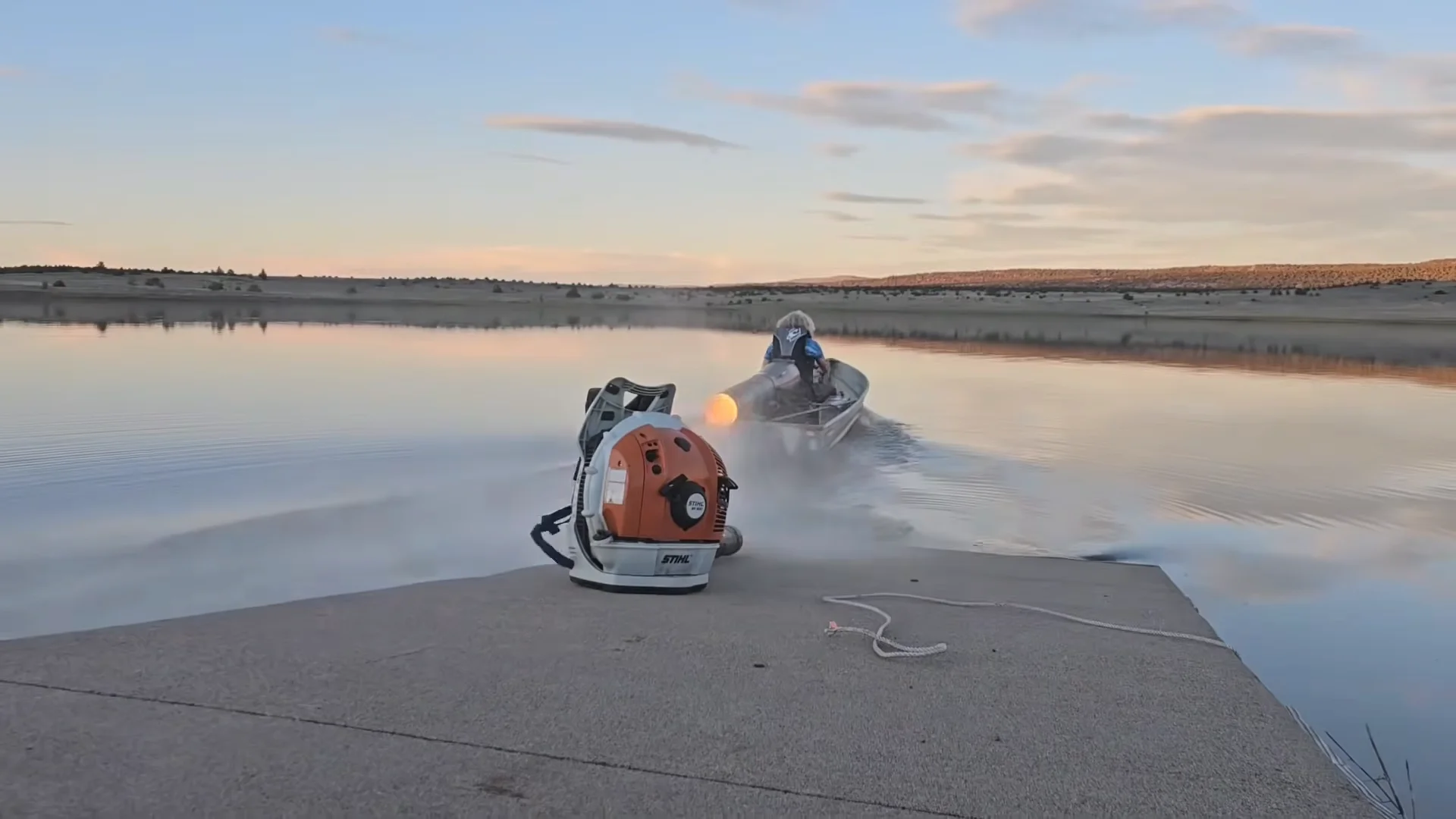
Oregon man mounted a jet engine on a 60-year-old fishing boat to blast around a lake and thinks he may have set a world record

A man from Oregon has unveiled something truly crazy after he added a jet engine to the back of a 60-year-old fishing boat – and he suspects he might have broken a world record.
YouTuber Robert Maddox from CrazyRocketman mounted a pulsejet engine and its 230lbs of thrust to the back of a 1965 12-foot Sears fishing boat.
A wild juxtaposition by any standard, and the video he posted on YouTube confirms that as the diminutive boat roars away.
But did the YouTuber actually actually get the record?
How does this 1965 Sears fishing boat get its power?
The video shows the Oregon man hurling the boat around a lake, with the engine glowing behind him.
Strapped to the back of the boat is a pulsejet engine that produces 230lbs of thrust.
Pulsejet engines are smaller, lighter jet engines with combustion occurring in pulses.
Such is their simplicity that they can be made with few or even no moving parts at all.
Engines like these were used on the German V-1 Flying Bomb from World War II.

These were the Argus As 014 engines, the very first pulsejet ever to be mass-produced.
It is a smaller and even simpler version of these that Maddox has put on the back of his boat.
The funny noise they make comes from the way in which the jet makes its power.
This old boat could be a record holder
In his video, Maddox had clearly enjoyed his outing on the boat.
“Man, this boat really is super controllable,” he said, highlighting the ease with which it handles.
The video suggested there are a few niggles still to sort out on the boat.

“It was making all kinds of fuel noises, I’ve probably got a fuel pump out or something,” he added.
Yet this isn’t the end of the road for this particular project.
“I’m going to do a lot with this boat, and put a twin engine on it,” Maddox said in the video.
Given the speed of the vessel, with two pulsejet engines, this should rocket through the water.
That means another world record could be up for grabs for the Oregon YouTuber.
If there was any doubt over a world record with one engine, two engines should end the debate in an instant.
Jet engine timeline
150 AD – Hero of Alexandria invents the aeolipile, a steam-powered device demonstrating the basic jet principle
1930 – Frank Whittle successfully patents the first design for a working gas turbine jet engine
1937 – Hans von Ohain tests his first centrifugal turbojet engine prototype in Germany
1939 – The Heinkel He 178 makes the first successful flight powered entirely by a jet engine
1941 – The Gloster E.28/39 completes the first British jet flight using Whittle’s engine design
1944 – The Messerschmitt Me 262 enters combat service as the world’s first operational jet fighter
1949 – The de Havilland Comet makes its maiden flight to become the first commercial jet airliner
1958 – The Boeing 707 enters commercial service and officially kicks off the global Jet Age
1969 – Concorde takes off for the first time to pioneer supersonic passenger jet travel
The global premium car auction platform powered by Supercar Blondie
DISCOVER SBX CARS:

CASCADE LOCKS, Ore. — DNA analysis has identified the remains found in a car in the Columbia River as those of an Oregon family that went missing in 1958 while on a trip to find Christmas greenery, authorities said Thursday.
The state medical examiner’s office has identified parents Kenneth and Barbara Martin and their daughter Barbie from remains located in the river within the wreckage of the car, the Hood River County Sheriff’s Office said. The sheriff’s office said it concluded its investigation and found no evidence of a crime.
The Ford station wagon thought to belong to the family was found in 2024 by a diver who had been looking for it for several years. Authorities pulled part of the car from the river the following year.
The family vanished in December of 1958. The bodies of two of the family’s children were found months after the disappearance, but the other members never turned up.
The search for the Martin family was a national news story at the time and led some to speculate about the possibility of foul play, with a $1,000 reward offered for information.
“Where do you search if you’ve already searched every place logic and fragmentary clues would suggest?” an Associated Press article asked in 1959, months after the disappearance.
Only the frame and some attached components were retrieved from the water because of the “extent to which the vehicle had been encased in sediment,” the sheriff’s office said. Analysis of those items allowed investigators to conclude that it was indeed the Martin family’s car.
Later in 2025, the diver located human remains that were ultimately turned over to the state medical examiner’s office.
Scientists developed DNA extracts from the remains and generated a profile that was compared with relatives of the Martin family, allowing for the identifications, authorities said.
-

 Washington, D.C3 minutes ago
Storm Team4 Forecast: A chilly, gusty Sunday before a cool start to the week
-

 Cleveland, OH9 minutes ago
Winners and Losers From Cleveland Cavaliers NBA Playoffs Game 1
-

 Austin, TX15 minutes ago
Storms dump small hail throughout Austin area Saturday
-

 Alabama21 minutes ago
YMCA of South Alabama holds Healthy Kids Day in Spanish Fort
-
Alaska27 minutes ago
Bear injures two US soldiers during military training in Alaska | The Jerusalem Post
-

 Arizona33 minutes ago
NFL mock draft: 4-round projections for Arizona Cardinals
-

 Arkansas39 minutes ago
No. 6 Arkansas ends top-ranked OU’s 31-game home winning streak with 3-2 decision
-
California45 minutes ago
Billionaire Steyer’s spending binge dwarfs rival campaigns in California governor’s race

