Sports
An inside look at the control center behind Honda's IndyCar racing effort

At the top of a hill in a sprawling Santa Clarita industrial park in the shadow of Magic Mountain’s roller coasters, a significant chapter in the history of motorsports was written.
But the story isn’t finished yet.
From the outside, the building is nothing special. Behind its walls, however, Honda Racing Corporation has designed, tested and built the engines that have won 14 of the last 21 IndyCar championships and all five IndyCar races this season. In Sunday’s Indianapolis 500, a race Honda has won 15 times since 2004, four of the top six starters will have Honda engines, including two-time winner Takuma Sato, who qualified second.
It’s a level of dominance unmatched in IndyCar history — in a series Honda probably helped save.
A technician works on an engine at Honda Racing Corporation. All of Honda’s engines for North American racing series are built in Santa Clarita.
(Robert Hanashiro / For the Times)
Amid the open-wheel civil war between Championship Auto Racing Teams and the Indy Racing League, Honda was prepared to walk away. Robert Clarke, who started Honda Performance Development (before it was renamed HRC in 2024) and made it a cutting-edge research and development facility, convinced American Honda president Koichi Amemiya to supply engines to IRL teams in 2003 after Honda left CART in 2002.
“It just was not Honda’s image of what a race car should be. That’s why Honda initially didn’t want to be involved,” Clarke said. “In my discussion with the president it was ‘OK, we developed all these skills and know-how. Are we just going to give that up and just walk away?’ That’s crazy.
”We invested literally billions of dollars. And we’ve seen the success.”
Chevrolet and Toyota eventually did quit, leaving Honda as the only IndyCar engine manufacturer for six seasons. Amemiya then doubled down, funding Honda’s move to its 123,000-square-foot home while expanding its workforce to 250 from an original staff of fewer than 10.
Honda hasn’t looked in the rearview mirror since.
Clarke, 75, left Honda in 2008 though he’s still something of an executive emeritus, one who wears the brand on his sleeve and often refers to the company with the collective pronoun “we.”

Robert Clarke, left, speaks to IndyCar driver Dario Franchitti at Mid-Ohio Race Course in July 2007.
(Jay LaPrete / Associated Press)
He was 10 when his father took him to his first race to watch a friend run in an amateur open-wheel event. When young Robert was invited into the garage and allowed to work on the car “I was hooked,” he said. “My bedroom walls were covered with pictures of Formula One cars and all kinds of racing.”
He took the long road to Honda racing, though, studying architecture and art/industrial design in college, then teaching for five years at Notre Dame. His first job at Honda was in the motorcycle accessory and product planning departments but when the company announced it was going to enter open-wheel racing, Clarke volunteered and he was soon tasked with building the program from the ground up.
That was in 1993. By the time Clarke left Honda 15 years later, the company’s place as a major force in IndyCar racing was secure and Honda’s two-story hilltop headquarters became his legacy.
The focus of work in the building now is mainly on supporting Honda teams in IndyCar and the IMSA WeatherTech SportsCar Championship. As such, it has become a one-stop shop for racing teams, housing comprehensive engine research and development operations; prototype and production parts manufacturing; engine preparation and rebuilding; a material analysis facilities; more than a half-dozen engine dynamometer test cells; a machine shop; electronics lab; parts center; multiple conference rooms; and administrative offices.
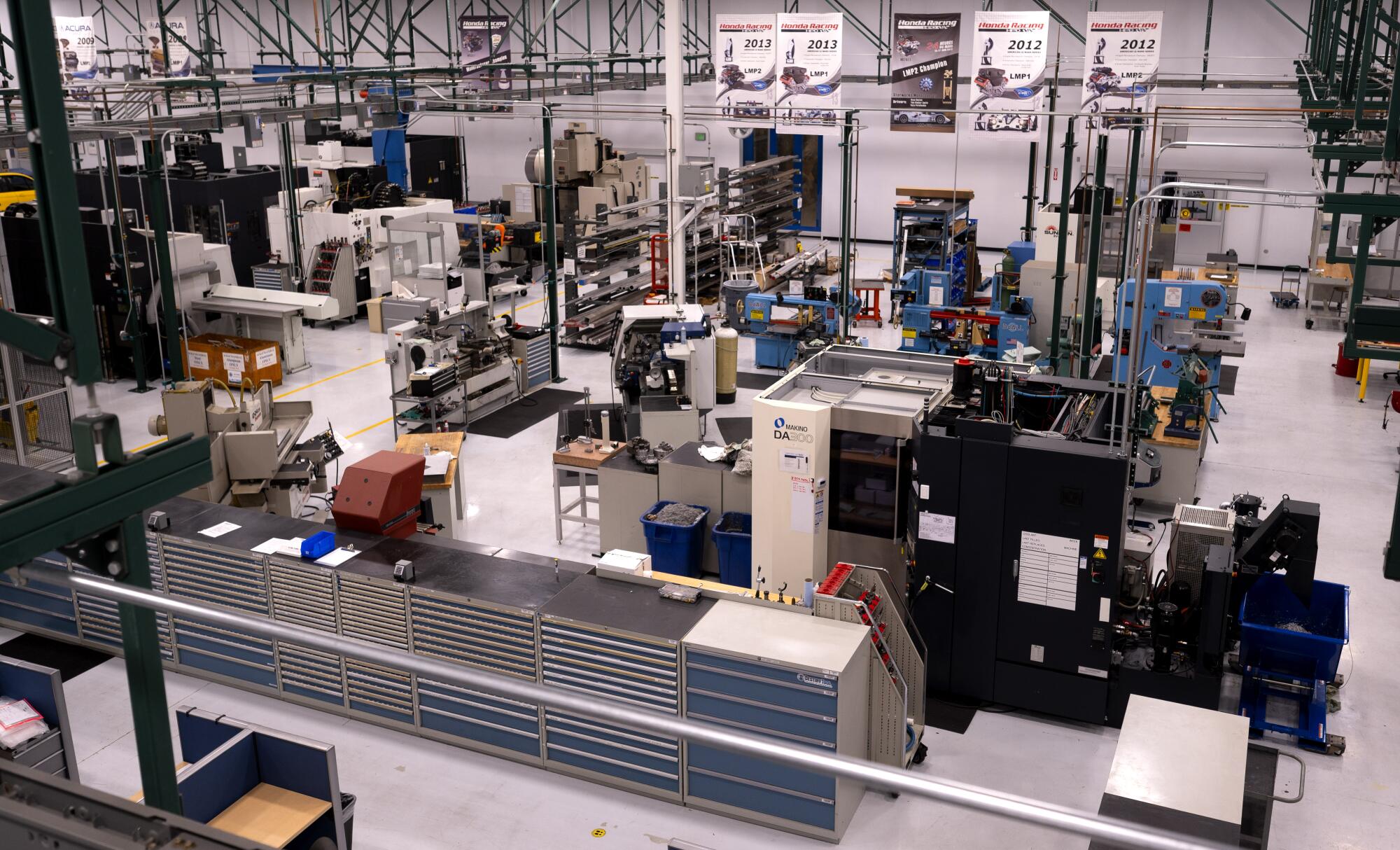
A view of the machine shop at the at the Honda Racing Corporation in Santa Clarita.
(Robert Hanashiro / For the Times)
Next year it will provide support for Honda’s effort to supply Formula One engines to Aston Martin.
Mostly the building is a maze of quiet office space where engineers sketch out their designs on computer screens, well-lit assembly bays where mechanics assemble the prototypes, and the noisy high-tech dyno rooms where those prototypes are tested. Every stage of a racing engine, from conception and construction to being shipped to the track, is managed at the facility.
“We develop the technology quickly,” said David Salters, the British-born engineer who heads HRC. “We try them. Sometimes they work, sometimes they don’t work and you try again. The point of having a racing facility inside your company is you can be agile. You can try stuff. You can train the people.
“The people are the most important thing of all this.”
The whole process is more NASA than NASCAR in that there’s not a speck of grease or oil on the bright, white vinyl flooring and everybody’s hands are clean.

David Salters, president of Honda Racing Corporation.
(Michael L. Levitt / LAT Images via American Honda Motor Co.)
“This is a world-class facility. It needs to be clinical and professional in the processes and systems we have here,” said Salters, who was head of engine development for the Ferrari F1 team and held a similar position at Mercedes-Benz before joining Honda a decade ago.
“It’s like an operating theater. We’re basically dealing with engines or electrical systems, which are like jewelry. They cannot tolerate dirt or anything like that. Everything has to be spotless and clean and well-organized. This is aerospace.”
And when the engines don’t work, they’re brought back to HRC and the engineering process is repeated in reverse in search of flaws. As for why they’re doing all that in a sleepy bedroom community better known for its paved bike paths and rustic hiking trails than for its motorsports history, that’s easy: Location, location, location.
Clarke originally expected to recruit engineers from Indianapolis and Charlotte, N.C., the heartland of American racing, while Honda insisted on keeping its operations near its corporate offices in Torrance. Clarke feared dropping people from the Midwest and South into L.A.’s traffic-clogged sprawl would be such a culture shock, he’d lose his best engineers.
So he chose Santa Clarita, which was isolated enough to not feel like L.A., but close enough to Torrance to be accessible. And the building came with an “Only in L.A.” feature: It shares a driveway with the studio where the popular TV series “NCIS” is filmed.
“Every so often a helicopter will land in the car park and we’re all told we can’t go outside in case we get swept away,” Salters said with a chuckle. “There was some ‘Star Trek’ thing where they decided our foyer could be useful. So for a few weeks we had a movie set in our foyer; we rented it out.
“You’ve got to look at business opportunities.”

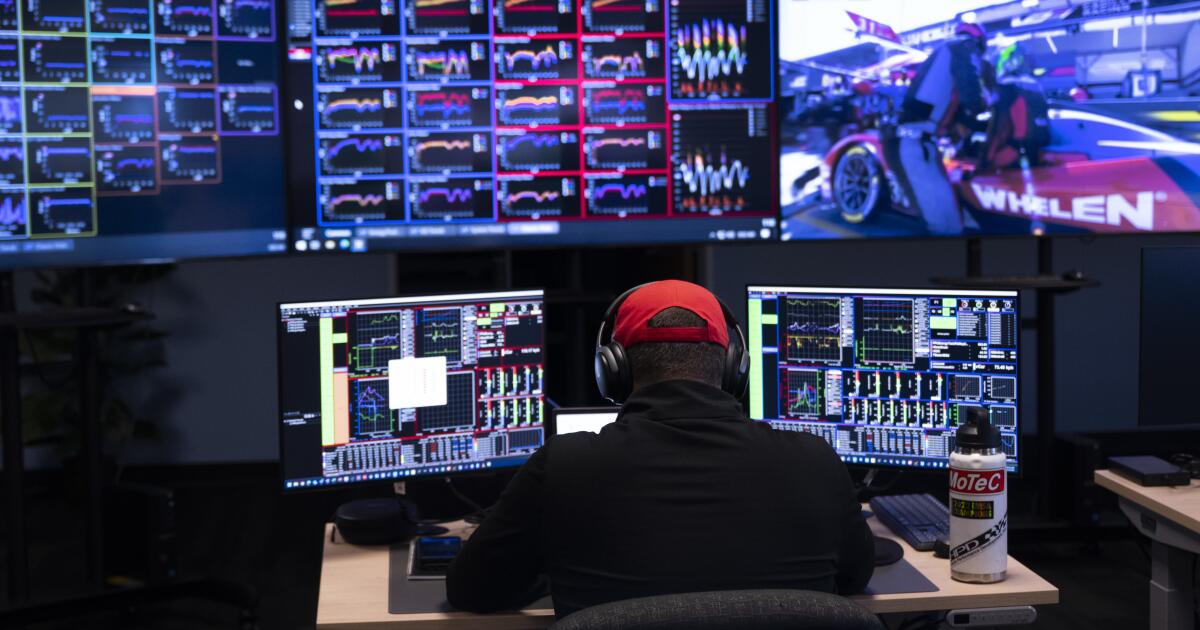
Adi Susilo, chief engineer of powertrain at Honda Racing Corporation, looks over large monitors before the start of the 12 Hours of Sebring in March.
(Robert Hanashiro / For the Times)
It’s early on a chilly Saturday in March and HRC’s headquarters is mostly empty save for one corner on the building’s second floor where nearly a dozen people, some wearing headphones, have gathered behind computer screens facing six giant TV monitors.
A continent away, in central Florida, more than 50 cars are lined up for the 12 hours of Sebring. Each driver with a Honda engine has an engineer monitoring their car’s performance.
Before the pandemic, engineers would travel and work with race teams on site. But for the last four years the engineers have been working mostly at HRC, monitoring in-car telemetry that provides real-time information about everything from engine status and tire pressure to suspension behavior.
“Data is king,” said Adi Susilo, one of the HRC engineers. “Humans make mistakes. Data rarely does.”
F1 teams have monitored telemetry remotely for years, but it didn’t become common in IndyCar racing until 2023. Now it’s a vital part of every major racing series, including NASCAR.
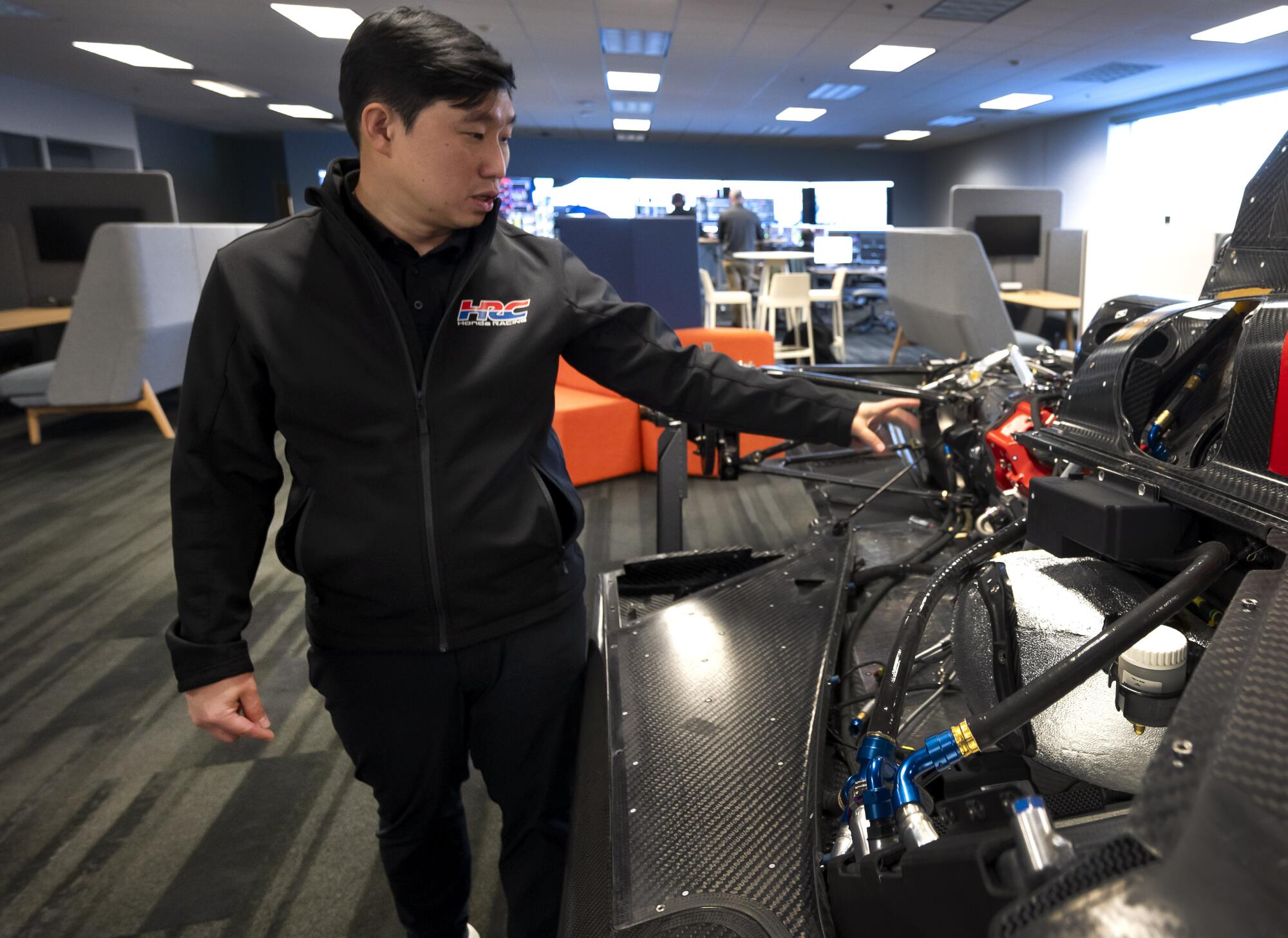
Powertrain chief engineer Adi Susilo looks at a full-size mock up of an IMSA prototype at Honda Racing Corporation.
(Robert Hanashiro / For the Times)
Engineers work out of what looks like a college classroom, only quieter. When the sound of a disembodied voice does cackle out of a headphone, it sounds like NASA Mission Control, the tone flat and unemotional, the conversation short and to the point.
“It’s better for solving problems,” said Susilo about working away from the track. “If there’s a problem, you just walk downstairs and talk to the guy who built the engine.”
That won’t be the case Sunday. For the Indy 500, Susilo said it’s all hands on deck, so most of Honda’s race-day engineers are in Indianapolis where the telemetry will be broadcast to their work stations in trailers at the track.
“A few of the IndyCar races are run that way,” he said, “but the 500 is almost always run that way just because everyone’s out here for the event. We’re also testing a new, hopefully more robust, telemetry streaming as it’s much harder to make sure we get 15 car’s worth of data.”
At first, the idea of having engineers looming electronically over the timing stand was a hard sell. Trusting someone with clean fingernails watching the race on monitors thousands of miles away wasn’t easy for some crew chiefs.
“What happens for people like me is that you have to erase the old-school way of thinking,” said Mike Hull, a former mechanic and driver who is now the managing director for Chip Ganassi Racing and chief strategist for driver Scott Dixon, a six-time IndyCar champion. “You’re electronically shoulder to shoulder with them.
“If you don’t listen to what somebody has to say, it stifles free thinking. Free thinking sends you down a path that you may not have originally been on, but makes you stronger at what you’re doing.”
1

2

3

4

1. Race engines being assembled at Honda Racing Corporation. 2. A technician in the HRC machine shop works on an engine. 3. Engineers monitor data during the 12 Hours of Sebring in March. 4. A engineer monitors telemetry remotely from HRC headquarters. (Robert Hanashiro / For the Times)
Dixon, the 2008 Indy 500 champion who will start Sunday’s race in the second row, agrees. Which is he why he’s made several trips to HRC to personally thank the engineers who design his engines and those who help direct his races.
“You always feel like there’s a big group behind you,” he said. “You just don’t get to see all them in one place but you know the machine is there, working pretty hard.”
One drawback, Dixon said, is you have to be careful what you say on the radio during races because you never know who’s listening.
“Twenty people at home, just on the team side, will be listening just on that one car,” he said. “So the communication is very wide open. You definitely have to watch your Ps and Qs.”
Two years later race teams have grown so comfortable with people looking over their shoulders, the engineers have become as much a part of the team as the cars. So when a nearby wildfire forced the evacuation of the building, Honda rented rooms at a nearby hotel, set up their TVs, computer monitors and a coffee machine in a conference room and worked from there.
“We’re pretty blind without it. The race teams are pretty competitive,” Susilo said. “They feel that instinct still does work. But it’s more data-driven.”

Honda powertain engineer Jake Marthaler monitors data during the 12 Hours of Sebring in March.
(Robert Hanashiro / For the Times)
Given the investment, the pressure can be intense.
“Every two weeks we want to have the latest development. We want to have made progress,” Salters said. “Every two weeks you have a deadline and the deadline does not move. It’s not like they’re going to say ‘OK, we’ll just delay the race a week.’ The flag drops, you’ve got to be ready.
“It’s sort of an engineering sport isn’t it? It’s like a true sport; the best team will win.”
If the IndyCar-Honda marriage has mostly been good for both sides, it has recently hit a rocky patch.
Honda’s supply contract with IndyCar ends next year and the company hasn’t hid its distaste over the cheating scandals that have recently tarnished the series. Last week Team Penske drivers Josef Newgarden, the two-time defending Indy 500 champion, and Will Power were forced to the back of the field for the start of Sunday’s race after illegally modified parts were found on their cars. Team Penske, which uses Chevrolet engines, was also caught cheating at the beginning of the 2024 season.
On Wednesday, the team fired three of its top racing executives. IndyCar, which is owned by Roger Penske (also the owner of Team Penske) said it is exploring the creation of an independent governing body absent of Penske employees.

Scott Dixon drives into the first turn during practice for the Indianapolis 500 on Friday.
(Michael Conroy / Associated Press)
That may not be enough to restore trust in the series. Honda, which supplies engines to 13 full-season IndyCar entries and three Indy 500-only cars, has declined to comment on the rules violations, but confirmed its continued participation in the series beyond 2026 may depend on Penske’s ability to separate himself from policing the series he owns and also competes in.
Honda said in a written statement Thursday that it has many concerns, among them “the relatively high overall cost to participate as an engine supplier” and “the potential (perceived or real) conflict of interest which may exist” with Penske’s ownership of the racing series, three of the cars competing in the series and his “significant stake” in Ilmor Engineering, which designs and manufactures engines for Chevrolet, Honda’s biggest competitor.
“Honda continues to have ongoing negotiations with IndyCar’s management and technical teams regarding our future as an engine supplier for the series,” said Chuck Chayefsky, manager of Honda & Acura Motorsports.
Whatever road Honda takes with IndyCar, it’s unlikely to change most of the day-to-day work at HRC, which is heavily involved with IMSA and will soon be working on F1 power-unit development.
So while the cars may change, the racing will never stop.
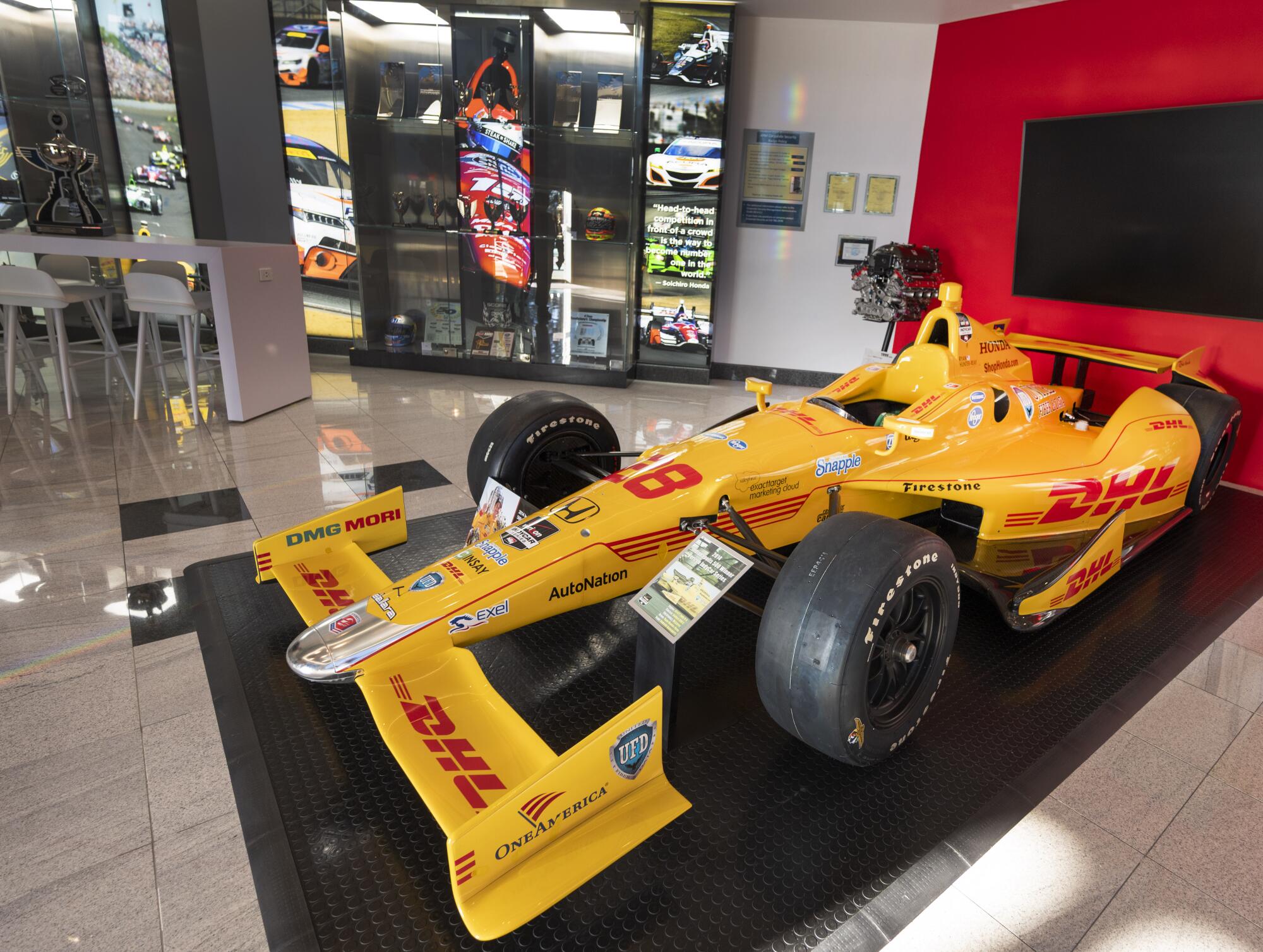
The car Ryan Hunter-Reay drove to victory for Andretti Autosport in the 2014 Indianapolis 500 sits on display at Honda Racing Corporation in Santa Clarita.
(Robert Hanashiro / For the Times)
“Thirty years ago our sole purpose in life was to look after racing in North America for Honda and Acura,” Salters said before last week’s events in Indianapolis. “Last year we changed that. We’re now part of a global racing organization. That’s another opportunity for associates here.”
“The automotive world, it’s pivoting,” he continued. “We are trying some new stuff. We’ll see how it goes.”
One chapter has been written. But the story isn’t finished.


NEWYou can now listen to Fox News articles!
All eyes were on Caitlin Clark on Wednesday night as she made her anticipated return from injury in a road matchup in Los Angeles.
But instead of a triumphant comeback, the Fever spent the entire night chasing the Sparks as Clark’s rough return fueled a 106-92 rout.
The superstar never found a groove, looking completely out of sync in her return from a back injury.
STEPHANIE WHITE GIVES CAITLIN CLARK STATUS UPDATE AHEAD OF FEVER-SPARKS, BUT HER NEXT MOVE RAISES QUESTIONS
Caitlin Clark huddles with teammates as the Indiana Fever battle the Sparks. (Photo by Katelyn Mulcahy/Getty Images) ((Photo by Katelyn Mulcahy/Getty Images))
Much of that disjointed performance falls squarely on head coach Stephanie White, who kept Clark on a ridiculously tight leash by limiting her to just 16 minutes. The stop-and-go approach could have sabotaged any chance for the phenom to establish a rhythm.
Clark finished with just 9 points, 4 rebounds and 3 assists. Her minus-16 plus-minus told the story.
The Los Angeles Sparks were severely shorthanded, taking the floor without stars Kelsey Plum and Cameron Brink.
MERCURY’S NOW-DELETED SOCIAL MEDIA POST MOCKING CAITLIN CLARK DRAWS SCRUTINY AFTER STAR’S INJURY
Yet while a depleted Sparks roster played to win, Indiana spent the night over-managing its biggest asset.
With Clark on a minutes restriction and Aliyah Boston out of the lineup, Kelsey Mitchell was forced to shoulder the entire offensive burden.
Mitchell did her part, pouring in 29 points while shooting 5-of-9 from beyond the arc.
Caitlin Clark orchestrates the Fever offense as Indiana battles the Los Angeles Sparks in primetime action. (Photo by Katelyn Mulcahy/Getty Images) ((Photo by Katelyn Mulcahy/Getty Images))
But one hot hand couldn’t stop an efficient LA squad.
The Sparks shot 45% from three-point range, going 9-of-20 from deep to cruise to the 106-92 victory.
White’s next move is to sit Clark against the Mercury on Thursday while Boston returns.
CLICK HERE TO DOWNLOAD THE FOX NEWS APP
After Wednesday’s loss to a shorthanded Sparks team, it’s fair to question whether Indiana’s cautious approach is working. The Fever dropped to 12-9.
Caitlin Clark and Dearica Hamby face off as Fever and Sparks battle at Crypto.com Arena in Los Angeles. (Photo by Tyler Ross/NBAE via Getty Images) ((Photo by Tyler Ross/NBAE via Getty Images))
Send us your thoughts: alejandro.avila@outkick.com / Follow along on X: @alejandroaveela
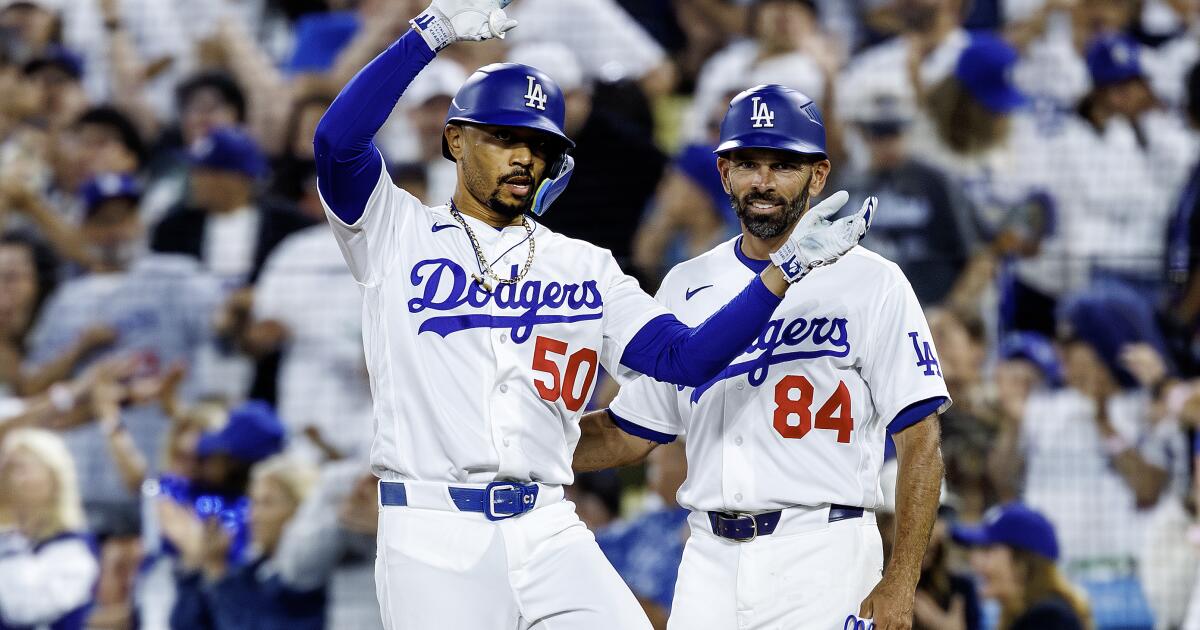
Mookie Betts’ first hit this series against the Rockies couldn’t have come at a more opportune time. With the crack of the ball against his bat, Tommy Edman scored from third, giving the Dodgers the lead.
And as Betts reached first, he pointed to Freddie Freeman, whose single put Edman in scoring position. It had taken a team effort to overcome another middling start from Roki Sasaki, and Betts, who had little to show before his game-winning hit, took the chance to highlight the joint contribution in the Dodgers’ 4-3 rubber-match win over Colorado (38-56).
“It feels great,” Betts said of his nine-pitch battle. “Helping the boys win, that’s really all it is. We play the game to win, and coming through in a big moment is kind of what, when you’re a kid, playing in the backyard, getting that hit is what you always strive to do, and fortunately, I was able to do it.”
Given a three-run lead in the first inning, brought to the Dodgers by a wild pitch and Kyle Tucker’s two-run, line-drive single to left field, Sasaki seemed set up for success.
Still, he gave away the lead as quickly as it came. In the second inning, he left a fastball too far over the plate, and third baseman Kyle Karros drove the ball over the left-center wall. The slider he dealt two batters later to second baseman Edouard Julien also crossed the zone too far over the plate, and Julien rounded the bases with another homer. In the third, a sacrifice fly by Mickey Moniak evened the scored, 3-3.
Sasaki’s troubles this season have been hard to pin down since his last win on May 23, as Sasaki tries to claw back the triple-digit velocity that’s escaped him as of late.
Against the Rockies, his fastball topped out at 99.1 miles per hour before steadily dropping to 98. He had managed five strikeouts in his six innings when manager Dave Roberts replaced him with Jack Dreyer, though the three earned runs couldn’t be ignored.
But Roberts also acknowledged the possibility that the pitcher had been tipping his pitches, possibly since he was playing in Japan, and Sasaki has tried to address it after a three-inning, six-run start last week. Even if he had fully self-corrected, his control issues remain. In the third inning, he walked the tying runner, Brett Sullivan.
“I’ve been working on a lot of things like the tipping stuff,” Sasaki said through interpreter Kensuke Okubo. “Also, I need to make quality pitches.”
Sasaki regained some of his confidence in the fourth when he worked out of a two-base jam with two strikeouts and a flyball to right, something that didn’t go unnoticed by Roberts.
“You can see the demeanor walking off the mound, the confidence,” Roberts said. “For me, it was more of let him end on a high note, feeling good about his outing, and then go from there.”
The Dodgers’ problems were compounded by Alex Call wasting the team’s two challenges in his at-bat in the first inning when the team had already taken the lead. And maybe it would’ve been excusable if Call had driven in the runners on first and second, but instead he ended the inning on a strikeout, stranding both. Roberts called the situation an “outlier” and didn’t feel as though he needed to have a conversation with Call regarding the situation.
After the three-run first, the Dodgers (61-33) remained hitless until Max Muncy laced a double down the right-field line in the sixth, though to little avail. As the innings ticked forward, Colorado’s chances seemed to increase. The Rockies hold the best league batting average (.297) in the eighth and ninth innings (the Dodgers are fourth with .268). And the Dodgers relievers, within the same constraints, have a 3.83 ERA — not bad, but not in the top 10 either.
Third baseman Max Muncy can’t get his glove on a line-drive double by Kyle Karros in the fourth inning.
(Gina Ferazzi/Los Angeles Times)
So when Alex Vesia struggled against the Rockies in the eighth inning and Muncy suffered a throwing error, Colorado seemed in position to score with the bases loaded and one out. Vesia struck out TJ Rumfield and Edgardo Henriquez (4-0), his replacement, retired Karros on a fly ball to right.
After Betts’ single allowed the Dodgers to take the lead, Tanner Scott (13) shut down the Rockies with back-to-back strikeouts, avoiding the team’s eighth series loss of the season.
“Didn’t feel great,” Roberts said. “Fortunately, we won a series, but that’s not the kind of way you want to do it.”
Sports
Justin Verlander announces he will retire after this season: ‘I’ve realized that time has come’

NEWYou can now listen to Fox News articles!
One of the greatest pitchers in the history of baseball will be hanging up his cleats after this season.
Three-time Cy Young Award winner Justin Verlander announced on Wednesday that the 2026 season will be his last.
Amid an injury-riddled season with the Detroit Tigers, Verlander decided it’s time to go.
Detroit Tigers pitcher Justin Verlander watches from the dugout during a game against the Chicago White Sox at Comerica Park in Detroit June 21, 2026. (David Rodriguez-Munoz/USA Today Network via Imagn Images)
“This season has challenged me in ways I haven’t experienced before, both physically and mentally. I’ve always believed that as long as I could compete at the level I expect of myself, I’d keep playing. I never wanted to retire because of a milestone, a number, or a date on the calendar. I wanted the game to tell me when it was time. Over the last several months, I’ve realized that time has come,” Verlander said in a social media post.
“While I’m fully committed to giving my team everything I have for the rest of this season, I’ve decided this will be my last. It’s fitting that I get to finish where it all started – with the Detroit Tigers, the organization that drafted me and gave me my first opportunity.”
Verlander inked a one-year deal with the Tigers, with whom he spent his first 12½ seasons before being traded to the Houston Astros, in the offseason. In Houston, he returned to dominance, winning both of his World Series titles and two of his Cy Young Awards.
“Baseball has given me more than I could have imagined. It taught me discipline, resilience, and the value of continuing to adapt and evolve. I’ve been fortunate to play with and against incredible players, for outstanding organizations, and compete in-front of fans who deeply appreciate the game,” Verlander added in his announcement.
Justin Verlander of the Houston Astros celebrates after the Astros defeated the Philadelphia Phillies in Game 6 of the 2022 World Series at Minute Maid Park Nov. 5, 2022, in Houston, Texas. (Mary DeCicco/MLB Photos via Getty Images)
PHILLIES STAR SAYS ‘BS RULE’ IS KEEPING HIM FROM BEING NAMED ALL-STAR IN FRONT OF HOME CROWD
“To every teammate, coach, player, clubhouse attendant, and fan who has been part of this journey – thank you. It’s been a privilege to share the field with you. To my family, especially my wife Kate, thank you for standing beside me through every season, every rehab, and every high and low. I couldn’t have done this without you. It’s time for the next chapter. But first, I’m excited to finish this season the only way I know how – with everything I’ve got.”
Verlander is the active leader with 3,554 strikeouts, which is good for eighth all-time. He needs 21 to surpass Don Sutton and 87 to pass Tom Seaver.
The 43-year-old made his MLB debut in 2005 and won the American League Rookie of the Year Award the following season in what was just a small glimpse of what was to come.
Verlander was a Cy Young Award finalist on four other occasions, consistently near the top of the leaderboard in just about every pitching stat. MLB Commissioner Rob Manfred gave Verlander a legend’s exemption to this year’s Midsummer Classic, making him a 10-time All-Star.
One could argue that Verlander should have at least one more Cy Young Award on his mantle, but he is on the fast track to Cooperstown and very much in the conversation to join Mariano Rivera as the only player unanimously elected to the Hall of Fame.
Verlander’s best season came in 2022, when he pitched to a career-best 1.75 ERA along with a 0.829 WHIP. However, that came after he missed the entire 2021 season due to Tommy John surgery for an injury he suffered after pitching just one inning in the abbreviated 2020 season.
Houston Astros starting pitcher Justin Verlander throws against the Boston Red Sox during the first inning Aug. 22, 2023, in Houston. (AP Photo/Michael Wyke)
CLICK HERE TO DOWNLOAD THE FOX NEWS APP
He won his first Cy Young Award in 2011, when he was also awarded the MVP Award, and his second in 2019. Verlander’s 11 seasons between his first and final Cy Young Awards are the second-most behind Roger Clemens, who had 18 seasons between his first and seventh.
Verlander led the majors in innings and WHIP four times while recording the most strikeouts in three seasons.
Follow Fox News Digital’s sports coverage on X, and subscribe to the Fox News Sports Huddle newsletter.
-

 Connecticut48 seconds ago
This Underrated Connecticut Town Is Getting National Recognition as One of the Best Places to Live
-

 Delaware8 minutes ago
Plans advance for Delaware city’s first Chick-fil-A restaurant
-

 Florida11 minutes ago
Summer Scheming ‘26: Florida State Seminoles
-

 Georgia16 minutes ago
Travel and Leisure listed unique experiences in each state, including GA
-

 Hawaii23 minutes ago
Three West Hawaii sex offenders arrested – West Hawaii Today
-

 Idaho26 minutes ago
Idaho Power crews respond to outage affecting 2,163 customers in Canyon County
-
 Illinois38 minutes ago
As Illinois enters 10th year under Evidence-Based Funding model, equity remains an elusive goal
-

 Indiana41 minutes ago
FAIRFIELD NATIVE AND HIS WIFE FOUND DEAD IN THEIR NEWBURGH, INDIANA HOME

