Oregon
Can AI help fight wildfires?


In this image provided by the Oregon Department of Transportation, the Durkee fire burns in the background as it nears Interstate 84 near Huntington, Ore., early Sunday, July 21, 2024. (Oregon Department of Transportation via AP)AP
Large forest fires fueled by climate change have burned over 1 million acres in California and Oregon, marking a particularly destructive start to wildfire season and hastening the need for new solutions.
It’s no surprise that much of that focus is on artificial intelligence, a burgeoning and hopeful technology that has also stirred fears and anxiety about its potential consequences, such as eliminating human jobs and industries.
AI is already used to mitigate the threat of wildfires nationwide, helping communities in the drought-hit West and places like Maui find, avoid, fight, and recover from them.
AI can help detect the first signs of smoke, spot fires from satellites, and predict where fires may start and how they will burn in certain terrains. On July 23, the Biden administration announced a $20 million investment that will improve detection, tracking, and provide public safety data.
The federal government maintains an online tracking system that offers a trove of live wildfire data neatly displayed on a map. It can show the location and size of fires, including associated smoke plumes and air sensor readings, acting as early warning systems for residents in neighboring communities and states.
While AI has been useful for residents, there are reservations about its effectiveness on the front lines, where humans remain the best form of defense against wildfires.
Max Alonzo, a 12-year wildland firefighter veteran and current Secretary-Treasurer of the Washington, D.C.-based National Federation of Federal Employees, told Reckon that he doesn’t believe AI has made much of a difference and has detracted from major pay and welfare disputes within the federal government’s wildland firefighting service.
“Artificial intelligence cannot pay our men and women enough,” said Alonzo, whose organization is leading a multi-year effort to secure a permanent pay increase and benefits for wildland firefighters. “It can’t raise the budget to create housing in rural areas for our land management employees. It can’t address the mental health issues we see with our men and women deployed to these fires for months at a time.”
Alonzo said he’s unaware of any formal AI training or planning within the service. However, he did note that as the threat from climate change has grown, the resources needed to fight wildfires have not and are becoming increasingly difficult to maintain.
“I’m sure there is a place for AI,” he added. But I have not seen where it can really make any positive impact at this point.”
The average wildland firefighter’s pay is typically around $34,000 a year but was significantly increased in 2021 by a temporary $20,000 bump that expired in Sept. 2023. However, with predictions that 50% of firefighters would quit without a new pay deal, the increase was extended by another year.
The U.S. House passed a $330 million pay increase, and there are encouraging signs that the plan will pass the U.S. Senate. But money is just one of the issues. High rates of suicide, homelessness and cancer remain major points of contention as pay negotiations continue.
Big wildfire season
Nearly 30,000 wildfires have burned around 4.7 million acres in 2024, higher than the 10-year average, according to the National Interagency Fire Center (NIFC).
The Durkee Fire in Oregon’s Blue Mountain region is 86% contained as of Monday after burning around 300,000 acres since July 17. Started by lightning strikes, it’s one of the largest wildfires in state history. Dozens of other large blazes in the state are close to collectively surpassing the massive and destructive 2020 season, which burned around 1.2 million acres.
California’s Park Fire has burned close to 400,000 acres but was allegedly started on purpose. It’s the fourth largest in state history and is around 30% contained.
It was hoped that heavy summer rains would deter drought conditions, but a triple-digit heatwave in July left large chunks of the West vulnerable. Smoke from the fires has spread to northern Canada, the Gulf of Mexico, and the Atlantic Ocean, according to the NIFC.
AI has shown some promise in mitigating the worst of wildfires and helping plan ahead.
In the aftermath of the Maui wildfires, which were started by downed powerlines but exacerbated by dry conditions, Michigan State University researchers produced highly detailed maps that allowed them to track how the fires started and spread. The maps can help with remediation efforts and assess future risks, like the location of forests and vegetation in relation to at-risk communities. Other AI technologies under consideraation in Hawai’i enable officials to make hyper-local wildfire predictions using rainfall, soil moisture and wind speeds. According to scientists at the University of Hawai’i, dry brush and high winds are strong predictors of wildfires.
Although some AI wildfire technology may be years away from reaching its full potential, combining it with advances in robotics, software, and climate change research could help with more than just detecting and fighting fires, such as monitoring flooding.
Here are some ways technology is helping:
1. Early detection and monitoring
- Satellite imagery: Satellites equipped with thermal sensors and infrared cameras can detect hotspots and monitor wildfire spread in real-time.
- AI-supported wildfire sensors: Ground-based sensors enhanced with artificial intelligence (AI) analyze data in real-time to detect early signs of wildfires, such as smoke, temperature spikes, and unusual atmospheric conditions.
- Drones: Unmanned aerial vehicles (UAVs) provide high-resolution images and real-time data, even in remote or inaccessible areas. They can also detect heat signatures and map fire perimeters.
2. Prediction and risk assessment
- Machine learning: Algorithms analyze vast amounts of data, including weather patterns, vegetation moisture levels, and historical fire data, to predict wildfire risk and behavior.
- Weather forecasting models: Advanced meteorological models predict conditions conducive to wildfires, such as high winds and low humidity, enabling better preparedness.
- GIS mapping: Geographic Information Systems (GIS) map high-risk areas by analyzing topography, vegetation, and human activity, helping to allocate resources more effectively.
- Flooding sensors: Post-fire sensors can monitor areas at risk of flooding due to vegetation loss and altered landscapes, providing early warnings and risk assessments.
3. Communication and coordination
- Incident management systems: Integrated systems like the Incident Command System (ICS) help coordinate responses by providing a common platform for communication and resource allocation among multiple agencies.
- Mobile apps: Apps like “Wildfire Info” and “Fires Near Me” provide real-time updates and alerts to the public, helping communities stay informed and safe.
4. Suppression and containment
- Aerial firefighting: Advanced aircraft equipped with infrared cameras and water or retardant dropping systems, such as I4F foam, are used to combat fires. These include helicopters, drones, and fixed-wing planes.
- Robotics: Ground-based firefighting robots can navigate hazardous terrains to create firebreaks, clear vegetation, and apply fire retardants, reducing risk to human firefighters.
- Firefighting equipment: Innovations like fire-resistant drones and autonomous vehicles enhance firefighting capabilities and safety.
5. Post-fire analysis and recovery
- Remote Sensing: Post-fire, remote sensing technology assesses damage, maps burned areas, and monitors vegetation recovery.
- Data Analytics: Analyzing data from past wildfires helps improve future responses and strategies. This includes understanding fire patterns and the effectiveness of suppression techniques.


PORTLAND, Ore. (KATU) — The Oregon Zoo has welcomed a second red panda to their ranks this month, as 6-year-old Liu gets settled in to the habitat.
Liu comes to Portland from the Toledo Zoo as part of the Association of Zoos and Aquariums’ Species Survival Plan for red pandas.
He arrived just weeks after Enoki, a female red panda, and caregivers will soon introduce the duo in the hopes that they may eventually help add to the population of the endangered species.
PAST COVERAGE | Enoki the red panda joins Oregon Zoo, ‘exploring, snacking & napping’ in new habitat
For those coming to see the pandas, they should be easy to tell apart. Liu has a blonde tail, and Enoki is much smaller with a darker coat.
“He’s very handsome,” said Dr. Carlos Sanchez, the zoo’s director of animal health, who stopped by Liu’s habitat to observe, a red panda plushy tucked under one arm. “His tail is so blond — surfer blond.”
Liu was born on June 28, 2019 at Prospect Park Zoo in Brooklyn. His name means “willow” in Mandarin Chinese, a nod to his mother, whose name is also Willow.
Enoki is nearly three years old, and is of the refulgens subspecies of red panda, known for having darker faces and more prominent tail rings.
“These two represent a species in trouble,” said Kelly Gomez, who oversees the zoo’s red panda area. “In the past 25 years, habitat loss, poaching and the illegal wildlife trade have wiped out nearly half the world’s red panda population. Hopefully, we can help inspire a new chapter in the conservation of this incredible species.”
The duo joins the Oregon Zoo family more than a year after the death of Moshu, the zoo’s previous resident red panda who was dubbed “Sir Snacks-a-Lot.” Moshu was 14 years old.
More info from the Oregon Zoo.

Summer is in full swing, and across the country, the songs of birds and the cheeps of baby chicks are filling the air. While birdwatching season is happening just about everywhere right now, the Pacific Northwest offers something truly special: the chance to see puffins along the Oregon Coast. If you’re wondering when, where and how to see puffins in Oregon, you’re in the right place.
Few wildlife sightings feel as magical as spotting a Tufted Puffin (Fratercula cirrhata) in the wild. These beloved seabirds return to the Oregon Coast each year during their breeding season, drawing birdwatchers, photographers and nature lovers hoping for a glimpse of their bright orange beaks, expressive faces and unmistakable charm. For many visitors, seeing puffins in their natural habitat is a heartwarming coastal experience that captures the spirit of the Pacific Northwest.
Because puffins are seasonal migratory birds that nest in specific coastal areas, timing and location are key. With a bit of planning—and a little luck—you can witness one of Oregon’s most iconic wildlife moments along its rugged coastline. Here are the best places to see puffins on the Oregon Coast.
What Are the Best Places to See Puffins in Oregon?
If you’re wondering where you can you see these cute creatures, there are three spots that are worth going to and are hailed as the best places to see puffins in Oregon.
Haystack Rock, Cannon Beach
Haystack Rock is a popular place where puffins nest in Oregon.Getty Images Big5 Studio
Few wildlife encounters feel as effortless as spotting puffins right from shore, and Haystack Rock at Cannon Beach is one of the rare places where that’s possible.
This towering sea stack isn’t just an Oregon landmark, it’s also a seasonal nesting site for Tufted Puffins, who return here each year to raise their young on the rocky ledges. From the beach, visitors can often catch glimpses of puffins flying to and from the rock or resting along its cliffs, especially during the warmer months when activity peaks.
Because it requires no boat or hike to access, Cannon Beach remains one of the most rewarding and beginner-friendly places to experience puffins in the wild.
Face Rock State Scenic Viewpoint (Bandon)

Image via Getty Images/Moelyn Photos
For a quieter, more immersive coastal experience, Face Rock in Bandon offers a different kind of puffin viewing.
Here, the focus shifts from crowds to coastline where Tufted Puffins and other seabirds nest along offshore rocks just beyond the shoreline. The setting is calmer than Cannon Beach, making it ideal for visitors who want to slow down and scan the horizon for wildlife activity.
Every Saturday and Sunday from now until July 26, Face Rock Wildlife Interpreters will host on-site sessions at Face Rock Wayside from 9 am to 11 am, where guests will get to look out for puffins nesting on Face Rock with the wildlife interpreters’ help. Whether you go puffin-peeping on your own or with a group, be sure to bring binoculars!
Three Arch Rocks National Wildlife Refuge

Image via Getty Images/Bob Stefko
If looking for something a little closer to Portland, Three Arch Rocks is home to the largest breeding colony of Tufted Puffins in Oregon. A trip to Three Arch Rocks National Wildlife Refuge is sure to be a treat for any lovers of the Pacific Northwest’s coastal wildlife.
Not only is it one of the top places in Oregon to spot nesting puffins over the summer, but it is also the only pupping site on the North Oregon coast for the federally-threatened Steller sea lion, one of two sea lion species native to Oregon. Incidentally, the Steller sea lion’s pupping season, which runs from mid-May to mid-July, coincides with the first half of the Tufted Puffin’s nesting season, so right now is the perfect time of year for a visit!
When Do Puffins Arrive on the Oregon Coast?
For a large part of the year, Tufted Puffins live far out at sea across the North Pacific Ocean (in fact, they can be found as far eastward as Japan). However, from right now through August, Tufted Puffins are making their way back to coastal islands along the Oregon coastline to create their nests and raise their young until they are strong enough to join them out at sea. Therefore, if you want to catch a glimpse of them, now’s the perfect time.
What’s the Best Time of Day to See Puffins in Oregon?
These birds don’t follow a predictable shoreline schedule, which is part of what makes spotting them such a rewarding experience. So when’s the best time to see puffins in Oregon? Throughout the day during the breeding season, they move between offshore feeding areas and nesting sites on rocky cliffs and sea stacks. However, early morning and late afternoon often offer the most consistent viewing opportunities, when bird activity around colonies tends to increase and lighting conditions make movement easier to spot from shore.
For visitors hoping to increase their chances, choosing calm, clear days can make distant movement easier to detect against the waves.
What Do Puffins Eat and Why Do They Come to Oregon?
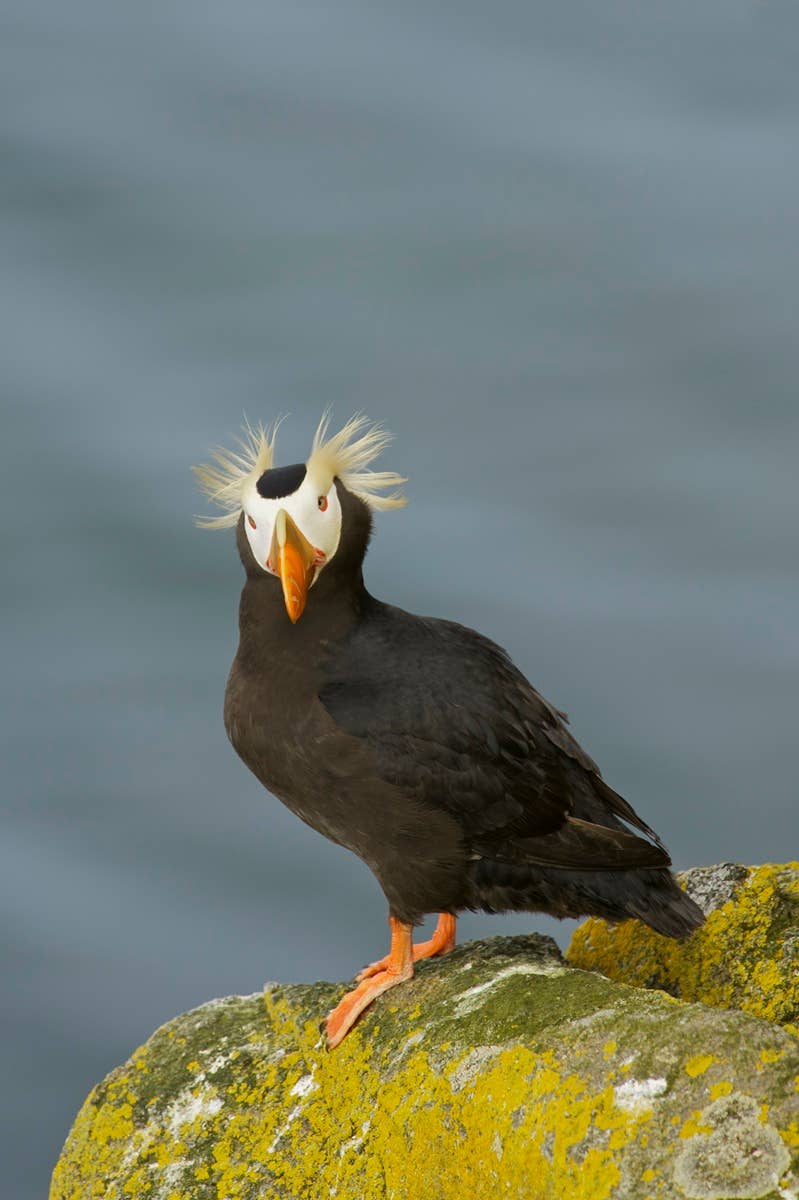
Tufted Puffins return to the Oregon Coast each summer.Getty Images Enrique Aguirre Aves
The presence of puffins along the Oregon Coast is closely tied to the health of the surrounding ocean ecosystem.
Oregon’s offshore waters provide an especially productive feeding environment thanks to cold currents that bring nutrients to the surface, supporting large fish populations. After all, Tufted Puffins rely on small schooling fish such as sand lance, anchovies and herring, which they catch by diving underwater and carry multiple fish back to feed both themselves and their chicks during the nesting season.
Combined with nearby rocky islands that offer protected nesting sites, the region creates an ideal seasonal habitat for breeding puffins and is what brings them back each year. It’s also why Oregon remains one of the most important puffin-viewing regions on the West Coast.
Tips for Spotting Puffins in Oregon
At one point, the Tufted Puffin’s distribution in North America stretched from northern California to British Columbia and the Aleutian Islands of Alaska. However, starting in the 1990s, the North American Tufted Puffin population plummeted in numbers, and now only a few thousand visit the Pacific Northwest every summer, including only a little over 500 puffins in Oregon. If you want the best odds at spotting these rare birds in Oregon, there are a few things you should keep in mind.
Puffins are easiest to spot when you know what to look for—and where to focus your attention. Bring binoculars and scan rocky cliffs and offshore waters, especially during calm mornings or late evenings when the sea is quieter. Watch for quick, low flights over the water or brief pops of movement near the surface as they dive for fish. Patience pays off, since puffins often appear suddenly and disappear just as quickly.
Why Puffin Sightings in Oregon is Special
Puffin sightings along the Oregon Coast are special because they’re both seasonal and fleeting. These seabirds spend most of their lives far offshore, only returning briefly to coastal nesting areas. That short window makes each sighting feel rare, especially when you catch them diving, flying, or gathering near rocky shorelines. Their bright beaks and energetic behavior make even a quick glimpse feel memorable.
Sources:

CURRY COUNTY, Ore. (KPTV) – A Texas man wanted for child sex crimes was arrested in Curry County on Tuesday afternoon.
The Curry County Sheriff’s Office says Kenneth Leatherwood of Bastrop, Texas, was arrested with the help of Oregon State Police and U.S. Marshals just after 12:30 p.m.
Leatherwood, who is accused of sex-related crimes involving a child in Texas, was reportedly found camping in a heavy wooded area near Lucas Lodge in Agness.
Investigators say Leatherwood has been on the run from Curry County law enforcement since June 16 after reports that he had been seen with a stolen car in the Agness area.
Leatherwood was also believed to have stolen weapons with him.
His dog was also found and returned to the suspect’s family in good shape, according to the sheriff’s office.
Copyright 2026 KPTV-KPDX. All rights reserved.
-

 Indianapolis, IN3 minutes ago
Man swims out to pickup stuck in White River, prompts emergency rescue
-

 Pittsburg, PA10 minutes ago
Caps Go Big on Trade Market, Light the Way for Penguins Rebuild
-

 Augusta, GA13 minutes ago
Finding Solutions: Augusta Training Shop celebrates inclusion, community at ‘Red, White, and Create’
-

 Washington, D.C18 minutes ago
Trump kicks off America’s 250th celebration with campaign-style rally
-

 Cleveland, OH25 minutes ago
2 people killed in multi-vehicle crash on SR-176 crash in Cleveland
-

 Austin, TX27 minutes ago
Texas insurance costs surge 79% in six years as lawmakers question AI impact on rates
-

 Alabama33 minutes ago
Two Alabama laws target Mobile blight by speeding sales and giving neighbors first bid
-
 Alaska34 minutes ago
Crews continue making progress on Delta Fires

