West
Oregon mistakenly registered hundreds more voters without proving citizenship

Officials in Oregon announced Monday that they have identified an additional 302 people on the state’s voter rolls who didn’t provide proof of citizenship when they were registered to vote.
The announcement comes just two weeks after officials in the Beaver state said 1,259 possible noncitizens have been registered to vote since 2021, bringing the total number of mistaken registrations to 1,561.
The mistakes occurred in part because Oregon passed a law in 2019 allowing some residents who aren’t citizens to obtain driver’s licenses. And the state’s so-called “Motor Voter” law, which took effect in 2016, automatically registers most people to vote when they seek a new license or ID.
OREGON MISTAKENLY REGISTERED NEARLY 1,260 POSSIBLE NONCITIZENS TO VOTE, DMV ADMITS
Oregon residents drop off their ballots near the Multnomah County Elections building in Portland on Nov. 3, 2020. (Ankur Dholakia/AFP via Getty Images)
The improper voter registrations stem from clerical errors at the state DMV.
On Monday, the DMV released an “After Action Report,” which identified errors in its processes that led to the mistakes, with Secretary of State LaVonne Griffin-Valade then directing county elections officials to inactivate all 302 voter registrations.
Griffin-Valade and Oregon Gov. Tina Kotek, both Democrats, called for an independent, external audit of the motor voter system in a joint statement.
“Thanks to the swift action of elections officials, I have full confidence that these new errors will not impact the 2024 election,” Griffin-Valade said. “The DMV’s After Action Report raises serious concerns about this important part of our voter registration system. The first step in restoring the public’s trust in Motor Voter is a transparent review by a neutral third party operating under strict government auditing standards.”
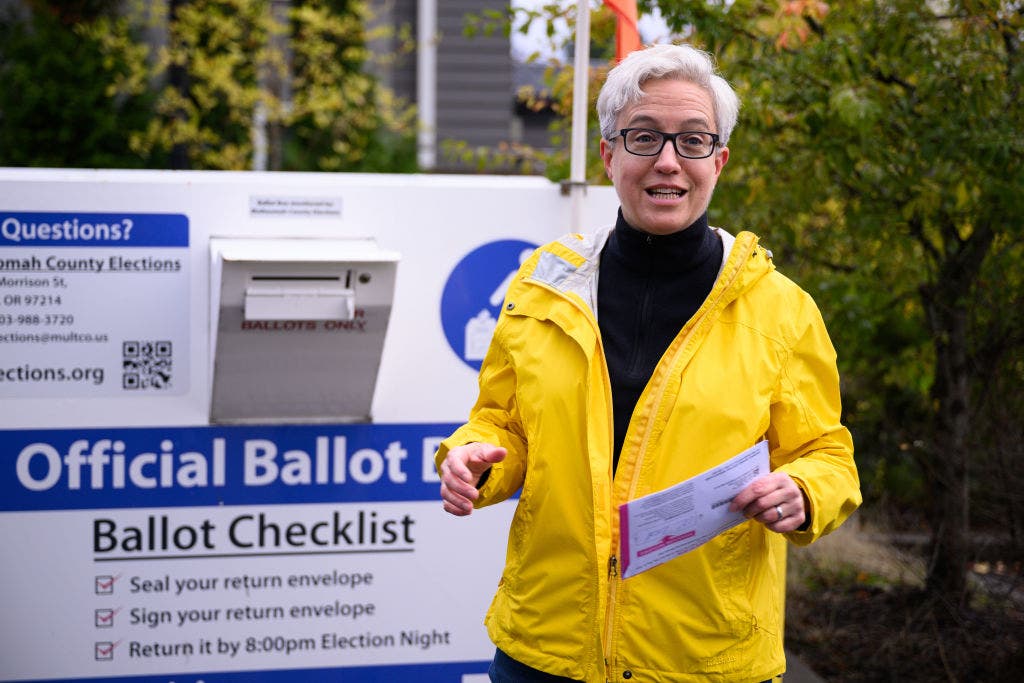
Tina Kotek, then the Democratic gubernatorial nominee, speaks with members of the media before casting her ballot on Nov. 2, 2022, in Portland. (Getty Images)
DMV Administrator Amy Joyce said the agency believed two weeks ago that it was confident it understood and had reviewed all records at risk of error.
“We have since learned this confidence was misplaced based on new information outlined in this announcement and after-action report and for this, we are sorry,” Joyce said in a statement. “DMV will follow the Governor’s directed actions and remains committed to continuous learning, corrective action, transparency and accountability.”
Griffin-Valade has ordered her office’s elections division to immediately hire a new Motor Voter oversight position, according to the statement. And she has instructed the division to establish a documented process for performing regular data checks with the DMV and update the administrative rules governing the Motor Voter system.
She said the Oregon Elections Division will work with the 36 county election officers to determine if any of the erroneously registered voters have previously cast a ballot. Every registered voter in Oregon is sent a ballot in the mail and the state had an 81.97% voter turnout rate in 2020. President Biden beat former President Trump comfortably in the 2020 election, winning the state by more than 380,000 votes.
RNC BLASTS WALZ ADMIN’S NONANSWER ON HOW NONCITIZENS MADE IT ONTO MINNESOTA VOTER ROLLS: ‘NO HYPOTHETICAL’
Of the 302 additional cases, 178 were due to people from the U.S. territory of American Samoa being misclassified as U.S. citizens, the DMV report said.
However, under federal law, people from American Samoa are U.S. nationals, not citizens, and don’t have the same right to vote. Another 123 records stemmed from the previously identified clerical error, but weren’t included in prior reviews due to a newly identified software issue. And one case was caught by the DMV’s new quality controls.
Griffin-Valade’s office says they are doing everything they can to prevent the 302 mistakenly registered voters from receiving a ballot, but cannot guarantee that all 302 ballots will be removed before they are mailed. Her office is putting in place a process that will ensure those ballots are not opened or counted.
Of the 1,259 possible noncitizens identified last month, 10 mistakenly enrolled individuals went on to cast a ballot, according to Oregon’s secretary of state, although at least one became a citizen before voting.
Officials in the state announced Monday that they have identified a further 302 people on the state’s voter rolls who didn’t provide proof of citizenship when they were registered to vote. (Mathieu Lewis-Rolland/Getty Images)
A DMV audit found staff may have accidentally selected “U.S. passport” when presented with a foreign passport, or “U.S. birth certificate” when given a foreign document, triggering voter enrollment.
The DMV said its drop-down menu has now been rearranged so “U.S. passport” is no longer the first, default option. Staff must also enter the state and county for all U.S. birth certificates and respond to a prompt when passport information is entered confirming that the documentation is accurate.
About half of all states, as well as Washington, D.C., have implemented automatic voter registration, according to the National Conference of State Legislatures.
But there have been numerous allegations of improper enrollment in states without automatic registration too.
Texas Gov. Greg Abbott announced in August that officials have purged 1.1 million ineligible names from the voter rolls since the 2020 presidential election.
Ohio’s secretary of state referred 138 noncitizens believed to have voted in previous elections to the state’s attorney general for possible criminal charges.
And a conservative watchdog group is suing Arizona’s Maricopa County for allegedly failing to remove more than 35,000 people who did not provide proof of citizenship.
Fox News’ Hannah Ray Lambert and Anders Hagstrom, as well as The Associated Press, contributed to this story.
Read the full article from Here


We were in Hilo for a story that had zero to do with the parks. Visiting Volcanoes National Park again, together with the coconut bridge problem, had sent us across the island from Kona, and the plan was straightforward enough: After our long-awaited volcano visit ended, we planned to do the remaining reporting, get something to eat, and head back out to Kauai via wonderful Hilo Airport. We had not flown through Hilo in years and wanted to check it out, too, and we were glad we did. And we were not expecting Hilo itself to change anything about the day. But it did.
Hilo gave us something we weren’t expecting.
What changed it was not a museum, any paid admission attraction, or some “must-see” visitor stop. It was a public park near the airport that we could have very easily passed by.
Liliuokalani Gardens does not look that impressive from the road. There was no gate, no fee, no reservation sign, and none of the now-familiar friction that can come with so many Hawaii stops. You did not have to plan for it, book it, or have any special reason for just being there. We just showed up. And almost immediately, we had the same thought that many other locals and visitors probably would: how is this still free?
Liliuokalani Gardens still feels generous and opulent.
Not free in the sense of being modest or “nice for what it is.” Free in the sense that if this were packaged somewhere else as a formal attraction, people would pay for it without much hesitation. The gardens are spacious, beautifully kept up, and full of details that only really register once you show up and slow down. The ponds, the bridges, the stonework, the open lawns, the beautiful trees, the way the paths keep opening up to new views. Nothing about it feels slapped together or reduced to the bare minimum.
What impressed us was just how easy it felt spending time there. People were wandering, stopping, sitting, talking, exercising, and taking their time. Some sat on benches and picnicked, as we did, while others strolled along the paths without any clear destination. Nobody seemed rushed. It was clearly Hilo at its best.
More often than not, the Hawaii experience starts before you even arrive. There is planning, the fee, the booking window, the parking issues, the time slot, the shuttle, the warning signs, the whole uncomfortable low-grade sense that you are entering something managed as tightly as Hawaii deems necessary. Some of that is understandable. Some of it is probably unavoidable. But it changes the feeling of a place in Hawaii. And it turns too many stops into logistics first and enjoyment second. But not here.
Liliuokalani Gardens felt like the opposite. We could hear planes not far off landing and taking off, and still see how close we were to the airport and town, but inside the gardens, all of that fell away. What took over instead was the sound of water, the stillness around the ponds, the nesting nenes, the bridges, and the rare feeling that nobody was trying to move us along.
After we left the park and before returning to Hilo Airport, we also stopped at Rainbow Falls. That stop turned out to be a whole different story. More on that soon.
Liliuokalani Gardens dates back to 1917.
The Territorial Legislature set aside land in Hilo for a public park dedicated to Queen Liliuokalani. The gardens’ own history says the park grew out of an early Hilo push to create a Japanese garden and tea house, influenced by Hawaii’s large Japanese immigrant community and by Laura Kennedy’s 1914 trip to Japan. That history helps explain why the place feels so substantial today: it now spans 24.67 acres, including the Japanese-style garden, Moku Ola, and other connected park areas.
What Hilo exposed about Hawaii.
These places are not good only because they are free. They are just good, period. The fact that they are free only sharpens the comparison. In a state where more visitor experiences now come wrapped in fees, reservations, restrictions, and various bottlenecks, Hilo can still find ways to offer places that feel open.
That does not mean every site in Hawaii can or should work this way. Some places are too fragile, too much in demand, or too small. But Hilo is a reminder that not everything meaningful in Hawaii has to be turned into a managed product. Not every worthwhile thing needs a layer of hassle between the visitor and Hawaii itself.
We did not go to Hilo looking for a parks story at all. We were nearby because of the coconut bridge problem.
Hawaii visitors are paying more, planning more, and dealing with infinitely more rules than they used to. Sometimes that is the price of preserving what visitors came for in the first place. Sometimes, however, it reflects a broader shift in how the state now handles access, demand, and public spaces.
Hilo offered exceptional beauty without a transaction attached and access without any conditions. We could just arrive spontaneously, stay as long as we wanted, look around, and then leave on our own terms. After so many Hawaii stops built around fees, timing, and control, this is one place where the welcome doesn’t come with a price tag.
For more information, visit the Friends of Lili’uokalani Gardens website or Facebook page.
Lead Photo: © Beat of Hawaii.
Get Breaking Hawaii Travel News
Montana
Californians caught using ‘Montana Loophole’ to dodge supercar sales tax — and Beverly Hills is the worst

California has launched a huge crackdown on criminals buying and registering supercars outside of the state to avoid eye-popping sales tax.
Fourteen people have been charged after $20 million worth of vehicles were sourced to the Big Sky State in what authorities are calling the “Montana Loophole.”
The cars include a $1.8 million McLaren Elva, a Porsche 918 Spyder and a $1.26 million Ferrari F12TDF, the attorney general’s office said.
In the Golden State base rate sales tax is 7.25%. For a Lamborghini or Ferrari that can reach up to $250,000 or higher, that can mean a tax bill over $18,000. In Montana it is zero.
The gang, from Alameda, Marin, Santa Clara and Sacramento, allegedly dodged more than $1.8 million in taxes since 2018.
They are accused of filing false records showing the supercars were bought in Montana but then drove and kept them in California.
The DMV has launched nearly 100 criminal investigations into similar schemes across California since 2023 and recovered $2.3 million. It says the schemes are costing over $10 million per year.
It says there are 601 fraudulently registered cars involved and the DMV and California Department of Tax and Fee Administration have reviewing all car sales made in Montana.
California AG Rob Bonta said: “When bad actors abuse legal loopholes and submit fraudulent documents to evade their obligations, the California Department of Justice will not stand idly by.
“Every dollar of unpaid taxes is a dollar taken from California’s roads, schools and the vital services our communities rely on.”
The AG’s office said Beverly Hills was the city with the most suspicious car sales, with 416 cases on its radar from the luxury enclave.
It also released a series of text messages from defendants in Marin County and Walnut Creek, which said: “Don’t want the state of California to know anything about this car.”
Another asked: “Before you deliver it to him can you please remove the dealer plate.” One more asked if those with Montana plates had issues, the reply was: “Not yet.”
Another defendant added: “70k saved — I can’t believe the registration lasts for five years — that’s crazy. Stupid California. Paid 3k to own a 600k car for 5 years — lol in Cali that’s like 75k for 5 years. Hella dumb.”
California DMV Director Steve Gordon said: “We encourage all Californians to do the right thing and register their vehicle here if they are operating it in California.”

As the Middle East conflict continues, politicians across the country are sharing their views on the situation.
On Sunday, Senator Mark Kelly (D-Arizona) paid a visit to Reno for a Democratic campaign fundraiser at the Neil Road Recreation Center.
At the event, he criticized the Trump administration’s actions.
“I think the president went into this conflict without having a strategic goal. Without having a plan and without having the timeline and what happens then is you don’t have a way to exit a conflict, so I’m really concerned about putting more Americans’ lives at risk with no explanation as to why,” said Kelly.
Nevada Gov. Joe Lombardo recently released a statement on the Iran attacks.
“Iran has long been a threat to the United States, Israel, and any hope of peace in the Middle East. They must never be allowed to obtain a nuclear weapon,” Lombardo said. “Right now, my priority is the safety of all Nevadans. Increased police presence may be seen at certain locations as we continue to monitor and synchronize with partners as the situation evolves.”
And prices at the pump are skyrocketing here in northern Nevada, and around the country. It’s partially due to traffic stalling in the Strait of Hormuz, a narrow waterway between Iran and Oman, which controls roughly 20% of the world’s oil supplies.
Energy Secretary Chris Wright aimed to ease concerns over rising costs.
“The world is very well supplied with oil right now. The United States is a net oil exporter, we’re a net natural gas exporter… We’re communicating with our allies abroad. The oil is there,” Wright said.
But Senator Kelly says gas prices could keep rising.
“This war in Iran is gonna drive up energy costs. Gasoline prices are gonna go up. Just driving down the road here, I noticed it was about $4.50 a gallon for a gallon of gasoline,” Kelly said.
Spike in utility bills after cold snap forces Delaware customers to make tough choices

Our leaders look to the past, but it's not a pretty picture

How should cities use AI? This Atlanta suburb may hold the answer.

Hawaii Keeps Adding Fees And Rules. This Park Is Still Free.

Big Ten tournament preview: An Illinois-Michigan rematch Saturday at the UC would be huge

Florida High School Football Rankings: Top 25 teams – Oct. 21

How old is Bo Nix? What to know about Oregon quarterback ahead of 2024 NFL Draft

Cleary's 21 help Le Moyne down Central Connecticut State 69-64 in OT

99th annual Pony Swim held in Virginia

Indiana Members Credit Union announced as new anchor tenant at Bottleworks District

Video: Airports Struggle to Staff T.S.A. During Partial Government Shutdown

Before-and-after satellite imagery offers a rare look at damage inside Iran
Hungary's opposition leader Péter Magyar calls on Russia to refrain from election interference

Video appears to show U.S. cruise missile striking Iranian school compound

Trump vows block on signing new laws until SAVE America Act passes Senate
-

 Wisconsin1 week ago
Setting sail on iceboats across a frozen lake in Wisconsin
-

 Massachusetts6 days ago
Massachusetts man awaits word from family in Iran after attacks
-

 Maryland1 week ago
AM showers Sunday in Maryland
-

 Florida1 week ago
Florida man rescued after being stuck in shoulder-deep mud for days
-

 Pennsylvania4 days ago
Pa. man found guilty of raping teen girl who he took to Mexico
-

 Oregon1 week ago
2026 OSAA Oregon Wrestling State Championship Results And Brackets – FloWrestling
-

 News1 week ago
2 Survivors Describe the Terror and Tragedy of the Tahoe Avalanche
-

 Sports4 days ago
Keith Olbermann under fire for calling Lou Holtz a ‘scumbag’ after legendary coach’s death