
West
One of the world's oldest gorillas dies at California zoo 20 years past life expectancy
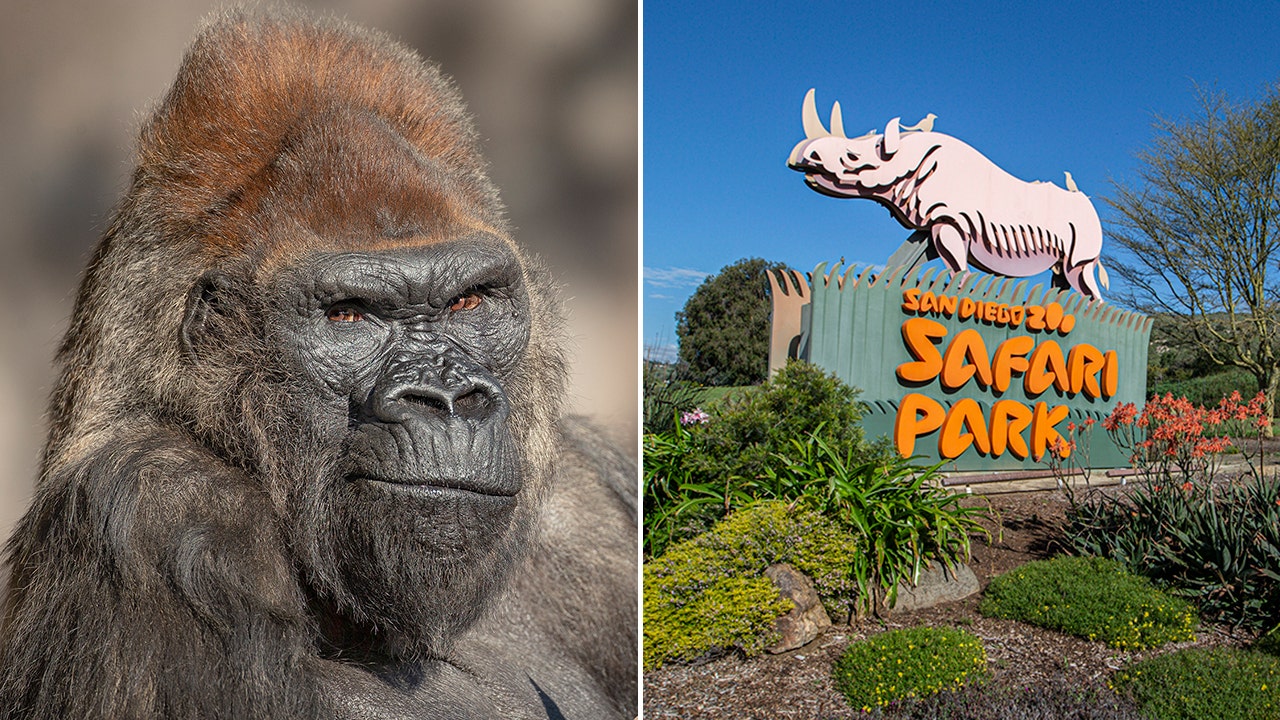
One of the oldest male gorillas who was living at a U.S. zoo has died at the age of 52.
The gorilla named Winston lived roughly 20 years beyond his life expectancy at the San Diego Zoo Safari Park in California.
The park recently announced his passing on July 13 after noting that the gorilla was receiving “significant medical treatments for several age-related conditions.”
GORILLA, JUST 4 MONTHS OLD, DELIGHTS ZOO VISITORS WITH FUNNY FACES: ‘VERY HAPPY’
Some of the conditions Winston was struggling with included heart disease, degenerative joint disease and kidney disease.
Winston was 52 years old — nearly 20 years older than the typical life expectancy of his kind. (San Diego Zoo Wildlife Alliance)
The gorilla was ultimately euthanized after what the park said was “careful consideration stemming from furthering complications from his worsening conditions.”
Care specialists at the San Diego Safari Park described Winston as “the best of us,” staff told Fox News Digital in an email.
SHOCKING VIDEO SHOWS ZOOKEEPERS ATTEMPTING TO ESCAPE GORILLA ENCLOSURE AT TEXAS ZOO
Winston was a western lowland gorilla who was born in the wild before being taken in by a private owner in England, TMX reported.
He arrived at the San Diego Zoo in 1984 and has since been known as a “patient, kind and compassionate troop leader,” according to TMX.
San Diego Zoo Safari Park announced the death of one of its most beloved gorillas, Winston. (Daniel Knighton/Getty Images)
Winston was also recognized as one of the first known great apes to be treated for COVID-19 in 2021, when veterinarians also discovered his heart disease.
For more Lifestyle articles, visit www.foxnews/lifestyle
The San Diego Zoo Wildlife Alliance said Winston “will be fondly remembered by all who had the privilege of knowing him,” according to a press release.
“San Diego Zoo Wildlife Alliance encourages everyone to share their condolences and support for Winston’s dedicated wildlife care and health team, staff, volunteers, Alliance members and guests, who are deeply affected by this loss,” the release said.
A zoo announced the death of one of the world’s oldest gorillas around. (San Diego Zoo Wildlife Alliance/Getty Images)
Western lowland gorillas typically weigh up to 440 pounds, can stand up to 5-and-a-half feet tall and are considered critically endangered, according to the World Wildlife Fund.
The animals are typically known to live in dense and remote rainforests in Africa, but most of the population exists in “isolated swamps and the remote swampy forests of the Republic of Congo.”
“In the wild, gorillas live for 30 or 40 years. In human care, gorillas may live into their 50s,” Smithsonian’s National Zoo & Conservation Biology Institute reported.
In April, the world’s oldest gorilla, Fatou, celebrated her 67th birthday in Germany, according to Guinness World Records.
Read the full article from Here
Arizona
How Arizona powered a 1st-of-its kind space telescope rescue mission
A NASA mission to rescue its Swift Observatory from the brink has relied on Arizona, with Flagstaff’s Katalyst Aerospace supplying the spacecraft due to reach orbit and boost the telescope’s orbit.
Arizona plays a central role in a daring NASA mission: It will soon attempt to stave off the death of one of its space telescopes in danger of falling back to Earth.
The Swift Observatory has been scanning the cosmos for more than two decades while orbiting Earth. But in recent years, NASA has noticed that the crucial satellite has been unexpectedly getting lower and lower – putting it in danger of burning up in Earth’s atmosphere.
Now, the U.S. space agency is on the cusp of mounting a rescue mission later in June – the likes of which has never before been attempted – that stunningly came together in less than a year.
The daring venture has recently reached the final stages, with the spacecraft that will fly in orbit – manufactured by an Arizona aerospace company – being mated with the rocket and the aircraft that will deploy it to orbit. If all goes to plan, the mission will soon send the spacecraft on a trajectory to intercept NASA’s telescope and reverse its decaying orbit by boosting it to a higher altitude, extending the observatory’s life.
Here’s what to know about the mission, and Arizona’s integral role in ensuring everything came together to save the observatory in time.
What is the Swift Observatory?
Launched in 2004, NASA’s Swift Observatory has spent more than two decades orbiting Earth while studying a variety of cosmic phenomena. The satellite’s primary objective, though, is to observe gamma-ray bursts – events triggered by the catastrophic deaths of massive stars and considered to be the most powerful types of explosions in the universe.
The satellite is equipped with three multiwavelength telescopes that are able to collect data in visible, ultraviolet, X-ray and gamma-ray light.
Swift space telescope falls faster to Earth than expected
NASA to mount rescue mission for vital space telescope named Swift
NASA and commercial partners will launch a spacecraft in June to boost Swift Observatory’s orbit, staving off its destruction and extending its life.
The Swift Observatory is in a region of space known as low-Earth orbit nearer to the atmosphere, which is also where the International Space Station resides.
All spacecraft in that region can expect to fall to lower altitudes if they don’t have propulsion systems to counteract atmospheric drag and maintain their orbits. But the Swift Observatory has fallen faster than NASA has anticipated because of increased solar storms since fall 2024.
NASA plans mission to rescue Swift
NASA could allow the Swift Observatory to fall back to Earth, where it would harmlessly burn up as it careened into the atmosphere.
Instead, the space agency is planning a mission to rescue the telescope and extend its mission for several more years.
A successful mission would mark the first time that a commercial robotic spacecraft captured a government satellite that – unlike other spacecraft like the Hubble Space Telescope – was never meant to be serviced in space. The unprecedented venture, NASA leaders say, would also test a new capability that could be used on other missions while negating the need to spend even more money to replace the observatory.
To accomplish the risky feat, NASA will need a spacecraft designed to capture and raise the orbit of the Swift Observatory, and a rocket to launch it into space, according to the agency. In the meantime, mission teams on the ground are keeping Swift at least 185 miles above Earth, where the boost mission has the best chance of success, NASA said.
Arizona aerospace company races to develop rescue spacecraft
The spacecraft that will attempt to rescue the Swift Observatory was developed by Katalyst Space, an aerospace company based in Flagstaff, Arizona, which was awarded the $30 million contract in September 2025.
With less than a year to help NASA mount a rescue mission, Katalyst developed the LINK robotic servicing spacecraft intended to latch onto a space telescope that was never meant to be captured.
Because Swift has no docking ports or grappling fixtures to grab onto, Katalyst built LINK with a custom robotic capture mechanism that will attach to a feature on the satellite’s main structure. The process is meant to mitigate the chance of any sensitive instruments being damaged, Katalyst said in a press release.
Why such a quick turnaround? Because Swift is falling – and falling fast.
According to Katalyst, the satellite has a 50% chance of making an uncontrolled reentry by mid-2026 without intervention, with those odds increasing to 90% by the end of 2026.
Northrop Grumman to launch LINK spacecraft
LINK will hitch a ride to space with a rocket manufactured by Northrop Grumman, a Virginia-based aerospace and defense company. At about 55 feet tall, Northrop Grumman’s Pegasus XL is classified as a small-lift rocket regarded as the world’s first privately developed orbital launch vehicle.
In mid-June, LINK was securely encapsulated in a payload fairing inside the Pegasus XL rocket at NASA’s Wallops Flight Facility in Virginia, according to Katalyst.
The Pegasus XL was also attached around the same time to the belly of Northrop Grumman’s Stargazer aircraft tasked with deploying the rocket, NASA said in a press release. The Stargazer aircraft then took off June 18 from Wallops bound for the Marshall Islands, where the mission is due to commence.
When, where is launch?
The Pegasus XL rocket is due to launch later in June from the Kwajalein Atoll in the Marshall Islands, located in the South Pacific Ocean between Hawaii and the Philippines, according to NASA.
Rather than get the rocket off the ground vertically on a launch pad, Northrop Grumman deploys an air-launch strategy to send the Pegasus to space. The approach will require the company’s Stargazer L-1011 aircraft to take off and climb to approximately 40,000 feet over the ocean, where Pegasus will be released.
After several seconds in free-fall, the Pegasus XL will then ignite the first of its three-stage rocket motors, delivering LINK into orbit in about 10 minutes, according to Northrop Grumman.
Eric Lagatta is the Space Connect reporter for the USA TODAY Network. Reach him at elagatta@usatodayco.com
California
5.6 earthquake strikes near Ukiah, triggers alerts across Northern California
Redwood Valley, Calif. — A 5.6 magnitude earthquake shook Northern California on Wednesday morning, according to the U.S. Geological Survey.
The quake was centered 7 miles north of Redwood Valley in Mendocino County, north of Ukiah, and east of Highway 101. It had a depth of 5.0 miles.
A ShakeAlert notification went off on many people’s phones moments before the earthquake hit at 8:10 a.m., initially forecasted as a 6.1 magnitude quake by the U.S. Geological Survey (USGS) and downgraded moments later.
People across Northern California felt the quake. Reports came in from as far away as Eureka, Redding, Sacramento, and the Bay Area. Most people reported light to moderate rolling and shaking.
Since the initial quake, several aftershocks have hit the same area. Three smaller quakes between 2.6-2.7 magnitude were detected in the same area between 8:17 a.m. and 9:06 a.m., and are expected to continue.
So far, there have not been any reports of major damage or injuries.
—
BE THE FIRST TO COMMENT
Report a correction or typo.
Colorado
Longmont declines to join Superior airport noise appeal before Colorado Supreme Court
The Longmont City Council voted unanimously Tuesday night to decline a request from the town of Superior to support its appeal to the Colorado Supreme Court in a long-running lawsuit over aircraft noise from Rocky Mountain Metropolitan Airport.
The decision comes about a week after the council met in a closed-door executive session to receive legal advice regarding Superior’s request that Longmont join an amicus brief supporting the appeal.
Councilmember Jake Marsing moved to adopt the city’s proposed response to Superior, and the motion passed 7-0 after a brief discussion.
Superior is seeking Colorado Supreme Court review of a Colorado Court of Appeals decision that found federal law prevents courts from ordering Rocky Mountain Metropolitan Airport to restrict aircraft operations because regulation of air traffic falls under the authority of the Federal Aviation Administration.
Superior and Boulder County sued the Jefferson County-owned airport in 2024, arguing that training flights create excessive noise and lead emissions for nearby communities. While a district court dismissed the lawsuit in 2025, the Court of Appeals this year revived part of the lead contamination claim while upholding the dismissal of the noise-related claims.
In the statement adopted Tuesday, Longmont acknowledged it has also heard complaints from residents about airplane noise and said the city takes those concerns seriously. However, the statement said, Longmont’s position differs from neighboring communities because it owns and operates Vance Brand Airport.
“The city believes that local control over airport operations is important and these rights should not be taken by the courts,” the adopted statement reads. The city also said it is continuing efforts to address noise concerns through voluntary measures, including updates to its voluntary noise abatement procedures and a voluntary saturated pattern policy that limits the number of aircraft in the traffic pattern.
Mayor Susie Hidalgo-Fahring also noted the city is continuing discussions about its long-term vision for airport operations.
The statement leaves the door open for future collaboration with regional partners and the FAA but concludes that Longmont will not file an amicus brief with the Colorado Supreme Court at this time.
Before the vote, Councilmember Matthew Popkin asked City Attorney Eugene Mei to clarify for residents who, exactly, had provided legal advice to the council during the executive session. Mei said Longmont’s outside aviation counsel did not advise the city because that firm is representing Jefferson County in the appeal and therefore has a conflict of interest. Instead, the council received advice solely from the city’s legal staff.
Longmont’s decision contrasts with those of neighboring Lafayette and Louisville, whose city councils have approved joining an amicus brief supporting Superior’s petition. Broomfield has also indicated support for the effort.
-
Arizona5 minutes agoHow Arizona powered a 1st-of-its kind space telescope rescue mission
-
Arkansas12 minutes ago
Arkansas Athletics, CommunityAmerica Credit Union launch multi-year partnership including Razorback Stadium naming rights
-
California15 minutes ago5.6 earthquake strikes near Ukiah, triggers alerts across Northern California
-
Colorado20 minutes agoLongmont declines to join Superior airport noise appeal before Colorado Supreme Court
-
Connecticut27 minutes agoBear Attacks Avon Resident’s Dog: Report
-
Delaware30 minutes ago16-year-old boy killed in Wilmington, Del., shooting Monday night, officials say
-
Florida35 minutes agoWhat is the Tartan Army? Scotland’s fans take over South Florida
-
Georgia42 minutes agoMeth, fentanyl seized before reaching Georgia, North Carolina streets
