New Mexico
What would a Harris presidency mean for the climate? • Source New Mexico


After weeks of intense media speculation and sustained pressure from Democratic lawmakers, major donors, and senior advisors, President Joe Biden has announced that he is bowing out of the presidential race. He is the first sitting president to step aside so close to Election Day. “I believe it is in the best interest of my party and the country for me to stand down and focus entirely on fulfilling my duties as president for the remainder of my term,” Biden said in a letter on Sunday.
He endorsed his vice president, Kamala Harris, to take his place. “Today I want to offer my full support and endorsement for Kamala to be the nominee of our party this year,” he said in another statement. Not long after, Harris announced via the Biden campaign that she intends to run for president. “I am honored to have the president’s endorsement and my intention is to earn and win this nomination,” she said.
During his term, President Biden managed to shepherd a surprising number of major policies into law with a razor-thin Democratic majority in the Senate. His crowning achievement is signing the Inflation Reduction Act, or IRA — the biggest climate spending law in U.S. history, with the potential to help reduce greenhouse gas emissions up to 42 percent below 2005 levels by 2030. In announcing his withdrawal, Biden called it “the most significant climate legislation in the history of the world.”
Despite his legislative successes, the 81-year-old Democrat couldn’t weather widespread blowback following a debate performance in June in which he appeared frail and struck many in his party as ill-equipped to lead the country for another four years. He will leave office with a portion of his proposed climate agenda unpassed and the U.S. still projected to miss his administration’s goal of reducing emissions at least 50 percent by 2030.
Former president Donald Trump has vowed to undo many of the policies Biden accomplished if he becomes president, including parts of the IRA. And scores of his key advisors and former members of his presidential administration contributed to a blueprint that advocates for scrapping the vast majority of the nation’s climate and environmental protections. Whichever Democrat runs against Trump has a weighty mandate: protect America’s already-tenuous climate and environmental legacy from Republican attacks.
With Biden’s endorsement, Vice President Harris, a former U.S. senator from California, is the favored Democratic nominee, but that doesn’t mean she will automatically get the nomination. There are fewer than 30 days until the Democratic National Convention on August 19. The thousands of Democratic delegates who already cast their votes for Biden will either decide on a nominee before the convention, or hold an open convention to find their new candidate — something that hasn’t been done since 1968.
As vice president, Harris argued for the allocation of $20 billion for the EPA’s Greenhouse Gas Reduction Fund, aimed at aiding disadvantaged communities facing climate impacts, and frequently promoted the IRA at events, touting the bill’s investments in clean energy jobs, including installation of energy-efficient lighting, and replacing gas furnaces with electric heat pumps. She was also the highest-ranking U.S. official to attend the international climate talks at COP28 in Dubai last year, where she announced a U.S. commitment to double energy efficiency and triple renewable energy capacity by 2030. At that same conference, Harris announced a $3 billion commitment to the Green Climate Fund to help developing nations adapt to climate challenges, although Politico reported that the sum was “subject to the availability of funds,” according to the Treasury Department.
“Vice President Harris has been integral to the Biden administration’s most important climate accomplishments and has a long track record as an impactful climate champion,” Evergreen Action, the climate-oriented political group, said in a statement.
Harris caught some flak for using a potentially overstated “$1 trillion over 10 years” figure to describe the Biden administration’s climate investments. She got that sum from adding up all of the administration’s major investments over the past four years, some of which are only vaguely connected to climate change.
As a presidential candidate in 2019, Harris proposed a $10 trillion climate plan to achieve carbon neutrality by 2045 on the campaign trail, including 100-percent carbon-neutral electricity by 2030. Under the plan, 50 percent of new vehicles sold would be zero-emission by 2030; and 100 percent of cars by 2035. But that proposal, like similarly ambitious climate change proposals released by other Democrats during that election cycle, was nothing more than a campaign wishlist. A better indicator of what her plans for climate change as president would look like — better, even, than her record as vice president, as much of her agenda was set by the Biden administration — could be buried in her record as San Francisco’s district attorney from 2004 to 2011 and as California attorney general from 2011 to 2017.
As district attorney, Harris created an environmental justice unit to address environmental crimes affecting San Francisco’s poorest residents and prosecuted several companies including U-Haul for violation of hazardous waste laws. Harris later touted her environmental justice unit as the first such unit in the country. An investigation found the unit only filed a handful of lawsuits, though, and none of them were against the city’s major industrial polluters.
As attorney general, Harris secured an $86 million settlement from Volkswagen for rigging its vehicles with emissions-cheating software and investigated ExxonMobil over its climate change disclosures. She also filed a civil lawsuit against Phillips 66 and ConocoPhillips for environmental violations at gas stations, which eventually resulted in a $11.5 million settlement. And she conducted a criminal investigation of an oil company over a 2015 spill in Santa Barbara. The company was found guilty and convicted on nine criminal charges.
“We must do more,” Harris said late last year at the climate summit in Dubai. “Our action collectively, or worse, our inaction will impact billions of people for decades to come.”
Clayton Aldern contributed writing and reporting to this article.



NEW MEXICO (KRQE) – Some call the multi-million-dollar El Camino Real Heritage Center an architectural masterpiece. Others, however, call it one of New Mexico’s most expensive blunders. In 2021, former Speaker of the House Don Tripp weighed in on the project, “As far as benefit, it really didn’t have any benefit to anybody.”
Taxpayers paid more than $4,000,000 to build it, a few million dollars more to operate it and, now, a half million to tear it down.
The El Camino Real Heritage Center is a history museum dedicated to the historic ‘Royal Road of the Interior’. Established by Spanish conquistadores in 1598, the historic byway extended from Mexico City to north of Santa Fe. Armed with $4,000,000 from the state legislature and the Bureau of Land Management, consultants were hired to find the best place to build the new museum. After studying various locations, they chose a remote spot on the prairie 37 miles south of Socorro.

The experts said, ‘build halfway between Socorro and Truth or Consequences,’ and the museum will draw 100,000 visitors a year, bring in $10,000,000 to the region, and create 174 new jobs. Back in 2004, no one raised a red flag about putting a tourist attraction in an out-of-the-way location. It was only after construction was complete that officials learned the so-called experts were dead wrong. The project was doomed to fail before it even opened its doors. “Who the heck thought it was a good idea to build it where they built it?” State Rep. Gail Armstrong told KRQE News 13 last year.
The state’s newest museum opened in 2005. An estimated crowd of 2000 turned out for the dedication ceremony. Socorro Mayor Ravi Bhasker was there. “We had Bill Richardson out there cutting the ribbon, and then we had the Vice President of Spain come down here with his beautiful wife, and we had dignitaries everywhere. It was exciting,” Mayor Bhasker said.
But the excitement was short-lived. Where the historic El Camino Real trail was in use for three centuries, the museum with its namesake lasted just eleven years. The remote location meant few visitors, meager revenue, inadequate staffing, expensive utilities, and maintenance.
In 2016, New Mexico’s Cultural Affairs Department pulled the plug on the El Camino Real Heritage Center, padlocked the doors, and permanently closed the museum. The parking lot is deserted, tourists are gone, artifacts are packed away, display cases vacant, exhibits dismantled, interpretive panels removed, and the gift shop is bare. All there is to show for millions of tax dollars is an abandoned building on the prairie.
“Eleven years is disgraceful. There was a real failure in this particular project,” the late State Senator John Arthur Smith said in a 2021 interview. We asked the retired Senate Finance Committee Chair, when the history of this project is written, what will it say? “They’re going to shake their head and (use this as) another example of government waste,” the retired Senator Smith said in 2021.
So what do you do with a $4,000,000 deserted building in the middle of nowhere? Time and vandals have taken a toll. The museum was closed and boarded up in 2016, and then state officials abandoned the site. Because little effort was made to secure the empty building, it is no longer habitable. Copper wiring has been stolen. There is significant structural damage, mold, a rodent infestation, and no electricity or lights. Most of the HVAC, electrical, plumbing, water, and septic systems are either obsolete or inoperable.
Faced with a whopping $3.5 million repair bill, the Museum of New Mexico’s Board of Regents made the difficult decision last year to demolish the building. Board of Regent’s President, Dr. George Goldstein, calls the building, “A loss, a huge loss.”
“What a complete waste of taxpayer dollars,” says State Rep. Gail Armstrong who’s District 49 includes the museum site. And what did taxpayers get for their $4,000,000 investment? “Nothing. It just cost them a ton of money. Nothing,” Representative Armstrong said.
This week, a state-hired demolition crew began the task of tearing down the museum complex. Tons of concrete, steel, and glass will be hauled away. The parking lot and nearby caretaker’s house will also be ripped out. The prairie will be graded, reseeded with native plants, and returned to the Bureau of Land Management in restored, pristine condition. The demolition project is expected to take four months.
The El Camino Real museum was planned and built during the Governor Bill Richardson administration. All of the State Legislators involved in the funding of the museum project have since left government service.
Soon, the El Camino Real International Heritage Center will be just a bitter memory. All clues to the existence of a pricey government blunder will have been erased. Pay a visit to the remote spot south of Socorro later this fall, and all you will find will be desert creosote, prairie dogs, and a few rattlesnakes.

CLOVIS, New Mexico (KVII) — A baby giraffe was born at the Hillcrest Park Zoo in Clovis.
The city announced a male calf was born around 1 a.m. Thursday to Jerrica, a Rothschild giraffe who has lived at the zoo since she was born there in January 2012.
Zoo officials said Jerrica, a first-time mother, and her calf are doing well.
Baby giraffe born at the Hillcrest Park Zoo in Clovis, New Mexico on July 9, 2026 (Credit: Hillcrest Park Zoo )
The calf will make his public debut from 10 a.m. to noon Saturday.
“This is a once-in-a-lifetime moment you won’t want to miss! Bring your family, your camera, and your excitement as we welcome the zoo’s newest (and tallest!) superstar!” said the zoo.
Because the calf is male, he will eventually be moved from Hillcrest Park Zoo to another zoo or facility, according to the city.
The zoo plans to ask the public to help name the calf in the coming weeks.

-
 Lifestyle1 minute ago
They just completed all of L.A. Times’ 101 Best California Experiences — and we’ve got questions!
-
 Politics7 minutes ago
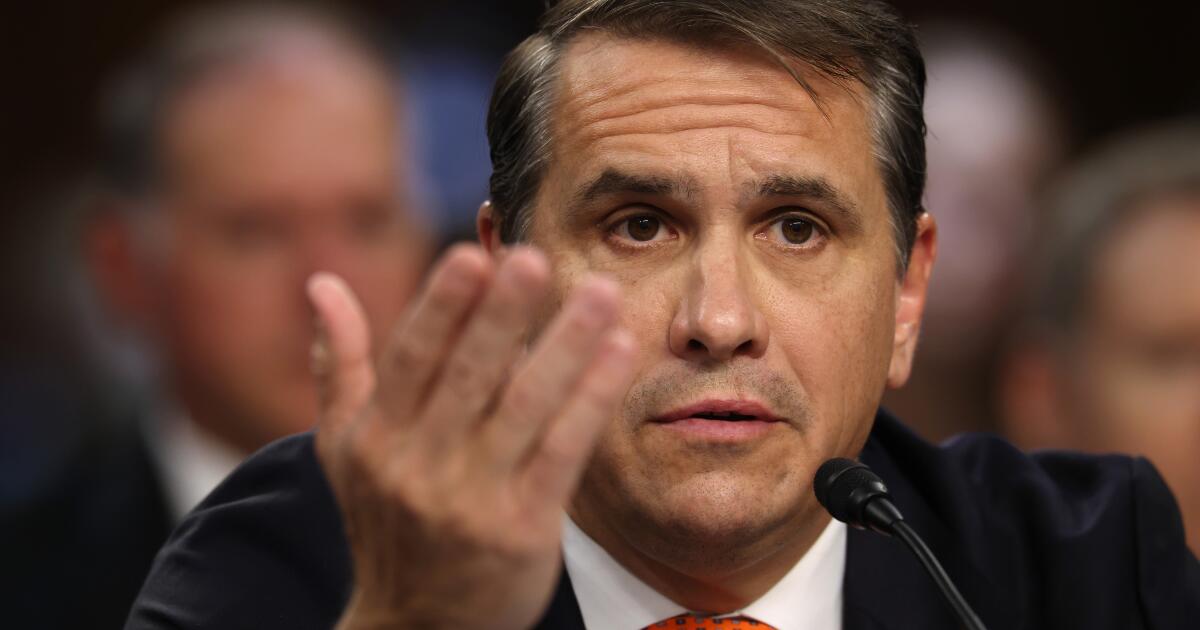
Blanche to face questions about his independence at attorney general confirmation hearing
-
 Sports19 minutes ago
How World Cup senior citizens like Lionel Messi have bio-hacked longer careers
-

 World31 minutes ago
Baltic presidents warn of Russian infrastructure attack plans
-
News1 hour ago
ICE should do traffic stops despite recent shootings, Trump says, seeming to oppose new suspension
-

 Los Angeles, Ca3 hours ago
Southern California hits hottest day of its extreme heat warning
-

 Detroit, MI3 hours ago
Steve Yzerman out as Detroit Red Wings GM, moves to senior advisor role
-
 San Francisco, CA3 hours ago
Supervisors urge California to expand S.F. speed-camera program


