New Mexico
Trump or Harris? For these New Mexico farmers, the more pressing question is survival

In New Mexico, nothing is a straight line. Roads curve when they’re not undulating. Agricultural communities pop up like emeralds in a landscape of brown. Brilliant blue skies worthy of an Instagram filter open up in seconds, unleashing torrential rains.
“Latino” in New Mexico is daily life, not a concept. It’s the state with the highest percentage of Latinos — nearly 49% — many with roots here going back centuries.
Seven days. Seven states. Nearly 3,000 miles. Gustavo Arellano talks to Latinos across the Southwest about their hopes, fears and dreams in this election year.
The L.A. antiquarian Charles Fletcher Lummis called it the Land of Poco Tiempo in his 1893 book of the same name, depicting it as a real-life territory of lotus eaters, of indolent pleasure. It’s a stereotype long thrown at Latinos and especially laughable when applied to rural New Mexico.
Here, those who work the land are those who survive.
That’s why I wanted to check in with growers along Interstate 25 — America’s unofficial Chile Highway. Agriculture is an underrated barometer of where a region and its people are heading, since it intersects with so many essential issues: the economy, climate change, immigration.
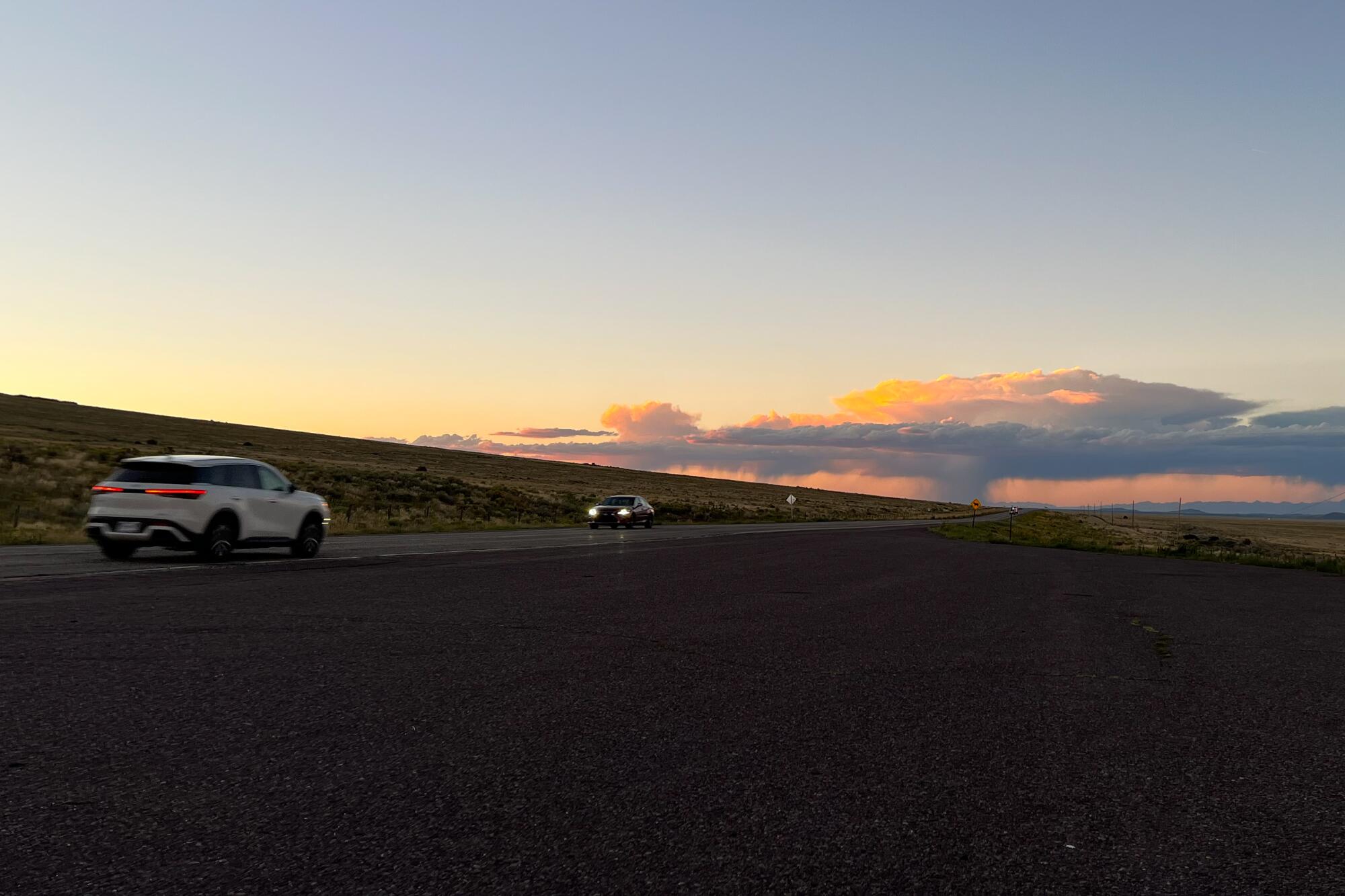
A sunset on Interstate 25 near Truth or Consequences, N.M.
(Gustavo Arellano / Los Angeles Times)
Hard times have long afflicted the Land of Enchantment. It’s been a testing ground for the Manhattan Project and a crossroads for drug trafficking networks, as dramatized in the television series “Breaking Bad.” It has the fourth-highest poverty rate, the seventh-highest drug overdose death rate and the highest alcohol-related death rate, cq all according to federal figures.
Still, New Mexico’s farmers manage to will bounty out of a seemingly inhospitable land. Farmers know that you have to work with what’s in front of you. And you have to fight like hell for it.

On my way to Hatch, I tuned in to local radio stations to blast New Mexico music. The genre sounds like a sweaty 1970s bar — polka beats with horns instead of accordions, songs that veer from oldies-but-goodies to rancheras, with springy bass lines, whirling keyboards and jangly guitars making it impossible to sit still.
It’s popular only in its namesake state and southern Colorado, the homeland of the so-called Hispanos, who trace their heritage to settlers who came from Mexico in the 16th and 17th centuries. I chose the music as a reminder of the proud people I know in the region — and how their small-town roots color their political outlook. Although long a blue state, New Mexico elected Republican Susana Martinez, the country’s first Latina governor, to two terms beginning in 2011.
Hatch is known for its big, meaty green pepper, which has increased in popularity worldwide over the last 20 years. My wife and I have bought them for 15 years — for personal use and for her market in Santa Ana — from Hatch Chile Sales, owned by the Atencio family.
There, I found Michele Atencio sitting at a table, surrounded by all manner of chiles: Habaneros. Chipotles. Hatch, of course. Fresh. Dried. Powdered. Jellies. Strung into ristras — bouquets used as adornments across the Southwest.
The chile season, which lasts from late summer through the fall and envelops New Mexico in a haze of fragrant smoke from all the roasting, had begun a few weeks earlier.
Atencio, 42, who runs the shop while her husband runs the family farm, asked what brought me back after so long — I hadn’t visited in years. I mentioned my Southwest road trip to profile Latino life in the region. Did she have any thoughts about the presidential election?
Usually warm and chatty, Atencio, who was raised in the Mexican state of Zacatecas, got uncharacteristically quiet.
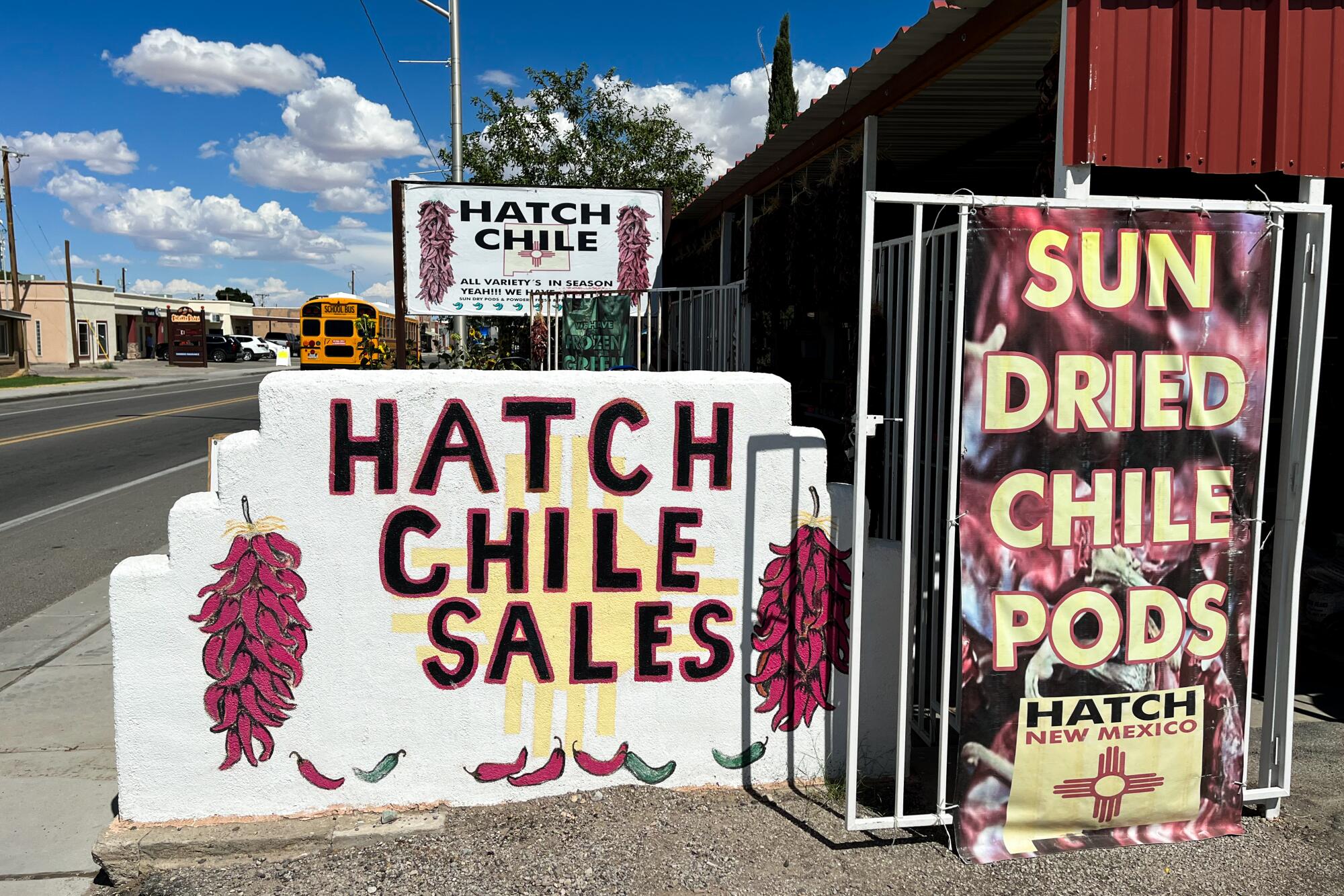
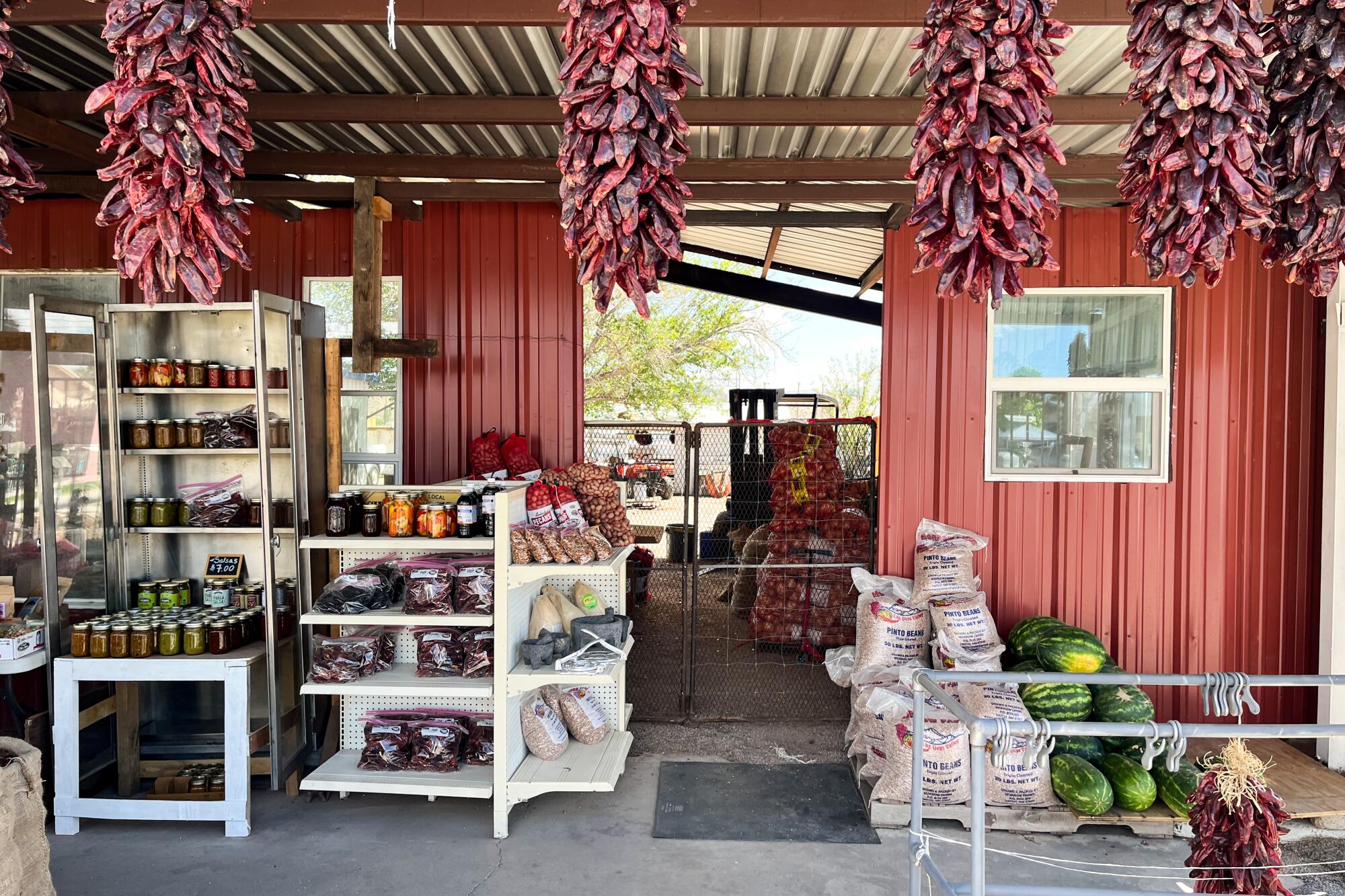
Top, Hatch Chile Sales offers various chiles in different forms, including habaneros, chipotles and hatch — fresh, dried, powdered and jellies too. Above, bouquets of dried chiles known as ristras and various pepper products are part of the inventory at Hatch Chile Sales in New Mexico.
(Gustavo Arellano / Los Angeles Times)
“I don’t want to be mean, but we need immigration control,” she said in Spanish. “There are a lot of Venezuelans coming in. They come and they get housing and they get food stamps. And you, who have worked here all your life? You don’t get that. We pay taxes and they get all the benefits.”
She sounded like some of my cousins.
Local farmers have offered jobs to the new migrants, Atencio said, “but they don’t like that work. I don’t get it. They need help. But there’s frustration growing here.”
She rang up my bill. Mamba, a senior pug, wandered around before lying down next to her feet.
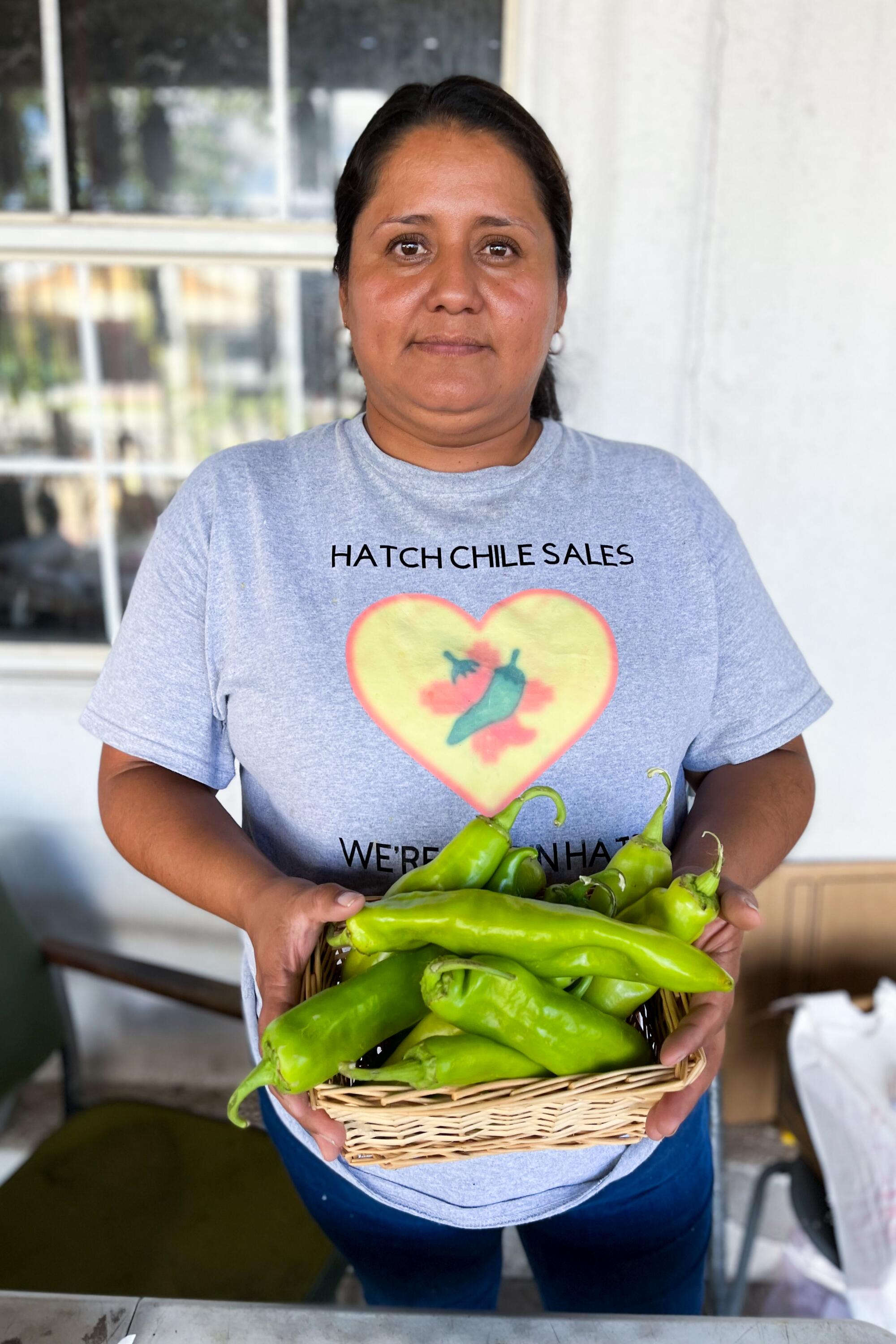
Michele Atencio with the bounty from her family farm in Hatch, N.M. She wants the next U.S. president to focus on immigration.
(Gustavo Arellano / Los Angeles Times)
“I’m not against them. I get why they come here. But my dad and your dad, they crossed the river. They took years to better themselves,” she said.
I asked whom she was voting for, but she shook off the question.
“Whoever’s next, they need to put better border control,” she said. “I’m not the only one who thinks that.”
I next visited Rosales Produce in Escondida, two hours north.
Linda Rosales, 68, took me in her dirt-caked Silverado through the back roads that connected the fields. Her father-in-law started off as a farmworker before buying his first plot of land in 1969. Today, the family works 500 acres, 60 of them devoted to chiles.
We passed over acequias — a system of communal irrigation ditches originating with the Moors that New Mexico’s farmers have used for centuries.
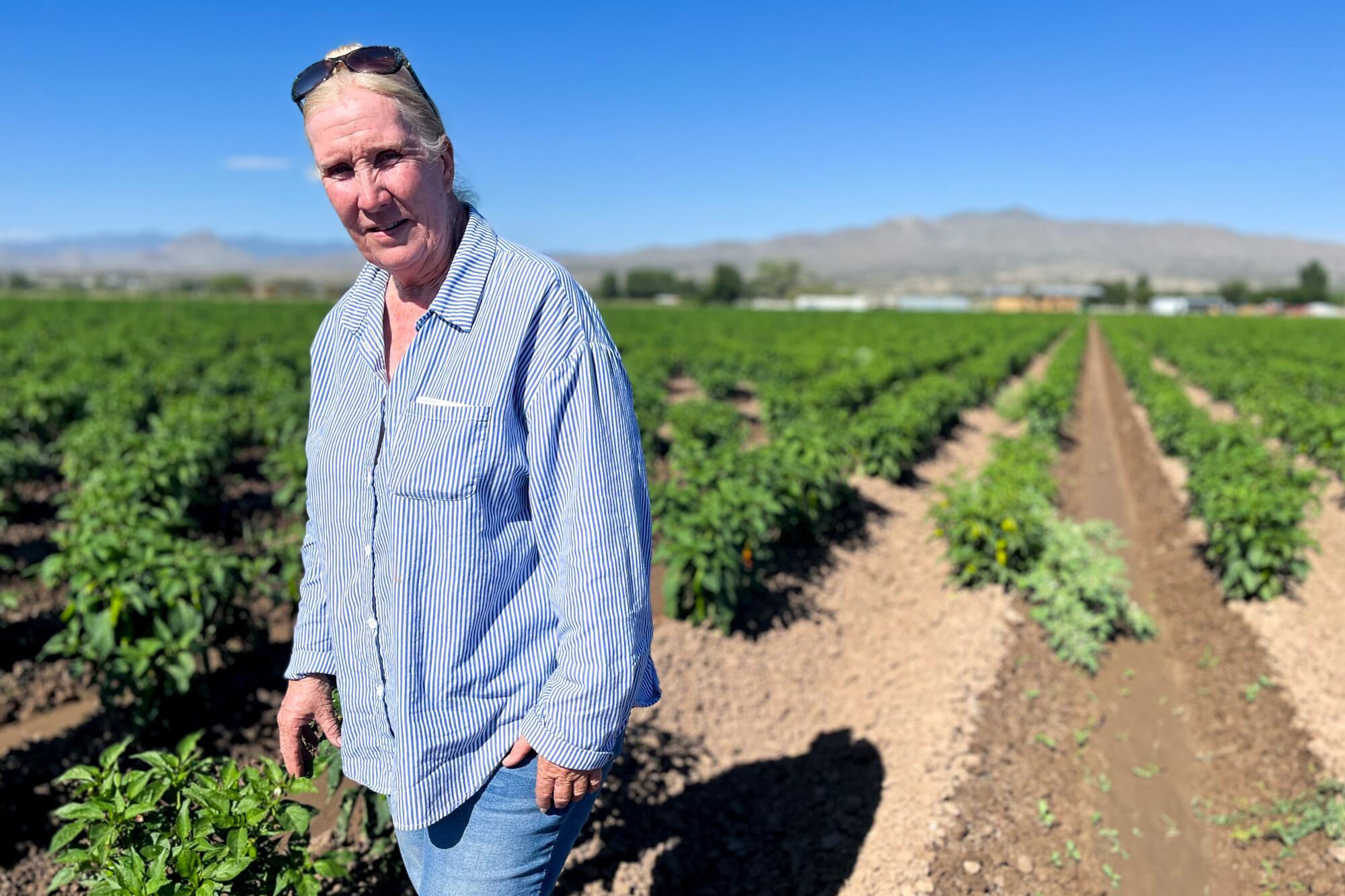
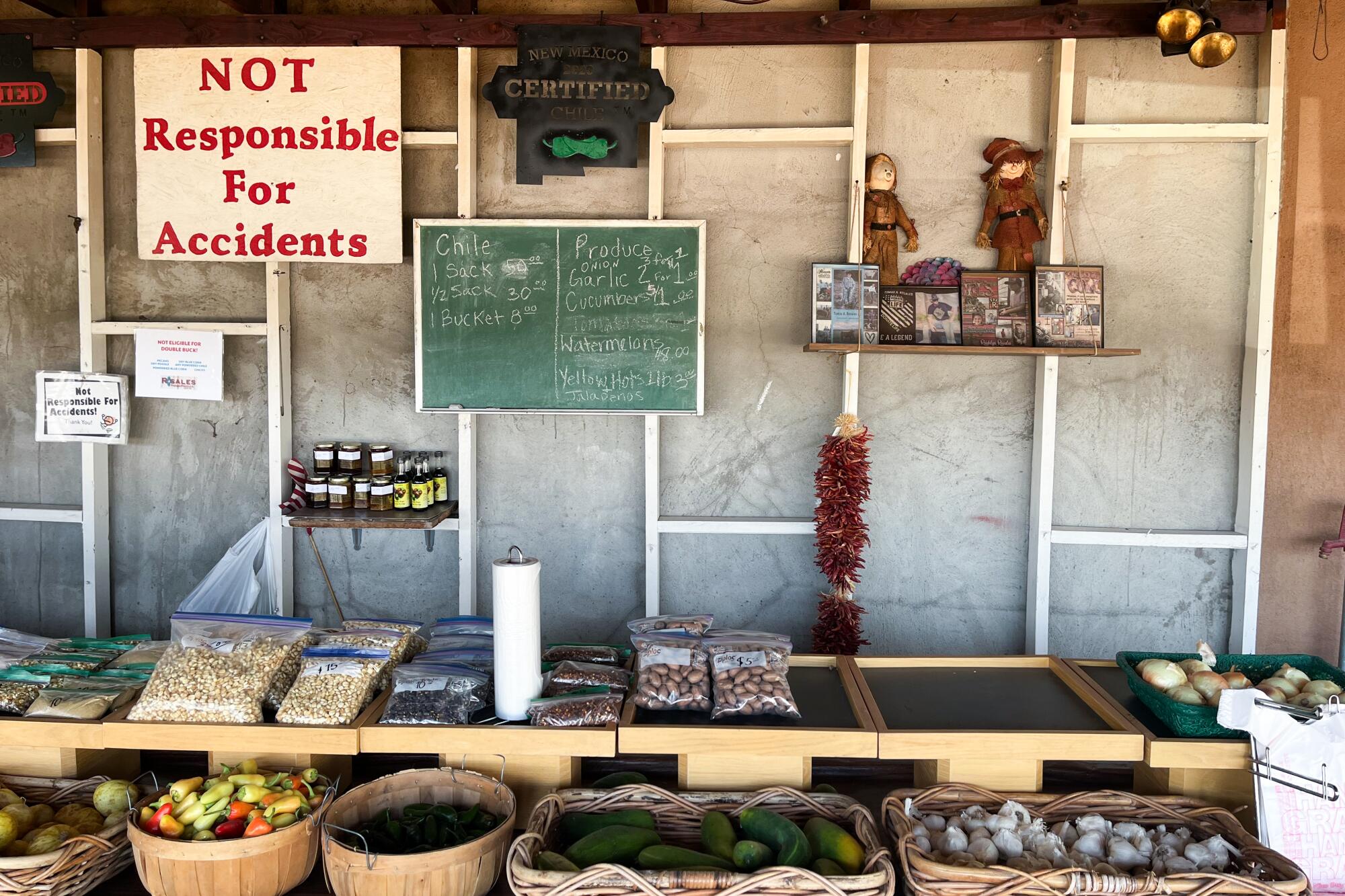
Top, Linda Rosales’ family farm covers 500 acres, 60 of them devoted to chiles, in Escondida, N.M. Above, the Rosales Produce stand in Escondida, N.M. “The monsoons have been great so far, so the harvest is really good,” Rosales said. “But it’s coming too early.”
(Gustavo Arellano / Los Angeles Times)
Water is the eternal conundrum in this state, especially as climate change has diminished the summer monsoons and the Rio Grande and its tributaries slowly dry up.
I asked how the chile harvest was going. In 1990, New Mexico farmers harvested nearly 29,000 acres of chiles, according to the New Mexico Chile Assn. In 2023, the yield had dwindled to 8,500 acres.
“The monsoons have been great so far, so the harvest is really good,” she said. “But it’s coming too early.”
Rosales parked the Silverado at the edge of a field. “See the red ones? That means they’re ripe. They shouldn’t be ripe right now. It’s been too hot. We can only pick until 1 [in the afternoon], because the heat will kill you.”
It wasn’t even 10 in the morning, but I didn’t see many workers.
“There’s no one here to work for us. Nobody has done nothing,” to make it easier to legally hire workers, Rosales said, speaking about both the Trump and Biden administrations. “Trump finished the border wall or whatever. Biden did, too. And you get to see who picks. No one.”
We headed back to the Rosales Produce stand. I asked which presidential candidate she favors.
“Whoever it is, the No. 1 issue for them should be workers,” she said.
The spare beauty of southern New Mexico soon turned into the suburban sprawl of Albuquerque. A digital billboard urged residents to turn off their sprinklers when it rains.
My next stop was Southwest Heritage Mills, which specializes in New Mexican products such as chile powder, dried posole and spice mixes. My wife and I have known owner Felix Torres for nearly a decade. I still remember when his business was a small warehouse space, a tiny upstairs office and a single mill to process blue corn into cornmeal.
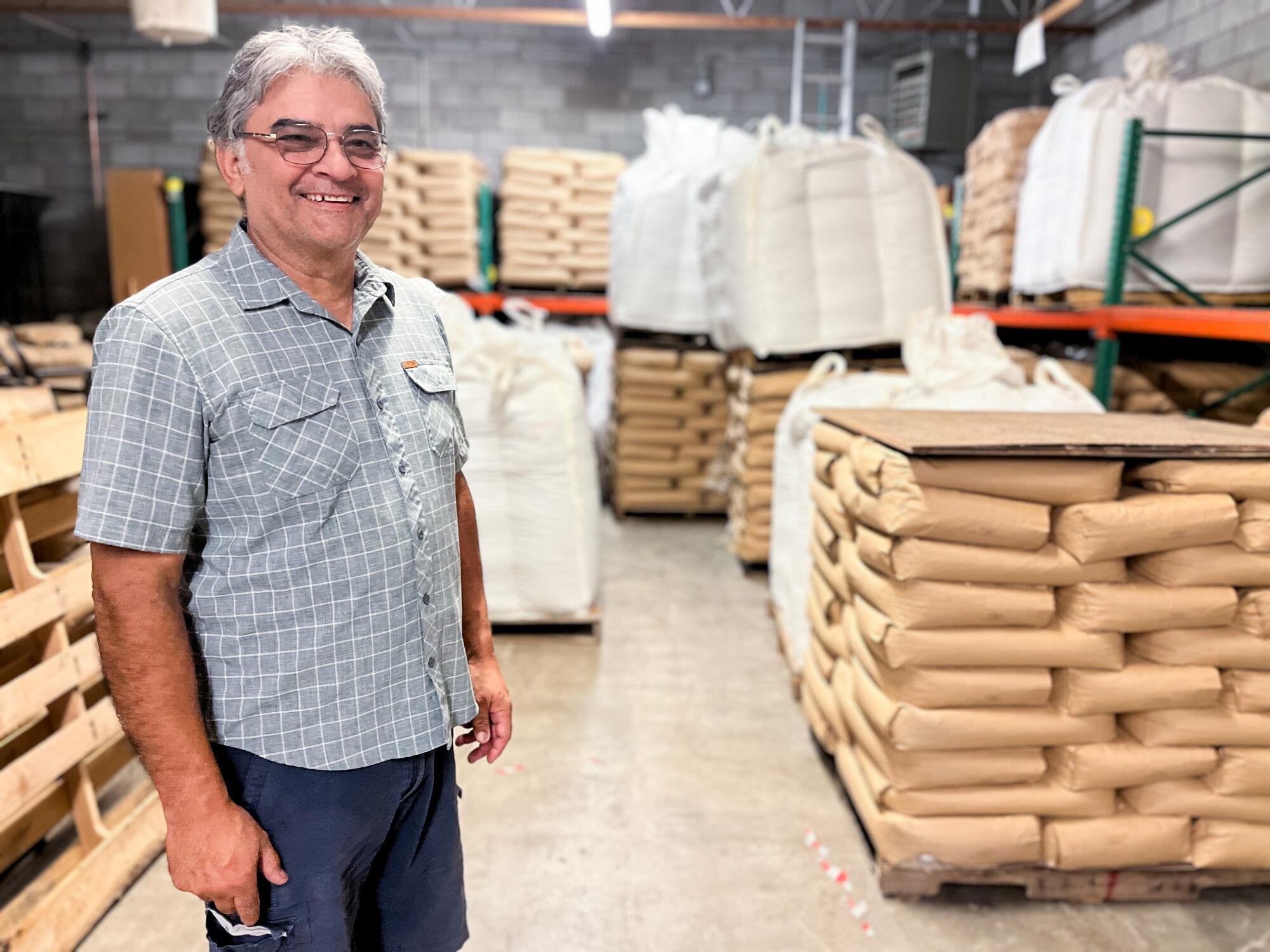
Felix Torres, owner of Southwest Heritage Mills, at his headquarters in Albuquerque. He says he’s having trouble hiring workers because the government doesn’t give people the incentive to work anymore.
(Gustavo Arellano / Los Angeles Times)
Today, the Air Force veteran has two huge warehouses with an array of equipment: a roaster, a cooking tank, a large mill. He has thought about relocating to a bigger facility near the airport, because business is better than ever. But…
“There’s no incentive to work right now. Even the immigrants don’t want to work,” he said. “They come in. The government takes care of them. It’s a very entitled mentality.

“The immigrants are acting like the Americans,” he continued with an exasperated laugh. We snacked on bizcochitos, an anise-flavored New Mexican shortbread cookie, in his spacious office. “And the Americans are worse!”
Torres is large, soft-spoken and even-keeled. This was the most upset I had ever heard him. The lifelong Democrat left the party this year, tired of what he called its “woke agenda,” but is turned off by Trump’s bluster. He’ll vote for a third-party candidate, if he votes at all.
The 61-year-old, who traces his family in New Mexico back to the 1600s, started his business to honor his home state’s food ways as well as to connect Hispanos and Native Americans with their roots and better deal with modernity. Torres used to have eight employees. Now, he is down to two, and he has to close Fridays to catch up on paperwork.
The federal and state government, he said, needs to “stop giving [people] incentives to not work. Some people will say, ‘That’s pretty callous,’ but that’s how it is.”
After chatting with Torres, I got back on Interstate 25, then headed northwest on U.S. Route 285. Clouds covered Santa Cruz Farm in Española, an hour and a half north of Albuquerque, as I rolled in late in the afternoon.
A sunset on Interstate 25 near Truth or Consequences, N.M., during Gustavo Arellano’s road trip across the Southwest.
The 4½-acre parcel has been in Don Bustos’ family for more than 400 years. With a shock of long white hair and a long beard, the 67-year-old looks like an Old Testament prophet. He’s a board member of the New Mexico Acequia Assn. and has taught young New Mexicans how to farm for decades.
Santa Cruz Farm grows 72 crops throughout the year and uses solar energy to power greenhouses and even water pumps. We passed by apple, nectarine and pear trees, then blackberry brambles as large as a football field. A Great Pyrenees, who had just gotten skunked but nevertheless maintained a grin, protected a flock of turkeys.
Bustos stuffed me with fresh fruit until I was a walking jar of jelly.
“As my dad said, ‘As long as you can feed yourself, the whole world can go to pot, mijo, and you’ll be OK,’” he cracked.
His politics are more liberal than those of the other New Mexican farmers I talked to. He likes Kamala Harris’ plan to combat grocery price-gouging and called Sen. Ben Ray Luján (D-N.M.) a “champion” for the state’s small farmers who fights to get more federal resources for them.
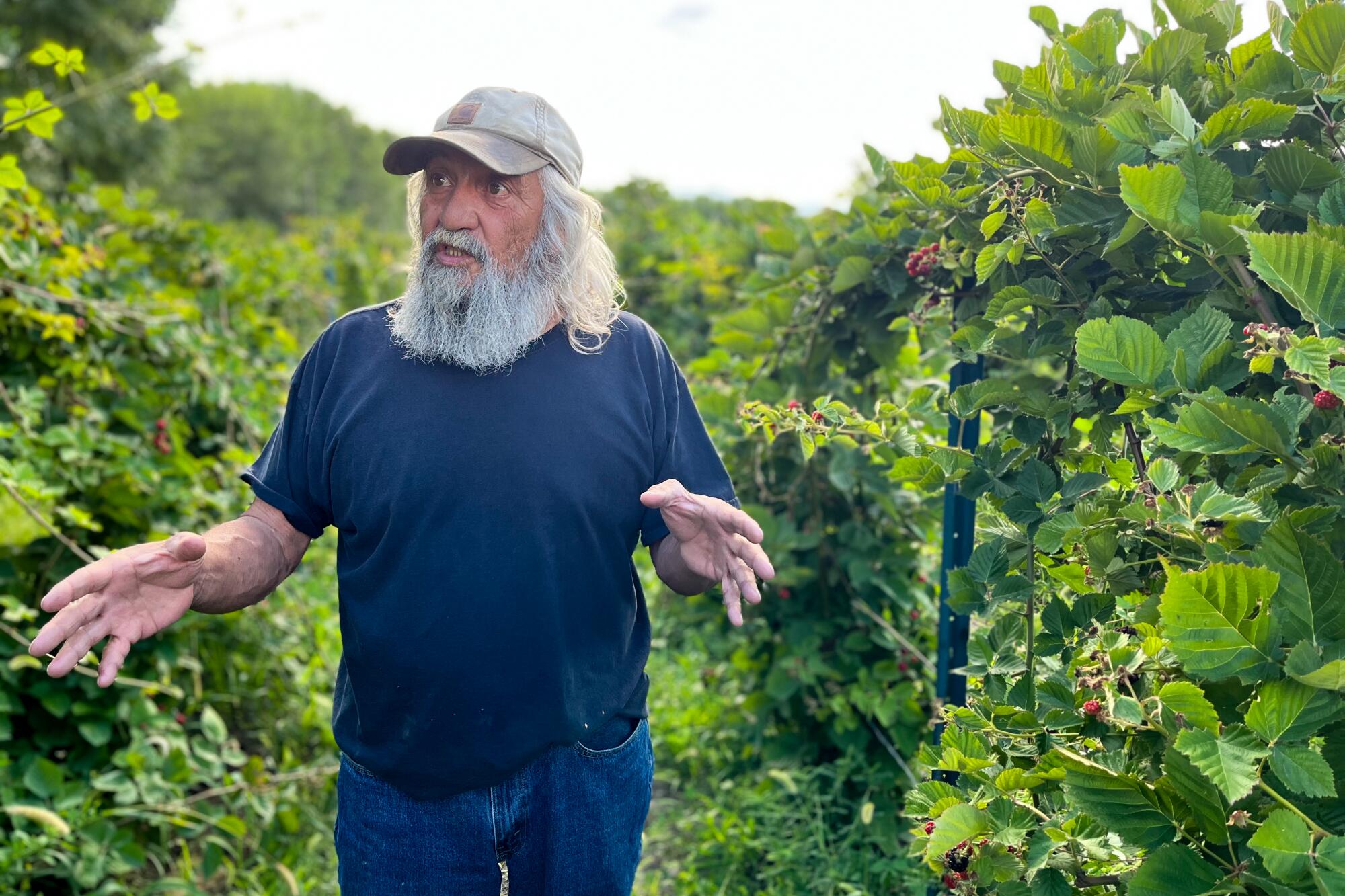
Don Bustos, 67, grows blackberry and dozens of other crops at his Santa Cruz Farm in Española, N.M. His family has owned the 4½-acre parcel for more than 400 years.
(Gustavo Arellano / Los Angeles Times)
But Bustos, like the others, was skeptical of faraway bureaucrats. Since the U.S. took over New Mexico, Hispanos have fought to keep land grants awarded to them under Spanish and Mexican rule — mostly through the courts but sometimes with violence.
Bustos credits his ancestors for standing up for their rights and organizing other Hispanos against threats to their way of life. But the fight continues: The looming issue for him is water, in a state that continues to grow, especially around Albuquerque, which he calls “the Beast.”
“When the state engineer says water is needed for tech, we need to rise up and say, ‘Basta, it’s for food.’ We’re in the battle of our lives,” he said.
We drove to a nearby house where Bustos was growing chiles for a friend. He turned a wheel that opened an acequia and flooded the field with clear, cold water. It was bucolic, inspiring — but how long could this last?
Federal and state water engineers often come and ask how Bustos knows his methods are efficient.
His answer is simple: “It’s been working for 400 years. Leave us alone.”


Local children at the Albuquerque Museum got cameras to keep and used them to capture their hopes and dreams.
ALBUQUERQUE, N.M. – Local children at the Albuquerque Museum got cameras to keep and used them to capture their hopes and dreams.
Saranam teamed up with Pictures of Hope for the event at the Albuquerque Museum. KOB 4 was there as children shared what they want in life and got a surprise.
“My dream is to be a farmer, go to college, a crazy cat lady, a crazy dog lady,” Janise said.
Linda Solomon said the children focused on goals like college and having a home.
“I don’t think there could be anything more special than having children share their dreams,” Linda Solomon said. “Their dreams are so unselfish, they’re not hoping for iPads or things like that, they’re hoping to go to college, to have a home.”
Janise said dreaming helps children plan for the future.
“You can’t really know what you’re going to do if you don’t have like a dream to do it,” Janise said.
“We surprise them with cameras they get to keep,” Solomon said.
Solomon said parents sometimes learn something new when children describe their goals.
“So often parents say to me, ‘I didn’t know my child was dreaming for this in life, I had no idea,’” Solomon said. “We care about their dreams, we care they can achieve these dreams.”
The children will return to the Albuquerque Museum on May 29 for an exhibition. Their pictures will be printed on greeting cards and proceeds will go back to Saranam.

NEW MEXICO (KRQE) – Thousands of people will be making their annual pilgrimage to El Santuario de Chimayo in northern New Mexico and Tomé Hill near Los Lunas Friday morning. The walks are in honor of Good Friday, with many people walking dozens of miles to complete their journey.
Each year many make the trek to the northern New Mexico church or Tomé Hill on Good Friday. Some start their journey in Santa Fe, others walk from as far as Albuquerque. The church in northern New Mexico has been a place of worship since the early 1800’s, bringing thousands from across the state for the chapel, shrine and grounds healing powers. The church is considered to be a sacred site and many believe it holds healing properties. Walkers also take the pilgrimage to Tomé Hill. At the top of the hill are three crosses and a shrine where people pray after making the journey.
Officials remind drivers to expect delays and stay alert on the road.

On average, more than once a week, there is a shooting near a school in New Mexico, and nearly half the time, someone is killed.According to data obtained by the Get the Facts Data Team, there have been 833 shootings adjacent to New Mexico’s schools in the past ten years, resulting in 526 people killed.”When you first told me the numbers, I thought I heard you wrong,” said Darren White, former Bernalillo County sheriff and public safety director. “I was shocked that there are so many shootings close proximity to our schools,” White said that numerous state laws make penalties harsher for crimes occurring near schools, including firearm possession and drug dealing. “We put laws in place years ago because we recognize that schools should be sanctuaries, right?” White said.La Mesa Elementary in Albuquerque’s International District leads the list. In the past ten years, there have been 24 shootings within 500 yards of this school, resulting in 20 deaths. However, this school is not alone in being close to gunfire.A map from the data team shows that statewide, Missouri Avenue and Valley View Elementary Schools in Roswell had 11 and 8 shootings, respectively, while Las Montanas Charter and Lynn Middle Schools in Las Cruces both had 8 and 8 respectively.”If it’s being reported that it’s over 800 in this period of time, how many more are taking place that haven’t been reported that we didn’t know about?” White asked. “And so I would argue, like in many of our crime stats, that number is even higher. And, uh … It’s chilling, it really is.”These shooting have either occurred at or close to the shools.For instance, 16-year-old Andrew Burson was killed right next to the football field at West Mesa High School. Another incident involved a shooting right outside Sandia High School and Christ Lutheran School, which led to both institutions being locked down in the middle of the day.
On average, more than once a week, there is a shooting near a school in New Mexico, and nearly half the time, someone is killed.
According to data obtained by the Get the Facts Data Team, there have been 833 shootings adjacent to New Mexico’s schools in the past ten years, resulting in 526 people killed.
“When you first told me the numbers, I thought I heard you wrong,” said Darren White, former Bernalillo County sheriff and public safety director. “I was shocked that there are so many shootings close proximity to our schools,”
White said that numerous state laws make penalties harsher for crimes occurring near schools, including firearm possession and drug dealing.
“We put laws in place years ago because we recognize that schools should be sanctuaries, right?” White said.
La Mesa Elementary in Albuquerque’s International District leads the list. In the past ten years, there have been 24 shootings within 500 yards of this school, resulting in 20 deaths. However, this school is not alone in being close to gunfire.
A map from the data team shows that statewide, Missouri Avenue and Valley View Elementary Schools in Roswell had 11 and 8 shootings, respectively, while Las Montanas Charter and Lynn Middle Schools in Las Cruces both had 8 and 8 respectively.
“If it’s being reported that it’s over 800 in this period of time, how many more are taking place that haven’t been reported that we didn’t know about?” White asked. “And so I would argue, like in many of our crime stats, that number is even higher. And, uh … It’s chilling, it really is.”
These shooting have either occurred at or close to the shools.
For instance, 16-year-old Andrew Burson was killed right next to the football field at West Mesa High School.
Another incident involved a shooting right outside Sandia High School and Christ Lutheran School, which led to both institutions being locked down in the middle of the day.

Melvin Edwards, sculptor who welded the African diaspora in ‘Lynch Fragments,’ dies at 88

How to have the best Sunday in L.A., according to Drew Michael Scott (a.k.a. Lone Fox)

Trump asks Congress for $152 million to start rebuilding Alcatraz prison

Autistic people are more likely to experience suicidal crisis. 988 is changing to serve them better

No. 1 UCLA baseball pulls away from No. 12 USC in highly anticipated showdown

Florida High School Football Rankings: Top 25 teams – Oct. 21

How old is Bo Nix? What to know about Oregon quarterback ahead of 2024 NFL Draft

Cleary's 21 help Le Moyne down Central Connecticut State 69-64 in OT

99th annual Pony Swim held in Virginia

Indiana Members Credit Union announced as new anchor tenant at Bottleworks District
Fact check: How can a country actually withdraw from NATO?

65, single, seeking a roommate: More seniors are being priced out of living alone

Video: Search and Rescue Underway After Iran Downs U.S. Fighter Jet

Nebraska Senate candidate restructures campaign after complaint over payments to family: report

Two dozen Democrat-led states sue Trump over mail-in ballot limits
-

 South-Carolina6 days ago
South Carolina vs TCU predictions for Elite Eight game in March Madness
-

 Culture1 week ago
What Happens When We Die? This Wallace Stevens Poem Has Thoughts.
-

 Miami, FL1 week ago
Jannik Sinner’s Girlfriend Laila Hasanovic Stuns in Ab-Revealing Post Amid Miami Open
-

 Education1 week ago
Video: Transgender Athletes Barred From Women’s Olympic Events
-

 Minneapolis, MN1 week ago
Boy who shielded classmate during school shooting receives Medal of Honor
-

 Vermont6 days ago
Skier dies after fall at Sugarbush Resort
-

 Politics6 days ago
Trump’s Ballroom Design Has Barely Been Scrutinized
-

 Atlanta, GA6 days ago
Fetishist ‘No Kings’ protester in mask drags ‘Trump’ and ‘JD Vance’ behind her wheelchair