New Mexico
Trump or Harris? For these New Mexico farmers, the more pressing question is survival

In New Mexico, nothing is a straight line. Roads curve when they’re not undulating. Agricultural communities pop up like emeralds in a landscape of brown. Brilliant blue skies worthy of an Instagram filter open up in seconds, unleashing torrential rains.
“Latino” in New Mexico is daily life, not a concept. It’s the state with the highest percentage of Latinos — nearly 49% — many with roots here going back centuries.
Seven days. Seven states. Nearly 3,000 miles. Gustavo Arellano talks to Latinos across the Southwest about their hopes, fears and dreams in this election year.
The L.A. antiquarian Charles Fletcher Lummis called it the Land of Poco Tiempo in his 1893 book of the same name, depicting it as a real-life territory of lotus eaters, of indolent pleasure. It’s a stereotype long thrown at Latinos and especially laughable when applied to rural New Mexico.
Here, those who work the land are those who survive.
That’s why I wanted to check in with growers along Interstate 25 — America’s unofficial Chile Highway. Agriculture is an underrated barometer of where a region and its people are heading, since it intersects with so many essential issues: the economy, climate change, immigration.
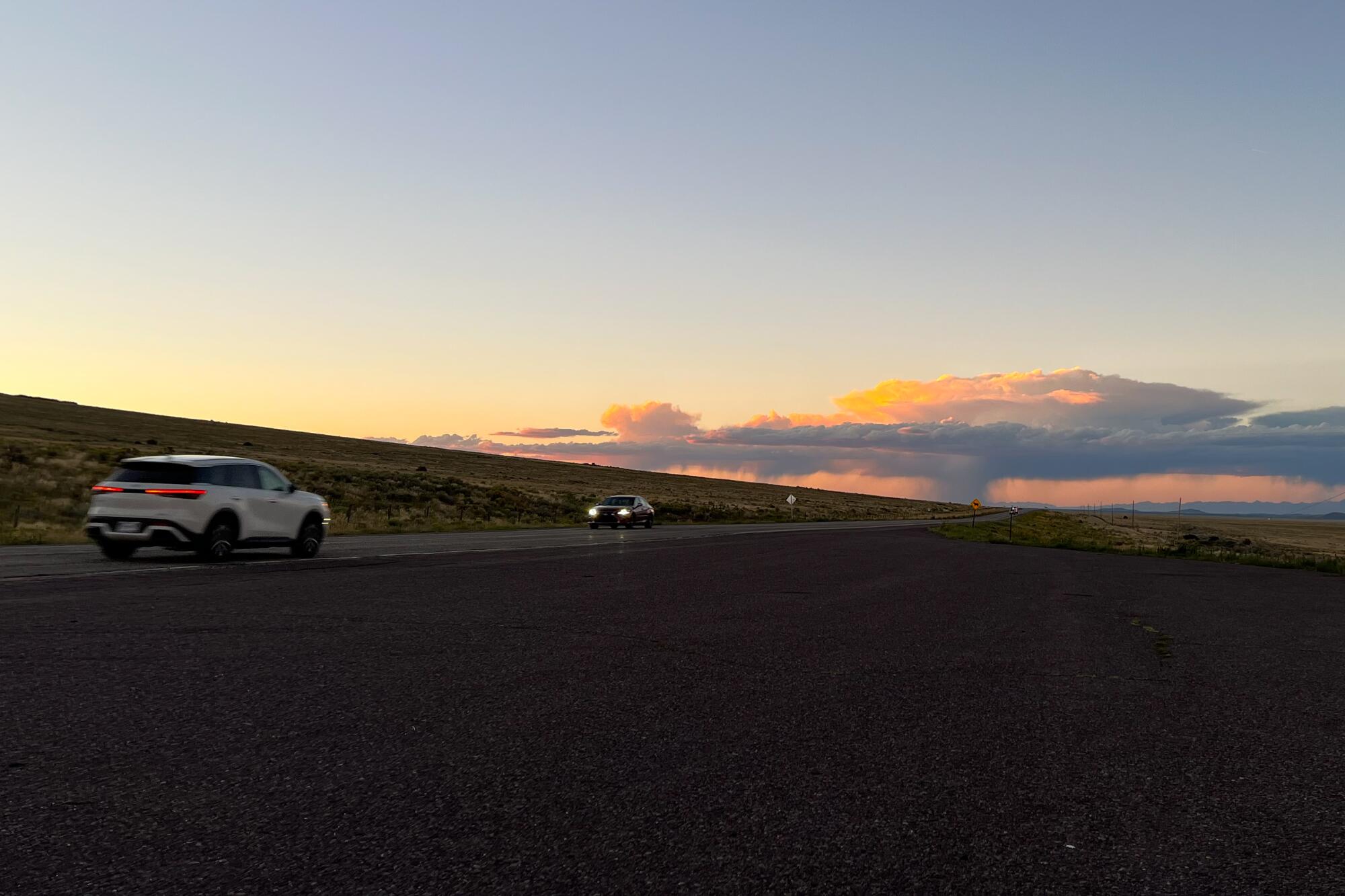
A sunset on Interstate 25 near Truth or Consequences, N.M.
(Gustavo Arellano / Los Angeles Times)
Hard times have long afflicted the Land of Enchantment. It’s been a testing ground for the Manhattan Project and a crossroads for drug trafficking networks, as dramatized in the television series “Breaking Bad.” It has the fourth-highest poverty rate, the seventh-highest drug overdose death rate and the highest alcohol-related death rate, cq all according to federal figures.
Still, New Mexico’s farmers manage to will bounty out of a seemingly inhospitable land. Farmers know that you have to work with what’s in front of you. And you have to fight like hell for it.

On my way to Hatch, I tuned in to local radio stations to blast New Mexico music. The genre sounds like a sweaty 1970s bar — polka beats with horns instead of accordions, songs that veer from oldies-but-goodies to rancheras, with springy bass lines, whirling keyboards and jangly guitars making it impossible to sit still.
It’s popular only in its namesake state and southern Colorado, the homeland of the so-called Hispanos, who trace their heritage to settlers who came from Mexico in the 16th and 17th centuries. I chose the music as a reminder of the proud people I know in the region — and how their small-town roots color their political outlook. Although long a blue state, New Mexico elected Republican Susana Martinez, the country’s first Latina governor, to two terms beginning in 2011.
Hatch is known for its big, meaty green pepper, which has increased in popularity worldwide over the last 20 years. My wife and I have bought them for 15 years — for personal use and for her market in Santa Ana — from Hatch Chile Sales, owned by the Atencio family.
There, I found Michele Atencio sitting at a table, surrounded by all manner of chiles: Habaneros. Chipotles. Hatch, of course. Fresh. Dried. Powdered. Jellies. Strung into ristras — bouquets used as adornments across the Southwest.
The chile season, which lasts from late summer through the fall and envelops New Mexico in a haze of fragrant smoke from all the roasting, had begun a few weeks earlier.
Atencio, 42, who runs the shop while her husband runs the family farm, asked what brought me back after so long — I hadn’t visited in years. I mentioned my Southwest road trip to profile Latino life in the region. Did she have any thoughts about the presidential election?
Usually warm and chatty, Atencio, who was raised in the Mexican state of Zacatecas, got uncharacteristically quiet.
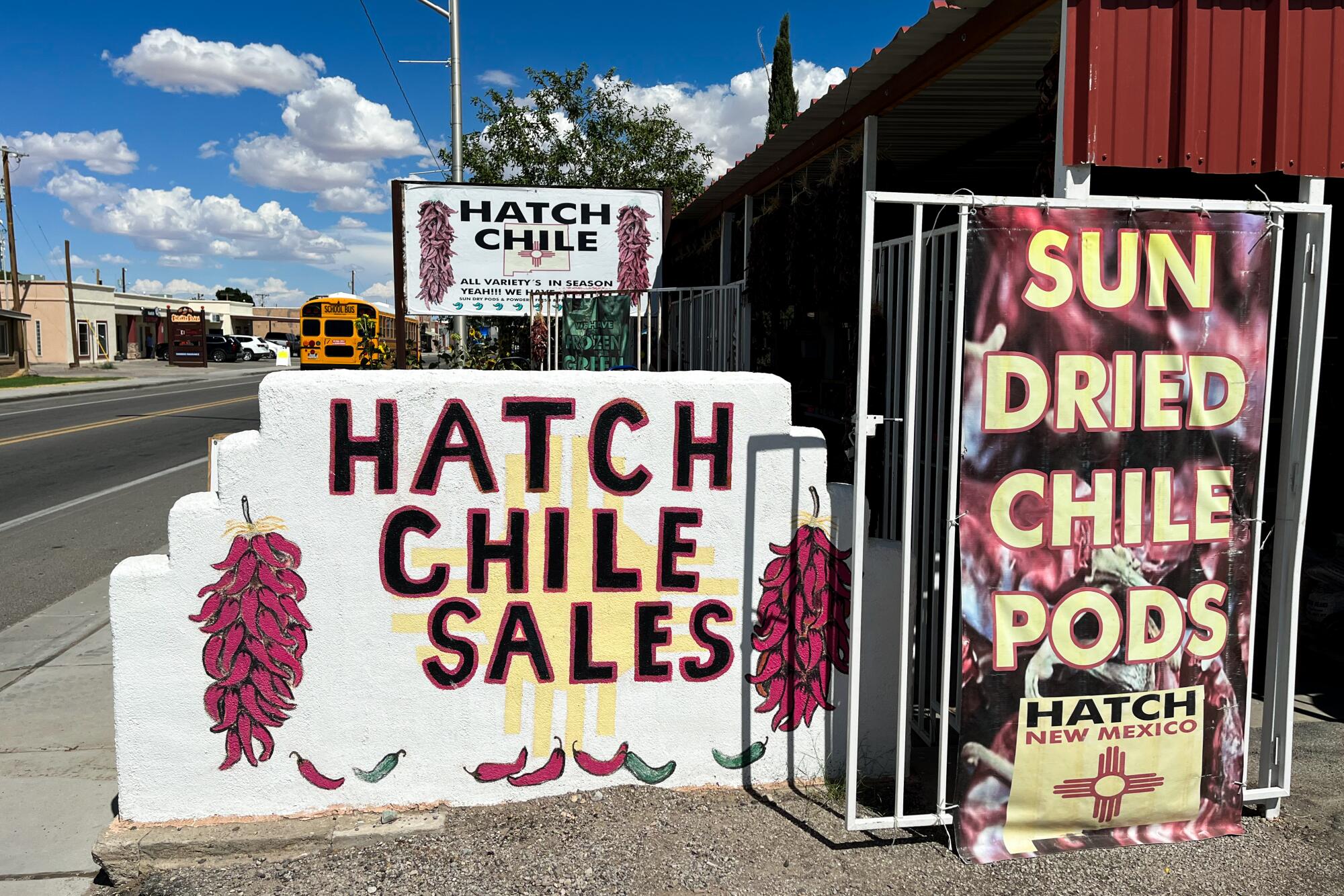
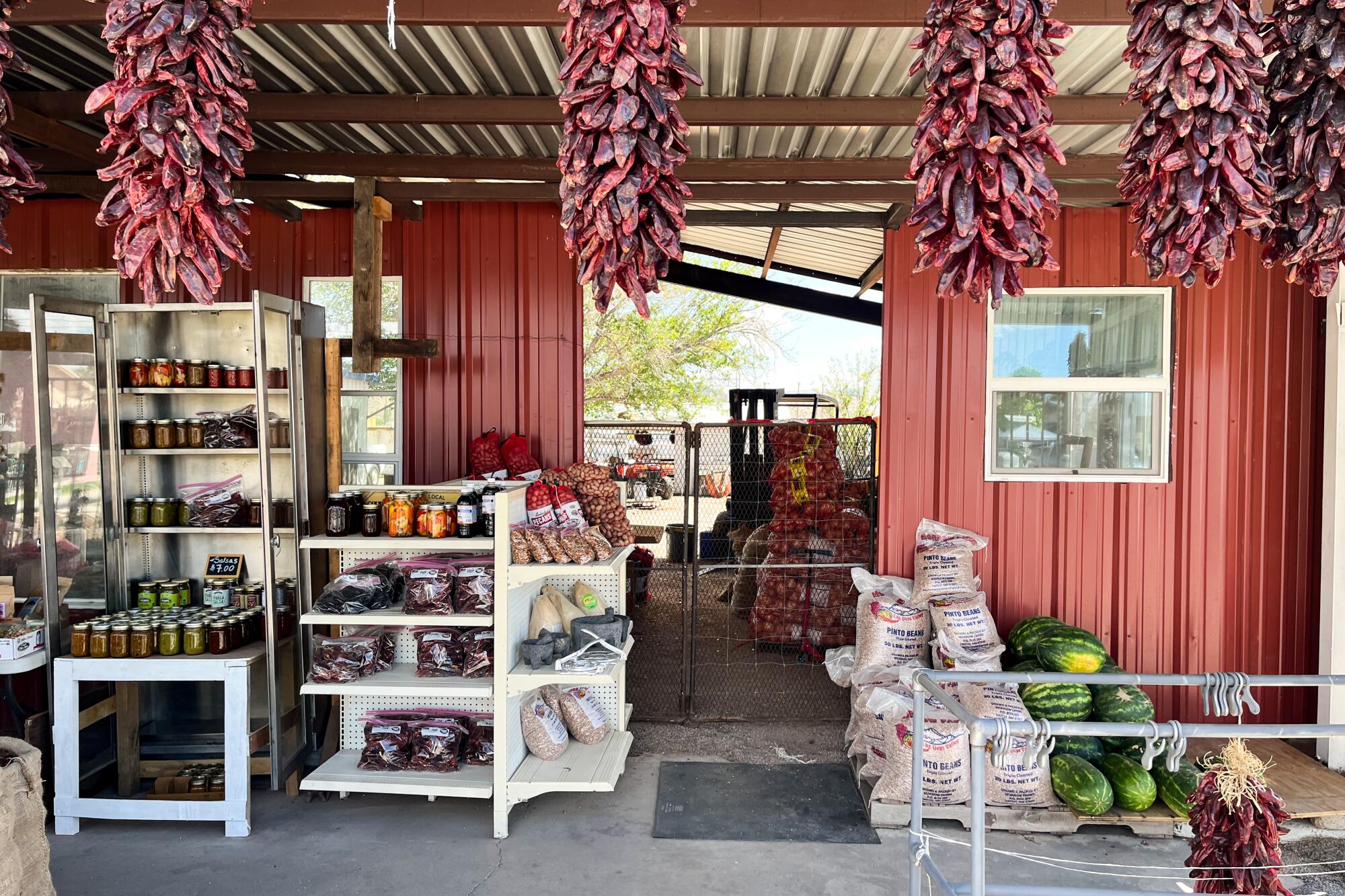
Top, Hatch Chile Sales offers various chiles in different forms, including habaneros, chipotles and hatch — fresh, dried, powdered and jellies too. Above, bouquets of dried chiles known as ristras and various pepper products are part of the inventory at Hatch Chile Sales in New Mexico.
(Gustavo Arellano / Los Angeles Times)
“I don’t want to be mean, but we need immigration control,” she said in Spanish. “There are a lot of Venezuelans coming in. They come and they get housing and they get food stamps. And you, who have worked here all your life? You don’t get that. We pay taxes and they get all the benefits.”
She sounded like some of my cousins.
Local farmers have offered jobs to the new migrants, Atencio said, “but they don’t like that work. I don’t get it. They need help. But there’s frustration growing here.”
She rang up my bill. Mamba, a senior pug, wandered around before lying down next to her feet.
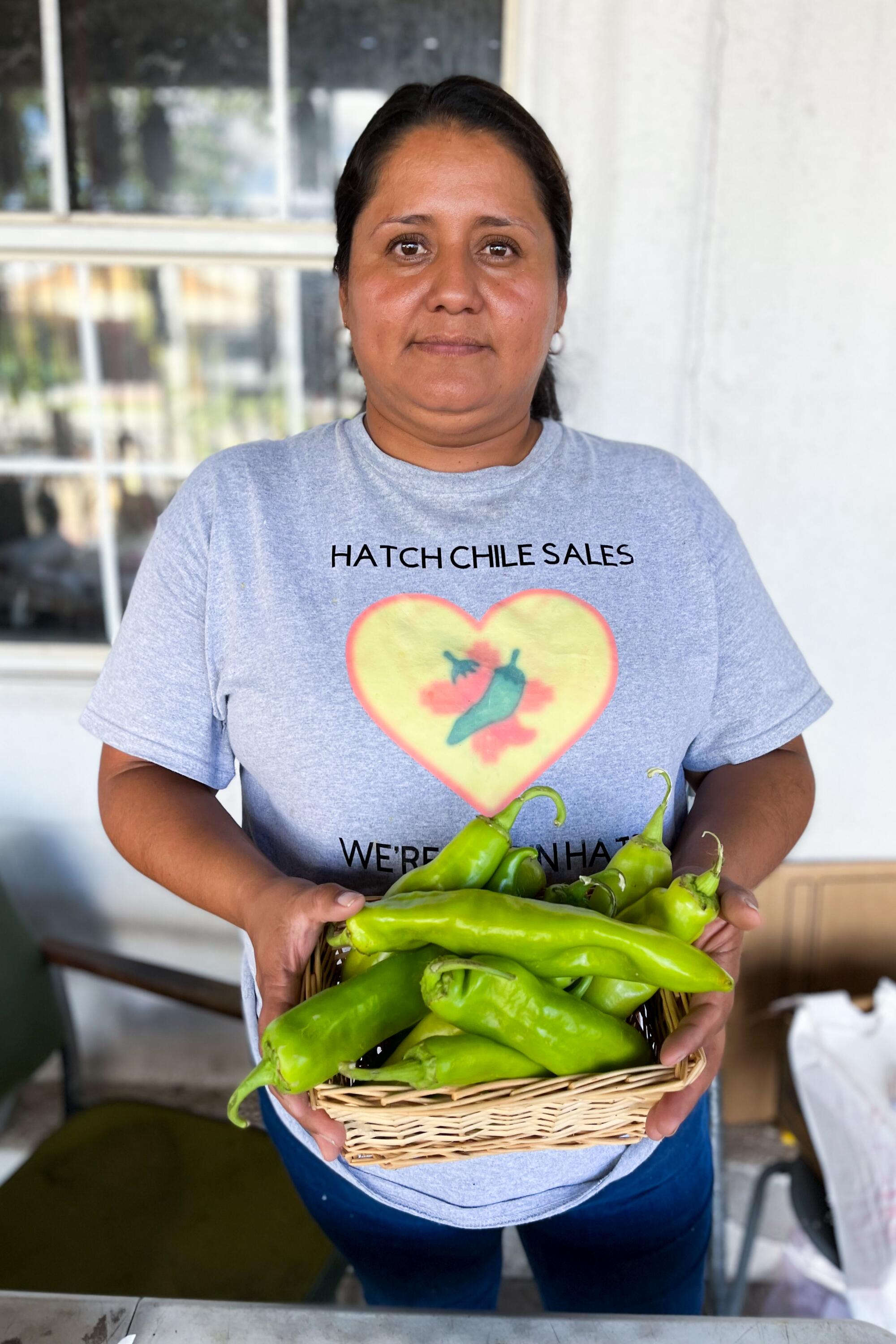
Michele Atencio with the bounty from her family farm in Hatch, N.M. She wants the next U.S. president to focus on immigration.
(Gustavo Arellano / Los Angeles Times)
“I’m not against them. I get why they come here. But my dad and your dad, they crossed the river. They took years to better themselves,” she said.
I asked whom she was voting for, but she shook off the question.
“Whoever’s next, they need to put better border control,” she said. “I’m not the only one who thinks that.”
I next visited Rosales Produce in Escondida, two hours north.
Linda Rosales, 68, took me in her dirt-caked Silverado through the back roads that connected the fields. Her father-in-law started off as a farmworker before buying his first plot of land in 1969. Today, the family works 500 acres, 60 of them devoted to chiles.
We passed over acequias — a system of communal irrigation ditches originating with the Moors that New Mexico’s farmers have used for centuries.
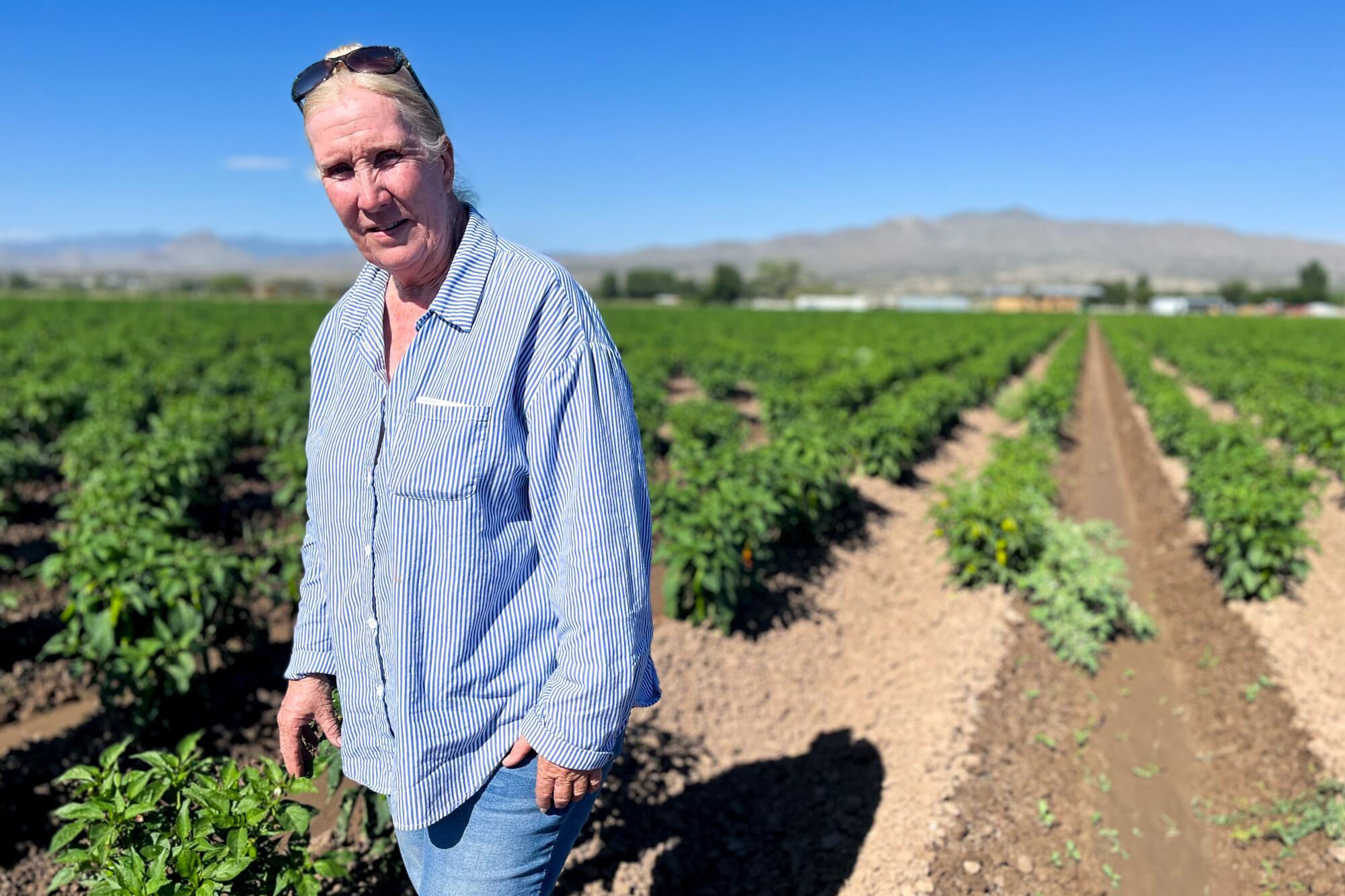
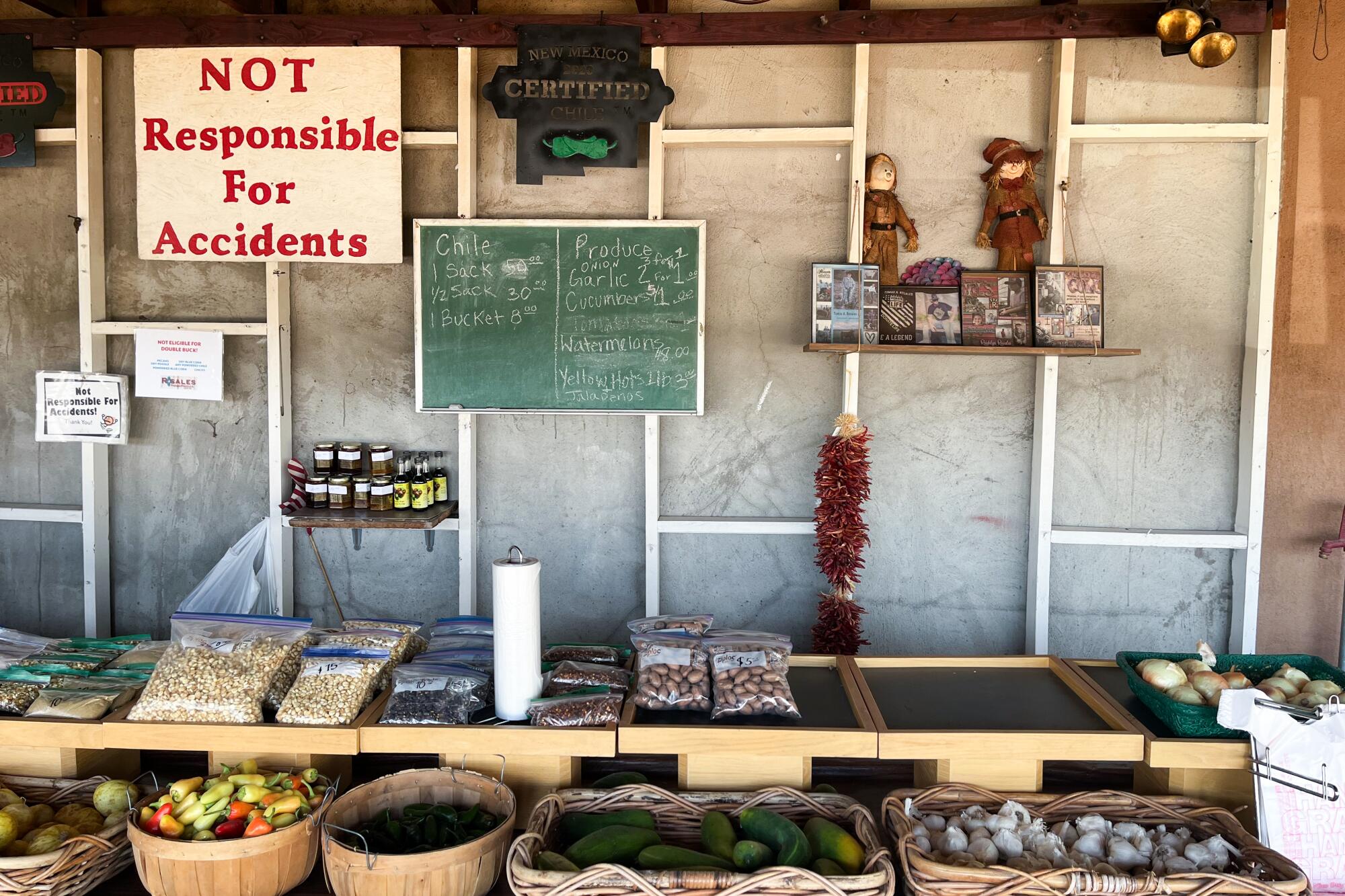
Top, Linda Rosales’ family farm covers 500 acres, 60 of them devoted to chiles, in Escondida, N.M. Above, the Rosales Produce stand in Escondida, N.M. “The monsoons have been great so far, so the harvest is really good,” Rosales said. “But it’s coming too early.”
(Gustavo Arellano / Los Angeles Times)
Water is the eternal conundrum in this state, especially as climate change has diminished the summer monsoons and the Rio Grande and its tributaries slowly dry up.
I asked how the chile harvest was going. In 1990, New Mexico farmers harvested nearly 29,000 acres of chiles, according to the New Mexico Chile Assn. In 2023, the yield had dwindled to 8,500 acres.
“The monsoons have been great so far, so the harvest is really good,” she said. “But it’s coming too early.”
Rosales parked the Silverado at the edge of a field. “See the red ones? That means they’re ripe. They shouldn’t be ripe right now. It’s been too hot. We can only pick until 1 [in the afternoon], because the heat will kill you.”
It wasn’t even 10 in the morning, but I didn’t see many workers.
“There’s no one here to work for us. Nobody has done nothing,” to make it easier to legally hire workers, Rosales said, speaking about both the Trump and Biden administrations. “Trump finished the border wall or whatever. Biden did, too. And you get to see who picks. No one.”
We headed back to the Rosales Produce stand. I asked which presidential candidate she favors.
“Whoever it is, the No. 1 issue for them should be workers,” she said.
The spare beauty of southern New Mexico soon turned into the suburban sprawl of Albuquerque. A digital billboard urged residents to turn off their sprinklers when it rains.
My next stop was Southwest Heritage Mills, which specializes in New Mexican products such as chile powder, dried posole and spice mixes. My wife and I have known owner Felix Torres for nearly a decade. I still remember when his business was a small warehouse space, a tiny upstairs office and a single mill to process blue corn into cornmeal.
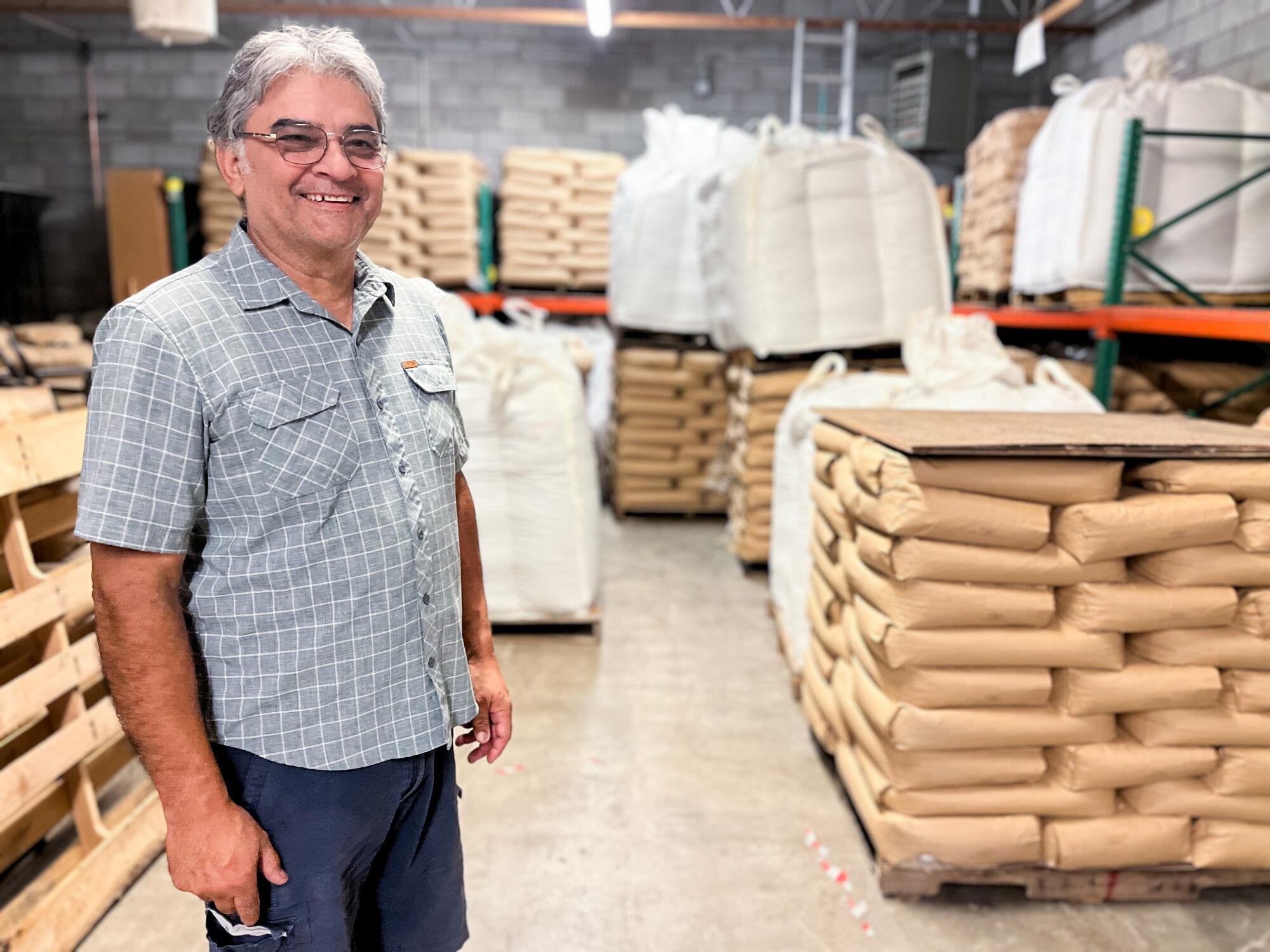
Felix Torres, owner of Southwest Heritage Mills, at his headquarters in Albuquerque. He says he’s having trouble hiring workers because the government doesn’t give people the incentive to work anymore.
(Gustavo Arellano / Los Angeles Times)
Today, the Air Force veteran has two huge warehouses with an array of equipment: a roaster, a cooking tank, a large mill. He has thought about relocating to a bigger facility near the airport, because business is better than ever. But…
“There’s no incentive to work right now. Even the immigrants don’t want to work,” he said. “They come in. The government takes care of them. It’s a very entitled mentality.

“The immigrants are acting like the Americans,” he continued with an exasperated laugh. We snacked on bizcochitos, an anise-flavored New Mexican shortbread cookie, in his spacious office. “And the Americans are worse!”
Torres is large, soft-spoken and even-keeled. This was the most upset I had ever heard him. The lifelong Democrat left the party this year, tired of what he called its “woke agenda,” but is turned off by Trump’s bluster. He’ll vote for a third-party candidate, if he votes at all.
The 61-year-old, who traces his family in New Mexico back to the 1600s, started his business to honor his home state’s food ways as well as to connect Hispanos and Native Americans with their roots and better deal with modernity. Torres used to have eight employees. Now, he is down to two, and he has to close Fridays to catch up on paperwork.
The federal and state government, he said, needs to “stop giving [people] incentives to not work. Some people will say, ‘That’s pretty callous,’ but that’s how it is.”
After chatting with Torres, I got back on Interstate 25, then headed northwest on U.S. Route 285. Clouds covered Santa Cruz Farm in Española, an hour and a half north of Albuquerque, as I rolled in late in the afternoon.
A sunset on Interstate 25 near Truth or Consequences, N.M., during Gustavo Arellano’s road trip across the Southwest.
The 4½-acre parcel has been in Don Bustos’ family for more than 400 years. With a shock of long white hair and a long beard, the 67-year-old looks like an Old Testament prophet. He’s a board member of the New Mexico Acequia Assn. and has taught young New Mexicans how to farm for decades.
Santa Cruz Farm grows 72 crops throughout the year and uses solar energy to power greenhouses and even water pumps. We passed by apple, nectarine and pear trees, then blackberry brambles as large as a football field. A Great Pyrenees, who had just gotten skunked but nevertheless maintained a grin, protected a flock of turkeys.
Bustos stuffed me with fresh fruit until I was a walking jar of jelly.
“As my dad said, ‘As long as you can feed yourself, the whole world can go to pot, mijo, and you’ll be OK,’” he cracked.
His politics are more liberal than those of the other New Mexican farmers I talked to. He likes Kamala Harris’ plan to combat grocery price-gouging and called Sen. Ben Ray Luján (D-N.M.) a “champion” for the state’s small farmers who fights to get more federal resources for them.
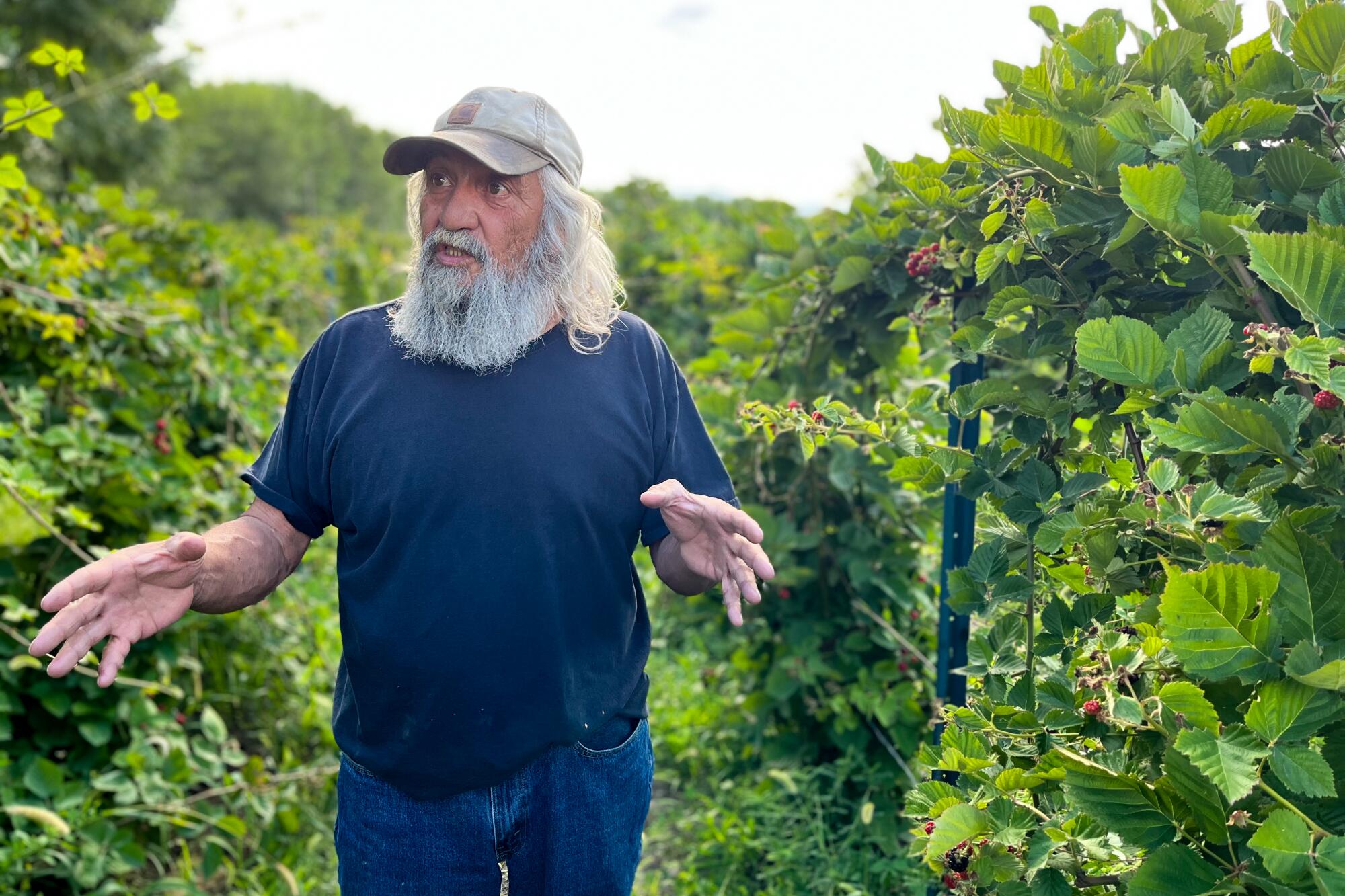
Don Bustos, 67, grows blackberry and dozens of other crops at his Santa Cruz Farm in Española, N.M. His family has owned the 4½-acre parcel for more than 400 years.
(Gustavo Arellano / Los Angeles Times)
But Bustos, like the others, was skeptical of faraway bureaucrats. Since the U.S. took over New Mexico, Hispanos have fought to keep land grants awarded to them under Spanish and Mexican rule — mostly through the courts but sometimes with violence.
Bustos credits his ancestors for standing up for their rights and organizing other Hispanos against threats to their way of life. But the fight continues: The looming issue for him is water, in a state that continues to grow, especially around Albuquerque, which he calls “the Beast.”
“When the state engineer says water is needed for tech, we need to rise up and say, ‘Basta, it’s for food.’ We’re in the battle of our lives,” he said.
We drove to a nearby house where Bustos was growing chiles for a friend. He turned a wheel that opened an acequia and flooded the field with clear, cold water. It was bucolic, inspiring — but how long could this last?
Federal and state water engineers often come and ask how Bustos knows his methods are efficient.
His answer is simple: “It’s been working for 400 years. Leave us alone.”


Enter your email and we’ll send a secure one-click link to sign in.
KRQE NEWS 13 is provided by Nexstar Media, Inc., and uses the My Nexstar sign-in, which works across our media network.
Learn more at nexstar.tv/privacy-policy.
KRQE NEWS 13 is provided by Nexstar Media, Inc., and uses the My Nexstar sign-in, which works across our media network.
Nexstar Media, Inc. is a leading, diversified media company that produces and distributes engaging local and national news, sports, and entertainment content across its television and digital platforms. The My Nexstar sign-in works across the Nexstar network—including The CW, NewsNation, The Hill, and more. Learn more at nexstar.tv/privacy-policy.
New Mexico
Think New Mexico Hosts Four 2026 Summer Leadership Interns To Assist In Researching And Developing Policy Proposals – Los Alamos Daily Post

Gathered for a luncheon Tuesday at La Plazuela at La Fonda Tuesday in Santa Fe, front row from left, Think New Mexico 2026 Summer Leadership Intern Viviana Ornelas, Board President Roberta Ramo and Intern Marly Fisher. Back row from left, Think New Mexico Field Director Noah Apodaca, Intern Ian Hernandez, Think New Mexico Board Secretary Liddie Martinez, Intern Awlen Salazar and Healthcare Reform Director Lauren Leland. Courtesy/TNM
 Gathered Tuesday at La Plazuela at La Fonda in Santa Fe, front row from left, Think New Mexico 2026 Summer Leadership Intern Viviana Ornelas, Board President Roberta Ramo and Intern Marly Fisher. Back row from left, Think New Mexico Intern Ian Hernandez, Think New Mexico Board Secretary Liddie Martinez and Intern Awlen Salazar. Courtesy/TNM
Think New Mexico News:
Each summer Think New Mexico offers four paid Leadership Internship positions to college or graduate students. Interns have the opportunity to meet with Think New Mexico board members and leaders in state government, as well as to assist Think New Mexico’s staff in researching and developing policy proposals.
The 2026 Summer Leadership Interns include:
Marly Fisher grew up in Albuquerque and graduated from Albuquerque Academy in 2023. As a senior in high school, she and three peers spearheaded a successful effort to pass a bill implementing period products in New Mexico’s public schools. She has since interned for Representatives Melanie Stansbury and Gabe Vasquez. Fisher is a senior in the dual degree program between Sciences Po Paris and Columbia, majoring in Political Philosophy and History, and serving as Senior Editor of the Columbia Political Review. She is passionate about improving education in New Mexico.
Ian Hernandez was born and raised in Santa Fe and graduated in the top 1% of his class from the MASTERS Program Early College Charter School. He was a 2023 recipient of the Davis New Mexico Scholarship, which allowed him to attend and graduate from the University of Denver this past June. Hernandez earned his B.A. in Socio-Legal Studies and History and hopes to begin law school in the fall of 2027. As an undergraduate, He interned with U.S. Sen. Michael Bennet (D-CO). He also worked as a teen journalist for the Santa Fe New Mexican, and as a teacher and tutor for Breakthrough Santa Fe. Hernandez hopes to use his education and life experiences to improve the lives of as many people living in New Mexico and the American Southwest as possible.
Viviana Ornelas is a Santa Fe native who graduated as Valedictorian of her Capital High School class. She received Davis and LANL scholarships to study at the University of Chicago, where she is earning a B.A. in Psychology and Public Policy with a minor in Education and Society. In high school, Viviana led a chapter of the New Mexico Dream Team. As an undergraduate student, she has worked as a research assistant in Dr. Levine’s Cognitive Development Lab where she helped conduct studies to understand the relationship between solving math word problems and spatial skills. Ornelas has also worked as a tutor for the Neighborhood Schools Program in Chicago and a teacher for Breakthrough Santa Fe. She hopes to return to New Mexico to pursue a career in education policy.
Awlen Salazar is a graduate of New Mexico State University (NMSU), where he earned a B.A. in Political Science with minors in Public Administration & Policy and Public Law. He is pursuing a Master of Public Policy at the University of New Mexico. Throughout his time at NMSU, Salazar was a part of the Associated Students of NMSU, where he held roles in the legislative and executive branches as public relations officer and as one of three standing committee chairs for the Senate. At the start of his senior year, Salazar re-chartered the NMSU College Democrats after the club’s two-year hiatus, and he served as President of the club until his graduation in May 2026. Since then, he continues to be involved in the Young Democrats of New Mexico, where he now serves as National Committee Representative. Off campus, Salazar worked closely with nonprofit sector leaders throughout Doña Ana County. In the summer of 2025, he interned for the Doña Ana County Resilience Leaders, where he helped advocate for policies to mitigate adverse childhood experiences (ACE’s) and expand access to affordable housing. Salazar also worked with NM Comunidades en Accion y De Fé (NM CAFé) as Social Media Associate.
Think New Mexico is New Mexico’s think tank – a results-oriented think tank whose mission is to improve the lives of all New Mexicans, especially those who lack a strong voice in the political process. It fulfills this mission by educating the public, the media, and policymakers about some of the most serious challenges facing New Mexico and by developing and advocating for enduring, effective, evidence-based solutions.
Its approach is to perform and publish sound, nonpartisan, independent research. Unlike many think tanks, Think New Mexico does not subscribe to any particular ideology. Instead, because New Mexico is at or near the bottom of so many national rankings, its focus is on promoting workable solutions that will lift all New Mexicans up.
Consistent with its nonpartisan approach, Think New Mexico’s board is composed of Democrats, Independents, and Republicans. They are statesmen and stateswomen, who have no agenda other than to see New Mexico succeed. They are also the brain trust of this think tank.
Think New Mexico began its operations Jan. 1, 1999. It is a tax-exempt organization under section 501(c)(3) of the Internal Revenue Code. In order to maintain its independence, Think New Mexico does not accept state government funding. However, contributions from individuals, businesses, and foundations are encouraged, appreciated, and tax-deductible.
As an independent, statewide, results-oriented think tank, Think New Mexico measures its success based on changes in law or policy that it helps to achieve.
Think New Mexico’s results include:
- Making full-day kindergarten accessible to every child in New Mexico;
- Repealing the state’s regressive tax on food and successfully defeating efforts to reimpose it;
- Creating a Strategic Water Reserve to protect and restore New Mexico’s rivers;
- Establishing New Mexico’s first state-supported Individual Development Accounts to alleviate the state’s persistent poverty;
- Redirecting millions of dollars a year out of the state lottery’s excessive operating costs and into college scholarships
- Reforming title insurance to reduce closing costs for homebuyers and homeowners who refinance their mortgages
- Winning passage of three constitutional amendments to professionalize and streamline New Mexico’s Public Regulation Commission
- Modernizing the state’s regulation of taxis, limos, shuttles, and moving companies
- Creating a one-stop online portal to facilitate business fees and filings
- Establishing a user-friendly health care transparency website where New Mexicans can find the cost and quality of common medical procedures at any hospital in the state
- Enacting the New Mexico Work and Save Act to make voluntary state-sponsored Individual Retirement Accounts accessible to New Mexicans who lack access to retirement savings through their jobs;
- Making the state’s infrastructure spending transparent by revealing the legislative sponsors of every capital project;
- Ending predatory lending by reducing the maximum annual interest rate on small loans from 175% to 36%;
- Repealing the tax on Social Security for middle and lower-income New Mexicans with incomes under $100,000 as individuals or $150,000 as married couples;
- Enhancing the training and transparency of local school boards;
- Leading a campaign to make financial literacy a high school graduation requirement, now in place in 46 districts reaching nearly 48% of New Mexico students; and
- Establishing a $2 billion permanent trust fund for Medicaid.
Think New Mexico is headquarters in the historic Greer House at 505 Don Gaspar in Santa Fe, at the corner of Paseo de Peralta and Don Gaspar, directly across the street from the state Capitol. To learn more, visit thinknewmexico.org.

-

 San Diego, CA52 seconds ago
Daily Business Report: July 17, 2026, San Diego Metro Magazine
-
 Milwaukee, WI7 minutes ago
‘You can see God’s hand in it’: How Milwaukee women are building a double Dutch community through sisterhood and fitness
-

 Atlanta, GA13 minutes ago
One Of Atlanta, Georgia’s Safest Suburbs Is An Irish-Inspired Town With Tasty Restaurants And Golf Greens – Islands
-
 Minneapolis, MN19 minutes ago
Roho Collective opens a gallery and business hub for artists of color
-

 Indianapolis, IN25 minutes ago
See inside Indianapolis Public Library’s upgraded, accessible bookmobiles
-

 Pittsburg, PA31 minutes ago
Pittsburgh’s air quality considered “unhealthy for everyone” on Friday due to wildfire smoke
-

 Augusta, GA37 minutes ago
VA Augusta launches new ambulance service
-

 Cleveland, OH49 minutes ago
Ohio air quality alert: Wildfire smoke drives demand for masks, air filters

