Brent Brennan smiled broadly as he sat down for a postgame interview Saturday night.
The first-year Arizona head coach was far from satisfied with his team’s performance in a 61-39 victory over New Mexico at Arizona Stadium. But Brennan knew it wasn’t going to be easy, no matter the perceived disparity between the Lobos and Wildcats, who were 29-point favorites at kickoff.
“It’s hard to win a college football game,” Brennan said.
Arizona managed to pull it off, even if it wasn’t pretty at times. The Wildcats struggled to run the ball in the first half. They allowed too many chunk plays on the perimeter. And they committed way too many after-the-whistle penalties.
It was far from perfect. But no one was expecting it to be. Despite bringing back more than half the roster, Arizona was still bound to endure a breaking-in period with an almost entirely new coaching staff.
People are also reading…
Arizona wide receiver Tetairoa McMillan, left, and quarterback Noah Fifita celebrate after McMillan’s catch-and-run score in the third quarter against New Mexico Saturday at Arizona Stadium.
Here are my top five takeaways on Game 1, warts and all:

Arizona wide receiver Tetairoa McMillan hops out of the hands of New Mexico safety Noa Polo-Gates (34) and down to the 1-yard line in the third quarter in their game Saturday at Arizona Stadium.
1. Just call him T-YAC
Tetairoa McMillan’s magnificence was on full display, and it was glorious.
The numbers were absolutely eye-popping: 10 catches, 304 yards, four touchdowns. And he probably could have had more if Arizona didn’t ease off the throttle in the fourth quarter.
But it wasn’t so much what McMillan did Saturday night as how he did it.
Per StatBroadcast, McMillan gained 176 yards after the catch. It’s the latest sign of his growth as a player.
As a freshman in 2022, McMillan did most of his work along the sidelines. Only 195 of his 702 yards came on YAC, or 27.8%.
Last year, as a sophomore, McMillan expanded his route tree. He became a more complete receiver. His YAC percentage jumped to 38.5% (537 of 1,396).
What more could he do as a junior? How ’bout becoming a YAC monster?
Every time he caught the ball in stride against the Lobos, McMillan refused to settle. He outran defenders, spun away from them and powered through them. All that work he did on the side while rehabbing a lower-leg injury suffered in spring showed up under the lights. He was more explosive and elusive than he’d ever been.

Arizona quarterback Noah Fifita (11) gestures at the line of scrimmage during the first half of the Wildcats’ game against New Mexico Saturday at Arizona Stadium.
“He looks more comfortable after the catch,” UA quarterback Noah Fifita said. “When you give him those tools and … more confidence, it’s going to be extremely fun to watch.”
2. Who’s No. 2?
For reasons that can’t be fully explained, New Mexico elected to single-cover McMillan for large portions of the game. Fifita would have been negligent if he didn’t look his way as often as possible.
But there will come a time when the opposition does everything in its power to take McMillan away.
“When you have one of those” — i.e., a superstar receiver — “eventually people are going to find ways to push coverage to them and make it hard,” Brennan said. “So those other guys need to step up.”
Brennan liked what he saw from players such as Keyan Burnett, Malachi Riley, Jeremiah Patterson and Chris Hunter on Saturday night. We just didn’t see very much of any of them in the passing game.
McMillan accounted for half of Arizona’s 30 targets. Running back Quali Conley was the Wildcats’ second-leading receiver with three catches. No one else had more than one.
No one is expecting any of Arizona’s secondary receivers to become Jacob Cowing. The Cowing-McMillan combo was one of the reasons the UA offense was so difficult to defend the past two seasons.
Fifita blamed himself for not getting more receivers involved. That was just Noah being Noah; if anything goes wrong, Fifita takes responsibility.
Regardless, look for him to make a concerted effort to spread the ball around more against NAU. He knows it’ll benefit the Wildcats in the long run.
3. Giving on the edge
Arizona’s defense, a strength for most of last season, struggled for extended periods Saturday night. In the first half alone, the Wildcats surrendered 305 yards.
The unit’s biggest issue was corralling slippery New Mexico quarterback Devon Dampier, who had a game-high 130 rushing yards. Most of those yards came on designed runs and scrambles to the outside.
Arizona’s edge containment was poor. And that might be a generous assessment.

Arizona defensive back Dalton Johnson, left, gets the barest of touches in trying to stop New Mexico quarterback Devon Dampier in the fourth quarter of their game Saturday at Arizona Stadium.
On multiple occasions, the Wildcats’ defensive ends got caught crashing inside or heading too far upfield to the outside, leaving wide swaths for Dampier to run through.
It’s hard to imagine that was the game plan, although defensive line coach Joe Seumalo does support a penetrating, vertical approach.
When asked about the defense’s struggles — which weren’t limited to edge containment — Brennan cited the lack of “live” reps during training camp. It’s a dilemma every coach faces: They all want to practice tackling, but none wants to put his players in harm’s way.
Dampier also is the type of quarterback Arizona won’t see very often. This experience should help the Wildcats the next time they face someone like him. The coaches can point to the film and note all the dos and don’ts. The breakdowns were that glaring.
4. No longer grounded
Arizona did not run the ball very often or very well in the first half, gaining just 28 yards on nine carries. Considering that New Mexico had allowed 362 rushing yards the previous week against Montana State, that wasn’t exactly encouraging.
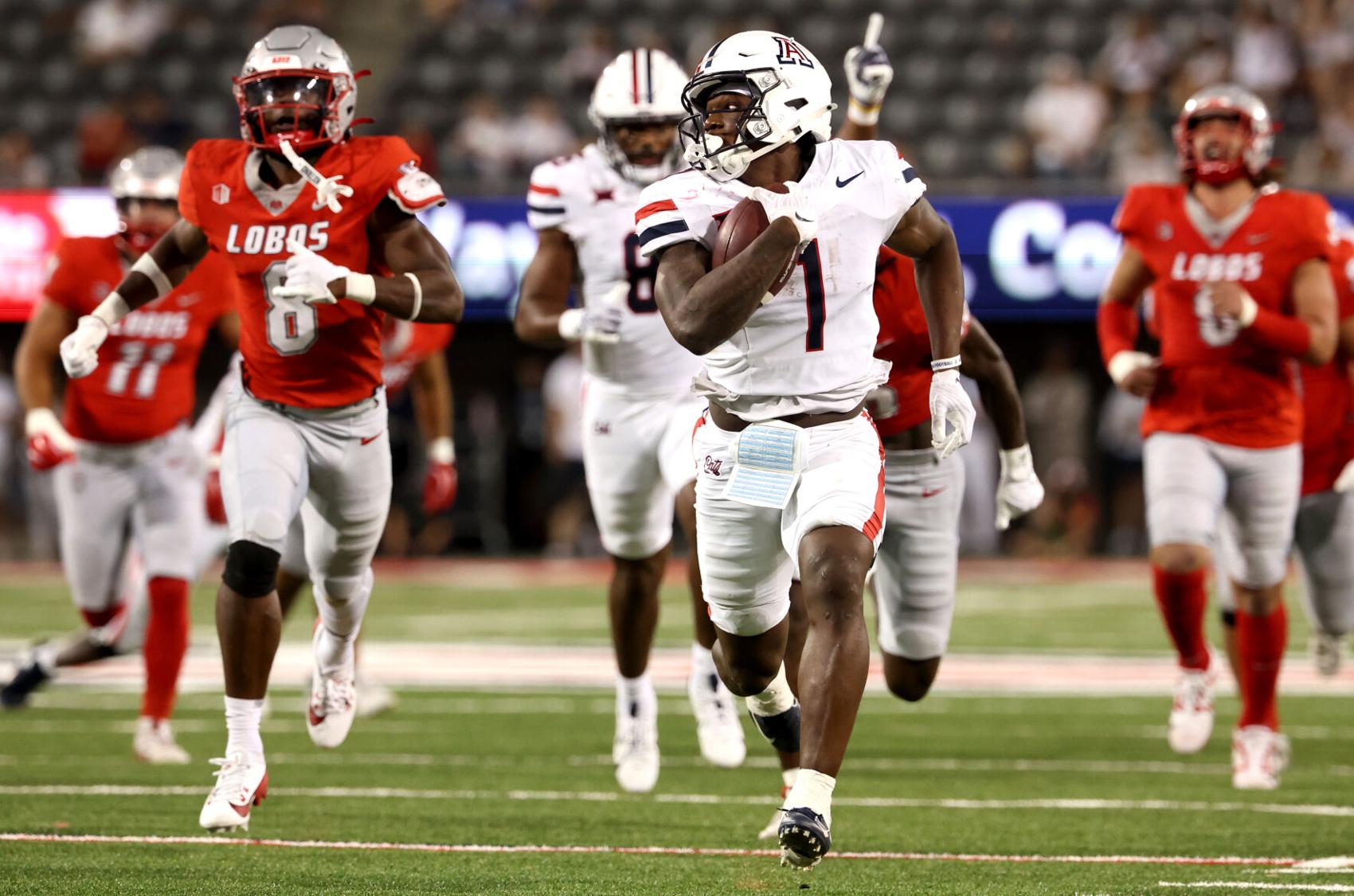
Arizona running back Jacory Croskey-Merritt checks for pursuit as he leaves everybody in his wake on the way to the end zone against New Mexico in the fourth quarter of their game Saturday at Arizona Stadium.
Conley said the discussion in the locker room at halftime was pretty straightforward: The Wildcats needed to be more physical in the second half. That applied to the linemen as well as the running backs.
They brought it after the break, totaling 177 yards and averaging 10.4 yards per rush. Conley had rushing touchdowns of 51 and 23 yards. Jacory Croskey-Merritt ripped off a 36-yarder.
Arizona had great success in short-yardage situations using a six-man line with its best blocking tight end, Roberto Miranda, and a fullback, freshman Kayden Luke. That formation screams physicality.
Hopefully that approach will carry over into the NAU game and the Wildcats can run effectively from start to finish. They need to build continuity and confidence up front heading into their two toughest matchups of the year — at Kansas State and at Utah.
“Balance” is in the eye of the beholder, but there’s no question that a consistent running game makes things easier for a quarterback. Arizona navigated through a handful of third-and-long situations thanks to Fifita’s cleverness and McMillan’s brilliance. But the Wildcats don’t want to make that a habit, especially with an offensive line that might be down a key starter.
5. A worrisome injury
Left tackle Rhino Tapa’atoutai suffered an apparent left knee injury during the third quarter and did not return. The promising redshirt freshman is one of the players Arizona least can afford to lose.
Tapa’atoutai took almost every first-team rep at left tackle during training camp, firmly establishing himself as the long-term successor to Jordan Morgan. Tapa’atoutai even took some second-team reps because the Wildcats were shorthanded at the position.
Transfer Michael Wooten, who had been backing up Tapa’atoutai, did not suit up Saturday because of a knee injury suffered during camp. When Tapa’atoutai went down, Arizona turned to true freshman Matthew Lado — but it wasn’t a straight swap.
The coaching staff moved star right tackle Jonah Savaiinaea to the left side and inserted Lado at right tackle in most alignments. It was the first time Savaiinaea had played on the left side in a college game. You wouldn’t have known it watching him.
“He’s so special,” Fifita said. “He’s never afraid to do what needs to be done for the team.”
Savaiinaea projects as a guard, the position he played as a freshman, in the NFL. That he’s been able to kick out to tackle and play effectively — on either side — is a tribute to his skill and smarts.
Still, not having Tapa’atoutai and having to shuffle the line is less than ideal. Arizona should be able to get by without him vs. NAU. Kansas State and Utah are different beasts.
Contact sports reporter/columnist Michael Lev at mlev@tucson.com. On X(Twitter): @michaeljlev