Connect with us

New Mexico

Michael Lev: 5 takeaways on No. 21 Arizona’s season-opening 61-39 win over New Mexico

Published

on

Michael Lev: 5 takeaways on No. 21 Arizona’s season-opening 61-39 win over New Mexico


Brent Brennan smiled broadly as he sat down for a postgame interview Saturday night.

The first-year Arizona head coach was far from satisfied with his team’s performance in a 61-39 victory over New Mexico at Arizona Stadium. But Brennan knew it wasn’t going to be easy, no matter the perceived disparity between the Lobos and Wildcats, who were 29-point favorites at kickoff.

“It’s hard to win a college football game,” Brennan said.

Arizona managed to pull it off, even if it wasn’t pretty at times. The Wildcats struggled to run the ball in the first half. They allowed too many chunk plays on the perimeter. And they committed way too many after-the-whistle penalties.

Advertisement

It was far from perfect. But no one was expecting it to be. Despite bringing back more than half the roster, Arizona was still bound to endure a breaking-in period with an almost entirely new coaching staff.

People are also reading…

Advertisement


Arizona wide receiver Tetairoa McMillan, left, and quarterback Noah Fifita celebrate after McMillan’s catch-and-run score in the third quarter against New Mexico Saturday at Arizona Stadium.

Advertisement


Here are my top five takeaways on Game 1, warts and all:


Advertisement

Arizona wide receiver Tetairoa McMillan hops out of the hands of New Mexico safety Noa Polo-Gates (34) and down to the 1-yard line in the third quarter in their game Saturday at Arizona Stadium.


1. Just call him T-YAC

Tetairoa McMillan’s magnificence was on full display, and it was glorious.

The numbers were absolutely eye-popping: 10 catches, 304 yards, four touchdowns. And he probably could have had more if Arizona didn’t ease off the throttle in the fourth quarter.

Advertisement

But it wasn’t so much what McMillan did Saturday night as how he did it.

Per StatBroadcast, McMillan gained 176 yards after the catch. It’s the latest sign of his growth as a player.

As a freshman in 2022, McMillan did most of his work along the sidelines. Only 195 of his 702 yards came on YAC, or 27.8%.

Last year, as a sophomore, McMillan expanded his route tree. He became a more complete receiver. His YAC percentage jumped to 38.5% (537 of 1,396).

What more could he do as a junior? How ’bout becoming a YAC monster?

Advertisement

Every time he caught the ball in stride against the Lobos, McMillan refused to settle. He outran defenders, spun away from them and powered through them. All that work he did on the side while rehabbing a lower-leg injury suffered in spring showed up under the lights. He was more explosive and elusive than he’d ever been.


Arizona quarterback Noah Fifita (11) gestures at the line of scrimmage during the first half of the Wildcats’ game against New Mexico Saturday at Arizona Stadium.

Advertisement


“He looks more comfortable after the catch,” UA quarterback Noah Fifita said. “When you give him those tools and … more confidence, it’s going to be extremely fun to watch.”

2. Who’s No. 2?

For reasons that can’t be fully explained, New Mexico elected to single-cover McMillan for large portions of the game. Fifita would have been negligent if he didn’t look his way as often as possible.

But there will come a time when the opposition does everything in its power to take McMillan away.

“When you have one of those” — i.e., a superstar receiver — “eventually people are going to find ways to push coverage to them and make it hard,” Brennan said. “So those other guys need to step up.”

Advertisement

Brennan liked what he saw from players such as Keyan Burnett, Malachi Riley, Jeremiah Patterson and Chris Hunter on Saturday night. We just didn’t see very much of any of them in the passing game.

McMillan accounted for half of Arizona’s 30 targets. Running back Quali Conley was the Wildcats’ second-leading receiver with three catches. No one else had more than one.

No one is expecting any of Arizona’s secondary receivers to become Jacob Cowing. The Cowing-McMillan combo was one of the reasons the UA offense was so difficult to defend the past two seasons.

Fifita blamed himself for not getting more receivers involved. That was just Noah being Noah; if anything goes wrong, Fifita takes responsibility.

Regardless, look for him to make a concerted effort to spread the ball around more against NAU. He knows it’ll benefit the Wildcats in the long run.

Advertisement

3. Giving on the edge

Arizona’s defense, a strength for most of last season, struggled for extended periods Saturday night. In the first half alone, the Wildcats surrendered 305 yards.

The unit’s biggest issue was corralling slippery New Mexico quarterback Devon Dampier, who had a game-high 130 rushing yards. Most of those yards came on designed runs and scrambles to the outside.

Arizona’s edge containment was poor. And that might be a generous assessment.


Advertisement

Arizona defensive back Dalton Johnson, left, gets the barest of touches in trying to stop New Mexico quarterback Devon Dampier in the fourth quarter of their game Saturday at Arizona Stadium.


On multiple occasions, the Wildcats’ defensive ends got caught crashing inside or heading too far upfield to the outside, leaving wide swaths for Dampier to run through.

It’s hard to imagine that was the game plan, although defensive line coach Joe Seumalo does support a penetrating, vertical approach.

Advertisement

When asked about the defense’s struggles — which weren’t limited to edge containment — Brennan cited the lack of “live” reps during training camp. It’s a dilemma every coach faces: They all want to practice tackling, but none wants to put his players in harm’s way.

Dampier also is the type of quarterback Arizona won’t see very often. This experience should help the Wildcats the next time they face someone like him. The coaches can point to the film and note all the dos and don’ts. The breakdowns were that glaring.

4. No longer grounded

Arizona did not run the ball very often or very well in the first half, gaining just 28 yards on nine carries. Considering that New Mexico had allowed 362 rushing yards the previous week against Montana State, that wasn’t exactly encouraging.


Advertisement

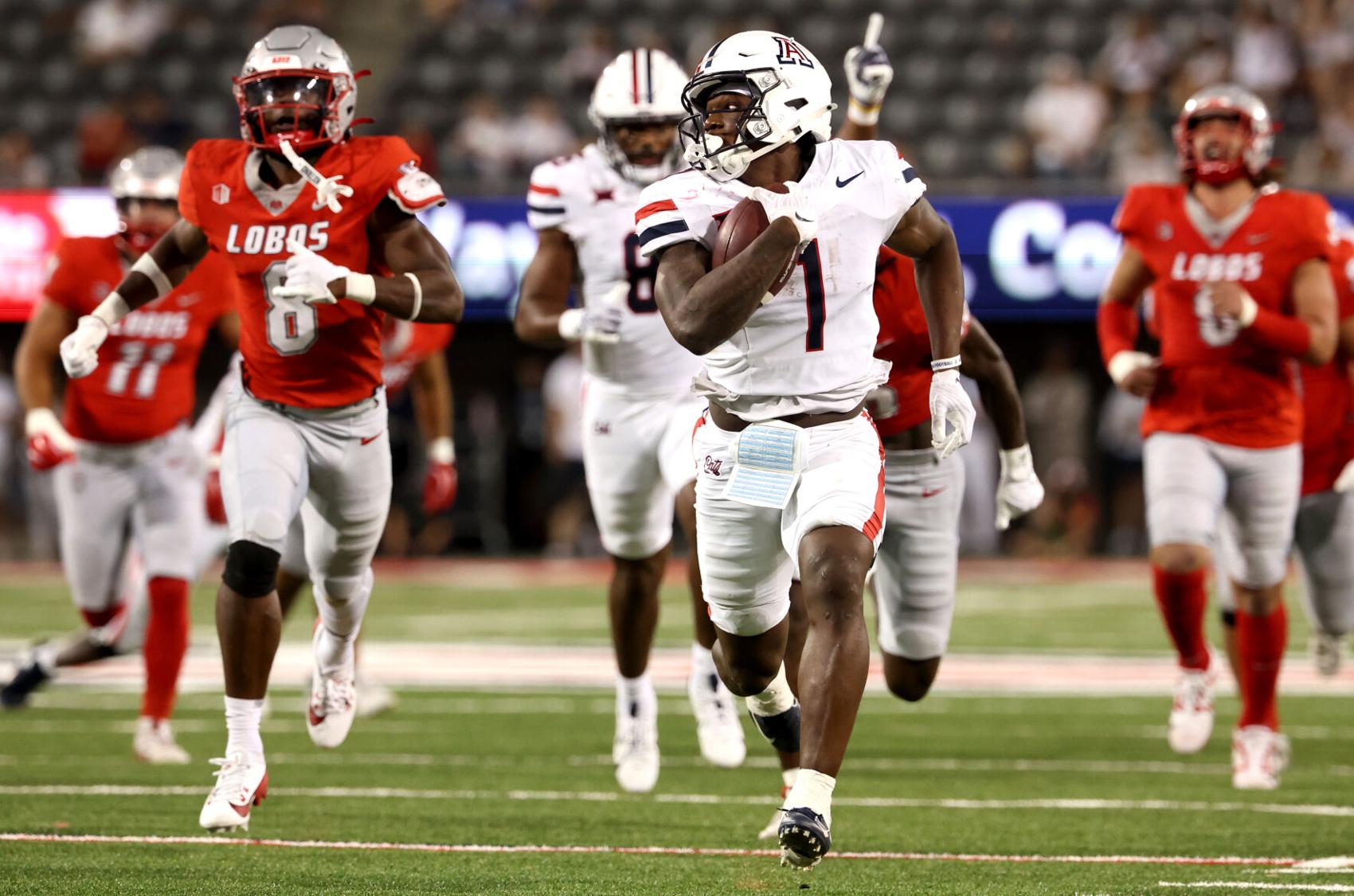
Arizona running back Jacory Croskey-Merritt checks for pursuit as he leaves everybody in his wake on the way to the end zone against New Mexico in the fourth quarter of their game Saturday at Arizona Stadium.


Conley said the discussion in the locker room at halftime was pretty straightforward: The Wildcats needed to be more physical in the second half. That applied to the linemen as well as the running backs.

They brought it after the break, totaling 177 yards and averaging 10.4 yards per rush. Conley had rushing touchdowns of 51 and 23 yards. Jacory Croskey-Merritt ripped off a 36-yarder.

Advertisement

Arizona had great success in short-yardage situations using a six-man line with its best blocking tight end, Roberto Miranda, and a fullback, freshman Kayden Luke. That formation screams physicality.

Hopefully that approach will carry over into the NAU game and the Wildcats can run effectively from start to finish. They need to build continuity and confidence up front heading into their two toughest matchups of the year — at Kansas State and at Utah.

“Balance” is in the eye of the beholder, but there’s no question that a consistent running game makes things easier for a quarterback. Arizona navigated through a handful of third-and-long situations thanks to Fifita’s cleverness and McMillan’s brilliance. But the Wildcats don’t want to make that a habit, especially with an offensive line that might be down a key starter.

5. A worrisome injury

Left tackle Rhino Tapa’atoutai suffered an apparent left knee injury during the third quarter and did not return. The promising redshirt freshman is one of the players Arizona least can afford to lose.

Tapa’atoutai took almost every first-team rep at left tackle during training camp, firmly establishing himself as the long-term successor to Jordan Morgan. Tapa’atoutai even took some second-team reps because the Wildcats were shorthanded at the position.

Advertisement

Transfer Michael Wooten, who had been backing up Tapa’atoutai, did not suit up Saturday because of a knee injury suffered during camp. When Tapa’atoutai went down, Arizona turned to true freshman Matthew Lado — but it wasn’t a straight swap.

The coaching staff moved star right tackle Jonah Savaiinaea to the left side and inserted Lado at right tackle in most alignments. It was the first time Savaiinaea had played on the left side in a college game. You wouldn’t have known it watching him.

“He’s so special,” Fifita said. “He’s never afraid to do what needs to be done for the team.”

Savaiinaea projects as a guard, the position he played as a freshman, in the NFL. That he’s been able to kick out to tackle and play effectively — on either side — is a tribute to his skill and smarts.

Still, not having Tapa’atoutai and having to shuffle the line is less than ideal. Arizona should be able to get by without him vs. NAU. Kansas State and Utah are different beasts.

Advertisement

Contact sports reporter/columnist Michael Lev at mlev@tucson.com. On X(Twitter): @michaeljlev 


Source link

New Mexico

Tree deaths in New Mexico tripled in 2025 as warming summers increases insects, stress on forests – New Mexico Political Report

Published

on

Tree deaths in New Mexico tripled in 2025 as warming summers increases insects, stress on forests – New Mexico Political Report


Tree deaths tripled in New Mexico during the second warmest year on record, according to new analysis of the state’s forest health from the U.S. Forest Service and New Mexico Forestry Division.

Spruce beetle-killed trees near blowdown in the Carson. Photo by Crystal Tischler, USFS. Over the
last decade, 291,000 acres with spruce beetle-killed trees have been mapped in New Mexico.

2025 saw a rapid expansion of bark beetle-caused deaths with 209,000 acres of conifers now dead — up from 67,000 acres in 2024 — mostly on national forest land managed by the USFS. “Fall and winter temperatures remained warmer and drier, allowing bark beetles to remain active late in the season,” the report concluded. “Large areas of ponderosa and piñon forests saw significant mortality from bark beetles, especially in the southern part of the state. Areas near burn scars from large wildfires continue to experience bark beetle attack on residual trees.”

New Mexico’s forests under threat
Findings from 2025 statewide survey

Beetle-killed conifer forest increased 211%, mostly on national forest lands
Defoliation (distinct from mortality) decreased 51%
Total acreage with damage decreased 6%
Forests impacted by drought and heat increased 66%

Advertisement

If there is good news in the report, it is that a virus infecting some of the most common insects causing defoliation greatly reduced the number of acres showing a loss of leaf or needle coverings. Insect infestations of the western spruce budworm, Douglas-fir tussock moth, western tent caterpillar, needleminers and scale insects was down 51% from 327,000 acres in 2024 to 160,000 acres in 2025.

Still, the number of forest acres under threat increased 6% in just one year and the number of acres threatened by drought and temperature were up a whopping 66%, the report’s authors say.

A stand of ponderosa pine discolored by drought and heat in the Capitan Mountains. Photo by Crystal Tischler, USFS.
A stand of ponderosa pine discolored by drought and heat in the Capitan Mountains. Photo by
Crystal Tischler, USFS.

“Our forests have exceeded the land’s carrying capacity,” said Victor Lucero, the state’s forest health manager. “No matter what, disturbance events will try to rebalance our ecosystems, whether it’s through human intervention, like proactive thinning, or biological events such as pest outbreaks or wildfire. We can manage disturbances to prevent catastrophic events like these in the future.”

Read more from the report here.

Advertisement
  • Pat Davis

    Pat Davis is the founder and publisher of nm.news. In a prior life he served as an Albuquerque City Councilor.

Advertisement


Source link

Continue Reading

New Mexico

New Mexico legend Al Hurricane Jr. honored at funeral

Published

on

New Mexico legend Al Hurricane Jr. honored at funeral


Loved ones filled Queen of Heaven Catholic Church as the state mourned musician Al Hurricane Jr., whose family said he died at 66 from a heart attack.

NEW MEXICO – Loved ones filled Queen of Heaven Catholic Church as the state mourned musician Al Hurricane Jr., whose family said he died at 66 from a heart attack.

Family members, friends and others gathered Saturday morning for his funeral service and honored the legacy he left behind. KOB 4 spoke with relatives as they said their final goodbyes.

“270 years we can still be listening to Beethoven, Mozart, Handel. Why couldn’t we in 270 year be listening to Flor de las Flores?” the priest said.

Advertisement

A voice that helped define New Mexico’s sound is now being remembered across the state. Al Hurricane Jr. started his musical career at age 5 and later followed in the footsteps of his father, Al Hurricane.

“Through the years, he was so sweet, he listens very well, very well. And he made a song, well, the song that was for him and I, that he always sang when we used to see him was Flor de las Flores,” Frances Lucero said.

Remembering his legacy

Lucero, whose husband Anthony Lucero is second cousins with Al Hurricane Jr., joined dozens of family members inside the church to pay respects.

“Al Jr.’s dad and I were first cousins, so I’ve known Al Jr. basically after he was born, after his dad passed away, we kept in touch with each other,” Jacob Sanchez said.

“People would see him, and he was so easy to get along with. For me, it was easy, because we were related, but I could see him relate to other people, and there was almost an immediate bond. I was very impressed by that all the time, and just had that ability to become close to people, complete strangers,” Sanchez said.

Advertisement

His relatives said that even with his fame, he never lost sight of who he was.

“Just his ability to have an impact on people, he was so humble, and he had this million dollar smile,” Sanchez said.

Will the music continue?

His family said his legacy will live on through his relatives and the music they continue to perform.

“It’ll continue on, because he still has a brother, Jerry D, Jerry Dean, and him and his sons are starting to come out too so that’s whats going to keep it alive, them and sparks is going to keep it alive,” Antonio Lucero said.

“I will always remember him. He’ll always.. there will not be a day in his years that no one will ever forget them, no. I guarantee you that so far,” Lucero said.

Advertisement

His family said he died at the age of 66 from a heart attack.


Source link

Continue Reading

New Mexico

Native America Up Close Along Route 66 In New Mexico

Published

on

Native America Up Close Along Route 66 In New Mexico


Historic Route 66 celebrates its 100th anniversary in 2026. While the so-called “Mother Road” defined classic Americana–tourist kitsch, neon signs, roadside motels–most of its mid-century fame has faded into memory.

Along a sun-drenched, 150-mile stretch of Route 66 between Albuquerque and the New Mexico-Arizona state line, however, thousand-year-old traditions remain vibrant. The Pueblo of Isleta. The Pueblo of Sandia. The Pueblo of Laguna. The Pueblo of Zuni. The Navajo Nation. The otherworldly Acoma Pueblo: Sky City.

Route 66 through western New Mexico offers a concentrated look at historic and contemporary Native America. See for yourself the highs and lows. Breathtaking cultural heritage. Astonishing artwork. Colonization’s heartbreaking legacy. Glitzy casino/resorts. Poverty.

Advertisement

Albuquerque

The corner of 4th Street and Central Avenue in downtown Albuquerque doesn’t seem exceptional. Look at the stoplights. Each one–all four–features the Historic Route 66 road sign. At this intersection, Route 66 intersects with itself.

This is the only place along its nearly 2500-mile stretch where it does that. The oddity is owed to political butt hurt.

The original 1926 path of Route 66 swung sharply northward at Santa Rosa in eastern New Mexico to include the state’s capital of Santa Fe before traversing back south to Albuquerque and then west toward Arizona. When Governor Arthur T. Hannett lost his re-election bid in 1927 to a candidate backed by the powerful Santa Fe political machine, he ordered a new highway constructed–a new Route 66–that would bypass Santa Fe and run straight from Santa Rosa to Albuquerque.

Upon completion of the new section in 1938, Santa Fe–and Hannett’s political enemies–were cut off from the economic engine of Route 66.

Begin your exploration of Native America along Route 66 in Albuquerque at the Indian Pueblo Cultural Center. Here, an introduction to the 19 Pueblos in present-day New Mexico is made through artwork, food, and dance. Admire the IPCC’s remarkable courtyard murals and special exhibitions. Most days, and particularly on weekends, Pueblo artists sell their work direct to visitors around the courtyard which hosts dance groups from the Pueblos every Saturday and Sunday. This is the only place in North America where Native American dances are performed every weekend. Be sure to see one.

Advertisement

IPCC also houses a fantastic Indian Pueblo Store selling museum-quality pottery, jewelry, and textiles, each treasure complete with a certificate of authenticity. The superfood blue corn griddle cakes at the on-site Indian Pueblo Kitchen are worth a visit themselves.

Petroglyph National Monument in Albuquerque protects one of the largest petroglyph sites in North America. The ancestors of today’s Pueblo people carved these images. While the Rio Grande Valley here has been inhabited by Indigenous people going back 10,000 years, most of the petroglyphs were etched between 1300 and 1650.

As with any outdoor activity in New Mexico, prepare for a harsh sun, alternately scorching heat or freezing cold depending on the season–this is desert–and potential dehydration. Albuquerque sits at 5,300 feet elevation and the combination of that elevation, the heat, and the dry desert air can take a toll on newbies.

The Pueblo of Sandia gets all the love in ABQ. Sandia Mountain, the aerial tramway to the peak, the fancy resort and casino, but don’t sleep on little Pueblo of Isleta south of town. Isleta has a spiffy resort and casino as well, but it’s Yonan Cultural Center is the gem here with a fantastic photography archive and two short films, one from 1898, the first moving images taken in New Mexico. Isleta also maintains one of the most well-preserved Catholic churches–a remnant of Spanish colonialism–and plazas among all the Pueblos.

Back in town, the Albuquerque Museum presents an excellent special exhibition related to Route 66’s centennial through January 3, 2027. The focus is Petroliana and car culture, not Native America, but it provides good context. Admission is free Sundays from 9:00 AM to 1:00 PM.

Advertisement

Take a cruise up Central Ave.–Route 66–before leaving. Admire the modestly sized, historic Native murals at 510 Central Ave., and Nani Chacon’s building-filling pottery lowrider three blocks away at the Arrive hotel.

Native Art Galleries In Albuquerque:

(A partial list)

Gallery Hózhó

Arrowsoul Trading Post

Allen Aragon Gallery

Advertisement

Penfeld Gallery

Gertrude Zachary jewelry

ABQ Eats:

Sadie’s

El Pinto

Tiny Grocer ABQ

Advertisement

Curious Toast Cafe

Barelas Coffee House

Church Street Café

Downtown Saturday Growers’ Market

World Famous Laguna Burger

Interstate 40 has subsumed what was once Route 66 across stretches of New Mexico. The “Mother Road” was decommissioned in 1984. Progress.

Forty-five miles west of Albuquerque at Exit 114 along I-40 find the Pit Stop convenience store and world famous Laguna Burger. Burgers became part of feast day celebrations at the Pueblo of Laguna in the mid-20th century. Their popularity grew. In 2005, the Pueblo began sharing its green chile cheeseburger with the world.

Today, multiple Laguna Burger locations can be found around the state–including across the street from the Indian Pueblo Cultural Center–but a visit to the Pit Stop location at Exit 114 is worth your while. As is taking Route 66 through the village of Laguna.

The story of Native America is not so easy here. Houses surrounding the hilltop Mission Church a couple minutes’ drive from Laguna Burger have seen better days. The community persists; prosper lies in the eye of the beholder. All the more reason to see for yourself. Travel as witness. Native America beyond the Vegas-style casinos and chic cultural centers.

Look at the cars. Look at the homes. Look at the roads. Look at the schools. Think about it. Pull off the side of the road and think about it.

Advertisement

Ask before taking photos or videos. At all the Pueblos. Error on the side of not. The Pueblo and the people are not living history props. Here’s a handy guide to Pueblo etiquette.

September is a big month for feast days at Laguna with the 19th being the largest event.

Gallup And The Navajo Nation

From Laguna, make the 90-mile trip west to Gallup skipping by the Pueblo of Acoma for now. Continuing to follow Route 66 has its own rewards, but using the interstate cuts driving time in half.

Gallup represents the most Route 66 town among all the Route 66 towns in New Mexico. Six thousand tourist cars per day used to stream through Albuquerque and Gallup at the “Mother Road’s” 50s and 60s peak. Not anymore. Not after I-40. The flood of tourists and tourist dollars has slowed to a trickle. Abandoned storefronts in Gallup equal those occupied.

Advertisement

Gallup can be hard to get your head around. Not only the businesses that have gone out of business–motels advertising color TV as an amenity–but those that remain operating, primary among them, the trading posts. Gallup is famous for trading posts.

Trading posts continue a system born out of the horrific Navajo livestock reduction program. Navajo people had their sheep–their food supply and source of income–slaughtered by the federal government. No good reason. Settler colonialism. As a result, the Navajo became economically dependent upon government subsidies. The subsidies, naturally, operated through white traders.

Navajo people purchased goods from traders on store credit or in trade for items they made. The relationship was exploitative from the start. Trading posts have become more equitable over time, but hardly equitable in all circumstances.

Gallup remains the epicenter of trading posts for tourists traveling along Route 66 looking to pick up a Native American souvenir. The caliber of those items ranges from counterfeit to museum-quality. How to know the difference?

Whether you’re purchasing pottery, Katsinas, fetishes, jewelry, paintings, even textiles, authentic, high quality Native American art being sold in a retail location should have an artist’s name attached to it. Not “authentic Indian art.” Not “Native made.” Remember the store at the Indian Pueblo Cultural Center; every piece had an artist’s name and tribal affiliation connected to it.

Advertisement

Also, remember the store display at IPCC. Respectful to the objects. It looks like a Tiffany’s. If you walk into a trading post in Gallup and see thousands of objects crammed together on shelves like a going out of business sale at the Dollar Tree, then you’re buying Dollar Tree caliber tchotchkes. Curios. Trinkets. The Route 66 version of a snow globe.

If a trading post primarily uses discounts to sell merchandise, keep moving.

With pottery, if there are dozens of objects of the exact same size and shape, or multiple sizes of the same form, that pottery is most likely molded and kiln fired, not hand coiled and wood fired; you want the latter if you’re looking for a treasure. The molded pieces are often hand painted by Native artists, technically/legally rendering them “Native art,” but it’s shady. Note that Native artists do sell molded pottery as well.

If all you want is a souvenir, whatever; if you’re looking for heirloom quality Native American fine art you can cherish in your home for decades, be careful. Error on the side of caution. More knowledgeable shoppers than you have been fooled.

Purchasing turquoise jewelry can be tricky as well.

Advertisement

If the price seems too good to be true, it’s fishy. Again, remember pricing at IPCC to gauge. There are a thousand good places in New Mexico to purchase authentic Native American art of the highest quality–including numerous opportunities to do so direct from the artist–and you can do that in Gallup, but be careful.

Recommended Native American Art Retailers In Gallup:

(A partial list)

Silver Dust Trading

Zuni Fetishes Direct

Yazzi’s Indian Art

Advertisement

Direct from artists during annual Gallup Inter-Tribal Indian Ceremonial.

Gallup Eats:

Jerry’s Café (406 W Coal Ave, Gallup, NM 87301; no website)

Stop for anyone selling tamales or burritos along the road or from their house. Have cash.

Navajo Code Talkers

When the Navajo Code Talkers left their homeland bound for Japan and the essential communications work they performed in World War II, they departed from the train station in Gallup. The free Gallup Cultural Center next to the train station provides an excellent introduction to the Code Talkers as well as Navajo sand painting. Find the Code Talkers mural a couple blocks away.

Advertisement

Gallup’s Works Progress Administration courthouse is a wonder with spectacular–and mysterious–examples of Depression-era Native art. Take a tour if you’re able.

A thirty-minute drive north from Route 66 takes road trippers to Window Rock, AZ, capital of the Navajo Nation. Go there. See Window Rock. Visit the Navajo Nation Museum. The Navajo count 300,000-plus members among the tribe, second most populous in the United States behind only the Cherokee.

Pueblo of Zuni

Forty miles south of Route 66 from Gallup sits the Pueblo of Zuni. The Zuni have a stronger tourism infrastructure than most Pueblos with a visitor and arts center, tours, restaurants, shops, accommodations, and public feast days and celebrations.

Opportunities to purchase artwork directly from the makers abound. Look up Raylan and Patty Edaakie for A++ jewelry.

Acoma Pueblo: Sky City

The most alluringly named visitor destination in America belongs to Acoma Pueblo: Sky City. Hearing it described seems like something out of a dream. A village continuously inhabited since roughly 1100 AD–the oldest continuously inhabited community in the United States–perched 360 feet atop a mesa with commanding views of the surrounding valley.

Advertisement

Acoma’s reality equals the fantasy of its moniker.

Begin your exploration at the exceptional visitor center and museum where most days artists will be selling their work direct to visitors. Guests can only access Sky City by taking a tour. Tours run hourly, 9:30 AM until 3:30 PM, seven days a week.

Tours visit the mesa-top Catholic church. The Acoma people were enslaved to construct the building. The violence of European colonization across the North American continent may have achieved a grisly apex at Acoma when, following a siege by Spanish conquistadors in 1595, a massacre occurred killing hundreds. Male survivors of the slaughter over age 25 had their right foot cut off. Women and children were enslaved. The Acoma Massacre.

Acoma eventually merged the Catholicism forced upon it with its traditional spirituality–as many Pueblos have–and today, Christmastime is a major celebration. The Pueblo is closed to visitors on Christmas Day, but on Christmas Eve, one of the most remarkable sights you will ever witness has a thousand luminarias lining the road to Sky City.

Acoma’s annual schedule of closures and public events can be found here.

Advertisement

The Pueblo operates Sky City Casino Hotel 60 miles west of Albuquerque just off the interstate. The interstate that rendered Route 66 mostly obsolete after only 60 years. Sixty years in America can seem like a long time. Not in Native America, where time is measured by seven generations and thousands of years.

Route 66 through western New Mexico represents a remnant of a bygone American past, and more importantly, a passageway through Native America’s dynamic present.

More From Forbes

ForbesEnchanted Winter Holidays In Northern New MexicoForbesSanta Fe, New Mexico: Winter Wonderland


Source link

Continue Reading
Advertisement

Trending