Nevada
Homelessness rates in Southern Nevada up 36% over past two years


LAS VEGAS (KTNV) — The number of people facing homelessness in Southern Nevada continues to grow.
On Wednesday, Clark County released the results of their annual census, which was carried out by volunteers on Jan. 25, 2024.
On any given night, 7,906 people in Clark County are experiencing homelessness. That’s a 20% jump compared to 2023 and a 36% jump compared to 2022.
Clark County
According to county data, the most impacted groups are women, African Americans, and those between 35 and 44 years old.
Clark County

County officials add that while individuals experiencing homelessness currently represent less than 1% of the overall population, the number of people and proportion relative to the total population have been rising.
Those trends “indicate a potential shift towards increased homelessness” and allow county officials to plan for the future, including putting proactive measures in place like adding additional shelter locations and adding affordable housing and permanent supportive housing programs.
How do we compare to other cities?
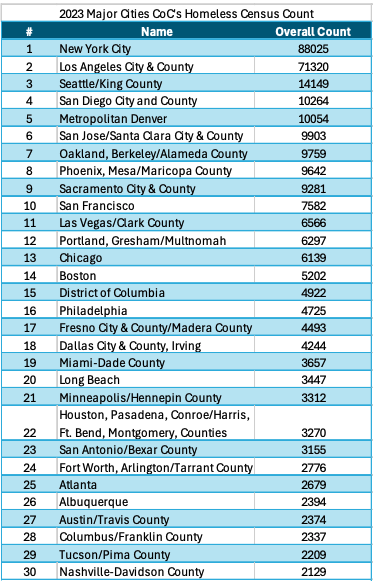
When looking at national data, Las Vegas is number 11 when it comes to the largest population of those experiencing homelessness on a single night.
(Note: Las Vegas numbers include those people in shelters as well as people on the street. Other major cities ranked lower on the list below only provided shelter-only counts. Based on shelter-only rates, Las Vegas would rank in the 20 to 25 range.)
Clark County
What is causing homeless rates to go up in Southern Nevada?
One of the biggest factors in the rise of homeless rates is housing affordability and income.
For example, between 2021 and 2022, median household prices surged by over 35%, according to Clark County. Officials add that income did increase but was “comparatively slower, growing at approximately half the rate of the surge in median household prices and Fair Market Rents.”
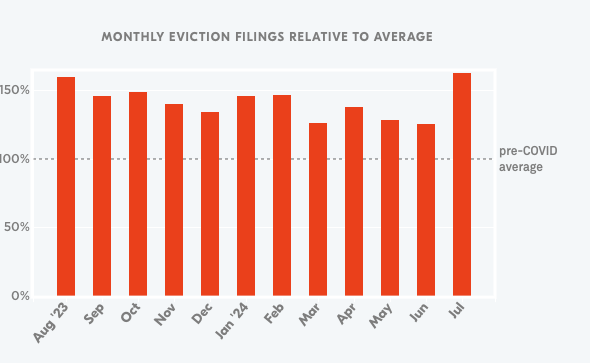
That tracks with data from the Princeton University Eviction Lab, which tracks housing and rent costs across the country.
Over the past year, there have been 51,825 eviction filings in Las Vegas, which is up 42%, compared to an average year before the COVID-19 pandemic. Looking closer, there have been 4,983 eviction filings in just the last month, which is up 63%, compared to an average year before the COVID-19 pandemic.
Many of those evictions are in the central or eastern part of the valley.
Princeton researchers say the data in Clark County is likely an undercount because those records “are only available with a delay”.
Princeton University Eviction Lab

Princeton University Eviction Lab
What are valley officials doing to help those experiencing homelessness?
In Clark County, there are 9,013 total beds for people experiencing homelessness. That number includes emergency shelters, transitional housing, permanent supportive housing, other than permanent housing, and rapid rehousing.
According to the 2024 census data, only 7,635 of those beds were used on any given night, or about 85%
Clark County has been looking for ways to add beds and last year, they opened the Clark County Navigation Center. A former Motel 6 was converted into temporary housing for up to 70 people. The Vintage Safari Motel was also converted into transitional housing.
WATCH: Vacant motel transformed into Betterment Community for homeless populations in Las Vegas
Vacant Las Vegas motel transforms into shelter for homeless Nevadans
In response to the 2023 homeless census, Clark County also added non-congregate shelter beds to help individuals find safer and more suitable accommodations and get more people off the street.
In May, Clark County commissioners approved over $66 million in funds to go towards constructing and rehabilitating affordable housing units for low to extremely low-income residents. That round of funding is going to nine projects, which will create 1,273 units.
The City of Las Vegas also has the Courtyard Homeless Resource Center, which has case managers to help people navigate the resources they need to get off the streets. That includes a computer lab, medical care, laundry room, showers, bathrooms, and a kennel for people’s animals.
The Courtyard also has a free Arrow shuttle that transports people to service providers such as the DMV, Nevada Job Connect, and the Goodwill Career Center.
Las Vegas also has a Multi-agency Outreach Resource Engagement, or MORE, team. They provide mobile intervention and outreach services to homeless individuals that live in encampments, the street, flood control tunnels, and outlying uninhabited areas around Las Vegas.
You can learn more about those resources here.
WATCH: Learn more about the MORE Team and the work they do in Las Vegas
13 Investigates: What’s being done to address homelessness in the Las Vegas Valley?



MESQUITE (KTNV) — A deadly crash on Interstate 15 near Mesquite prompted a group of bystanders to spring into action before first responders could arrive, pulling a man from a burning motor home after a collision with a semi-truck.
Steven Grossman, a retired Army National Guard veteran, said he was driving northbound on I-15 after a Fourth of July camping trip with his family when he saw a motor home cross the center median from the southbound lanes.
“It was like a pile of dust, it was going across the center medium and down that big hill,” Grossman said.
WATCH | Nevada bystanders pull crash victim from burning motorhome on I-15 near Mesquite
Nevada bystanders pull crash victim from burning motorhome on I-15 near Mesquite
Nevada State Police Highway Patrol said the motor home had a blown tire. When it crossed the median, it crashed into a semi-truck and burst into flames.
Grossman said he immediately pulled over and ran toward the fire.
“I seen it on fire and, you know, we just, I just got out of the truck and just ran over there,” Grossman said.
NSP
Several other drivers also pulled over. Together, they worked to pull the motor home’s driver to safety.
“Let’s grab him and get him out of here. So we just grabbed him and just tugged him into the gutter right there, into the center medium,” Grossman said.
A propane tank exploded shortly after.
Grossman used his military medical training to keep the man still, while another bystander helped stabilize the victim’s neck until paramedics arrived.
NSP

The driver of the motor home, 62-year-old Gregory Louis Painter, later died at the hospital. Fire officials said 3 other people were taken to the hospital for injuries sustained in the crash.
Grossman said he does not consider himself a hero and that stopping to help was simply the right thing to do.
KTNV
“We were just the first ones there that if the next people that were the first ones there would have done the same thing,” Grossman said. “Same thing with behind them if it was 10 cars behind me, the cars behind them would have taken care of it. It’s just I think it’s just our human nature. People just want to help.”
This story was reported on-air by a journalist and has been converted to this platform with the assistance of AI. Our editorial team verifies all reporting on all platforms for fairness and accuracy.


Beach Boys co-founder selling Tahoe mansion for $43 million
The Lake Tahoe mansion of one of the original members of the Beach Boys was listed for $43 million.
You love to see it: local artists on local stages. Here are 12 shows featuring local artists between now and Labor Day, including rock, metal, punk, folk, jazz, hip-hop and more.
Bark Hardly
This indie-folk group from Reno headlines an all-local bill with Glitter Bats, Sad Giants and Anabelle and the Desert Scrubs. It starts at 7 p.m. at Holland Project, 140 Vesta St.
The show is July 10. Tickets are $12. Details: 775-742-1858 or hollandreno.org.
Thrashmob
It’s an all-local hip-hop night featuring this artist as headliner. They perform at 7 p.m. at Club Underground, 555 E. 4th St.
The show is July 11. Tickets are $20-$25. Details at clubundergroundreno.com.
Shared Scars
This Reno metal band celebrates the release of its new EP with a show that also features area metal bands Emberwake, Desolist, Titvn and Everglade. It all begins at 7 p.m. at The Alpine, 324 E. 4th St.
The show is July 11. Tickets are $20-$25. Details at thealpine-reno.com.
Cruz Control featuring Bree Rose
Rock, soul and hip-hop mix with this group from Reno. They play at 7 p.m. the first night and 8 p.m. subsequent nights at Terrace Lounge, Peppermill Resort Casino, 2707 S. Virginia St.
Free shows are July 16-18. Details at peppermillreno.com.
Next Question
The popular indie-punk group from Reno kicks off its tour at this show, which also features locals Blackstallion and Ring Pop Wedding. It begins at 7 p.m. at Holland Project, 140 Vesta St.
The show is July 17. Tickets are $10-$12. Details: 775-742-1858 or hollandreno.org.
Vampirates
The longtime local progressive-punk/noise band performs with Sacramento ska punks Lesdystics and local hardcore punk band The Scattering. It all begins at 7:30 p.m. at Lost Highway, 1526 S. Wells Ave.
The show is July 17 and there is a $10 suggested donation. Details at instagram.com/corrigans_losthighway.
Fireman’s Ball Reignited
A benefit for the Silver City Volunteer Fire Department, this show features some big northern Nevada and regional names including former Tahoe resident and country-rock singer/songwriter Matt Axton. Also on the bill are Darren Senn, Charity Kiss and Next Question, among others. It all starts at 1 p.m. at Silver City Park, 385 High St., Silver City.
This free show, with donations accepted, is July 18. Details at instagram.com/silvercityvfd_nv.
Everything Sucks Fest 2026
The annual punk-band event returns, this time with locals Hired Fun, Irreplaceable Beings, Flicker And Fade and Cold Amber Medicine. It begins at 4 p.m. at Shoe Tree Brewing Co., 1496 Old Hot Springs Road, Carson City.
This free show is July 25. Details at instagram.com/shoetreebrewing.
Reno Jazz Orchestra with Matt Mauser
For their Artown show, this local group will be joined by Mauser, an “America’s Got Talent” finalist who specializes in pop and jazz standards. The show starts at 7 p.m. at Robert Z. Hawkins Amphitheater, 6000 Bartley Ranch Road.
This show is July 29. Tickets are $35. Details at artown.org.
Reno Devilles
Rockabilly meets surf-rock with this local band. They play at 8 p.m. at Pele Utu, 1275 Stardust St.
This free show is Aug. 1. Details at instagram.com/peleutureno.
Jakota Wass
A country singer/songwriter from Gardnerville, Wass plays at 7 p.m. at the Outdoor Stage, Brewery Arts Center, 449 W. King St., Carson City.
The free show is Aug. 8. Details at breweryarts.org.
The Electric
A straight-ahead alternative rock band from Reno, the Electric headline an all-local bill that also features Sad Giants and The Jackeyes. They play at 7 p.m. at Holland Project, 140 Vesta St.
The show is Aug. 15. Tickets are $8-$10. Details: 775-742-1858 or hollandreno.org.
Cape Fear Quartet
This swing-jazz quartet from Reno performs at 8 p.m. at Pele Utu, 1275 Stardust St.
This free show is Aug. 15. Details at instagram.com/peleutureno.
Jelly Bread
Soul music meets alternative rock with this Reno group. They perform at 7 p.m. at the Outdoor Stage, Brewery Arts Center, 449 W. King St., Carson City.
The free show is Aug. 15. Details at breweryarts.org.
Band Wars Music Festival
An extension of the contest at Club Underground earlier this year, the participants now get to play at Bartley Ranch. Contest winners No One Good are joined by Split Persona, Interstate, Giant Skunk and Quitter, among others. It all begins at 2 p.m. at Robert Z. Hawkins Amphitheater, 6000 Bartley Ranch Road.
The show is Sept. 5. Tickets are $25-$35. Details at clubundergroundreno.com.

The dilapidated fishing vessel from which “Rose of Nevada” takes its name disappeared into the sea off the coast of Cornwall, England, in 1993, bringing with it two members of a shorthanded crew. A young fisherman who had called out sick that day later died by suicide; some speculate because of survivor’s guilt. There’s a lot of speculation about that old boat. It was the kind of tragedy from which a tight-knit community never really recovers, and this quaint Cornish fishing village has since been stricken by decades of poverty and rot. Now, 33 years later, the Rose has mysteriously returned. It just showed up, ship-shape and empty, sitting there in the harbor one misty Monday morning. All she needs now is another crew.
How and why the boat returned is not for me to say, nor are such matters of much concern to writer-director Mark Jenkin. A time travel adventure with the cadence of a ghost story, “Rose of Nevada” haunts the viewer like the sound of a faint, distant horn on a foggy night. George MacKay stars as Nick, a loving husband and doting dad who has been out of work for some time now. He’s also a bit of a dummy, caving in their apartment’s roof while trying to patch a leak during a rainstorm. Nick finds himself crewing the Rose out of financial necessity — he’s literally trying to put a roof over his family’s heads — while Callum Turner’s gruff drifter Liam comes aboard seemingly because he’s got nothing better to do.
Any other movie would probably try to explain exactly how these boys return from their maiden voyage with a robust catch to find themselves transported back to 1993. They discover their little town thriving and keep running into younger, happier versions of characters we’ve met in the miserable present. Everyone seems to know who Nick and Liam are, but they’re calling them different names. It’s as if the two have somehow stepped into the shoes of those doomed crewmembers from 33 years ago, brought back here by the Rose either to fix history or repeat it.
Part of what makes the movie so mesmerizing is Jenkin’s artisanal approach. He shoots on an ancient, hand-cranked 16mm Bolex camera — a model slightly less advanced than what my film school class was using three decades ago. Jenkin leans into the grainy imperfections of the image, keeping in all the scratches and light leaks that professional labs and technicians typically scrub out. It’s impossible to capture synchronized sound with this equipment, so background noises and the necessarily sparse dialogue are added later in post-production, lending an eerie, uncanny quality to the proceedings.
The set of self-imposed limitations creates its own aesthetic. Jenkin’s hand-cranked camera won’t run for more than 28 seconds at a time, forcing him to tell the story in a series of punchy, discrete images. Instead of wide establishing shots, he favors tight closeups made even more claustrophobic by 16mm’s boxy 1.33 aspect ratio. Our brains assemble the scenes almost like a mental jigsaw puzzle, getting a full sense of the boat without ever getting a complete look at it. Same goes for the town. It’s amazing how many gaps your mind fills in for you when prompted properly.
Jenkin takes a similar approach to the screenplay, allowing rhyming images and visual cues to provide most of the exposition. I went back and watched the movie a second time to try and understand how I always felt like I knew what was happening, even though I couldn’t possibly explain what was going on. The rhythms of the picture feel almost like a dream, obeying their own strict logic that locks in perfectly at the end. Jenkin’s previous picture, the cryptic Cornish island folk tale “Enys Men,” tried similar tactics, but with annoying, off-putting results. Two of the reasons this film connects so much better are the appealing lead performances by MacKay and Turner, a couple of genuine movie stars with whom we are happy to get lost at sea.

MacKay made no impression at all in the insipid, Oscar-winning World War I gimmick film “1917,” but has since revealed himself to be one of our most adventurous young actors. He was electrifying as a bi-curious, homophobic hooligan in the 2024 Boston Underground Film Festival favorite “Femme,” and nailed multiple roles from swoon-worthy stud to psychopathic incel stalker in Bertrand Bonello’s brain-melting “The Beast.” There’s a performative aspect when most actors play dumb, a theatricality that reminds the audience they’re actually smarter than the character. As our stranded family man Nick, MacKay offers no such condescension. He’s a dim bulb with a big heart in an unfathomable situation; his eyes sometimes touchingly, hilariously blank. So much is already beyond Nick, and then all this happens.
Most readers probably know Turner as Mr. Dua Lipa. For those who have trouble keeping track of their cute British boys, he’s the jug-eared, scruffy one who isn’t Josh O’Connor. I’ve never understood the hubbub about this guy, but he won me over here. It’s tough to recall a character in a science-fiction story quite like Liam, who, when experiencing something as foundation-shattering as time travel, figures, “Sure, why not?” and rolls with it. MacKay has some hilarious reaction shots to his screen partner’s blithe acceptance of their new reality. Though I suppose it helps that in this alternate 1993 timeline, Liam winds up with a beautiful wife and daughter, while Nick just gets stuck with overbearing parents.
I’ve been turning over the movie’s ending in my mind for a couple of weeks. “Rose of Nevada” comes to a conclusion both hopeful and bittersweet, depending on how you want to read it. This is an odd, beguiling film that doesn’t look or sound like anything else you’ll see in theaters this year. The raggedly beautiful imagery is a feast of rust and decay, the film itself dinged up like it’s followed the boat here from a distant, mysterious time.
“Rose of Nevada” opens at the Coolidge Corner Theatre on Friday, July 10.
-
Nevada7 minutes ago
Nevada bystanders pull crash victim from burning motorhome on I-15 near Mesquite
-

 New Hampshire10 minutes ago
Townsend man arrested in connection with two armed robberies in New Hampshire and New Jersey, authorities say – The Boston Globe
-

 New Jersey15 minutes ago
Are all Freedom Fuel locations $3.47? Not anymore
-

 New Mexico22 minutes ago
New Mexico’s ban on liquor ‘minis’ yields mixed results five years later
-

 North Carolina25 minutes ago
NC state budget includes $27M for Madison County’s new public service complex
-

 North Dakota30 minutes ago
The Women’s College Fan Guide To 2026 Junior Nationals – FloWrestling
-

 Ohio37 minutes ago
Ohio reports nearly 200 cases of ‘explosive diarrhea’ illness
-

 Oklahoma40 minutes ago
Every Oklahoma State Cowboys’ College Football 27 Preseason Player Rating

