Montana
What are individual Montanans doing to combat climate change?

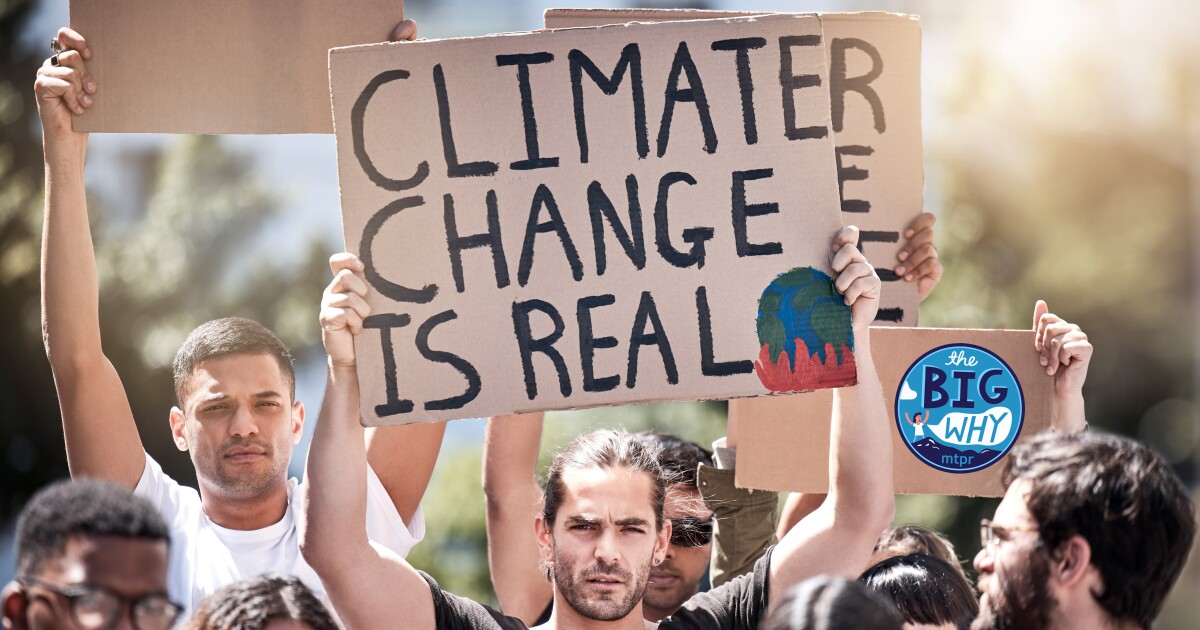
Austin Amestoy: Welcome to the Big Why, a series from Montana Public Radio where we find out what we can discover together. I’m your host, Austin Amestoy. This is a show about listener-powered reporting. We’ll answer questions — large or small — about anything under the Big Sky. By Montanans for Montana, this is The Big Why.
Today, we’re returning to the question about state and local efforts on climate change. And, joining me with more is MTPR reporter Ellis Juhlin. Hey Ellis!
Ellis Juhlin: Hey, Austin. I’m glad to be back. This is part three of our Big Why series fueled by a question from Huson-based listener Cassandra Rideg–
Cassandra Rideg: I heard a lot of hype, but I haven’t seen a lot of action.
Ellis Juhlin: –about climate change in Montana. Rideg told me she wants to know what’s being done to address climate change. So, we set out to answer that over the course of three Big Why episodes. The first discussed what the state is doing, and the second asked that same question of tribal nations and cities.
Austin Amestoy: And the third?
Ellis Juhlin: Now we’re tackling our final part of this question: What are individuals across Montana doing about climate change?
Austin Amestoy: You know, I’ve got a feeling we could spend a whole season of the Big Why answering that question.
Ellis Juhlin: I’ve been thinking the same thing. So, for this episode, imagine that we’re going to take an audio road trip. We’ll go to three parts of the state and hear three stories about people looking for solutions to climate change in their own lives, but approaching it pretty differently.
Austin Amestoy: The car’s gassed up, I’ve got the snacks — Ellis, where’s the first stop?
Ellis Juhlin: We’re headed to Red Lodge to meet two doctors who spent their careers on the Crow Reservation.
Lori Byron: Hi, I’m Lori Byron.
Rob Byron: I’m Rob Byron.
Ellis Juhlin: Rob and Lori are husband and wife. The Byrons told me they realized what they were doing to treat people in the exam room didn’t matter if they didn’t address the source of some of those health issues — things like more exposure to heat and poor air quality.
Rob Byron: When I started practice in the late 80s in Montana, we would talk to people with heart disease or lung disease about if there was a big forest fire. But as time went on, I had to start doing that sooner and much more often and involving a lot more people.
Austin Amestoy: So, the Byron’s noticed a problem. How’d they decide to act on it?
Ellis Juhlin: They started by working on education, drawing on their scientific backgrounds to teach politicians, environmental regulators and other health care workers about how climate change affects people’s health. And five years ago, they created Montana Health Professionals for a Healthy Climate.
Lori Byron: We have about 1,200 people that are signed on with us. Most of them are health care providers or health care researchers. We work to motivate them to speak out on climate, to sign petitions, sometimes to educate in the Legislature.
Ellis Juhlin: Through organizing bike rides, conferences, flying different colored flags to let people know what the air quality is in a given area, they’ve been all about raising awareness.
Austin Amestoy: So the organization started in 2019. How’s that work going five years on?
Ellis Juhlin: Well, the Byrons told me that creating their organization and expanding their network has made them and others feel a lot more hopeful about making a difference.
Lori Byron: It does give a sense of camaraderie, and it does give a sense of hope that that there are things that are happening.
Austin Amestoy: Okay, so that’s climate action through the lens of public health education. Ellis, where to next on the road trip?
Ellis Juhlin: Now we’re heading west to Missoula to meet Winona Bateman.
Winona Bateman: I have a 10-year old daughter, and I became concerned about climate change in a deep way when my daughter was 4.
Ellis Juhlin: Bateman realized there were lots of parents and caregivers looking for help just like her.
Winona Bateman: And I think a lot of parents are a little bit paralyzed about the issue because it’s not like your kid running into the street, and you run and like, move them out of the way of a speeding car, which is really clear, like what to do. It’s literally millions of things you could do to work on the issue and get involved. And that can feel hard that you can’t solve it by yourself.
Austin Amestoy: That’s interesting. It sounds like Bateman viewed climate change as this slow-moving disaster. How did she decide to take action.
Ellis Juhlin: She figured there had to be other people that were feeling the way that she was. So she decided to create an organization focused on them, looking at parents and caretakers. And she founded Families for a Livable Climate in 2019. Bateman’s group builds coalitions among nonprofits and citizen groups working to address climate change. For example, families worked with other environmental groups this spring on a project proposal to fund energy-efficient upgrades in schools that would also reduce greenhouse gas emissions.
Winona Bateman: The more we can work together, the better shot we have at making a difference.
Ellis Juhlin: Bateman’s organization is among those asking state utility regulators to consider climate change in their decisions, which some lawmakers have said should be left to the Legislature. She says her mission is creating a community to drive systemic change.
Winona Bateman: The climate crisis is a community crisis, and it’s a communications crisis. Those are the divides that we have to bridge. But what’s amazing is human beings are hard-coded to for community.
Austin Amestoy: It really sounds like a common thread we’ve heard from these folks so far is the idea of coming together.
Ellis Juhlin: That’s exactly it, Austin. That idea carries into our last story and our last stop on the trip in Livingston, where we’ll hear from a former teacher at Park High School.
Alecia Jongeward: My name is Alecia Jongeward. And when we got to what I turned into a climate change unit, the students started being like, “Ms. J, why don’t we have recycling at this school?”
Ellis Juhlin: So the kids started a recycling program that led to the creation of the Park High Green Initiative, a student environmental club. Over several years, the students fundraised to put solar panels on the school. They got federal grants for electric school busses. And this past fall they organized, funded and hosted the first ever Montana Youth Climate Summit.
Remi Sexton: And I loved meeting people from around the state that felt the same kind of anxiety that I do about climate.
Ellis Juhlin: That’s Remi Sexton. She Just graduated from Park High, where she did all kinds of climate work as part of the green initiative. But I want to zoom in to that youth climate conference. Students came together from all over the state.
Student 1: But I am more connected now than ever to my community.
Student 2: I am no longer holding the future at bay because we are building a better one.
Remi Sexton: I think that the climate movement has felt very isolated for me, especially just living in a state where things are very spread out. And I think that having that kind of introduction and feeling that unity was a big impact that the climate summit had on me.
Ellis Juhlin: Sexton told me seeing this bigger picture in Montana — that she’s not alone — has made her feel a lot more hopeful. She was also included in a group created by state environmental regulators to suggest changes to how Montana’s Environmental Policy Act includes climate change.
Remi Sexton: Inaction is the easiest way to feel overwhelmed. Since I have been starting to feel like I’m actually making a difference and feel like I am working towards something, it has felt a lot less anxiety-inducing.
Austin Amestoy: I keep hearing this sense of community and collective action.
Ellis Juhlin: Yeah, that is really something that came up time and time again through this reporting. Everyone I spoke with on this story found or worked with others to create change. And there are people all over the state that are calling for this kind of action. You’ve probably heard about one group of them that also deserves a mention here — 16 kids challenging the state’s fossil fuel-friendly policies. And their case is now before the state Supreme Court.
Austin Amestoy: Right, the Held v. Montana case.
Ellis Juhlin: Exactly. Hearings on that are beginning next month, so stay tuned for future coverage.
Austin Amestoy: Ellis, this series of climate “Big Whys” has truly been a joy to unpack with you. Thank you so much for all your reporting over these three episodes.
Ellis Juhlin: Thank you too, Austin. It’s been fun to dive into it.
Austin Amestoy: Now we want to know what makes you curious about Montana. Submit your questions below. Find us wherever you listen to podcasts and help others find the show by sharing it and leaving a review. Let’s see what we can discover together!


Where Khloe Kardashian Stands With Ex French Montana More Than 10 Years After Breakup
French Montana is done keeping up with reality TV.
In fact, he only agreed to appear on Keeping Up With The Kardashians and Kourtney & Khloé Take the Hamptons over a decade ago as a favor to then-girlfriend Khloe Kardashian.
“She said to get on the show,” he exclusively told E! News at the BET Awards on June 28. “And I got on the show. Shout out to Khloe.”
The “Ever Since U Left Me” rapper, who split with Kardashian in December 2014 after eight months of dating, said the experience was “fun” because her family kept it real.
“They filmed their real life,” he continued. “And we were part of something together that one time. So it felt great. It didn’t feel like work because they film what they do everyday.”
As for his future in reality TV, the 41-year-old said those days are over, shutting down any prospective offers with a simple, “Negative.”
Although the “Unforgettable” artist—whose real name is Karim Kharbouch—may not be returning to television anytime soon, he has no problem hanging out with his ex-girlfriend these days.

French Montana, Rick Ross & Max B Turn the BET Awards Into “
06/28/2026
More

GREAT FALLS — For Staff Sgt. Brianna St. Lawrence-Brody, service does not only happen in uniform.
Outside the gates of the base, she works at Benefis as a nurse, Great Falls Public Schools as a school nurse, and comes home as a wife and mom of four. For the Montana Air National Guard, she serves as a command post controller with the 120th Airlift Wing in Great Falls.
(WATCH: Montana nurse and Guard member earns national Air Force recognition)
Montana nurse and Guard member earns national Air Force recognition
This year, St. Lawrence-Brody was named the U.S. Air National Guard’s Outstanding Airman of the Year in the Non-Commissioned Officer category.
She said the recognition came as a surprise, especially because her path into the Guard started later than others.
“I joined very late in life,” St. Lawrence-Brody said. “I joined the Guard right before I turned 40. So for me, every opportunity that’s presented, I want to take the bull by the horns and just run with it and do the best of my ability.”
During the COVID-19 pandemic, she joined the Guard after finishing nursing school. She said she went straight from nursing school into helping open a COVID unit, while also working at Benefis.
She said that experience was the start of one journey, but not the whole of what she wanted to accomplish.
St. Lawrence-Brody joined the Guard for the opportunities, the challenge and to help build a future for her four children.
“It’s a little bit of a competition for myself,” she said. “Like, if I can do it, why not try my best to achieve it?”
120th Airlift Wing Public Affairs
As a command post controller, she assists in helping move information during emergencies and major events.
“Outside, obviously, I’m a nurse. Inside the Guard, I have nothing to do with the medical field, which is kind of amazing,” St. Lawrence-Brody said. “It keeps me on my toes.”
She explained balancing the Guard, two civilian jobs and four children takes support from her family, her employers and her unit. She said Benefis and GFPS have been supportive of her military service.
Her nomination included her deployment experience, training work overseas and involvement across the wing. St. Lawrence-Brody said she deployed to Ramstein Air Base in Germany, where she worked with an operations center supporting entities connected to Africa.
But, she says this recognition is not the finish line.
“This award, it’s not necessarily a landing pad for me,” St. Lawrence-Brody said. “I want to use it as a springboard.”
120th Airlift Wing Public Affairs

St. Lawrence-Brody hopes her story encourages others to keep taking on new opportunities, even when they feel uncertain.
“Get comfortable with being uncomfortable and be okay with doing things afraid,” she said. “I think when you get to be okay with doing things afraid, that’s where you’re going to find the growth.”
She has already won at the Air National Guard level, but she recently traveled to Washington, D.C., as part of the broader Air Force Outstanding Airman of the Year process, which includes nominees from the Guard, Reserve and major commands across the Air Force.
-

 Culture12 minutes ago
Test Your Knowledge of New York’s Algonquin Round Table
-
 Lifestyle17 minutes ago
They were world-class tennis rivals. Now friends, they’ve teamed up against cancer
-

 Technology27 minutes ago
T-Mobile is booting customers from its oldest plans
-

 World32 minutes ago
Gunman kills 6 at youth welfare facility in suspected child custody dispute: reports
-

 Politics39 minutes ago
Emotion and feelings: How Democratic Socialists’ congressional insurgency could come back to bite them
-

 Health42 minutes ago
Rare tick-borne virus turns deadly fast as US cases reach record high, experts warn
-

 Sports47 minutes ago
Lions release Terrion Arnold after bond set at $1 million in armed robbery, kidnapping case
-

 Technology54 minutes ago
Texas data breach hits 3M license customers

