Montana
Understanding the Pesticide Problem in Montana’s Waterways – Flathead Beacon


Are pesticides a problem in Montana’s waters? How many of these chemicals, which include insecticides, herbicides, fungicides and more, commonly used on lawns and farms alike, have made their way into our waterways? How can we still control pests and keep our waters clean for future generations? The Pesticide Stewardship Partnership Program (PSPP) is an ambitious initiative led by assistant research professor Dr. Rachel Malison at University of Montana, Flathead Lake Biological Station (FLBS) and is funded by a U.S. Environmental Protection Agency grant. The PSPP is working to answer these questions in western Montana — the headwaters of the Columbia River Basin. To chart a course for sustainable pest management in Montana’s future, Malison said, the program aims to build a network of partners, collect data to detect if pesticides are in Montana waterways, and to provide education on sustainable pesticide practices and alternatives, and more.
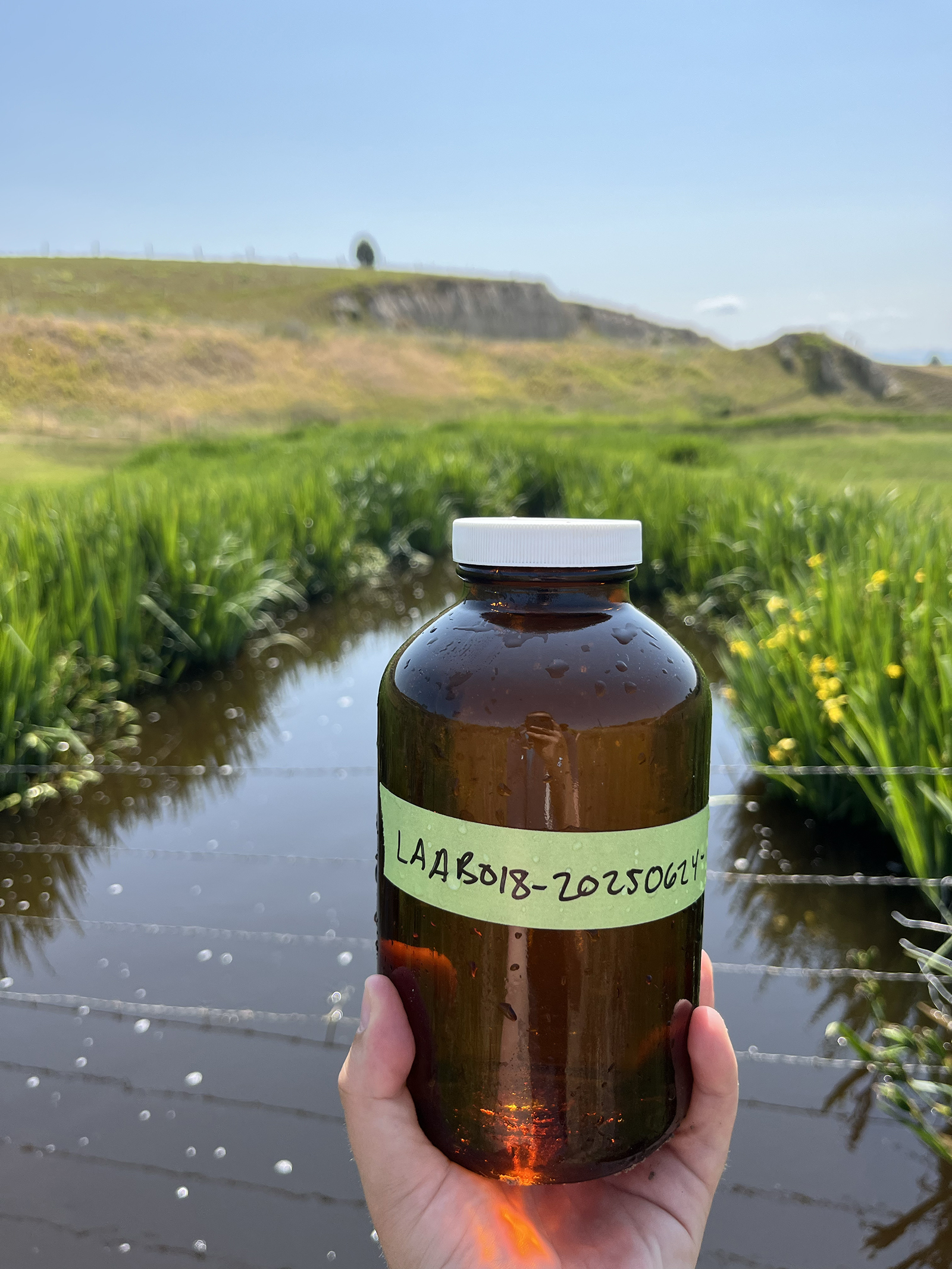
This story starts in the field. Big Sky Watershed Corps member Chloe Czachor, who is serving her term at FLBS with PSPP, carefully pulls her weathered FLBS expedition off a gravel road near Ronan, Montana. The nearby irrigation ditch will be her fifth sampling stop of the day, another step in her largely solitary journey to collect samples from western Montana waterways that will be used to test for the presence of pesticides. In its first year of sampling, the PSPP is aiming to collect around 650 samples from rivers, streams and other waters in Montana’s portion of the Columbia River Basin. Most of these waterways have never been sampled for pesticides before, Czachor said, and whether they are contaminated with pesticides is unknown.
Czachor unloads her gear from the back of the vehicle, including an instrument that measures water characteristics like temperature and pH, a large glass bottle and water-resistant notebooks, and carries the gear over to the ditch which eventually flows back into the river. The instrument’s probe goes in the water to start measuring while Czachor wades into the stream and fills the bottle with water. After writing in the site name and location, Czachor enters the instrument’s readings into the notebook before pulling it out of the water. Then, she hauls her gear back to the vehicle, finds the next stop on Google Maps and starts driving again.
Later, at the PSPP team’s base at the FLBS, Czachor unloads the coolers filled with water sample bottles from her latest sampling run. These samples will join hundreds of others that the PSPP has gathered so far from across western Montana. Samples are delivered once a week to the Montana Department of Agriculture Analytical Laboratory in Bozeman, which analyzes each sample for 103 pesticide compounds. This is only a fraction of the number of different pesticides used in Montana, Czachor said, but detecting the presence of these chemicals can also indicate that other chemicals might also be present.
Czachor’s sample collecting work started in April. As the team’s main sample collector, she said that she has driven all over western Montana while sampling. Staff from FLBS and other volunteers are able to help Chloe sample part of the time, but she is leading the effort.
The travel takes a physical toll, Czachor said. “It’s long hours and I definitely need to be doing more yoga after how wrecked my body feels after being that long in the car. … These cars are so old, there’s no sort of lumbar support in the seats.” However, she said that she doesn’t mind when she is alone for so long on sampling runs. “I’m an introvert at heart,” she said. “I have my music and I have my podcasts and my audiobooks.” Sometimes, Czachor said that she calls friends while on long sampling drives. On the longest days, she said she focuses on the value of the experience for her career in conservation and on the unique opportunity of helping build a large-scale pesticide monitoring program where none existed before. “I’ve seen some pretty incredible places through this work, places that I would have never known existed. As someone new to Montana, I can’t think of a better way to see so much of the state. And to be seeing these beautiful places and know that I’m helping to protect them in some way is very rewarding,” Czachor said.
Czachor’s travels are guided by Research Coordinator Janelle Groff and Research Scientist Diane Whited. Together, they developed the maps of pesticide sampling sites the program uses and create the routes that Czachor and others travel each week on sampling trips. Whited used a variety of geospatial data to create maps of how likely waterways are to be contaminated with pesticides, based on different land uses and their proximity to surface water. Using these risk maps, the team then randomly created a roster of potential sampling locations on waterways with varying risks of pesticide contamination and near a range of land uses, from agriculture to residential areas to National Forests.
The sampling effort is divided into different types of sites, Groff said. Even though the program will collect many samples, the large area and variety of land uses the program aims to monitor mean that a limited number of samples can be collected at each site. However, pesticide concentrations can change over time as different pests emerge on nearby lawns and farms, stream flows rise and fall, and other seasonal changes shifts occur. PSPP monitors a broad area while also tracking changes in pesticide concentrations over time by dividing monitoring into three types of sites, Groff said. At a small set of focal sites, samples are collected every two weeks or once a month to detect potential changes over time. The larger set of baseline sites are only visited once or twice a year but span a much broader area. Focal and baseline sites are located on waterways at high risk of pesticide contamination. Together, these sites allow the program to monitor a large geographic area and understand changes over time, Groff said. In addition to testing focal and baseline sites, she said the program also tests reference sites, which are located in areas with low chances of pesticide contamination, like stream locations in National Forest or near remote headwaters. The results from these samples, which should show very low levels of pesticides, help substantiate that the testing regimen is accurate and provide data on baseline pesticide levels in the environment, Groff said.
Using this roster of potential sampling sites, Groff builds routes for Czachor to follow on her weekly trips. She said that building these routes involves Google Maps and “a lot of zooming” since she must ensure that Czachor can safely park her vehicle near each site and can physically reach the water. Groff also provides a list of alternative sites for each of Czachor’s trips, in case a site is inaccessible or the stream or ditch is dry when she reaches it.
The sampling effort just launched in the spring of 2025, Groff said, and extensive data will likely not be available for some time. In the future though, she said that this data will help Montana residents understand and address pesticide contamination in their waters by identifying where it is occurring and what pesticides are involved. The fate and transport of pesticides from land to water is very complex because there are so many pesticides and they have different characteristics, which means that some reach water more easily than others. The data collected will help individuals understand the water conditions around them and guide larger scale collective efforts to reduce the amounts of pesticides in the water, Groff said. She also said that knowing where pesticides are common in the water will help guide education about pesticide use, another key part of PSPP’s mission.
On a rainy and cold day on Flathead Lake, Rachel Malison stands by the rail of the boat and speaks to the small crowd about the PSPP program and the importance of using good stewardship practices to control pests. Malison is speaking at the annual FLBS Research Cruise, where people from neighboring communities can learn about research at the station and see demonstrations while cruising Flathead Lake on the chartered boat. Malison explains to the group that the available tools for controlling pests are like a Swiss Army knife, and that people tend to pull out the pesticides first to tackle a pest problem, like they pull out the knife first even though another tool might be just as or more effective. She says that sustainable pest management requires using all the tools available in a careful and judicious manner, including proper use of pesticides, to keep pests controlled and waters clean.
Opportunities like this are part of the PSPP’s broader educational project, Malison said. PSPP uses both direct outreach, like speaking at the Research Cruise or giving presentations to homeowner’s associations, and indirect outreach through partners like the Montana Watershed Coordination Council to spread information about proper pesticide use and best stewardship practices, she said. The education work also covers important water science concepts, like the idea that water moves pollutants, including how large rain events or excessive lawn watering can move chemicals on the land into the groundwater or nearby streams. “For a lot of the outreach and education, we’ve been realizing that we need to start by sharing more about how water moves and how our actions influence what is carried with that water when it’s moving” she said. This education is “trying to help people know that there are more options to pest management and that their actions can make a difference,” Malison said.
“That part of the program is going to grow and continue to get bigger as the program progresses,” Malison said, with PSPP being only in its second year. She said that the program is developing more outreach materials and going to more events, like the Northwestern Agricultural Research Center Field Day or the Bigfork Monday Market. The pesticide sampling work will help guide this outreach, she said, letting the team identify areas with particularly high levels of pesticides and target outreach to the have the maximum impact. “If we find pesticides in waters near different land uses, we can share that information with people and also provide ideas on how land uses could be modified to help protect our waters,” Malison said.
These outreach efforts have already had impacts, said Malison, such as one homeowner’s association that it now considering a buffer strip between its lawns and nearby ponds to reduce the movement of pesticides into the water after hearing a talk from her. Although reaching everyone or making large changes to pesticides use may be difficult, Malison said that even small changes, like spraying lawns twice a year instead of four times, can reduce the amount of chemicals that enter the water.
For Malison, this work has personal meaning. “We live here, I have children, I want their children to have healthy rivers and functioning ecosystems too. We produce chemicals and we use them, it’s not just going away, so we need to make the best decisions we can to protect our waters.”
Josh Pike is a Missoula-based environmental journalist with a focus on water issues. He works as a journalism intern for the Flathead Lake Biological Station.



Montana
Escobar, Jayapal, Members of Congress Call on Camp East Montana to be Shut Down – Congresswoman Pramila Jayapal

(Washington, D.C.) – Today, Congresswoman Veronica Escobar (TX-16) – joined by Representative Pramila Jayapal, the Ranking Member of the Immigration Integrity, Security, and Enforcement Subcommittee, and 22 other Members of Congress – sent a letter to Department of Homeland Security (DHS) Secretary Kristi Noem and Immigration and Customs Enforcement (ICE) Acting Director Todd Lyons calling for the immediate closure of Camp East Montana in El Paso. They cite urgent humanitarian concerns following multiple deaths in custody, documented unsafe conditions, and serious deficiencies in medical care.
This marks the fourth letter Congresswoman Escobar has sent to DHS and ICE leadership. The previous three letters have gone unanswered.
The letter can be found in its entirety below and here.
“Secretary Noem and Acting Director Lyons:
We are urgently calling on the Department of Homeland Security (DHS or the Department) and U.S. Immigration and Customs Enforcement (ICE) to shut down Camp East Montana in El Paso, Texas.
Camp East Montana has been operational for six months, and at least three people have died at the site since December 2025: Francisco Gaspar-Andres, Geraldo Lunas Campos, and Victor Manuel Diaz. The El Paso County Medical Examiner has officially ruled Lunas Campos’ death a homicide, citing “asphyxia due to neck and torso compression.”
Camp East Montana was constructed in a matter of weeks and opened before construction was complete and it does not have enough federal staff on-site to provide adequate oversight. Over the last several months, Congresswoman Veronica Escobar, in whose district this facility is located, has sent multiple letters to DHS and ICE regarding concerns about the conditions at Camp East Montana, and has received no responses.
According to detainees, there have been constant and consistent problems at the facility since it opened, beginning with the facility’s poor construction and poor ambient temperature control. Upon opening, the drinking water at Camp East Montana tasted foul and made some detainees sick. Detainees continue to be served inadequate meals, including food that is rotten or frozen; last fall, the facility was also consistently failing to make dietary accommodations for detainees. Detainees have shared that they have sporadic access to outside spaces and recreational areas, and that their dormitory pods are cleaned only once every eight days, despite pods housing up to 72 people at a time. Laundry services are not consistent, and people are washing their clothes in the facility showers. Additionally, the facility experiences flooding and sewage backups when it rains, leading to stagnant water.
One of the biggest concerns with the Camp East Montana facility is the inadequate medical care being provided to detainees. Our offices have heard that only the most ill detainees are referred to the medical unit and that there are inconsistencies as to how soon after arriving detainees are able to undergo initial medical screenings. Detainees with chronic health issues who rely on regimented medications for their health have had difficulty accessing necessary medications, including blood pressure medication and insulin.
At least one of the deaths that occurred in ICE custody, the death of Francisco Gaspar-Andres, appears to partially be the result of poor medical care by staff at the facility. According to ICE’s own account, Gaspar-Andres sought medical attention from facility staff for increasingly serious symptoms, but was only transferred to an area hospital once his condition had severely deteriorated.
In addition to our concerns about poor medical care, we are also aware that detainees have experienced irregular access to their legal counsel, including instances of detainees having only two minutes allotted per phone call every 8 days, which is contrary to ICE’s Detention Standards on access to counsel, and that the belatedly created law library lacks adequate resources for the amount of people currently held at the facility. In January 2026, ICE announced the on-site death of Geraldo Lunas Campos “after experiencing medical distress.” ICE opened an investigation into the death, but did not provide a cause of death. However, The Washington Post later reported that another man detained at Camp East Montana had witnessed guards choking Lunas Campos when he refused to enter a segregated housing unit. Weeks later, the El Paso County Medical Examiner ruled that Lunas Campos had experienced “asphyxia due to neck and torso compression” and ruled his death a homicide.
Lunas Campos is the first detainee to die at Camp East Montana as a result of a use-of-force incident, but we are strongly concerned that he will not be the last if ICE is allowed to continue operating Camp East Montana.
ICE was given $45 billion in taxpayer dollars in the reconciliation bill, $1.2 billion of which were awarded to Acquisition Logistics, LLC, a company with no previous experience managing immigration detention facilities, to build and oversee Camp East Montana. However, in the wake of three deaths in custody so far, continued concerns about conditions at the facility, and ICE’s apparent disinterest in responding to oversight letters from Congress, we do not believe Camp East Montana is being run professionally or responsibly.
Camp East Montana must be shut down. For the safety of everyone at the facility, for an end to abuses to detainees, and for fiscal responsibility to the American people, the site cannot continue to operate. We are calling on DHS and ICE to move to immediately close operations at Camp East Montana.
We look forward to hearing from the Department promptly on this matter.
The other co-signers include Representatives Yassamin Ansari, Nanette Barragán, Yvette Clarke, Lloyd Doggett, Maxwell Frost, Jesús “Chuy” García, Sylvia Garcia, Daniel Goldman, Jimmy Gomez, Henry Johnson, Stephen Lynch, Seth Moulton, Eleanor Holmes Norton, Delia Ramirez, Andrea Salinas, Janice Schakowsky, Darren Soto, Rashida Tlaib, Paul Tonko, Lauren Underwood, Gabe Vasquez, and Nydia Velázquez.
Issues: Immigration

We recognize you are attempting to access this website from a country belonging to the European Economic Area (EEA) including the EU which
enforces the General Data Protection Regulation (GDPR) and therefore access cannot be granted at this time.
For any issues, contact newsroom@abcfoxmontana.com or call 406-542-8900.

Feeding South Dakota

Trump touted gas prices under $2.30. Tennessee gas prices say otherwise

North Texas middle school closes after a norovirus outbreak

Utah man dies of injuries sustained in avalanche in Big Cottonwood Canyon

Here are five places to ice skate in Vermont this winter

Florida High School Football Rankings: Top 25 teams – Oct. 21

Cleary's 21 help Le Moyne down Central Connecticut State 69-64 in OT

How old is Bo Nix? What to know about Oregon quarterback ahead of 2024 NFL Draft

99th annual Pony Swim held in Virginia

Indiana Members Credit Union announced as new anchor tenant at Bottleworks District

Where Iran’s ballistic missiles can reach — and how close they are to the US

Has India’s influence in Afghanistan grown under the Taliban?

Bill Clinton to testify before House committee investigating Epstein links

Read Judge Schiltz’s Order

Vulnerable House Dem lashes out at Trump’s ‘racist’ SOTU challenge: ‘That was uncomfortable’
-

 World2 days ago
Exclusive: DeepSeek withholds latest AI model from US chipmakers including Nvidia, sources say
-

 Massachusetts2 days ago
Mother and daughter injured in Taunton house explosion
-

 Montana1 week ago
2026 MHSA Montana Wrestling State Championship Brackets And Results – FloWrestling
-

 Oklahoma1 week ago
Wildfires rage in Oklahoma as thousands urged to evacuate a small city
-

 Louisiana4 days ago
Wildfire near Gum Swamp Road in Livingston Parish now under control; more than 200 acres burned
-

 Technology6 days ago
YouTube TV billing scam emails are hitting inboxes
-

 Denver, CO2 days ago
10 acres charred, 5 injured in Thornton grass fire, evacuation orders lifted
-

 Technology6 days ago
Stellantis is in a crisis of its own making