Montana
Montana Is a Frontier for Deep Carbon Storage, and the Controversies Surrounding the Potential Climate Solution – Inside Climate News


A new project aims to take carbon dioxide pollution, likely from two natural gas processing plants in Wyoming, and store it thousands of feet underground beneath the wide-open prairies of southeastern Montana.
The project, currently in the final phase of public input, comes as new federal pollution rules prioritize capturing and storing the climate-warming gas emissions from fossil fuel-burning plants to prevent them from entering the atmosphere.
The Snowy River Carbon Sequestration Project in Carter County is the first in Montana to use the space under federal public lands as a storage vessel for greenhouse gas emissions. The new federal rules could lead to much more storage in the decades ahead.

Explore the latest news about what’s at stake for the climate during this election season.
But the potential climate solution has been criticized by scientists and policy experts who claim the reductions in atmospheric concentrations of greenhouse gases the technology could bring have been significantly overstated. In the meantime, ranchers, conservationists and nearby residents are concerned about the impacts the projects’ pipelines and injection wells will have on the landscape and the potential for accidents and contamination.
“This project is going to change our way of life here forever,” said Jack Owen, a rancher in Carter County who leases from the Bureau of Land Management on the southern side of the project area and is also a member of Save Native Range, a small group of community members who have come together to oppose the project.


“Our native range is composed of indigenous plants,” he said. “They’re going to bring bulldozers, roads, Caterpillars and trucks. When they’re done, the area will be nearly taken over by invasive species.”
Other residents worry about possible disruptions to cattle grazing, impacts on water resources, damage to roads and infrastructure, potential health risks from pipeline explosions for humans and wildlife, threats to sage grouse populations and the possibility that the project might drive down property values.
Owen is concerned about the devaluation of his private properties surrounded by the project area.
“People don’t want to live near fossil fuel activities,” Owen said. “If I want to sell some of my land in the future, I worry, it won’t have the same value.”
Private CCS Projects, Public Land
In April 2024, the Environmental Protection Agency implemented a new rule aimed at curbing greenhouse gas emissions from fossil fuel power plants. Specifically targeting coal-fired plants scheduled to operate beyond 2039 and new or modified gas-fired plants, the regulation mandates the adoption of the best available emissions reduction technology and requires these plants to use carbon capture and sequestration technology (CCS) to capture 90 percent of their carbon dioxide emissions.
The Snowy River project is owned by a subsidiary of Exxon Mobil. Over 20 years, the project plans to store 150 million tons of carbon dioxide, which some sources have indicated will come from two natural gas processing plants in Wyoming: Exxon’s Shute Creek plant and the Contango plant in Lost Cabin. The BLM concluded its public comment period for the environmental assessment of the project on May 17 and is currently reviewing the submitted comments.
To accommodate the infrastructure necessary to move and store the CO2, which often requires extensive amounts of land, the federal Bureau of Land Management is providing rights-of-way for CCS projects. “This policy is an important tool to help the BLM combat the climate crisis and supports the Biden-Harris Administration’s goal of reaching net zero emissions economy-wide by no later than 2050,” BLM Director Tracy Stone-Manning said when the BLM published its policies for geologic carbon storage in June 2022.
That year, the agency approved the first private CCS project on public land—Exxon Mobil’s operation at Shute Creek, Wyoming, which stores carbon from Exxon’s adjacent natural gas processing plant. This is also one of the two plants in Wyoming that will send carbon dioxide to the proposed CCS plant in Carter County. Since then, four other CCS projects have been proposed on BLM land—three in Wyoming and one in Montana.


On a federal level, momentum grew for CCS with the expansion of the 45Q tax incentive under the Inflation Reduction Act of 2022. This incentive, initially established in 2008, was enhanced through the IRA, providing fossil fuel companies with an $85 credit for each ton of carbon stored underground.
Such initiatives are gaining traction in states that have embraced robust legal frameworks to support CCS.
In 2009, Montana enacted a forward-looking carbon sequestration and management regulation law. Former Montana State Rep. Keith Bales, who sponsored the bill during his tenure from 2007 to 2011, said his goal was to nurture a new industry as the coal sector declined.
“In this case, I wanted to ensure that if a mandate for carbon sequestration materializes, there would be a structured framework enabling companies to proceed,” Bales said.
Usually, the Environmental Protection Agency oversees Class VI injection wells—the type designated for CCS projects to inject CO2 into deep rock formations. However, Wyoming obtained federal “primacy” in 2020 to regulate its own CCS industry, a pioneering move nationwide. That same year the state enacted legislation mandating Wyoming power plants using fossil fuels to incorporate carbon capture by 2030, further incentivizing companies using coal and gas to generate electricity to develop CCS infrastructure and expertise.
The alignment of the new Biden administration rule, financial incentives, evolving regulations from government agencies facilitating rights-of-way and state governments’ pursuit of new opportunities for fossil fuel-dependent economies have created a pivotal moment for CCS.
Realities On, and Under, the Ground
Carter County, in the extreme southeast corner of Montana, borders Wyoming and South Dakota. Denbury Inc., an Exxon subsidiary and Montana’s larger producer of crude oil, plans to inject 150 million tons of CO2 below the surface of BLM lands there.
Denbury’s 105-mile-long Cedar Creek Anticline pipeline currently transports CO2 from the Shute Creek plant in Wyoming through Carter County north to Fallon County, Montana. There the carbon is used to force oil to the surface at Denbury’s Coral Creek oil field, a long-established technique known as enhanced oil recovery.


The Snowy River CCS plan calls for Denbury to send additional carbon dioxide through the Cedar Creek pipeline to be drawn off and stored before it reaches Fallon County. This storage is solely for Exxon to earn a tax credit from the federal government for managing its carbon emissions instead of releasing them into the atmosphere.
Denbury plans to lease about 100,000 acres of land and porous space from the BLM for 30 years to store CO2 underground, but the carbon would be stored, the project proponents hope, in perpetuity. After Denbury’s lease expires, the Environmental Protection Agency will continue monitoring, as they are the authority to permit the injection wells.
The proposed Carter County site was chosen by Denbury due to the availability of vast uninterrupted public land, which comprises 92 percent of the area. Factors such as geological formations, existing pipelines and environmental considerations such as impacts on sage grouse habitat and other wildlife, invasive weeds, sediment levels in water bodies, and topsoil management were found to be minimal.
Carter County is flat, dry and sparsely populated, with an average of about three residents per square mile across its approximately 3,500 square miles. Anyone driving a car is assumed to be an outsider and it’s a rarity to see more than one vehicle on the road at a time. Traveling through the area can evoke a sense of desolation in visitors, yet it offers glimpses of the classic Montana culture, with cowboys crossing the highway on horseback. Known for its expansive skies, vast flatlands and low hills, the community embraces isolation and self-sufficiency, fostering a tight-knit bond where everyone knows each other.
Although the Snowy River project has been in the works for three years, few people in Carter County have a solid understanding of what Denbury is proposing and many feel excluded from the process. Traditionally, ranchers and farmers in the area have regarded the BLM as stewards of the land, but they perceive a growing conflict of interest as the agency prioritizes infrastructure projects, particularly those supported by fossil fuel companies.
Liz Barbour, who manages a ranch on the eastern side of the project area, pressed the BLM to conduct an Environmental Impact Statement, which the agency declined to do, stating the project would not have a significant impact. In response, Barbour has made multiple trips to Washington, D.C., this year to lobby against the Snowy River project.
“BLM already has a no surface occupancy stipulation on that specific piece of land for sage-grouse habitat,” Barbour said. “It doesn’t matter if you’re putting in oil wells or a theme park.”
Supported by the Northern Plains Resource Council, an organization that brings farmers and ranchers into discussions about environmental and climate issues, Barbour has met with Stone-Manning—the director of the BLM, as well as the director of the BLM in Montana, and nearly all Montana legislators. So far, she hasn’t received a response from any authority that convinces her of the safety of the project.
“I partner with the land every day and feel it’s my responsibility to protect it,” she said. “We have demanded the BLM conduct an EIS so that we can assess the exact impact of this project on our environment.”
Mike Hansen, a third-generation rancher in Carter County, has properties on the southeast side of the project area. Approximately 8,000 acres of his private property are adjacent to the proposed project areas, and he also holds a BLM grazing lease on 4,000 acres within the project boundaries.
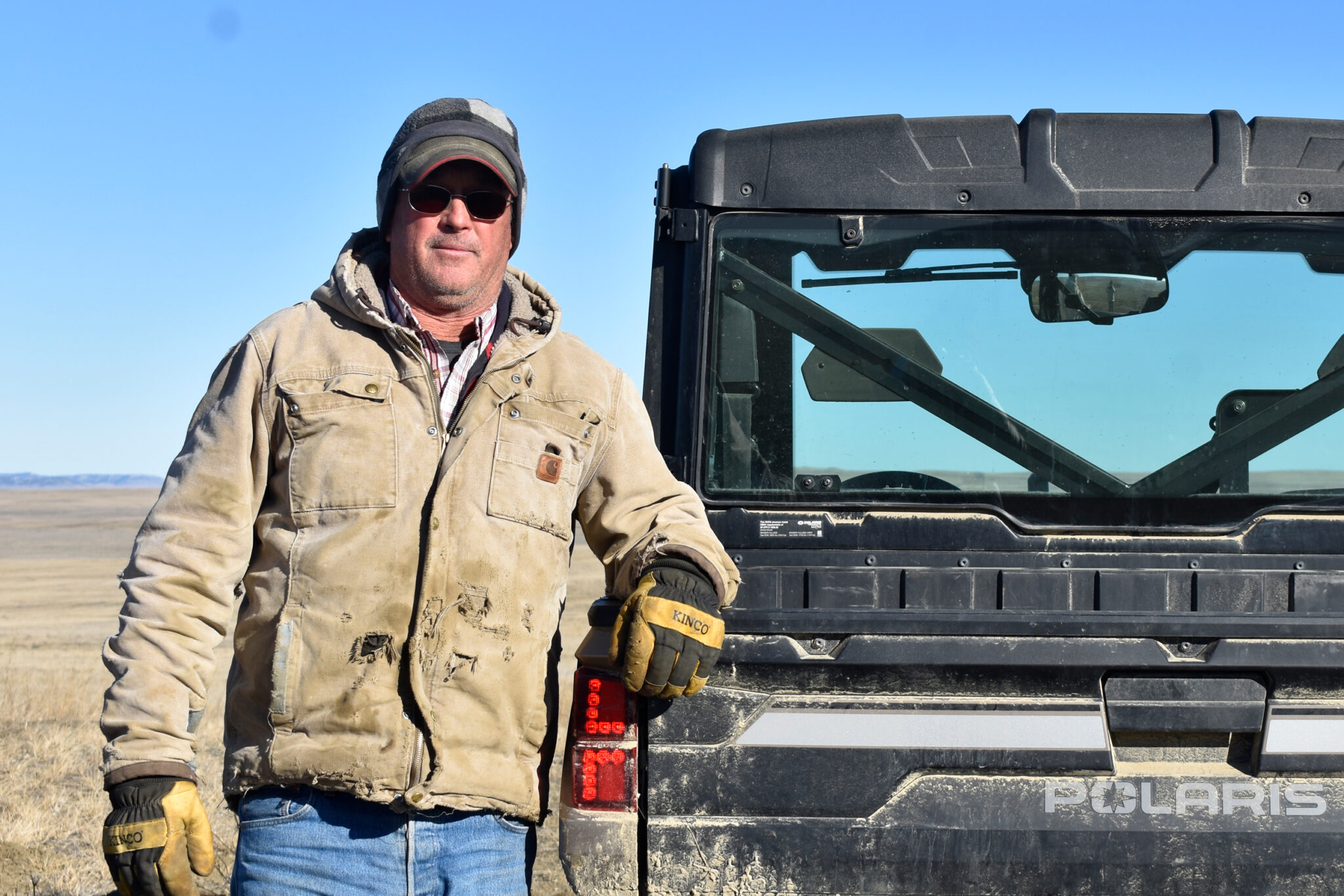
Denbury plans to construct 15 injection wells to sequester carbon underground. Four of these wells, a seismographic drill and a testing well to gather geological information about that area are planned on land Hansen leases from the BLM.
He is concerned the impact of drilling will contaminate the surface water. He owns three reservoirs that are vital for cattle watering, two of which are adjacent to proposed drilling sites. “If stuff from underground surfaces, what’s going to happen to my water supply? How am I going to water my cows?” Hansen said.
Another rancher, Jerry Keith, relies solely on groundwater to irrigate his lands and provide water for his cattle through pipelines spanning his ranch. One of his water wells is located 4 miles away from one of the proposed injection sites and he worries Denbury drilling may disrupt his water supply.
“You can’t drill to get water because there is no water down there,” Keith said of the area to which he pipes water. “So, we have to pipeline it to the cattle and the building and everything else. We’ve got almost 15 miles of pipeline on the ranch.”
John LaFave, research division chief of the Montana Bureau of Mines and Geology and a professor at Montana Tech, believes there is little risk of groundwater being seriously impacted by the project. The geologic formation of the proposed project area differs from most of the county, he said, with no bedrock aquifers existing beneath the surface. At the project site, the surface primarily consists of shale formed from compacted mud and clay, which acts as a barrier or seal for water and other fluids.
“These deep injection projects are counting on the impermeable seal rocks to prevent anything from going up,” LaFave said. “From that point, the risk to groundwater resources seems pretty minimal.”
More Pressures on an Already Threatened Bird
It’s not just people who have a problem with the project.
Construction for energy development projects can directly impact sage grouse, an important upland game bird in Montana that’s designated as a sensitive species. To draw carbon off of the existing Cedar Anticline Pipeline, the Snowy River project will construct 40 miles of new pipelines in Carter County, a crucial area for sage grouse habitat conservation.
A 2011 study conducted by researchers from the University of Montana on the effects of energy development on sage-grouse populations found that disturbances during the breeding season, such as noise, vehicle traffic or power lines, can lead sage grouse to abandon their breeding grounds.
After analyzing coal and natural gas extraction infrastructure in the Powder River Basin of Wyoming and Montana between 2001 and 2005, researchers observed a more rapid decline in male sage-grouse populations in areas with energy development compared to those without. In development zones, only 38 percent of sage grouse breeding grounds remained active, in contrast to 84 percent in undeveloped areas.
“I’m worried about all the power lines and construction that would pass through these lands,” said Doug Bomsell, a member of the Carter County Conservation District. “Habitat disruption and noise really bother the birds, especially during nesting season.”
Denbury has pledged to limit activities during sage grouse nesting season, typically from March to June. However, the company acknowledges the challenge of completely avoiding disturbances in sage grouse habitat. Consequently, Denbury has proposed protecting sage grouse habitat elsewhere in Montana to make up for potential impacts related to the Snowy River CCS project, said Therese Hartman, program manager of The Montana Sage Grouse Habitat Conservation Program.
Whether such offsetting programs really work to protect wildlife is another question, but some conservationists see climate change as an even bigger threat to the birds than construction disturbance. They believe that amid the long-standing decline in sage grouse populations, the sage grouse credit system presents an experiment for conserving their habitat in the long term.
“We already have extensive negative impacts occurring to sage grouse habitat from active fossil fuel development,” said Ben Deeble, president of the Big Sky Upland Bird Association, which works to enhance upland bird habitat in Montana. The CCS project in Carter County “is more than likely to damage the habitat further, even though it may have a global climate benefit. I guess if you’re going to damage wildlife habitat, I’d rather do it with something that has a potential global benefit than continuing just on the same pattern of atmospheric destruction.”
Locals are also concerned about potential damage to existing roads or the creation of additional roads around their grazing lands. The project plans to use approximately 25 miles of existing roads and 27 miles of two-track routes over a mix of BLM, county and private lands.
Tom Sieg, a rancher with properties on the northern side of the project, questioned why the BLM is granting rights-of-way for large-scale construction while imposing stricter restrictions on ranchers for wildlife and other environmental considerations.
“I guess if you’re going to damage wildlife habitat, I’d rather do it with something that has a potential global benefit than continuing just on the same pattern of atmospheric destruction.”
“We can’t even drive on it, and they’re going to put roads, wells and pipelines too?” Stieg said “What’s the deal?”
He believes the project will further restrict grazing, potentially leading to conflicts between ranchers and project personnel, and fears that Denbury doesn’t respect the traditional ranching lifestyle.
“If they can pump it in the ground and it wouldn’t cause a problem, why don’t they pump it in Wyoming where it came from?” he asked. “I don’t want them messing around here in the middle of our BLM land.”
A Troubling Legacy
Denbury, which has operations along the Gulf Coast as well as in the Rocky Mountain West, has faced scrutiny for various incidents. In February 2020, a leaking Denbury CO2 pipeline exploded in Satartia, Mississippi, the first such incident officially reported in the country, causing 49 hospitalizations and the evacuation of 300 residents. The U.S. Pipeline and Hazardous Materials Safety Administration fined Denbury $2.8 million, citing its lack of preparedness for hazards, delayed notification of local authorities and inadequate community education regarding the pipeline’s presence.
In April, another leading pipeline in Sulphur, Louisiana leaked more than 2,500 barrels of CO2, triggering an emergency response in the former mining town.
Carter County residents worry about similar hazards.
“I wonder how much pressure will be forced out underground, since they will be putting the CO2 so deep underground,” Keith said. “When that blows out, that could be a major catastrophe.”


Exxon and its subsidiary, Denbury, did not respond to requests for comments regarding the residents’ concerns.
But leaks may not be the most significant risk associated with CCS projects, said Brian McPherson, who directs the Carbon Science and Engineering Research group at the University of Utah. CO2 plumes move slowly even under extreme conditions, he said, which slows the rate at which it can travel to potential leakage points, such as wells or faults, and limits the amount of the gas that can escape.
“If the sites are monitored and the potential leakage points are monitored and tracked, the safety associated with leakage is very tractable,” he said.
Induced seismicity—earthquakes caused by the process of pumping the CO2 underground— poses a more significant threat, he believes. These earthquakes, common in oil and gas fields, result from changes in fluid pressure underground and can be small and undetectable. And, unlike oil fields, CCS projects lack the financial incentive to maintain precise pressure control across their underground storage space, he said.
“In every well and every spot in the reservoir, oil companies spend billions of dollars to maintain that control because it means trillions of dollars across the sector,” McPherson said. But, even with the federal incentives, and the EPA designated to monitor the projects, fossil fuel companies have little motivation to adhere to monitoring and policy regulations without a profitable resource to pull up from underground, rather than something to dispose of there.
“For oil companies tax credits like 45Q are a net liability, not an asset,” he said. “It’s a high-risk endeavor and the first big earthquake that occurs associated with CO2 injection will destroy the entire operation.”
Denbury already faces allegations of irresponsible land stewardship in Montana. Tom Giacometto, a rancher from Broadus in Powder River County, adjacent to Carter County and home to one of Denbury’s enhanced oil recovery units, is suing the company for damages he alleges it caused on his property, which borders the facility. In two lawsuits filed in 2016 he sought financial compensation for the destruction of one of his cattle reservoirs, health hazards and hindrance to property use and residents’ comfort caused by the operation. Another lawsuit filed in 2022 cites 16 pipeline leak incidents, including two near Giacometto’s residence and one in his alfalfa field, which resulted in explosions and the release of CO2.
“The least they could do is contribute some things here for the benefit of the land and community,” Giacometto said. “That’s my biggest gripe; that would not make them a complete asshole.”
After a nine-year courtroom battle, Giacometto settled with Denbury in March 2024, declining to disclose the compensation amount for legal reasons.


But it could be some time before fossil fuel companies have a financial incentive to be better neighbors.
While the new federal CCS rule may change the financial equation for electricity plants in the long run, it does not go into effect until 2032 and only governs new gas-fired plants and existing coal generators.
A separate rule no sooner than 2025 is expected to address existing gas plants, such as the two expected to feed the Carter County CCS project.
A Costly Experiment?
Critics of CCS say the cost and industrial intensity of the technology make it an unlikely climate savior, and it’s debatable whether these projects will bring jobs and big investments to rural areas.
Mark Z. Jacobson, a professor of civil and environmental engineering at Stanford University, published a study in 2019 suggesting that CCS technologies may do more harm than good. His research indicates that over 20 years, a full-fledged carbon capture and storage (CCS) operation captures only 10 to 11 percent of the total emissions of the plant where it’s installed. This figure accounts for cumulative greenhouse gas emissions from outside the project’s direct operations, including the carbon footprint associated with logistics, such as transporting equipment from different parts of the world.
“If the energy is coming from a renewable source and could have been used better in Montana or anywhere else to replace a fossil electricity [plant],” that would do more to reduce emissions than using the power to run a CCS operation, Jacobson said. “In most cases they are still using fossil fuel to run the carbon capture equipment, so that’s even worse.”
This story is funded by readers like you.
Our nonprofit newsroom provides award-winning climate coverage free of charge and advertising. We rely on donations from readers like you to keep going. Please donate now to support our work.
Donate Now
He concluded that the overall costs, including air pollution, potential health issues, economic impacts and contributions to climate change, could be similar to or even higher than those of operating a fossil fuel plant without carbon capture, or not capturing carbon at all.
His study is particularly relevant to Montana’s largest CO2-producing industry, the Colstrip Power Plant. A 2018 study on the power plant considered establishing a CCS plant using the 45Q tax credit to capture and store 63 percent of Colstrip’s CO2 emissions annually. However, the plant eventually abandoned the idea due to high infrastructure costs.
McPherson disagrees with Jacobson’s skepticism. He sees private investment in CCS as a positive step with industry securing funding, shaping policies and advancing the technology. However, he acknowledges the importance of the 45Q tax incentive, which is currently set to expire in 2033, for industry expansion, and believes its renewal is crucial. And CCS companies need to turn a profit during that time, he emphasized.
“Unless carbon markets become a tangible and a significant financial force, the industry won’t stand on its own just with credits,” he said.
Major fossil fuel companies, such as Exxon, are intrigued by large-scale projects like the one in Carter County but are taking a cautious approach, McPherson suggested, and are waiting to gauge the success of early adopters in the marketplace before committing their capital investments.
“The project in Montana will be among the first tangible data sets,” McPherson said. “Before companies jump in with their capital investments.”
Is the Payoff Worth the Risk?
Communities like Carter County that are taking the initial risks on a technology with an uncertain future may not receive the compensation they expect.
Another Mark Jacobsen, who works as a communication officer of BLM Montana-Dakotas, said in an email that the rentals and fees collected from the project would be allocated to the federal treasury as mandated by the Federal Land Policy Management Act. Twenty five percent of the project’s hiring will be sourced locally, and a portion of the lease fees will go to the Montana School Trust Funds.
That’s not how it works with the existing Cedar Anticline and other natural gas pipelines. Federal oil and gas regulations ensure compensation for landowners affected by oil and gas projects. But carbon dioxide is not classified as a mineral, and so industry is not required to pay the affected individuals for the impacts from the pipelines for CCS projects. And while the pipes don’t cross private lands, ranchers with grazing agreements with the BLM may retain mineral rights on those public lands.
While Denbury pays the BLM for surface land use and underground pore space, ranchers do not receive compensation for disruption on the surface, impacts on any mineral rights they might hold or the exploitation of the previously unvalued void beneath the soil.
Jerry Keith feels that’s unfair.
“This is where they would drill the injection well,” he said, pointing towards an empty space on BLM land adjacent to land he leases from the agency. Pipes will travel for miles in various directions from the well over land that Keith leases from the agency. “If we have the mineral rights on it, why shouldn’t we be getting something from that?”
About This Story
Perhaps you noticed: This story, like all the news we publish, is free to read. That’s because Inside Climate News is a 501c3 nonprofit organization. We do not charge a subscription fee, lock our news behind a paywall, or clutter our website with ads. We make our news on climate and the environment freely available to you and anyone who wants it.
That’s not all. We also share our news for free with scores of other media organizations around the country. Many of them can’t afford to do environmental journalism of their own. We’ve built bureaus from coast to coast to report local stories, collaborate with local newsrooms and co-publish articles so that this vital work is shared as widely as possible.
Two of us launched ICN in 2007. Six years later we earned a Pulitzer Prize for National Reporting, and now we run the oldest and largest dedicated climate newsroom in the nation. We tell the story in all its complexity. We hold polluters accountable. We expose environmental injustice. We debunk misinformation. We scrutinize solutions and inspire action.
Donations from readers like you fund every aspect of what we do. If you don’t already, will you support our ongoing work, our reporting on the biggest crisis facing our planet, and help us reach even more readers in more places?
Please take a moment to make a tax-deductible donation. Every one of them makes a difference.
Thank you,


Najifa Farhat
Fellow
Originally from Dhaka, Bangladesh, Najifa has been an environmental journalist for over three years. She graduated in Spring 2024 with a master’s in Environment and Natural Resource Journalism from the University of Montana. During this period, she freelanced for several local outlets and completed reporting internships with the Flathead Lake Biological Station and Montana Public Radio.
Najifa intends to explore issues such as energy transition, public lands, and environmental concerns in rural areas, inspired by her master’s project on a carbon sequestration project in Eastern Montana. Despite lacking formal education in environment or science, she is deeply motivated to pursue environmental journalism due to her homeland’s vulnerability to the impacts of climate change. Najifa aspires to illuminate the stories of individuals worldwide grappling with the extensive effects of climate change, with a special emphasis on South Asia.



Montana
Now a true pop star, Miley Cyrus returns to her ‘Hannah Montana’ roots to fete anniversary special

LOS ANGELES (AP) — Sporting that “Hannah Montana” blonde hair and bangs, Miley Cyrus went back to her roots — celebrating 20 years of the TV show that launched the career of a real-life pop star.
Cyrus reunited with cast members of “Hannah Montana” in Los Angeles Monday evening for the premiere of the “Hannah Montana 20th Anniversary Special.”
Cyrus told The Associated Press that the milestone has given her a chance to see the character and series from “a new perspective.” Cyrus, who began the Disney Channel show at age 13, played Miley Stewart, a tween and middle-schooler hiding her secret life as a famous pop singer.
“Getting to be on the outside now, getting to be grown and be a part of it in a way that I couldn’t when I was in the middle of it before, and all the chaos and the schedule and the performing of it all,” Cyrus said, “now it just gets to be a celebration. So it is a new perspective. I love that.”
The anniversary special, which started streaming Tuesday on Disney+ and Hulu, celebrates 20 years since the show’s premiere. Filmed in front of a live audience, it features music, archival footage and an interview with Cyrus — now 33 and a genuine pop star — conducted by podcast host Alex Cooper.
Addressing the audience at the premiere, Cyrus paid tribute both to fellow cast members and fans. “Without you all, this show would have never been what it is, and I love saying what it is, not what it was,” she said.
“Tonight isn’t about looking back into the past, but it’s about what it means to us still tonight,” she said.
Jason Earles, who played Miley’s brother Jackson, told the AP that watching the show now highlights how much time has passed.
“I think if you go back and you watch the episodes, there’s enough dated references like old flip phones and stuff that you go, ‘Oh no, no, this show was a little while ago,’” he said.
Cody Linley, who played Miley’s on-and-off boyfriend Jake Ryan, reflected on the impact of portraying a teen heartthrob.
“It’s hard to believe that there were girls that had pictures of me with my shirt off in their locker and they would have me sign it,” Linley said. “And it’s hard not to let it go to your head, because you have to remember that it’s an image that they are seeing. It’s not you.”
Also attending the premiere was country singer Lainey Wilson, who recalled working as a “Hannah Montana” impersonator early in her career.
“From 8th grade to 12th grade, five years of my life, I would open up the show as Lainey Wilson, I would run behind a tree and put on my ‘Hannah Montana’ get-up,” the singer said. “I did birthday parties, fairs, festivals … I was hitting the roads.”

New numbers from the Department of Labor and Industry show a slight improvement in workplace safety across Montana.
The data indicates 13,200 nonfatal injuries and illnesses were reported in 2024. This is down slightly from the year before where it was 13,600.
The overall injury rate held steady with retail, manufacturing, and transportation seeing the highest rates.
State leaders say the data helps identify risks and improve safety efforts statewide.
The department says it’s also expanding training programs and keeping workers safe.
The data will continue to guide safety improvements in the years ahead.
The followng press release was sent out by the The Montana Department of Labor & Industry (DLI):
DLI Releases Latest Statistics on Workplace Injuries and Illness in Montana
HELENA, Mont. — The Montana Department of Labor & Industry (DLI) released today the 2024 Montana Occupational Injuries and Illnesses Report, providing an overview of workplace injury and illness trends across the state’s private industry sector.
“This report provides valuable insight into where workplace injuries and illnesses are occurring in Montana and helps guide efforts to improve safety across industries,” said Sarah Swanson, Commissioner of Labor and Industry. “By understanding these trends, employers and workers can take steps to reduce risks and build safer workplaces. This helps fulfill our mission to ensure every worker goes home safe after every shift.”
Key Findings from the 2024 Report
In 2024, employees of Montana businesses reported 13,200 OSHA-recordable nonfatal occupational injuries and illnesses, resulting in an overall incidence rate of 3.4 cases per 100 full-time workers.
The 2024 injury count decreased slightly from 13,600 cases in 2023, while the overall incidence rate remained unchanged.
Industries with higher 2024 incidence rates included retail trade (4.6), manufacturing (4.6), and transportation and warehousing (4.5).
Industries with lower incidence rates included mining, quarrying, and oil and gas extraction (1.6), utilities (1.2), and finance and insurance (0.5).
The report reflects data collected during the 2024 calendar year* through the Survey of Occupational Injuries and Illnesses (SOII), a nationwide program conducted by the U.S. Department of Labor’s Bureau of Labor Statistics in partnership with state agencies. Each year, a sample of Montana employers submits workplace injury and illness data through the survey.
Focus on Prevention and Training
In addition to tracking workplace injuries and illnesses, DLI promotes safety through training and education. The department offers workplace safety training, including OSHA 10-hour courses that help workers recognize hazards and improve jobsite safety. DLI also provides Labor Law Training and Education on topics such as wage and hour laws, prevailing wage requirements, and collective bargaining in the public sector.
Programs such as SafetyFestMT provide free safety training opportunities for workers and employers statewide. The department also supports professional development through the Workers’ Compensation Claims Examiner Certification program, which strengthens expertise in managing workplace injury claims.
Supporting Long-Term Safety Improvements
Montana has participated in the Survey of Occupational Injuries and Illnesses for more than 30 years. The data helps track long-term workplace safety trends and support efforts to reduce job-related injuries and illnesses.
The next survey cycle will collect data for the 2025 reference year, with results expected to be released in 2026.
The full 2024 Montana Occupational Injuries and Illnesses Report is available here.
*Because the survey relies on detailed employer reporting and data analysis, results are released after the survey year to allow time for collection, verification, and analysis.
Montana
What to Stream: Charlie Puth, Daniel Day-Lewis, Robyn, James Marsden and a ‘Hannah Montana’ special

A “Hannah Montana” anniversary special starring Miley Cyrus and fresh music from Robyn and Charlie Puth album are some of the new television, films, music and games headed to a device near you.
Also among the streaming offerings worth your time this week, as selected by The Associated Press’ entertainment journalists: the Oscar-winning Norwegian family drama “Sentimental Value,” James Marsden as a hit man in “Mike & Nick & Nick & Alice” and the San Francisco Giants host the New York Yankees on Netflix’s first MLB broadcast.
New movies to stream from March 23-29
— In “Mike & Nick & Nick & Alice” (Friday, March 27 on Disney+), James Marsden plays a hitman named Mike who’s hired by a time traveler named Nick (Vince Vaughn). Nick wants to prevent the biggest mistake of his life by killing his past self. Writer-director BenDavid Grabinski’s film, recently premiered at the SXSW film festival.
— Following its win at the Academy Awards, Joachim Trier’s Norwegian family drama “Sentimental Value” has its streaming debut Monday on Hulu. Nominated for nine Oscars, including best picture, it won for best international film. In it, Renate Reinsve and Inga Ibsdotter Lilleaas play sisters who reconnect with their filmmaker father (Stellan Skarsgård), who’s making an autobiographical film starring an American actor (Elle Fanning). In her review, AP Film Writer Lindsey Bahr wrote that the film’s focus “may be small and limited — one Norwegian family struggling to connect and communicate — and yet its emotional scope is downright cosmic.”
— Daniel Day-Lewis came out of retirement to star in his first film since 2017’s “Phantom Thread” in “Anemone” (Saturday, March 28 on Netflix), a family drama directed by his son, Ronan Day-Lewis. In it, Day-Lewis plays a hermit in the North England woods who’s visited by an old friend (Sean Bean) sent to bring him back to his son. In her review, AP’s Jocelyn Noveck called it “bleak, somber, absorbing but also sometimes frustratingly opaque.”
— AP Film Writer Jake Coyle
New music to stream from March 23-29
— The Red Hot Chili Peppers’ eccentric bassist Flea will release his debut album on Friday. And in a true shock to those who don’t know him, it’s a trumpet-forward jazz record. You read that correctly. Long before the rocker made a name for himself in a band known for songs about California, he was a huge jazz fan, a musical world he explores on the record titled “Honora.” Come for the name, stay for his inventive improvisations and star-studded collaborations, which include Radiohead’s Thom Yorke and the always introspective Nick Cave.
— A lot has happened to singer/songwriter Charlie Puth in the time since his last album, “Charlie,” was released in 2022. He got married. He’s expecting his first child. He performed at the Super Bowl. Taylor Swift gave him a shoutout on her album “The Tortured Poets Department.” And now, he’s embracing it all on a new record, the playful “Whatever’s Clever!” Expect fun pop songs about life and its many transformative moments. That, and some Kenny G.
— Swedish pop savant Robyn has returned with “Sexistential,” her first album in eight years. It is nine-tracks of shimmering synths (“Dopamine,” “Really Real”) ascendant choruses (“Into the Sun”) and rebellious pop songs that double as emotional life rafts (“Sucker for Love.”) The songs are all about freedom, single motherhood, love and lust — often in the same breath. It’s a lascivious collection for the dancefloor: exactly what most pop stars hope to achieve, many fail, and Robyn makes look effortless.
— AP Music Writer Maria Sherman
New series to stream from March 23-29
— “Hannah Montana” made Miley Cyrus a star and a new special streaming Tuesday on Disney+ celebrates 20 years since the show’s premiere. Filmed in front of a live audience, the “Hannah Montana 20th Anniversary Special” will feature music, archival footage and an interview with Cyrus, hosted by podcast host Alex Cooper.
— Grab your peanuts and Cracker Jack because Netflix’s first MLB broadcast is opening-night on Wednesday. The San Francisco Giants will host the New York Yankees. Former Giants outfielder Barry Bonds has joined the commentary team for the streamer.
— A bride-to-be starts to get a bad feeling about her impending nuptials. Is it cold feet or intuition? “Something Very Bad is Going to Happen” stars Camila Morrone (“Daisy Jones & The Six”) and Adam DiMarco (“The White Lotus”) star in the new creepy limited-series debuting Thursday on Netflix.
— Alicia Rancilio
New video games to play from March 23-29
— In 2015’s Life Is Strange, a young woman named Max rewound time to save her childhood friend Chloe’s life. The series has bounced around since between different lead characters with different supernatural gifts, but Max and Chloe are back in Life Is Strange: Reunion. Max is now a teacher whose university has been destroyed by an inferno — and when she turns back the clock this time, Chloe shows up. Does she have mysterious powers of her own? Can they save the school and their relationship? If you’re craving an emotional, metaphysical mystery, you can check in Thursday on PlayStation 5, Xbox X/S or PC.
— Lou Kesten

Motown Museum in Detroit to Premiere New Psychedelic Soul Exhibit

Pain at the pump: One gas station in S. San Francisco near $7 a gallon

H-E-B plans new store on the eastern side of Dallas-Fort Worth

Motorcyclist killed in crash on Biscayne Boulevard, deputies say

Another crop of Boston College NFL hopefuls get a chance to shine at Eagles’ annual Pro Day

Florida High School Football Rankings: Top 25 teams – Oct. 21

How old is Bo Nix? What to know about Oregon quarterback ahead of 2024 NFL Draft

Cleary's 21 help Le Moyne down Central Connecticut State 69-64 in OT

99th annual Pony Swim held in Virginia

Indiana Members Credit Union announced as new anchor tenant at Bottleworks District

See How the LaGuardia Plane Crash Unfolded

Mullin confirmed as DHS chief as lawmakers near solution on shutdown standoff

Von der Leyen clinches Australia trade deal

Trump administration places Christopher Columbus statue on White House grounds

See TSA Wait Times at Major U.S. Airports
-

 Detroit, MI6 days ago
Drummer Brian Pastoria, longtime Detroit music advocate, dies at 68
-

 Oklahoma1 week ago
Family rallies around Oklahoma father after head-on crash
-

 Georgia1 week ago
How ICE plans for a detention warehouse pushed a Georgia town to fight back | CNN Politics
-

 Alaska1 week ago
Police looking for man considered ‘armed and dangerous’
-

 Movie Reviews5 days ago
‘Youth’ Twitter review: Ken Karunaas impresses audiences; Suraj Venjaramoodu adds charm; music wins praise | – The Times of India
-

 Education1 week ago
Video: Turning Point USA Clubs Expand to High Schools Across America
-
 Science1 week ago
Long COVID leaves thousands of L.A. county residents sick, broke and ignored
-

 Sports3 days ago
IOC addresses execution of 19-year-old Iranian wrestler Saleh Mohammadi