


Michelle Pfeiffer as Stacy Clyburn. “I wonder if they would do a theatrical release because it is so sweeping,” says the actress, who credits 1923 star Helen Mirren for helping her commit to the project.
Emerson Miller/Paramount+


By Mara Silvers MONTANA FREE PRESS
Gwendolyn Chilcote tried to make it hard for patrons entering a bar in uptown Butte to miss her. On a Tuesday in mid-May, she wore a pink sweatshirt, smiled brightly and didn’t hesitate to make eye contact. Before they passed her table, she used one question to snag as many people as possible.
“Have you signed the petition for reproductive rights yet?”
Two of the incoming pub-goers were bearded men in hoodies and baseball hats who looked to be in their early 30s. They hadn’t signed the petition supporting Constitutional Initiative-128 and doubled back to hear more.
Chilcote, who volunteers with the local reproductive rights group Butte Action Alliance, gave them her intentionally crafted spiel. Signing the petition supports putting CI-128 on the ballot, she said, and if the campaign gathers more than 60,000 signatures, voters in November will be able to choose whether to keep pregnancy decisions in Montana between a woman and her doctor.
The men, both registered voters, nodded and jotted down their names. Chilcote kept a close eye on their progress. One mistaken date or illegible address would make the signature worthless. When they walked away, she leaned back and briefly relaxed. Two down, thousands more to go.
The last week of May marked about eight weeks of CI-128’s signature-gathering campaign and about three weeks until the sponsoring group Montanans Securing Reproductive Rights, or MSRR, must submit verified signatures to local election administrators. If that effort is successful, Montanans will have the chance to vote “yes” or “no” on the explicit constitutional abortion protection in the fall.
Supporters and opponents of CI-128 acknowledge that getting the initiative on the ballot is not a sure thing. A multi-month court battle between MSRR and Montana’s Republican Attorney General Austin Knudsen pushed back signature gathering by several weeks, much to the frustration of CI-128 advocates and the relief of anti-abortion groups.
And, even as MSRR touts a wave of volunteer interest, the group’s strategy for gathering signatures has been intentionally cautious. Organizers have avoided holding large public events or publicly posting the addresses of campaign offices out of fear of harassment and violence from anti-abortion advocates. Instead, MSRR has opted to send volunteers and paid staff from the firm Landslide Political out to pound the pavement, knock on doors and circulate clipboards among their friends and family.
MSRR declined to say how many signatures it has collected so far. A spokesperson for the Montana Secretary of State’s Office said that, as of May 29, MSRR has not submitted any of the 60,359 required signatures.
Opponents are organizing, too. In recent weeks, a political committee called the Montana Life Defense Fund has ramped up alternate messaging about CI-128, claiming it would usher in an era of limitless abortion and lead to a series of negative consequences. As the June 21 deadline approaches, the group is training its own volunteers to deter petitioners and, when sheets of signatures are submitted, to weed out ineligible names turned in to election officials.

The tension around CI-128 underscores Montana’s evolving landscape for abortion rights. Access remains legal and mostly unencumbered in the state while a plethora of Republican-backed prohibitions are blocked in court. Supporters of CI-128 say enshrining protections in the state Constitution is essential given those recent efforts and since the end of Roe v. Wade. For opponents, CI-128 represents an existential threat to the anti-abortion cause in Montana — a bulwark that, once built, would be exceedingly difficult to overcome.
For voters, the initiative represents a historic opportunity to weigh in on the question of legal abortion. Chilcote said she’s met plenty of people who are excited to sign the petition, while others haven’t heard about it at all and don’t understand why it’s necessary when abortion is already permitted in Montana.
“I wonder if it’s because abortion hasn’t been outlawed yet so people don’t realize it’s in danger,” she said. “And what I’m telling people is, ‘Not yet.’”
A few days before Chilcote set up her signature-gathering station in a Butte bar, the Montana Life Defense Fund scheduled a volunteer training for anyone interested in preventing CI-128 from advancing to the ballot.
The group’s leadership includes Jeff Laszloffy, the president of the conservative Christian policy nonprofit the Montana Family Foundation, and two lobbyists. Laszloffy didn’t respond to Montana Free Press’ requests to attend the ongoing training. But, in a mid-May episode of the organization’s podcast, organizers Patrick Webb and Derek Oestreicher laid out the aims of the opposition campaign: Spread the message that CI-128 is vague and could have serious downstream effects, and, ultimately, recruit volunteers willing to help curb the initiative’s progress.
“We have been operating to do everything we can to prevent this from gaining access to the ballot,” Webb said in the podcast.
One of the group’s most visible strategies has been videotaping CI-128 volunteers working in public places — a tactic that requires audibly announcing that an observer is recording, per Montana law. So far, Webb and Oestreicher said, they’ve found the strategy successfully disrupts signature gathering by “shining a light” on the process.
“Them not getting out and actually signing up every person that comes by, because they are actually trying to walk away from our people or get away from the camera, prevents them from getting signatures,” Webb said. “When we multiply this across multiple people doing this in each county where they’re at, we can stop them from getting this on the ballot. We can stop CI-128.”
Montana Life Defense Fund used this strategy at least once in Helena in early May. A CI-128 volunteer on the downtown strip of Last Chance Gulch called the police after Webb began videotaping her, according to photos and a video reviewed by MTFP. The Helena Police Department later told MTFP that responding officers hadn’t identified any illegal activity and that people are permitted to videotape in a public place.
In an emailed comment, Laszloffy said the event was “nothing newsworthy” and that Webb was within his right to videotape signature gathering on public property.
“No harassment, no confrontation. Patrick was simply videotaping the process,” Laszloffy said.
State law prohibits physically preventing or physically intimidating signature gathering for statewide ballot issues. MSRR has not filed a lawsuit about the videotaping incidents or any other interactions with its volunteers or staff but has said the campaign is “monitoring the situation closely.”
“Them not getting out and actually signing up every person that comes by, because they are actually trying to walk away from our people or get away from the camera, prevents them from getting signatures.”PATRICK WEBB, MONTANA LIFE DEFENSE FUND ORGANIZER
“The opposition knows that Montanans support reproductive rights so they are resorting to these tactics to silence voters,” said Kiersten Iwai, the executive director of Forward Montana, one of MSRR’s member groups, in a written statement. “We will remain focused on the task at hand — collecting signatures so that voters can make their voice heard.”
Several opponents of CI-128 have also filed complaints with the Commissioner of Political Practices against the MSRR campaign alleging violations in signature gathering. Some of the complainants describe watching CI-128 organizers for hours in Billings, Bozeman and near Stevensville, quizzing them about the initiative’s implications, filming them at various locations and standing close enough to hear their interactions with voters.
In letters to the complainants and the MSRR campaign, Commissioner of Political Practices Chris Gallus said that none of the allegations — including that CI-128 petitioners left clipboards unattended and failed to ask signers if they were registered to vote — fall under his jurisdiction until after petitions are submitted.
A spokesperson for MSRR called the complaints “baseless” and an apparently coordinated effort by opponents of CI-128.
“All of our signature gatherers go through thorough training. Despite the extreme opposition’s desperate tactics, our signature gatherers are doing an excellent job focusing on the qualification of CI-128,” said campaign spokesperson Ashley All.
Laszloffy did not respond to MTFP’s questions about whether his group was training volunteers to submit complaints to the Commissioner of Political Practices.
Kelly Hall, the executive director of The Fairness Project, one of the national groups backing the CI-128 campaign, said the opposition tactics playing out in Montana are “nearly identical” to those happening in other states considering reproductive rights initiatives, such as Arizona and Missouri. She cast the “decline to sign” movements as evidence that, above all, opponents fear these measures going before voters.
“They are a demonstration, typically, of the fact that even these activists know that the electorate is not with them on this issue. That the most efficient way that they can get their policy preference to be the law of the land is to prevent voters from getting to express their will at the ballot box,” Hall said.
In the May podcast episode, Webb and Oestreicher stressed that opponents of CI-128 can volunteer in any capacity that suits them. Not everyone has to confront signature gatherers on the street, they said. Even making baked goods for a “signature verification party” helps propel the movement forward. The most important thing, they said, was to raise a grassroots campaign that can challenge the proponents.
“The next six weeks are paramount. If you can spare, you know, a couple hours even, every week for the next six weeks. Let us know. Get in touch,” Oestreicher said. “We can outperform them. Okay? We can do it.”
Opponents of CI-128 were nowhere to be seen near the Beartracks Bridge in Missoula in late May, where Lillian Thomas was stationed with an MSRR clipboard. Even still, she said, new supporters were proving hard to come by compared to when she began volunteering for the campaign a few weeks earlier.
The weather had been intermittently cold and rainy, she said, putting a damper on foot traffic. On the other hand, many passersby spotted her clipboard pasted with MSRR’s teal blue logo and told her they’d already added their names to the petition. Thomas takes that as a good omen — that the group has managed to reach much of Missoula’s pool of registered voters — but wonders about where she can find more supporters who haven’t signed.

In a little under an hour, Thomas and another MSRR volunteer tallied nine new signatures and had conversations with many more supporters who had already signed. Three people firmly declined to join the petition, with two explicitly citing their opposition to abortion.
Thomas said that over several weeks of volunteering, interactions with opponents have been rare and enthusiastic support common. She recalled one man who saw her clipboard while dining outside at a downtown Missoula restaurant. He briefly abandoned his table to run after Thomas so he could sign the petition and then asked her to come back to the restaurant so his wife could, too.
Earlier that day, other volunteers swapped signature-gathering stories while dropping off petitions at the Missoula CI-128 office. Some had gone door-to-door in Missoula neighborhoods or staked out a corner at weekend farmers markets in Kalispell and Whitefish. Their positive interactions far outnumbered any confrontations with opponents of the initiative, they said. In the rare case someone raised their voice or started to speak against abortion, most volunteers opted to politely disengage and move on to other potential supporters.
Still, the prospect of disruption, harassment and threats of violence from people who oppose abortion hangs over many aspects of the CI-128 campaign. Some volunteers in more conservative pockets of the state aren’t gathering signatures at all for fear of adversarial interactions but, instead, are speaking to their friends and families about the initiative’s aims. MSRR has held door-knocking events in Butte and plans to do more in Helena and Billings in the coming weeks. But the campaign is avoiding holding public events or establishing regular signature-gathering hours in the same place, a strategy meant to prevent bad actors from threatening staff and volunteers.
Hall, with The Fairness Project, said methods for canvassing efforts vary widely by state. But she added that many campaigns the group has supported have benefitted from volunteer signature gatherers.
“The overwhelming momentum and enthusiasm from volunteers to go out with signatures and collect in their communities, under their own volition, where they know people, where they frequent, where they think there are going to be people for them to communicate with — those volunteers are really the lifeblood of any of these campaigns,” Hall said.
In Missoula and Butte, volunteers and signatories to CI-128 repeatedly asked how many signatures had been gathered across the state and in different towns. Organizers, in turn, declined to give specifics, only sharing that the campaign was “on track” to meet its local and statewide goals.
All, the MSRR spokesperson, directly attributed that tight-lipped posture to the tense political environment.
“Due to the extreme opposition’s harassment of our volunteers and staff and their efforts to deceive and obstruct voters who want to sign the CI-128 petition, we will not be sharing signature numbers or counts by location,” All said. “We take safety very seriously. We will not do anything that might encourage anti-abortion extremists to further harass or intimidate our signature gatherers.”
In Butte, several signatories told Chilcote that they had come to the pub solely to sign CI-128 upon hearing about the event from friends or on Butte Action Alliance’s social media. Others said they had been trying to sign for several weeks and wished that access was more straightforward.
Thomas, the volunteer from Missoula, has also been frustrated at times by the campaign’s tactic of seeking signatures one by one, rather than holding well-publicized events to encourage supporters to come to them en masse. She said she’s heard similar sentiments from people she meets while canvassing.
“There have been multiple people who have said that kind of thing. Like, ‘Oh, I know my friend really wants to find this. How can they find you? How can they find you?’” Thomas said.
At the same time, Thomas said she understands how the specter of aggression and threats from the opposition creates a chilling effect.
“Obviously, you don’t want to set yourself up to be targeted,” she said. “What a barrier.”


[The story contains major spoilers from the season one finale of The Madison.]
The Madison has brought a new family to the Sheridan-verse. And after the conclusion of its first season, the story of the Clyburns is only just getting started.
The grief drama from Yellowstone hit-maker Taylor Sheridan introduced viewers to the Clyburns when it plucked them out of their New York City comforts and plopped them on an uncomfortable yet transformative six-episode tour through their grief in Montana.
The first season was given an unusual release, as it streamed in two parts over the last two weekends on Paramount+, like two mini-movies — which is how the story could be viewed. The second season has already been filmed and is in the can, awaiting an official release date from the streamer, and the cast, in conversations with The Hollywood Reporter here, makes it clear that Sheridan plans to continue.
“They’re hoping for season three,” star Michelle Pfeiffer tells THR.
No official announcements have been made, but Sheridan usually gets what he wants.
The Madison was a leap of faith for Pfeiffer when she signed on to play Clyburn matriarch Stacy. She didn’t have a script or much of a character description after leaving an early 2024 meeting with Sheridan at his Texas ranch when he pitched her the series in person — nor did she have a scene partner. Kurt Russell, who would eventually sign on to play her husband, Preston, was in production on his Apple series Monarch: Legacy of Monsters and wasn’t available when season one was set to begin in the fall. So Pfeiffer and Sheridan pitched to Paramount that they move forward with a second season, and that Russell film all of his season one scenes when they return one year later, in 2025, to make season two.
That meant Pfeiffer would film the entirety of season one without Russell, their scenes cut together in the edit. “I was not happy about that,” Pfeiffer recently told THR with a laugh. “It was touch and go if they were going to make [Kurt’s] schedule work. But Taylor was insisting it was going to happen, so I just decided, ‘OK, it’s Kurt.’ And because I know him, that was pretty easy to conjure up.”
Michelle Pfeiffer as Stacy Clyburn. “I wonder if they would do a theatrical release because it is so sweeping,” says the actress, who credits 1923 star Helen Mirren for helping her commit to the project.
Emerson Miller/Paramount+
The series proves to be a Pfeiffer vehicle as she steers her fractured, privileged and often out-of-touch family through their stages of grief after Preston’s sudden death. After Preston and his brother Paul, played by Matthew Fox, tragically die in a plane crash while at their Montana home to open the series, Preston’s children (played by Beau Garrett and Elle Chapman; with a son-in-law played by Patrick J. Adams) and grandchildren (played by 11-year-old Alaina Pollack and Amiah Miller) travel with Stacy to the cabin in the mountains that Preston loved his entire life, but a place that the rest of his family had never visited.
“That’s often how people die in airplanes, when an emotional factor makes their decision-making,” Fox, a pilot himself, tells THR. “He only gets his brother out there for a couple weeks a year. He’s flown him to this special place. It bothered me that Paul was a little nonchalant about the weather that was moving in, but I justified i that he’s just trying to give his brother the very best birthday gift he possibly could.”
After many hurdles for this fish-out-of-water family and self-proclaimed “city mouse” Stacy — ranging from outhouse attacks by hornets, elk dinners that nearly undo the family and many, many lessons in empathy and readjusting preconceptions — Stacey ends the first season deciding to live at the Montana home that has now been imprinted onto her soul. After burying her husband there and holding a memorial in New York City, she leaves the city without any word to her family and arrives at Preston’s final resting place in Montana. When she is found by cowboy Cade (Kevin Zegers), she tells her friendly neighbor that she could use a hand getting settled, as she plans to stay for a while.
The ending sets up The Madison to return the series to the mountains as the main setting for season two, and the cast told THR they all plan to follow — in some way, shape or form.
“The family unit of the Clyburns is what holds everyone together, and they’re all integral to that dynamic. So there are a lot of questions at the end of season one that will be answered when you get to season two,” Yellowstone veteran Christina Voros, who directed the entire series, tells THR. “When the script showed up in my inbox, I cried. It’s such a unique show for Taylor in a lot of ways, but it’s a very specific show for me as an East Coaster who met a cowboy [husband Jason Owen, also animal coordinator on the series] and fell in love and moved to Texas and discovered Montana through shooting Westerns for Taylor. There was so much in the DNA of the show that felt specifically like it was speaking to me. I’ve never had the opportunity to direct something that I felt so creatively attached to.”
What especially spoke to Voros was the storyline with Abby, Stacy’s older, divorced daughter — and mother to Bridgette (Miller) and younger sister Macy (Pollack) — who is played by Garrett. “It’s funny watching her conversations with Van,” Voros says of the sheriff played by Ben Schnetzer. “Some of those are conversations I had with Jason when I first met him.”

Ben Schnetzer as Van with Beau Garrett as Abigail (Abby). “Five [seasons] feels like a good number. However long it takes for the story to be told,” says Garrett, who has been riding horses her entire life, of her hopes for the series.
Emerson Miller/Paramount+
After finding a deep (and steamy) connection while in Montana, Abby heads back to New York City after a difficult conversation with Van that highlighted their seemingly impossible romance. But the door is left ajar after a finale phone call heading into season two. “Christina was able to bring a very deft touch and particular insight, which was hugely helpful,” says Schnetzer, who returns for season two. “It’s a love story between two people who have quite complicated and committed lives, but that only adds to the drama and the intrigue. At times it really takes fire, and at times they’re kind of pulled apart.
“I find Christina to be so enthralling, and her story to be so enthralling,” says Garrett of The Madison helmer and what’s in store for Abby and Van. “There’s a softness to Abby that happens in season two that didn’t have a place in season one that was really fun to explore, a happiness; a joy. A bit of life that maybe she had forgotten in herself.”
She adds, “I don’t think this family is going to let the matriarch be alone in Montana.”
Pfeiffer and Russell were officially on board when Voros was approached in 2024 by Sheridan to direct his next series. They were filming what would become the final episodes of Yellowstone, and Sheridan told his go-to director that he would have scripts for her soon. But the supporting cast wasn’t yet set when the scripts showed up in her inbox.
When the rest of the Clyburn family booked their auditions — which, for most of them, included screen tests in Wyoming — they questioned if the show was set in the Yellowstone-verse, since that’s how it was first announced. There was a group chat named “Clyburn & Co” (separate from a text chain that included their Oscar- and Emmy-nominated onscreen parents) that would churn with every script delivery. “We would text, ‘Episode five just dropped, guys!’ Everybody would race to read it, and then we’d all discuss,” shares Chapman.
Adams said it was then made clear that The Madison would no longer be existing in or connected to the world of the Duttons, and that this series would be “its own thing.”
He also had a personal connection to the story. “We lost my stepdad about three years ago now and part of that was that we inherited this cabin. So I was in a cabin with my family, much like the Clyburns, when this show came to me,” Adams shares with THR. “I was having a very similar experience of wondering how we take care of it when I got the audition. Then I got a message that Taylor was really into [my tape] and he wanted me in Wyoming. But I couldn’t go. I would have to strand my family to get down there. I thought that would be it, and then they came back and said I could just make another tape.”
Chapman recalls at the screen test in Wyoming hearing other actors auditioning for Russell saying, “’Thank God Patrick J. Adams isn’t here, because I heard he was testing.’ They thought he was out of the running,” she says with a smile.
Adams would go on to land the role of Russell, who serves as comedic relief and an unexpected ally to Stacy as she tries to enlighten her daughters about Montana. And Chapman booked the role of his wife, Stacy’s younger and most self-centered daughter Paige. “It was very surreal,” admits the 27-year-old of her first screen test, for Sheridan, no less. “I tested against nine other girls, most of which I had grown up watching. I was so nervous.”
Paige and Russell seem the least likely to book a return flight to Montana for season two, but the actors say more evolution is in store for all of the Clyburns, including their married characters.
“Both places exist at the same time [between Montana and New York],” says Adams of next season. “The bulk of the story is Montana-based. They find themselves there and, I’m not sure how much they want us talking about the specifics, but this show exists with these people in this space trying to figure out who they are, not only to themselves but to each other, and it’s sort of a deepening position.”
Miller, who plays oldest granddaughter Bridgette, sums up: “Season one is about the family reconnecting and learning how to survive both emotionally and physically. Season two is about them rebuilding after they’ve reconnected and finding their footing and their love for each other.”

Elle Chapman as Paige with Patrick J. Adams as husband Russell. “Part of the joy of this show is that these people are totally unprepared. We’re all deer in headlights,” says Adams. “These people certainly exist in New York. They exist in every city when you’re disconnected. Taylor is using New York and their position as a way to give contrast to what happens when any of us get in the car or drive out of a city and take a breath and touch grass and go, ‘What is this quiet, peaceful feeling? What is this conversation I can have with someone undistracted?’”
Emerson Miller/Paramount+
One person not returning for season two, however, is Fox. The Lost star also filmed the entirety of his scenes during season two production, since Russell was his scene partner, and the idea of a limited engagement was a draw for the actor.
“That’s one of my requirements these days,” he tells THR with a laugh, sharing that he still gets approached by people on airplanes who tell him he makes them nervous (because of Lost). “I’m at a point in my life where I’d rather pop in and do something interesting, but I don’t want to dedicate six years of my life to something [again]. Taylor is an an exceptional writer. When I read the scripts, it really hit me where it hurts, and also made me laugh.”
Fox, who grew up in Wyoming, says he “appreciated Taylor’s authenticity of the world. He offers a lot as a storyteller, not just on a dialogue level but there’s so much subtext. I don’t know how he does everything that he’s doing. It’s mind-boggling. I’ve worked on other series where there’s a creator and a writers room where a lot of people are involved, and he writes everything. It’s really kind of astounding.”
When making a rare public appearance to introduce The Madison at its recent New York City premiere, Sheridan acknowledged the labor of love that went into what he has described as his most intimate and personal series yet. “This is a very emotionally taxing project because it’s about grief and family and tearing apart and coming back together, so it demanded a lot and it demanded a lot of everyone,” he said. He then credited Voros for carrying out his vision. “I had to turn it over to one person to trust to execute my vision and take this on. I’m a big believer that when you find a talent that understands your voice, you need to surrender to that talent,” he said. “[Voros] exceeded even my wildest expectations.”
The first episode ended with a dedication to the late Robert Redford, which Voros says was Sheridan’s idea, and Redford’s A River Runs Through It was an inspiration — it’s even part of the plot when Stacy shows the movie to her daughters after Preston’s death. The series was filmed on location in Montana, with the cabin interiors filmed on a stage in Texas. The New York City scenes were filmed both on location and in Dallas’ Fort Worth area.
“This was a beautiful series to make,” says Voros. “It all starts with the writing. There’s a reason for those of us who are lucky enough to work on Taylor’s shows — the reason people gravitate to these stories is because of the characters and the language they are able to speak. He’s a rare voice in this industry.”

The Clyburn brothers played Matthew Fox (Paul) and Kurt Russell (Preston). “We’re both pilots, we both love to spend time outdoors and do things like fly fish,” says Fox of himself and Russell. “I read the scripts and they were really beautiful and moving and funny, and created imagery in my mind that felt familiar and like home. It just swept me in.”
Emerson Miller/Paramount+
Garrett thinks five seasons would be a nice number to follow the Clybun story through, though she admits “I don’t know where it goes, where it could go” beyond season two. But “grief is universal. Everyone has someone or something they’ve lost. That is relatable for anybody. Also, we all want to laugh, and this is also a really funny show. Grief is messy and funny,” she says.
“I think I speak for everyone when I say we would gladly shoot this show forever,” adds Adams. “I think we’ve found something kind of miraculously special here, so as long as it’s a story people want to hear, we’d be happy to tell it.”
Voros agrees, “Any time you get a show together with a cast like this you kind of want it to go forever. Having completed the second season, you just fall more and more in love with them as a family. It’s more complicated, emotionally, underneath.”
Season two will also bring about Pfeiffer and Russell’s first scenes actually filmed together, as Stacy and Preston’s love story will continue even after his death.
“You might see more of us in season two, together,” Pfeiffer briefly teases. Russell echoes only, “It’s in a different way.”
The pair are well trained on spoilers as they settle into their roles within the Sheridan-verse.
“I’ve spent a lot of time on the East Coast and I’ve spent a lot of time in the mountains. They all have something different to offer,” says Pfeiffer of relating to Stacy. “I love Montana. But I don’t know that I would live there. I am a city mouse.”
The Madison is now streaming all of season one on Paramount+. Read THR’s show coverage.
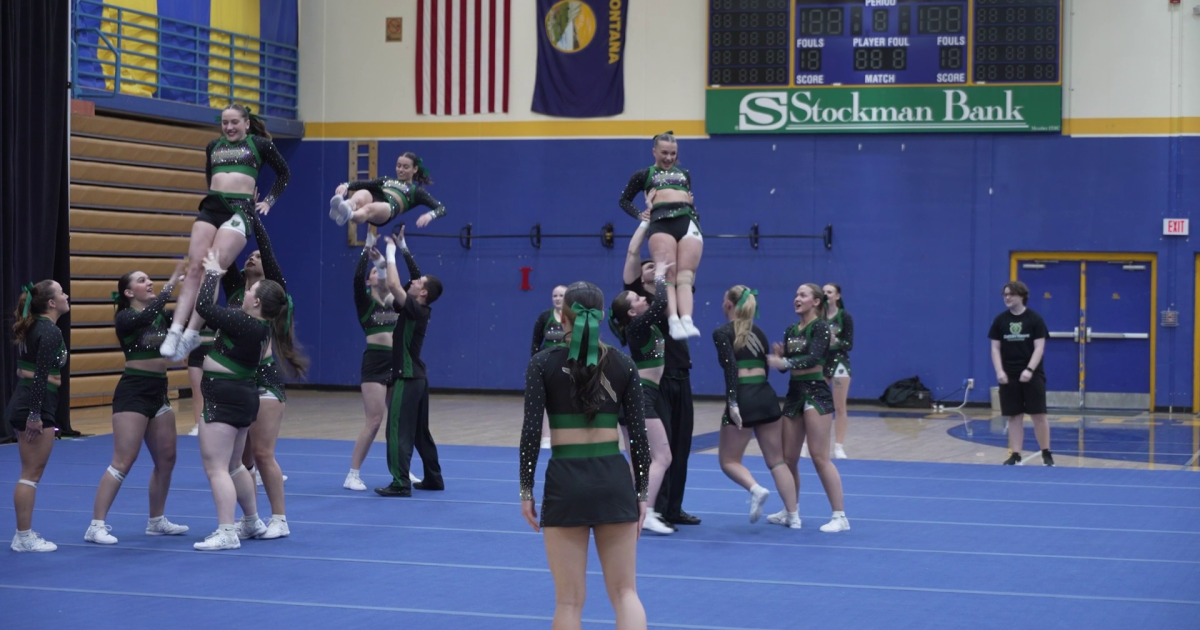
LEWISTOWN — 27 teams of cheerleaders from across Montana gathered at Fergus High School for Cheerfest.
Justin Robicheau reports – watch the video here:
Cheerleaders showcase talent at Cheerfest
“It’s the largest interscholastic cheerleading competition for Montana. We’re very excited that schools can come and show what they’ve been working all season for. This is our state, this is our divisional. So we’re very excited and can’t wait to see what Montana brings to the mat,” Cheerfest Director Rayna Phelps said.
Phelps said this year’s event is different from last year.
“We were really focusing on ways that we can really up this experience for cheerleaders and dancers across the state of Montana. This year, we included a backdrop, and lots of beautiful accents all throughout. We have a judging table, so it looks really nice,” Phelps said.
“There’s a high school mascot competition. Junior high team competition. There’s all classes of high schools. Class B, class A, double A, small group and large group. There’s dance solos, dance teams from across the state. And we have a college showcase,” Phelps said.
Glasgow High School senior Annika Smith said her school finished third in last year’s Cheerfest.
“I’m so excited. This last year we got third. So I’m really excited to come back and really go and try and get first. And it’s a little sad because it’ll be my last year, but I’m really excited to go out and give it my all,” Smith said.
MTN News
For Fergus High School senior Miriam Pavlovick, being surrounded by other cheerleaders from across the state is uplifting.
“It’s nice to see, like, a lot so many cheerleaders who enjoy the same thing. So much. And we just all come together and support one another,” Pavlovick said.
“Obviously when we go travel for basketball and state, like that, we’re cheering on our team. And this is a cool opportunity to show what cheerleaders can do and our stunting on all of our dancing and really get to show off a different side of cheerleading,” Smith said.
Registration for next year’s competition will open after Christmas.
MTN News





Drummer Brian Pastoria, longtime Detroit music advocate, dies at 68


Family rallies around Oklahoma father after head-on crash


Wildfire forces immediate evacuation order for Farnam residents


How ICE plans for a detention warehouse pushed a Georgia town to fight back | CNN Politics


Police looking for man considered ‘armed and dangerous’

Federal EPA moves to roll back recent limits on ethylene oxide, a carcinogen


‘Youth’ Twitter review: Ken Karunaas impresses audiences; Suraj Venjaramoodu adds charm; music wins praise | – The Times of India


Thousands march worldwide in solidarity with Palestine, Iran on al-Quds Day
