West
Kidnapping, intimidation, murder: Accusations against Honolulu man provide glimpse into Hawaii's underworld

A U.S. prosecutor revealed a possible glimpse into Hawaii’s underworld on Monday as he outlined the crimes a Honolulu businessman is accused of orchestrating: the kidnapping of a 72-year-old accountant who owed a debt, the release of a toxic chemical into a rival’s nightclubs and the killing of his late son’s best friend, among them.
Michael Miske Jr. was arrested in 2020, along with seven people whom prosecutors described as associates. But following a series of guilty pleas by the others — including a plea deal signed by his half-brother on Saturday — the trial opened with Miske as the lone defendant.
“The defendant used fear, violence and intimidation to get what he wanted,” Assistant U.S. Attorney William Akina said in his opening statement. “What he wanted was money, control and revenge.”
HAWAII MAHUNT FOR FELON OUT ON BAIL ENDS IN FATAL POLICE SHOOTOUT
Miske’s attorney, Michael Kennedy, painted a completely different picture of his client.
Miske, 49, wasn’t a crime lord, but rather a “self-made man” who, despite growing up “on the wrong side of the tracks,” successfully built a family business called Kamaʻaina Termite and Pest Control, Kennedy said in his opening statement.
The company saved iconic Hawaii structures and “cultural treasures,” including outdoor theater Waikiki Shell, ʻIolani Palace and the Polynesian Cultural Center, Kennedy said. Miske even fumigated a Honolulu concert hall for free after the city couldn’t afford the $200,000 estimate, Kennedy said.
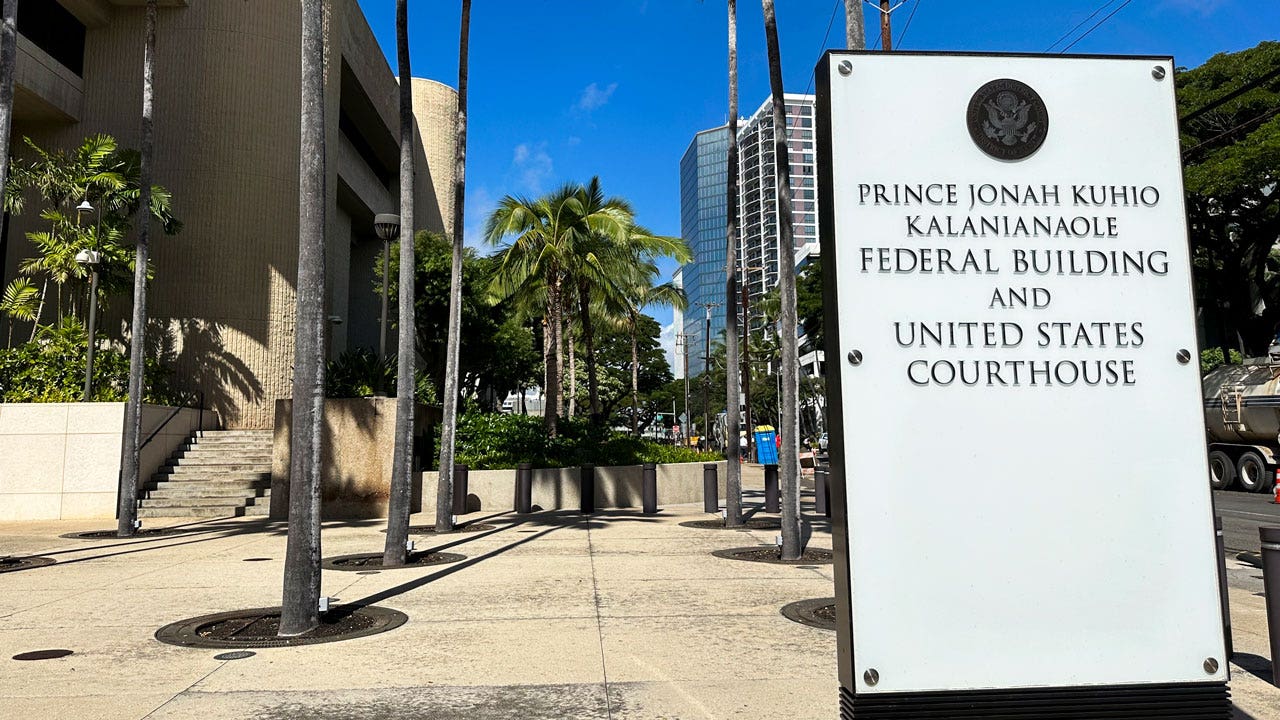
Seen here is a sign for the Prince Jonah Kuhio Kalanianaole Federal Building and Courthouse on Jan. 22, 2024, in Honolulu. The ongoing trial of Michael Miske Jr. could provide a peek into Hawaii’s criminal underworld. (AP Photo/Jennifer Kelleher)
Akina alleged that Miske also owned several nightclubs where disputes over bar tabs would be met with physical assault from his “thugs.” In addition, he made millions selling illegal commercial-grade aerial fireworks on the black market, Akina said.
The businessman also groomed people from his Waimanalo neighborhood to violently rob drug dealers and carry out other orders, the prosecutor said.
Akina said Miske ordered hits on people, and though many were never carried out, at least one was: the 2016 killing of Johnathan Fraser, best friend to Miske’s only son, Caleb. Miske had long thought Fraser was a bad influence on Caleb, and blamed Fraser when the friends got into a car crash in 2015 that led to Caleb’s death, Akina said.
HAWAII MAN ACCUSED OF ATTEMPTED MURDER STEALS CAR AT GUNPOINT, DIES AFTER FIREFIGHT WITH POLICE
“There could be only one price to pay for the death of the defendant’s son,” Akina said. “A life for a life.”
An indictment alleges that Miske purchased a boat to dump Fraser’s body into the ocean, though the body has never been found.
Kennedy told jurors on Monday that Miske didn’t blame Fraser for the crash and had nothing to do with his disappearance.
The people who will be testifying against Miske have something to gain from authorities, Kennedy said, referring to plea deals made by his alleged associates.
“Lies are going to rain down into this courtroom from that stand,” he said.
Testimony is scheduled to begin Tuesday.
Opening statements proceeded despite a motion filed Sunday night by Miske’s defense team. His attorneys argued that a new jury should be selected because Miske’s half-brother John Stancil pleaded guilty after a jury had been assembled and sworn and Miske’s daughter-in-law Delia Fabro Miske pleaded guilty after four days of jury selection.
Defense attorney Lynn Panagakos noted that Stancil pleaded guilty early Monday before the courthouse was even open to the public.
U.S. District Chief Judge Derrick Watson denied the motion.
Read the full article from Here


It’s series finale time, and it’s rubber match time, as the San Francisco Giants host the Atlanta Braves.
It’s a battle of Cy Young southpaws. For the Giants, it’s Robbie Ray, who won the award in 2021 in the American League. Ray, a 34-year old two-time All-Star, is making his 17th appearance of the year, and is 6-6 with a 3.70 ERA, a 4.80 FIP, and 80 strikeouts to 42 walks in 87.2 innings. After a rough patch, he’s been exceptional in his last two games, including allowing just an unearned run in eight innings against the Athletics his last time out.
For the Braves, it’s Chris Sale, who won the prestigious pitching award in 2024. Sale, a 37-year old nine-time All-Star, has made 14 starts, and is 8-5 with a 2.14 ERA, a 2.71 FIP, and 99 strikeouts to 21 walks in 84 innings. He allowed two unearned runs in 5.2 innings against the Milwaukee Brewers in his last start.
Enjoy the game, everyone.
Who: San Francisco Giants (34-48) vs. Atlanta Braves (49-32)
Where: Oracle Park, San Francisco, California
Regional broadcast: NBC Sports Bay Area
Radio: KNBR 680 AM/104.5 FM, KSFN 1510 AM

Firefighters say a car crash was the cause of a large fire that broke out north of the Denver International Airport on Saturday afternoon.
The Brighton Fire Rescue District says a vehicle was traveling through the area of E. 120th Avenue and N. Watkins Road around 2 p.m. when it crashed. Fortunately, the people inside the vehicle did not suffer serious injuries, but the fire department says the vehicle’s catalytic converter caught the nearby grass on fire.

The 120 Fire quickly grew, and firefighters responded with engines, brush trucks and water tenders to attack it from multiple sides. Multiple agencies responded to assist as the winds continued to push the fire across the grassland.

It covered around 237 acres by the time firefighters brought it under control around 3:30 p.m. BFRD says firefighters continued to put out hotspots and monitor a large cottonwood tree that was smoldering nearly 30 feet up the trunk.
With Independence Day approaching, the fire rescue district shared a reminder that a single spark can ignite a fast-moving grass fire. They added that aerial fireworks are illegal in Brighton and pose a serious fire risk in the current conditions.

Despite some overcast skies, thousands of Seattleites showed up in rainbow colors and bright smiles to celebrate the Seattle Pride Parade on Sunday.The march kicked off at 11 a.m. along Fourth Avenue in downtown, and wrapped up around 3:00 p.m. near Seattle Center.Seattle Pride traces its roots to 1974 and has grown into one of the nation’s largest LGBTQ+ celebrations, drawing hundreds of thousands of people each year. (KOMO)
-

 Sports5 minutes ago
J.T. Poston posts a 12 on a single hole at Travelers Championship in stunning meltdown
-

 Technology12 minutes ago
Midjourney’s wild body scanner scans you in water
-
 Business15 minutes ago
Why tech stocks are getting hammered
-
 Entertainment20 minutes ago
Sigh. Again? ‘Love Island USA’ confirms another contestant fired over apparent use of racial slur
-
 Politics30 minutes ago
Commentary: This California bill is so bad it has me agreeing with a Trump Republican
-
 Sports42 minutes ago
Wife, kids of Dodgers’ Miguel Rojas in Caracas when earthquakes hit Venezuela
-

 World50 minutes ago
Stars, Stripes, VIPs and Protests: Brussels hosts US Independence bash
-

 News1 hour ago
Can the so-called nanobubbler save the Reflecting Pool? | CNN Politics

