West
Jewish students file lawsuit against UCLA over anti-Israel encampment on campus

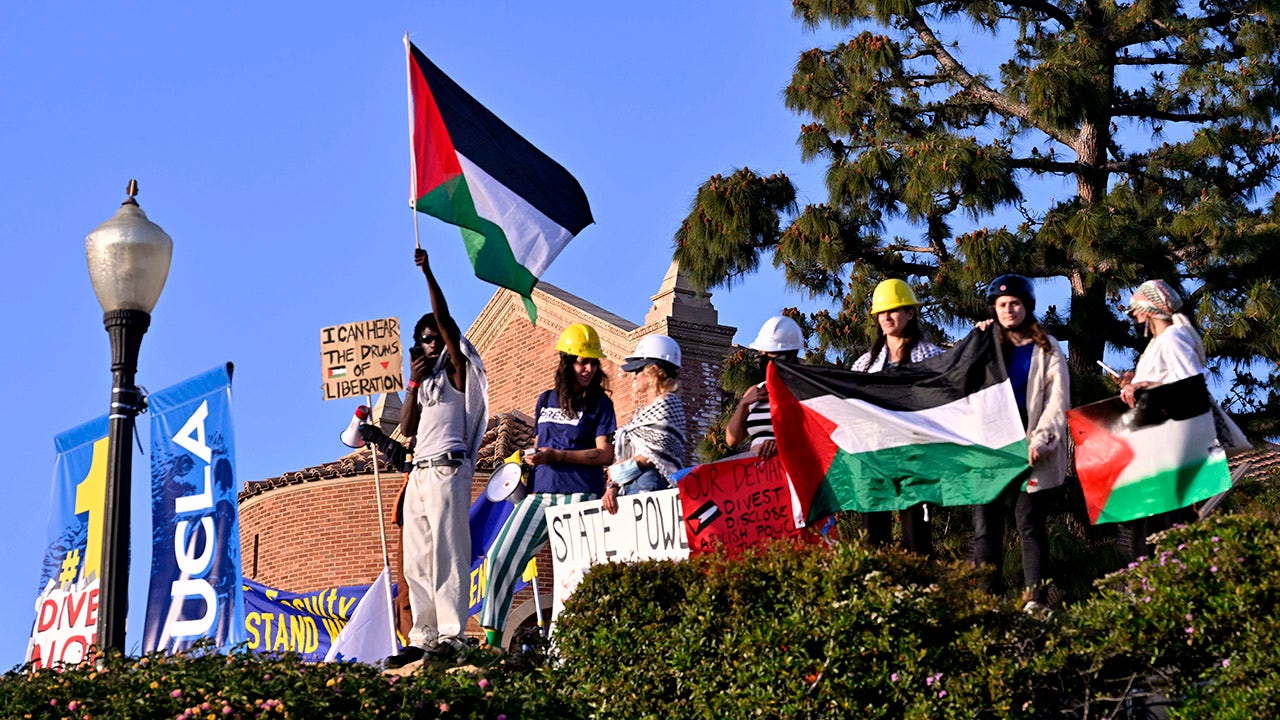
Three Jewish students filed a civil rights lawsuit against the University of California Board of Regents and university officials, claiming UCLA allowed “antisemitic activists” to prevent Jewish students from walking to classes, offices and the library on campus during anti-Israel demonstrations in April and May.
Two law students and an undergraduate student allege that UCLA allowed a group of students and outside demonstrators to set up an encampment, and that these demonstrators prevented Jewish students and faculty from accessing the heart of campus, according to the complaint.
This comes amid the ongoing war in the Middle East between Hamas terrorists and Israeli forces, which stems from Hamas’ Oct. 7 attacks against Israel that led to a retaliatory military response from Israel.
Since Oct. 7, anti-Israel demonstrations have been observed on college campuses across the U.S. and around the world. Other lawsuits have been filed over the campus protests by students claiming their universities failed to keep campuses safe. Schools facing lawsuits include Rutgers University and Columbia University, which this week settled with a Jewish student who brought a lawsuit against the university over an “unsafe educational environment.”
COLLEGES HIT WITH LAWSUITS OVER HANDLING OF ANTI-ISRAEL CAMPUS PROTESTS
Hundreds of students protest outside the Palestine Solidarity Encampment on the campus of UCLA in Los Angeles on Wednesday, May 1, 2024. (Keith Birmingham/MediaNews Group/Pasadena Star-News via Getty Images)
The complaint against UCLA said the university allowed protesters to set up an encampment that enforced a “Jew Exclusion Zone,” stopping Jewish students and faculty from accessing the encampment and other parts of campus unless they agreed to disavow Israel’s right to exist. The activists used checkpoints, issued wristbands, built barriers and often locked arms to prevent Jewish students and faculty from passing through.
UCLA’s administration was aware of this for a week without taking action, according to the complaint, which also said UCLA instructed security staff to discourage unapproved students from attempting to cross through the areas blocked by the activists instead of clearing the encampment.
“If masked agitators had excluded any other marginalized group at UCLA, Governor Newsom rightly would have sent in the National Guard immediately,” said Mark Rienzi, president and CEO of Becket, which filed the lawsuit on behalf of the three Jewish students. “But UCLA instead caved to the antisemitic activists and allowed its Jewish students to be segregated from the heart of their own campus. That is a profound and illegal failure of leadership.”
“This is America in 2024—not Germany in 1939. It is disgusting that an elite American university would let itself devolve into a hotbed of antisemitism,” Rienzi continued. “UCLA’s administration should have to answer for allowing the Jew Exclusion Zone and promise that Jews will never again be segregated on campus.”
Since Oct. 7, anti-Jewish demonstrations have been observed on college campuses across the U.S. and around the world. (Photo by ETIENNE LAURENT/AFP via Getty Images)
UCLA said in a statement it is aware of the lawsuit and that it will review and respond in due course. The university said it remains committed to supporting the safety and well-being of the entire campus community.
According to the plaintiffs, activists within the encampment “viciously targeted” Jewish students on campus.
Plaintiff Yitzchok Frankel, a law student and father of four, said he faced antisemitic harassment and was forced to abandon his regular routes through campus because of the “Jew Exclusion Zone.”
Demonstrators allegedly repeatedly blocked plaintiff Joshua Ghayoum, a sophomore and history major, from accessing the library and other public spaces, and he claims to have heard chants at the encampment that included “death to Jews.”
UCLA STUDENT TEARS INTO ‘SQUAD’ FOR ‘GLORIFYING’ ANTI-ISRAEL AGITATORS: THEY SHOULD BE ‘ASHAMED’
Graffiti at the Powell Library on the UCLA campus where anti-Israel demonstrators erected an encampment on Monday, April 29, 2024, in Los Angeles, California. (Getty Images)
The third plaintiff, law student Eden Shemuelian, said her final exam studies were severely compromised when she was forced to walk around the encampment and immerse herself in its antisemitic chants and signs to access the law school’s library.
The students are asking the court to ensure that Jews will never again face this kind of treatment on UCLA’s campus.
Police eventually cleared the UCLA encampment and arrested more than 200 people after a delayed law enforcement response.
Read the full article from Here

Washington
Where to watch Washington Nationals vs Baltimore Orioles: TV channel, start time, streaming for June 27


What to know about MLB’s ABS robot umpire strike zone system
MLB launches ABS challenge system as players test robot umpire calls in a groundbreaking season.
The 2026 MLB season has surpassed the quarter mark, and after each team’s first 40 games, there’s plenty of reasons to tune in all summer long.
Chicago White Sox slugger Munetaka Murakami has already proven doubters wrong by launching 17 home runs, Pittsburgh’s Paul Skenes consistently looks like the best version of himself on the mound and Milwaukee ace Jacob Misiorowski is throwing harder than any starter in the majors.
The MLB action continues on Saturday as the Washington Nationals visit the Baltimore Orioles.
Here’s everything you need to know to tune in for the first pitch.
See USA TODAY’s sortable MLB schedule to filter by team or division.
What time is Washington Nationals vs Baltimore Orioles?
First pitch between the Baltimore Orioles and Washington Nationals is scheduled for 7:05 p.m. (ET) on Saturday, June 27.
How to watch Washington Nationals vs Baltimore Orioles on Saturday
All times Eastern and accurate as of Saturday, June 27, 2026, at 6:33 a.m.
Watch MLB all season long with Fubo
MLB regional blackout restrictions apply
MLB scores, results
MLB scores for June 27 games are available on usatoday.com . Here’s how to access today’s results:
See scores, results for all of today’s games.

CHEYENNE, Wyo. — Wyoming is a state known for cowboys, rodeos, and beautiful plains, but is also known for being the first territory to grant women the right to vote, something historian Jennifer Helton explored in her Suffrage Stories presentation.
Helton was invited to highlight Wyoming’s remarkable role in the fight for women’s suffrage as part of the museum’s special America 250 Discover & Discuss series on Jun 18, but the recorded version was just released. This is a part of Cheyenne Frontier Days Old West Museum’s goal of exploring Cheyenne and the greater state of Wyoming’s history.
Helton’s presentation not only celebrates Wyoming’s role in suffrage, but also how the state’s pioneering women helped shape the future of voting rights across the nation.
Born and raised in Wyoming, Jennifer Helton left the state at age 18 to attend college, “which left a giant, Wyoming-sized hole in my heart,” Helton said, “and the way that I fill that hole is by conducting research on women’s suffrage.”
Upon realizing that most people outside of the state of Wyoming did not know the West’s progressive role in suffrage, she became obsessed with bridging this knowledge gap and researching the history of suffrage.
“My kids would tell you it’s an obsession, not just an interest or a hobby,” Helton said. “They always joke that I have three kids, the two of them and then Esther Morris.”
During her presentation, Helton’s admiration for Esther Morris was apparent due to her trailblazing nature as suffragist, her courage to stand up to torch-bearing mobs, and abolitionist activities.
Interestingly enough, her sons were also instrumental in shaping Wyoming’s history. E.A. Slack is known as the “Father of Frontier Days” and citizens of Wyoming can thank Robert C. Morris for Cheyenne’s public library, as he brought the Carnegie Public Library System to Wyoming.
.
” data-large-file=”https://i0.wp.com/capcity.news/wp-content/uploads/2026/06/image-2.png?fit=780%2C863&ssl=1″ alt=”” class=”wp-image-170117″ style=”aspect-ratio:0.90332473687879;width:464px;height:auto” srcset=”https://i0.wp.com/capcity.news/wp-content/uploads/2026/06/image-2.png?resize=925%2C1024&ssl=1 925w, https://i0.wp.com/capcity.news/wp-content/uploads/2026/06/image-2.png?resize=271%2C300&ssl=1 271w, https://i0.wp.com/capcity.news/wp-content/uploads/2026/06/image-2.png?resize=768%2C850&ssl=1 768w, https://i0.wp.com/capcity.news/wp-content/uploads/2026/06/image-2.png?resize=780%2C864&ssl=1 780w, https://i0.wp.com/capcity.news/wp-content/uploads/2026/06/image-2.png?resize=400%2C443&ssl=1 400w, https://i0.wp.com/capcity.news/wp-content/uploads/2026/06/image-2.png?resize=706%2C782&ssl=1 706w, https://i0.wp.com/capcity.news/wp-content/uploads/2026/06/image-2.png?w=960&ssl=1 960w, https://i0.wp.com/capcity.news/wp-content/uploads/2026/06/image-2-925×1024.png?w=370&ssl=1 370w” sizes=”auto, (max-width: 780px) 100vw, 780px”/><figcaption class=) Photo of Esther Morris, the first female justice of the peace (Cheyenne Frontier Days Old West Museum). Credit: Cheyenne Frontier Days Old West Museum (Jennifer Helton Presentation) / Cheyenne Frontier Days Old West Museum
Photo of Esther Morris, the first female justice of the peace (Cheyenne Frontier Days Old West Museum). Credit: Cheyenne Frontier Days Old West Museum (Jennifer Helton Presentation) / Cheyenne Frontier Days Old West Museum
Throughout the course of her presentation, Helton revealed the results of her research by tracing the course of American history in order to highlight the intersection between Wyoming, women, and winning the right to vote.
The talk also highlighted incredible Black women such as Lucy Phillips and Nancy Phillips, some of the first Black women to vote.
As America celebrates its 250th anniversary, the museum invites visitors to explore the stories of trailblazers like the nation’s first woman justice of the peace Esther Morris, the first woman governor, the first Black women to vote, and many other extraordinary leaders who made history.
The museum is hosting its special America 250 exhibit and allows visitors to discover the stories, artifacts, and moments that connect the community to the nation’s history. The exhibit even features six U.S. presidents who visited Cheyenne or Cheyenne Frontier Days, and is currently running at the museum. For those who cannot attend, lectures such as this are filmed and provided online.
As Helton closed her lecture, she read the words of Esther Morris, “I say do all the good you can while you do live.”
“Because women like Esther Morris, like Theresa Jenkins, had the courage to stand up and do all the good that they could in their lives we are all able to live the lives that we are living today,” Helton said.
“So, we should be grateful to them, and I think we should also be asking ourselves what is it that we need to be doing so that future generations can preserve the same opportunities we have, and perhaps more.”
Watch Jennifer Helton’s full presentation at the link provided here.
To learn more about historian Jennifer Helton visit jenniferhelton.org.
.
” data-large-file=”https://i0.wp.com/capcity.news/wp-content/uploads/2026/06/image-3.png?fit=780%2C519&ssl=1″ alt=”” class=”wp-image-170141″ srcset=”https://i0.wp.com/capcity.news/wp-content/uploads/2026/06/image-3.png?resize=1024%2C681&ssl=1 1024w, https://i0.wp.com/capcity.news/wp-content/uploads/2026/06/image-3.png?resize=300%2C200&ssl=1 300w, https://i0.wp.com/capcity.news/wp-content/uploads/2026/06/image-3.png?resize=768%2C511&ssl=1 768w, https://i0.wp.com/capcity.news/wp-content/uploads/2026/06/image-3.png?resize=1536%2C1022&ssl=1 1536w, https://i0.wp.com/capcity.news/wp-content/uploads/2026/06/image-3.png?resize=1200%2C799&ssl=1 1200w, https://i0.wp.com/capcity.news/wp-content/uploads/2026/06/image-3.png?resize=780%2C519&ssl=1 780w, https://i0.wp.com/capcity.news/wp-content/uploads/2026/06/image-3.png?resize=400%2C266&ssl=1 400w, https://i0.wp.com/capcity.news/wp-content/uploads/2026/06/image-3.png?resize=706%2C470&ssl=1 706w, https://i0.wp.com/capcity.news/wp-content/uploads/2026/06/image-3.png?w=1605&ssl=1 1605w, https://i0.wp.com/capcity.news/wp-content/uploads/2026/06/image-3-1024×681.png?w=370&ssl=1 370w” sizes=”auto, (max-width: 780px) 100vw, 780px”/><figcaption class=) Jennifer Helton’s information (Cheyenne Frontier Days Old West Museum).
Jennifer Helton’s information (Cheyenne Frontier Days Old West Museum).
Related
San Francisco, CA
San Francisco Pride kicks off with rainbow lasers, ValQueeries celebrate at Valkyries Pride Night

San Francisco kicked off Pride weekend with the return of the Market Street Pride lasers, while the Golden State Valkyries celebrated Pride Night alongside the ValQueeries, an LGBTQ fan group building community through basketball.
-

 Washington23 seconds ago
Where to watch Washington Nationals vs Baltimore Orioles: TV channel, start time, streaming for June 27
-

 Wisconsin7 minutes ago
Baboucarr Ann’s commitment pushes Wisconsin into nation’s top three
-

 West Virginia10 minutes ago
Justice firm’s delinquent DEP fines rise past $1.6M amid DOJ criminal liability relief
-

 Wyoming15 minutes ago
Wyoming, women, and winning the right to vote: Historian presents suffragette research
-

 Crypto22 minutes ago
4 arrested in Poland for SIM-swapping and cryptocurrency theft
-

 Finance25 minutes ago
Your Savings Account Is Failing: 3 Shifts to Reclaim Your Wealth
-

 Fitness30 minutes ago
Steffie Bryant, Alistair Brownlee to Share AI, Performance Insights at European Congress – Health & Fitness Association
-

 Movie Reviews40 minutes ago
Movie Review: SUPERGIRL – Assignment X

