Idaho
New lawsuit seeks to stop enforcement of Idaho library materials bill • Idaho Capital Sun


A group of lawyers on behalf of private Idaho schools, privately-funded public libraries, parents and their children have sued Idaho officials in federal court to stop the enforcement of House Bill 710, a law that codified the process libraries must follow if a patron were to deem a material harmful to children.
House Bill 710 was signed into law after years of attempts from the Idaho Legislature to restrict library material access. It took effect on July 1.
Under the new legislation, students, parents and legal guardians can fill out a written notice asking libraries to relocate a library item that they deem “harmful” to an area with adult access only. If a library fails to relocate the item within 60 days of receiving the relocation request, then one could sue the library for $250, as well as “actual damages and any other relief.”
According to House Bill 710, a “school” means any public or private school providing instruction for students in kindergarten through grade 12.
The plaintiffs include the Northwest Association of Independent Schools, Sun Valley Community School, Foothills School of Arts and Sciences, the Community Library Association and Collister United Methodist Church, and four parent plaintiffs and two of their children.
“Our coalition of independent schools, libraries, parents, students, and patrons is challenging this unprecedented government interference because it threatens the independence and core missions of our beloved community institutions across the state,” the plaintiffs wrote in a statement to the Sun.
The suit alleges the law violates the First Amendment rights of private schools and libraries and 14th Amendment protections for the fundamental liberty interest of parents.
The defendants named in the suit include Idaho Attorney General Raúl Labrador, Ada County Prosecutor Jan Bennetts and Blaine County Prosecutor Matt Fredback.
McKay Cunningham, an Idaho lawyer representing the plaintiffs, told the Sun that parents have a fundamental right to direct the education of their children under the U.S. Constitution.
“This fundamental right is no less true in Idaho despite the Idaho Legislature’s attempt to substitute its judgment for that of Idaho parents,” he said. “Our coalition of plaintiffs seeks to restore this right to its constitutional origins – Idaho parents.”
About the plaintiffs: A coalition of private schools, libraries, and parents
There are 11 plaintiff parties in this case, with three of them representing private school entities.
‘We are not getting rid of books’: How libraries across Idaho are implementing new materials law
The Northwest Association of Independent Schools is a nonprofit organization of private schools based in the Northwest and Canada. Its members in Idaho include the other plaintiffs, Sun Valley Community School and Foothills School of Arts and Sciences.
Sun Valley Community School serves pre-kindergarten to 12th grade to youth in Sun Valley. The Foothills School of Arts and Sciences is based in Boise, and it offers education to pre-kindergarten through ninth grade.
According to the lawsuit, the private school entities named in the lawsuit “make available to its students certain constitutionally protected, non-obscene materials that contain content described in (House Bill 710) that the Defendants and/or some Idahoans may find subjectively offensive, and that may therefore fall within the scope of H.B. 710’s prohibition.”
The fourth plaintiff includes The Community Library in Ketchum. The library is privately-funded, and any member of the public with a picture identification can sign up for a library card. According to the lawsuit, nearly 5,000 people from Idaho, nearly every state, and abroad hold library cards from the library. Because it is open to any member of the public, the library considers itself subject to House Bill 710.
The fifth plaintiff includes Collister United Methodist Church based in Boise. According to the lawsuit, the church is a Reconciling Ministry, meaning it is committed to achieving LGBTQ+ justice and inclusion in their churches. To further that goal, the church opened a lending library focused on books about LGBTQ+ people and topics for children and adults. Because any member of the public can borrow books from the church’s library, the church also believes it is subject to House Bill 710.
The next four plaintiffs are parents of minors. Two of them, Matthew Podolsky and Jeremy Wallace, are based in Boise. The two others, Mary Hollis Zimmer and Christina Leidecker, are based in Hailey.
Wallace and Leidecker’s two children are also plaintiffs named in the lawsuit using abbreviations to protect their identity.
Carey Dunne, a lawyer with Free + Fair Litigation Group representing the plaintiffs, said in a statement to the Sun that Idaho lawmakers are engaged in an unprecedented and “wildly unconstitutional” attempt to control speech in private institutions.
“Our coalition of schools, libraries, parents and students is asking the court to stop this government overreach before the first bell rings on the new school year – and before other states even think about following suit,” Dunne said. “A healthy democracy depends on vibrant, independent, private institutions. This new, dark turn for state censorship in America cannot stand.”
Bill sponsor Rep. Jaron Crane, R-Nampa, previously said that library legislation would not cause a book ban or financially strain Idaho libraries.
Bill cosponsor, Sen. Cindy Carlson, R-Riggins, previously told the Sun that the intention of the bill was to “protect the innocent minds of underage children.”
1 – Complaint for Injunctive and Declaratory Relief_NWAIS



CALDWELL, Idaho (CBS2) — More than 2,000 Idaho Power customers in Canyon County are without electricity Wednesday evening as crews respond to an outage affecting Caldwell and Middleton.
Idaho Power reported the outage at 8 p.m. July 8, listing 2,163 customers impacted in the 83605, 83644 and 83687 ZIP codes.
The outage is expected to be resolved by 10 p.m. July 8; Idaho Power said a crew was dispatched and en route. The cause of the outage is not immediately known.

(KRON) — An Idaho man is recovering after a life-threatening rattlesnake bite during a family visit to Oroville, Northern California. Chris Howarth spent nearly two weeks in intensive care following the incident in his mother’s garden.
During his 12-day stay in intensive care, Howarth received 54 vials of anti-venom and multiple blood transfusions, split between six days at Oroville Hospital and six days after being flown to Stanford.
Six weeks after the incident, he is approximately 80% recovered.
Howarth initially believed the bites were a prick from a thorn or a “star thistle or one of those goat heads.” He described the sensation as feeling “like getting your blood drawn.”
“I think I got bit twice. I said ‘ow’ again and ‘ow’ again. It almost felt like getting your blood drawn,” said Howarth. Howarth also noted he “didn’t hear it at all” when his father went to inspect the area and observed the snake shaking its tail without making noise.
As his wife drove him to the hospital, his condition worsened.
“On the way there, he was started kind of feeling some numbness and tingling in his mouth and his tongue so I knew we needed to get to the closest hospital,” said Jenny Howarth.
Howarth is still experiencing lingering effects from the bite, including swelling, soreness and fatigue.
“My leg is still kind of sore and tender, my ankle still swells, I barely got able to tie a shoe just a few days ago and also still having lingering effects of fatigue,” Howarth said.
California’s Poison Control system has received 77 rattlesnake-related calls this year, with experts reporting encounters are occurring earlier and more frequently. Dr. Rafa Lima, an emergency physician at Kaiser Permanente in San Leandro, explained that rattlesnake venom “destroys local tissue and causes a lot of pain and swelling.”
Dr. Lima advised immediate medical attention for suspected venomous snake bites. “If you are bitten by a snake with a rattle or you suspect is venomous, you should really get care immediately,” Dr. Lima said.
He also dispelled common myths, stating, “There’s a common myth that you should just tourniquet up the wound and bind it and mobilize it, or even try to suck the venom out but all that does is delays the time to get treatment and the longer the venom is in the tissue, the worst prognosis.”
Howarth mentioned that the weather conditions were unexpected for a rattlesnake encounter.
“That day and even the day before, it kind of been cooler and it had been raining so we weren’t expecting to see a rattlesnake,” she said.
Howarth hopes his experience highlights that rattlesnakes pose a risk in garden areas, not just hiking trails, even during cooler weather. Howarth hopes to return to work next week.
Those who want to donate to a GoFundMe set up for Howarth can do so here.
All facts in this report were gathered by journalists employed by KRON4. Artificial intelligence tools were used to reformat information into a news article for our website. This report was edited and fact-checked by KRON4 staff before being published.
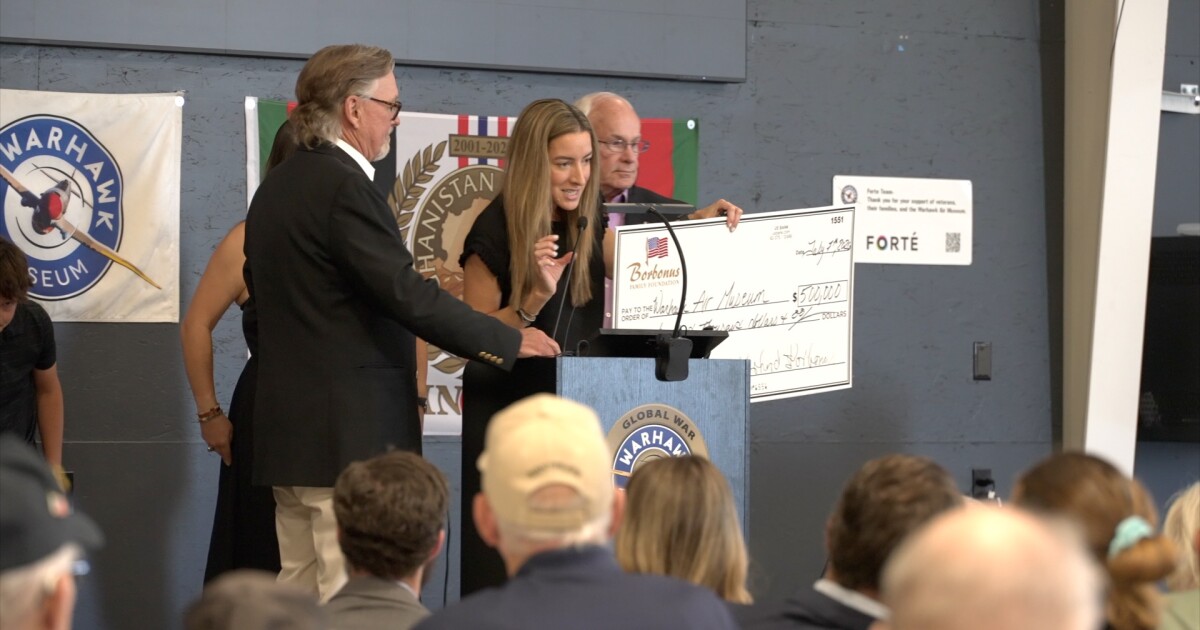
NAMPA, Idaho — Nearly 20 years after Idaho soldier John Borbonus was killed in Iraq, his legacy is continuing to serve fellow veterans.
The Borbonus Family Foundation, created in his honor, announced a $500,000 grant Tuesday to the Warhawk Air Museum in Nampa.
WATCH: One Idaho soldier’s legacy continues to serve fellow veterans
Warhawk Air Museum receives $500K grant honoring Idaho soldier John Borbonus
The museum says the unrestricted gift is its largest ever and will help cover operating costs as it continues to grow.
Executive Director Carson Spear says grants of this size often come with requirements to fund a specific project, but the Borbonus Family Foundation instead asked to use the funds where they are most needed.
Warhawk leaders say the funding will help preserve veterans’ stories and continue programs like the Kilroy Coffee Klatch, which brings together veterans from different generations each month.
RELATED | Kilroy Coffee Klatch brings veterans together at the Warhawk Air Museum
Vietnam veteran Emil Berry says the museum is more than a place to display history.
“It brings back memories, and also it helps the veteran, helps the military personnel. It’s just a special, very special establishment,” Berry said.
Borbonus’ sister, Alexa Borbonus, says Warhawk already preserves part of her brother’s story through a display dedicated to his service.
“The Warhawk Museum, they have a special place in our hearts,” Alexa Borbonus said. “They have John’s case on display now, and they provide a safe space for all our veterans in Idaho.”
RELATED | Skydivers honor fallen Boise soldier John Borbonus at annual memorial golf tournament
Sen. Jim Risch, who attended Tuesday’s announcement, said museums like Warhawk remind people that “freedom isn’t free” and help future generations appreciate the sacrifices made by those who served.
Following the announcement, the Borbonus family also donated John Borbonus’ challenge coin and the KIA bracelet worn by his family to Warhawk’s bar display, adding another piece of his legacy to the museum.
For Canyon County happenings, news, and more— join our Facebook Group: 2C Neighborhood News – Nampa, Caldwell, Middleton
This story was initially reported by a journalist and has been, in part, converted to this platform with the assistance of AI. Our editorial team verifies all reporting on all platforms for fairness and accuracy.
Send tips to Nampa neighborhood reporter Keith Burrell
Have a story idea from Nampa? Share it with Keith below —
-

 Illinois18 seconds ago
Illinois waives tax penalties for 11 counties hit by storms, including Stephenson and Winnebago
-

 Indiana3 minutes ago
Attempted murder suspect arrested in Indianapolis for Bloomington shooting
-

 Iowa8 minutes ago
Iowa WWII veteran approaching 100th birthday honored in Cedar Rapids
-

 Kentucky13 minutes ago
Exantus may be subject to involuntary hospitalization due to Kentucky law
-

 Louisiana23 minutes ago
Parasitic stomach illness that can cause explosive diarrhea rises in Louisiana
-

 Maine30 minutes ago
Is prison in play for Graham Platner?
-

 Maryland33 minutes ago
Office building in Glen Burnie evacuated after shift in parking garage floor
-

 Michigan38 minutes ago
Menominee, Michigan man arrested on sexual assault charges involving a minor

