Hawaii
Jonathan Okamura: Alarming New Report On Hawaii Public Schools Is One More Sign Of Legislative Failure


The Kids Count Data Book for 2024 was recently issued by the Annie E. Casey Foundation based in Baltimore, which has been reporting on the well-being of American children and their families since 1990.
For those like myself who advocate for ethnic equality in Hawaii and support public education as one of the principal means for its attainment, the report’s findings are distressing, although they are not necessarily surprising or new.
The report indicates that Hawaii’s public school students are not faring well academically in attaining basic skills such as reading and math and even just showing up for classes.
While most of the report’s data is not broken down by ethnicity, I’m certain that there are significant differences in educational performance among ethnic groups in the public schools because such disparities are evident in other areas of educational attainment, such as undergraduate representation at the University of Hawaii Manoa.
Since the report is concerned with the educational achievement of K-12 students who have yet to enter the job market, its findings clearly demonstrate the perpetuation of ethnic inequality for another generation due to the ongoing failure of the Legislature to fix the chronic teacher shortage problem.
Indigenous and ethnic minority students represent about 70% of those in the public schools.
The Number Of ‘Chronically Absent’ Skyrockets
In the Kids Count report, what I found most troubling was the 39% of Hawaii students who were “chronically absent,” which means they missed 10% or more days of school in 2022. The DOE school year is 180 days, so these students were absent at least 18 days or about three and a half weeks.
The 39% figure represented more than a doubling from the 19% in 2019, prior to the pandemic, which may have had an impact on the huge increase. It can be assumed that chronic absenteeism negatively impacts a student’s ability to proceed to the next grade level and ultimately to graduate from high school and enter college or the job market.
This is one area where the report did break down its data by ethnicity. It found that 59% of Native Hawaiian and Pacific Islander students, including Micronesians, Samoans and Tongans, were chronically absent in 2022.
A figure that high, a clear majority of those students, indicates that they probably are also well represented among the 14% of Hawaii students who did not graduate on time, according to the report.
Legislature’s Misplaced Priorities
I will cite information from Waianae High School, not to belittle its students, but because more than $6 million in funds were recently appropriated by the Legislature. One might assume that those funds are going to be used to address the school’s long-term chronic absenteeism problem, but one would be wrong.
Of Waianae’s 1,900 students, 54% are Native Hawaiian or Pacific Islander, 8.7% Asian, 3.3% Caucasian and 22% Hispanic.
According to the DOE Strive Hawaii report on the school’s academic performance in 2021-2022, Waianae had a graduation rate of 81%, which refers to the percentage of 12th-graders who graduated on time with their classmates.
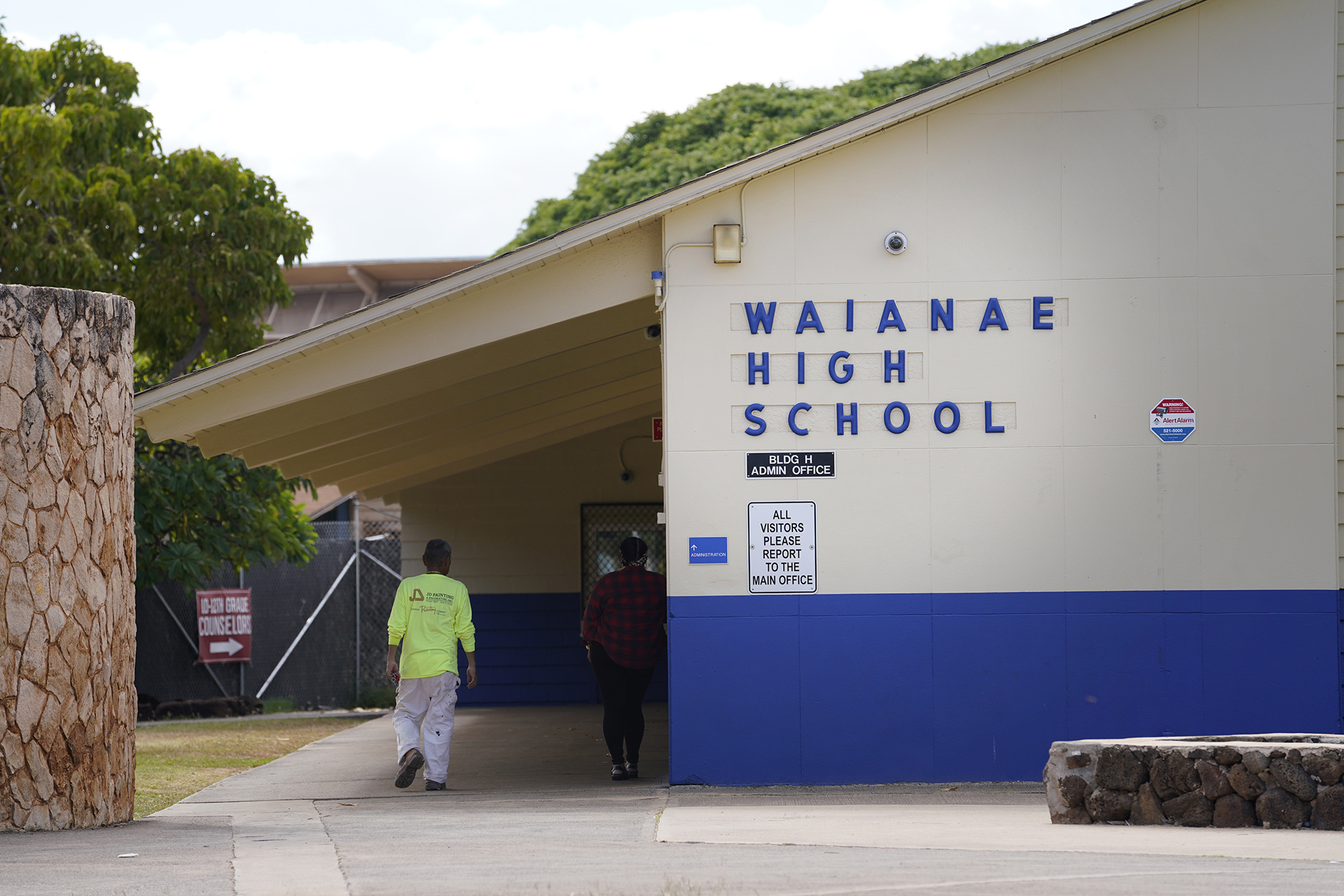
As for being chronically absent, in 2022, 58% of Waianae students missed 15 or more school days, which might be attributable to the pandemic’s after-effects, but the state average was much lower at 32%.
Despite those troubling statistics in the DOE Strive report, Rep. Cedric Gates, a Waianae graduate, announced funding last week for building a new artificial-turf football field at the school. Gates, who represents Waianae and nearby communities in the Legislature, led the $6 million legislative initiative.
He told a television news reporter, “It’s so important to get Waianae High School up to the same standards as the other high schools in the state,” but he wasn’t referring to academic standards, such as increasing its graduation rate or its college-going rate of 28%.
Gates continued, invoking the arguments used to support race-based affirmative action programs in college admissions as leveling the playing field, but literally referring to athletic fields: “It gives us a fair playing field to compete with the other schools because when you’re competing on grass and you’re transitioning over to a school with turf, it’s just a different field.”
Which Playing Field Do We Really Want To Even?
The $6 million Waianae High School received could have been used to hire more fully licensed teachers, instead of relying on unqualified emergency hires, or additional counselors to keep students on track to graduating on time or to urge them to take Early College courses available on campus.
Those teachers and counselors could have encouraged and supported more of their students to proceed on to college at UH Manoa, UH West Oahu, Leeward Community College or elsewhere so that they can compete fairly in the job market and not just in football.
Since only 13% of the Waianae community has a college education, teachers and counselors, rather than parents, can play a major role in their students’ further education.
Hiring more DOE staff to fill vacant positions obviously was not the policy priority of the Legislature.
Some might counter that the community wanted a new football field, and legislators responded positively to their wishes. But lawmakers don’t necessarily provide their constituents what they desire, such as publicly funded election campaigns that are supported by a majority of Hawaii voters.
Hiring more DOE staff to fill vacant positions obviously was not the policy priority of the Legislature, which instead allocated almost $600 million this past session for school facilities, including Waianae’s new football field.
While such new facilities won’t be completed before the primary and general elections, photos of groundbreaking or signing ceremonies for them with the governor can be prominently displayed in a legislator’s campaign advertisements and website.
Those ads reveal the personal priorities of many but not necessarily all legislators — to get themselves reelected rather than to address their constituents’ needs and desires for a more equitable and rewarding future for their children.

Sign up for our FREE morning newsletter and face each day more informed.


The Philippine Consulate General in Honolulu welcomed the arrival of the Philippine contingent from the Philippine Navy and the Philippine Coast Guard participating in the Rim of the Pacific (RIMPAC) Exercise 2026 that will be held from 24 June to 31 July 2026.
Led by Consul General Arman R. Talbo, the Consulate, together with members of the Filipino community in Hawaii, greeted the officers and crew aboard the PH Navy’s BRP Miguel Malvar and the PH Coast Guard’s BRP Gabriela Silang as they arrive and dock in Pearl Harbor, and conveyed support for their participation in the world’s largest international maritime exercise.

In his remarks, Consul General Talbo highlighted that the deployment of both a Philippine Navy and a Philippine Coast Guard vessel to RIMPAC 2026 reflects the Philippines’ growing maritime capabilities and its commitment to advancing maritime security, interoperability, and regional cooperation alongside allies and partners to promote a free, open, and secure Indo-Pacific region.

The Consul General further underscored that the participation of BRP Miguel Malvar and BRP Gabriela Silang is especially meaningful as the Philippines and the United States commemorate the 80th anniversary of diplomatic relations this year. He noted that the presence of both vessels at RIMPAC symbolizes the strength of the Philippines-US alliance and the expanding cooperation between the two countries in defense, security, and maritime affairs.

Named after two distinguished heroes of Philippine history, BRP Miguel Malvar and BRP Gabriela Silang also serve as reminders of the Philippines’ enduring legacy of courage, patriotism and unwavering dedication to national sovereignty.
The Philippine contingent will join other ships and personnel from participating nations during RIMPAC 2026 to further strengthen interoperability in multi-domain combat and contingency training. END
This article is brought to you by The Office of the Consul General of the Republic of the Philippines in Honolulu.

(BIVN) – 10,000 rubber duckies will “race” across the lake at the Kings’ Shops in Waikoloa this Fourth of July.
The 34th annual Great Waikoloa Rubber Duckie Race will be on the Saturday, July 4th, held in support of the United Cerebral Palsy Association of Hawaiʻi.
From a news release courtesy the Kings’ Shops and the United Cerebral Palsy Association of Hawaiʻi:
The community fundraiser brings together a July 4 celebration, live entertainment, keiki activities and one of Waikoloa’s most visual traditions to support programs for children and adults with cerebral palsy and other disabilities with similar service needs. The event runs from 10 a.m. to 5 p.m., with scheduled activities beginning at 11 a.m. and the rubber duckie race starting at 3 p.m. at Kings’ Shops.
“Each year, this event gives the community a fun, visible way to support programs for people with disabilities and their families across Hawaii,” said John Nishida, executive director of United Cerebral Palsy Association of Hawaii. “The duckie race has become a Waikoloa tradition because it brings people together for a celebration with a purpose.”
More than $25,000 in prizes will be awarded, including a grand prize trip for two to Japan. Additional prizes include resort stays, golf packages, boat cruises, dolphin experiences, gift baskets, shopping and dining certificates, and more. The first 50 duckies to finish the race, along with the last-place duckie, will win prizes for the people who adopted them.
This year’s Super Quackers theme will bring costumed superheroes throughout the center for photo opportunities and family-friendly fun. Tommy Ching returns as emcee, and the first 250 people to RSVP will receive a commemorative Super Quackers can cooler, while supplies last.
Event highlights include A-Bay’s Watermelon Eating Contest, live music by Kona Soul and Keoni Thompson, the Original Big Island Shave Ice Co. Shave Ice Eating Contest, the Fitness Forever Challenge, a preview of Aloha Theatre’s “Seussical,” and the duck waddling and duck calling contests. Guests will also find a scavenger hunt, free keiki activities, local artisan and food vendors, merchant offers, temporary tattoos by the Hawaii Army National Guard, Keiki ID services by the Hawaii Police Department, and pupus and drinks at Roy’s Waikoloa Bar & Grill.

Duck adoptions are $5 each. Special adoption packages include the $30 Quack Pack, which includes five ducks in the race and a free T-shirt, and the $100 VIP package, which includes 40 ducks in the race and a free T-shirt. T-shirts for Quack Pack and VIP package adoptions will be held for pickup on race day.
Duckies may be adopted online in advance. In-person adoptions will be available at Kings’ Shops on July 2 and 3 from 10 a.m. to 4 p.m., and July 4 from 10 a.m. until sold out.
For more information, contact UCPA of Hawaii at (808) 532-6744 or visit kingsshops.com/events.

-

 Hawaii3 minutes ago
PH Consulate welcomes PH contingent to Hawaii for RIMPAC 2026
-

 Idaho10 minutes ago
ISU event turns summer fun into rocket science – East Idaho News
-

 Illinois13 minutes ago
5 tornadoes confirmed in central Illinois following weekend storms
-

 Indiana18 minutes ago
Top Indiana high school performers at U20 Championships, Nike Outdoor Nationals
-

 Iowa25 minutes ago
Iowa Football Depth Chart: Projecting Hawkeyes’ Week 1 Special Teams
-
Kansas28 minutes ago
Kansas Lottery Powerball, Pick 3 winning numbers for June 22, 2026
-

 Kentucky33 minutes ago
Four Northern Kentuckians named among Leadership Kentucky's 52-member Class of 2026
-

 Louisiana40 minutes ago
Louisiana insurance officials to host storm assistance event in Pointe Coupee Parish

