Connect with us

Hawaii

I took my 30-year-old son on a vacation to Hawaii. We had to set ground rules first.

Published

on

I took my 30-year-old son on a vacation to Hawaii. We had to set ground rules first.


I live in New York City. My 30-year-old son, Alec, lives across the country in Southern California. When I visit, I respect that he has his own busy, adult life. While I’d like nothing more than to spend every minute with him, I’m proud of his independence and try not to monopolize his time.

Alec has a roommate and no space for an overnight guest. When I’m on his home turf, I stay in a hotel or with a friend.

When he comes to NYC for the holidays, his schedule is packed. Plus, with the entire family under one roof, it can be tough to carve out one-on-one time.

I don’t feel shut out of Alec’s life, but I do miss spending quality time with him, so I floated the idea of a mother-son vacation.

Advertisement

He set a few ground rules before we started planning

Alec was vocal that for our getaway to work, we’d need to approach it as equals. This may sound deceptively simple, but it took lots of self-control on my part.

Little kids and I pair like milk and cookies. I did my graduate studies in early childhood education and taught preschool for years. Parenting young kids is never easy, but it felt instinctive. It grew harder as my children grew older.

Alec is my firstborn, and my parental grip was tightest around him. When he was a teenager, he told me I didn’t understand that teens needed autonomy. At the time, he was correct, but over the years, I’ve worked hard to pacify my bossy instincts.

Advertisement

This time, I would welcome his voice in planning our vacation.

Alec brought up another rule: that part of being equal should include sharing expenses. I gifted Alec his airline ticket using miles, and we split additional expenses.

Choosing a destination

Alec had four days off work over Memorial Day Weekend. I advocated for a location that wasn’t too hot, as I had suffered a bout of heatstroke in Greece last summer. A yoga class nearby would be a bonus.

Alec made a case for Hawaii. He’d never been, but its laidback reputation appealed to him. He said he wanted to destress at a resort and eat poke every day.

Hawaii is special to me. I first visited when I was a kid, spending a summer at my aunt and uncle’s home in Waianae on Oahu. The idea of sharing Hawaii with Alec was exciting.

Advertisement

From a practical point of view, Hawaii made sense. There are numerous nonstop flights from LAX, Alec’s home airport. I was going to be in Denver for work, so I was already heading in a westerly direction.


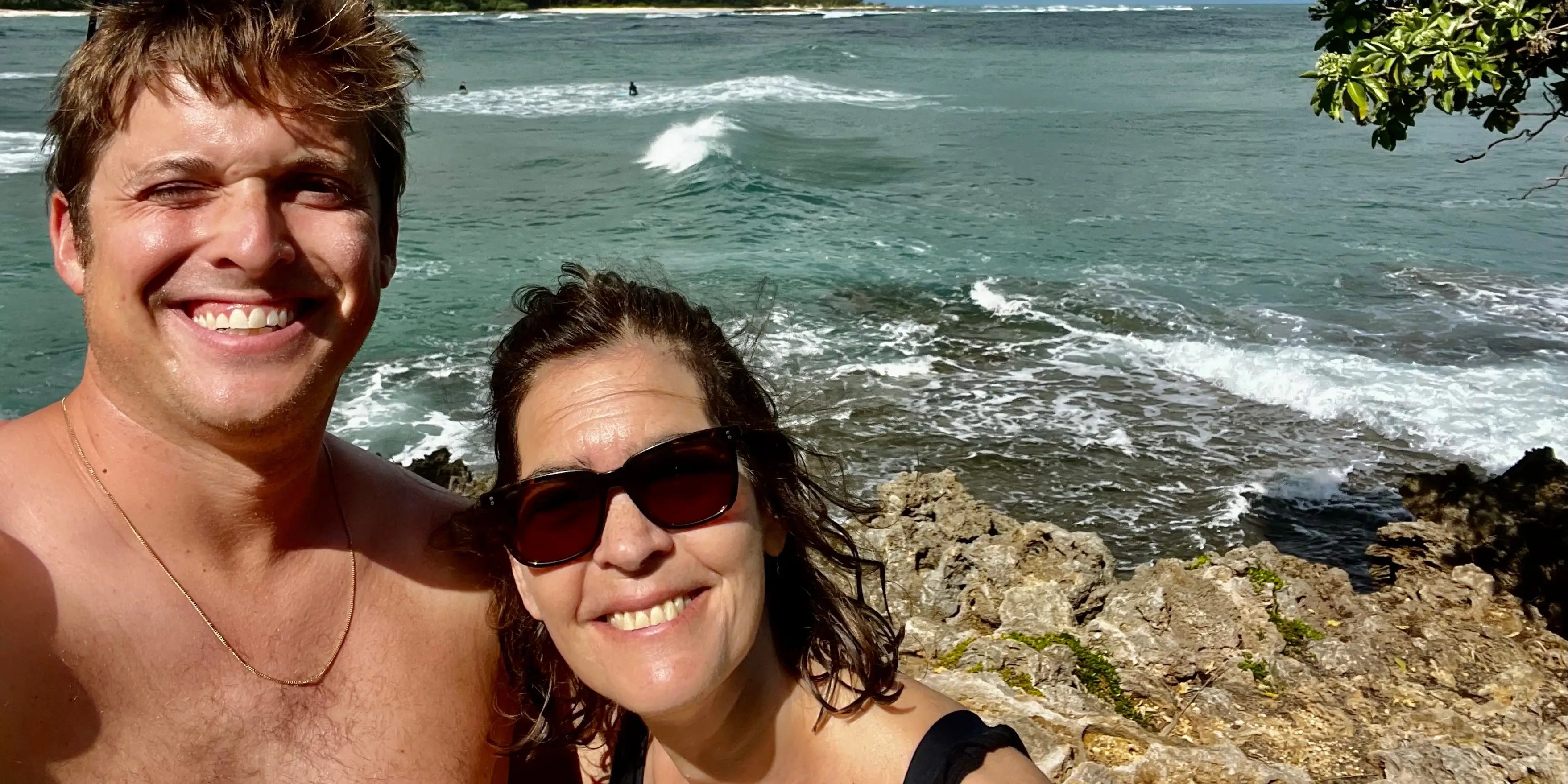
Allison Tibaldi  and her son in front of the ocean in Hawaii wearing leis

The author loved spending time with her adult son. 

Courtesy of Allison Tibaldi


Each of the Hawaiian Islands has its own flavor. We had lots of options and weren’t quite sure how to narrow them down.

Alec is a fan of the television cooking show “Top Chef.” During his online research, he learned that former contestant Sheldon Simeon was scheduled to be the visiting chef at the Ritz-Carlton O’ahu, Turtle Bay on the island’s North Shore on the Saturday night of our trip.

Advertisement

The Hawaiian-born chef would be preparing a multi-course dinner using island-grown ingredients. I’m all about exploring local culture through food, so it seemed like a jackpot for both of us.

After we booked the dinner, we figured it made sense to stay at the Ritz-Carlton.

Balancing time together and separately was key

Another boundary we set for our vacation was balancing time together with time apart.

Each morning, Alec surfed, and I swam laps in the pool. I signed up for a lei-making workshop while he attended a tennis clinic.

In a perfect world, we would have reserved individual rooms; however, we shared a room for economic reasons.

Advertisement

We were still able to maintain boundaries and give each other privacy as our room had a comfortable ocean-view patio, perfect for reading and relaxing.

Meaningful conversations are what stand out

Time together sparked the meaningful conversations and connection I had longed for.

On May 24, I mentioned that it was my beloved dad’s heavenly birthday. Alec shared tender memories of his grandpa and told me that my dad had been a father figure for him, too, teaching him lessons that continue to impact his life. It made me teary.

We also had an intelligent discussion on income inequality. Alec overheard a group of vacationing doctors and a group of vacationing teachers chatting in the Jacuzzi. He said the doctors worked very long hours without complaint, while the teachers complained nonstop about their overwhelming workload. This led to a conversation between Alec and me about teachers being underpaid and undervalued.

As a former teacher, I found that my son’s thinking about socio-economic issues that hit so close to home really resonated with me.

Advertisement

Our mother-son vacation brought us closer

Our mother-son vacation was a success. Alec ate plenty of poke. I got to practice yoga. Together, we swam in the Pacific, walked trails surrounded by gardenias, and enjoyed a delectable Hawaiian dinner.

As much as I loved our activities, it’s the memories of our personal and poignant conversations that are etched in my heart.

I can’t wait to travel with Alec again.


Source link

Advertisement

Hawaii

Filipino dignitaries embrace RIMPAC hospitality amid outside protests – Hawaii Tribune-Herald

Published

on

Filipino dignitaries embrace RIMPAC hospitality amid outside protests – Hawaii Tribune-Herald


Aboard the Philippine navy ship BRP Miguel Malvar on Wednesday night, prominent members of Honolulu’s Filipino community rubbed shoulders with military personnel and diplomats as they wined and dined on its deck in Pearl Harbor before the ship set sail to join other warships participating in the biennial Rim of the Pacific exercise.

“This warm atmosphere, the smiles, enthusiastic conversations truly echo the spirit of Filipino hospitality, or bayanihan … central to Filipino psychology, which means we see ourselves in others,” said Vice Admiral Jose Ezpeleta, the Philippine navy’s top officer, as he addressed attendees at Filipino Community Night reception.

“These cherished Filipino values and rich heritage are primarily reflected and carried out by you, our Filipino community,” Ezpeleta said. “Serving as a final bridge that links the Philippines to the United States cultures and peoples, and beyond defense and security, these vibrant people-to-people ties clearly form part of the foundational cornerstone of the Philippines and the United States of America.”

But outside the base’s gates on Kamehameha Highway, about 20 protesters carried signs and shouted slogans condemning the Philippine military’s participation in RIMPAC. During the protest, part of the group went to the base’s Halawa Gate and stood outside it until base security officials asked that they step back and return to the road.

Advertisement

The group included members of the Ho‘opae Pono Peace Project, Anakbayan Hawaii, Democratic Socialist of Oahu, Hawaii Coalition for Human Rights in the Philippines, the Party for Socialism and Liberation, Social Medicine Hawaii, and the Filipino Artist Movement.

“Everyone here is here because they love someone and they know someone that’s been impacted by U.S. militarism across the world” said Silayan Camson, a member of Filipino Artists Movement. “We’re all united in that struggle. U.S. militarism is one of the number one polluters in the world, and it has also spread across not only in the Asia-Pacific, but also in the Middle East, and that impacts day-to-day working people here, not only here in Hawaii, but across the oceans into the Philippines.”

In a statement preced­-ing the protest, the HICHRP said that “while mainstream media views RIMPAC as providing valuable opportunities for the Philippine Navy to enhance interoperability with its allies and partners, the Philippines continues to enter into military agreements with the U.S. at the expense of its people.

“Filipino citizens risk becoming collateral damage amidst increasing U.S. tensions with China,” the group said. “Recent events, including the massacre of 19 individuals, including two Filipino-Americans in Negros Occidental, highlight the dire human rights situation in the Philippines.”

The American citizens in question were Lyle Prijoles, 40, and Kai Dana-­­Rene Sorem, 26. Both had friends in Hawaii, who gathered with local activists to hold vigils after their deaths. They were among a group of activists and researchers taking part in a program put together by leftist organizers taking them into the countryside.

Advertisement

They were killed in a controversial operation by Philippine army troops hunting down members of the New People’s Army — the armed wing of the Communist Party of the Philippines — in the town of Toboso.

The Philippine military described it as an hours-long gun battle with rebels that wounded one soldier before they ultimately called in air support, while activists say indiscriminate strafing fire from the sky rained down on helpless civilians below. The NPA has confirmed that 10 of those killed in the incident were armed members of the group, but maintains the other nine were unarmed civilians.

“The U.S. has been assisting and aiding the Philippine military and its human rights abuses,” argued Camson, who told the Honolulu Star-Advertiser that Prijoles and Sorem were “learning about Filipino struggles in the Philippines, they were unjustly murdered by the Philippines military, and the Philippines military has continually neglected its people.”

Manila has sought to deepen military ties with countries around the region as it has been locked in a bitter dispute with Beijing over maritime territorial and navigation rights in the South China Sea, a busy waterway that nearly one-third of all global trade travels through.

Beijing claims nearly the entire sea as its exclusive territory over the objections of most neighboring countries and many others around the world who depend on goods flowing through it. In 2016 an international court ruled in favor of the Philippines and found that China’s claims have “no legal” basis.

Advertisement

China rejected the ruling and has built bases on disputed islands and reefs. The Chinese military also has harassed and sometimes attacked fishermen and other marine workers from the Philippines, including scientists trying to study the ecological impacts of operations in the area.

“The officers and sailors aboard this ship are more than members of our Armed Forces of the Philippines,” said Consul General Arman Talbo, the Philippines’ top diplomat in Hawaii. “They are our fellow Filipinos, our sons, our daughters, our brothers, our sisters, who have chosen a life of service. Their dedication helps safeguard our nation’s sovereignty, protect our people, and contribute to regional peace”

“The presence of this remarkable ship in Honolulu is the source of great pride for the Filipino community here in Hawaii,” Talbo said. “As one of the Philippine navy’s newest and most capable vessels, BRP Miguel Malvar reflects our nation’s steadfast commitment to modernizing its armed forces and strengthening its ability to secure peace, security, and stability in the Indo-Pacific.”

The U.S. military, for its part, has conducted frequent “freedom of navigation” operations through the region, increasingly in partnership with other countries, and frequently makes use of Subic Bay and other ports in the Philippines to support its operations.

While U.S. troops left permanent bases in the country in the 1990s after nationalist protests led to their eviction, training rotations by American forces and now those from other countries have increased amid tensions with China along with port calls by warships. Last year, President Donald Trump and Philippine President Ferdinand Marcos Jr. announced plans for Subic Bay to become a new arms manufacturing hub.

Advertisement

Camson argued that “Filipinos and the Philippine budget should be going toward people’s rights and education … The working conditions and working-class people of the Philippines are struggling while their leaders are busy participating in RIMPAC when they should be focusing on how to help Filipinos both in the U.S. and back in the Philippines.”

The Philippines is also among the most likely staging areas U.S. troops would use to respond to a Chinese invasion of Taiwan. The Philippine military’s top commander, Gen. Romeo Brawner, told his troops in the northern tip of the country last year to “start planning for actions in case there is an invasion of Taiwan.”

Brawner, an alumnus of the Daniel K. Inouye Asia-­Pacific Center for Security Studies in Waikiki, asserted in his remarks that “if something happens to Taiwan, inevitably we will be involved. There are 250,000 (overseas Filipino workers) working in Taiwan, and we will have to rescue them.”

The Philippine navy also has sent ships, including the Malvar, to train as far away as India and Australia. Talbo said that he sees it as a source of pride that the Philippine navy can now regularly sail its ships across the vastness of the Pacific, arguing that years ago that would have been unthinkable.

Star-Advertiser photo editor George Lee contributed to this report.

Advertisement


Source link

Continue Reading

Hawaii

Evacuations ordered for Buildings 4 and 5 of the Lofts in Waikōloa as firefighters continue response to brush fire | Big Island Now

Published

on

Evacuations ordered for Buildings 4 and 5 of the Lofts in Waikōloa as firefighters continue response to brush fire | Big Island Now


July 10, 2026, 6:19 PM HST
* Updated July 10, 6:20 PM

This story was updated at 6:19 p.m. July 10, 2026.

Hawai‘i Fire Department issued a wildfire warning and is responding to a brush fire in the Waikōloa area of South Kohala, with evacuations ordered for Buildings 4 and 5 of the Lofts in Waikōloa Village.

An evacuation shelter is open at Waikōloa Elementary School cafeteria, located at 68-1730 Hoʻokō St.

Advertisement

Waikōloa Road from Paniolo Avenue to Highway 190 is closed. Hawai’i Police Department advises motorists to avoid the area for at least the next 4 hours.

Only local traffic will be allowed on Waikōloa Road from Paniolo Avenue to Queen Ka‘ahumanu Highway.

More information will be provided as it becomes available. Hawai’i County Civil Defense is providing updates as conditions change.


Source link

Advertisement
Continue Reading

Hawaii

Magnitude 4.5 earthquake strikes off Hawaii island | Honolulu Star-Advertiser

Published

on

Magnitude 4.5 earthquake strikes off Hawaii island | Honolulu Star-Advertiser


COURTESY USGS

This U.S. Geological Survey map shows the location of a magnitude 4.5 earthquake that struck off Hawaii island’s southwest coast Friday night.

Advertisement
Advertisement

A magnitude 4.5 earthquake struck off the southwest coast of Hawaii island Thursday night, according to the U.S. Geological Survey.

The epicenter of the quake, which hit at 8:17 p.m., was about 34 miles west-southwest of Captain Cook at a depth of about 24 miles below sea level, USGS officials said. It did not generate a tsunami threat to the islands, the Pacific Tsunami Warning Center said.

USGS said in a statement that the earthquake “was related to bending of the ocean crust and upper brittle mantle (the lithosphere) by the weight of the islands.” No impact to the Mauna Loa volcano nor the ongoing Kilauea eruption was expected.

The USGS self-reported “Did you feel it?” online survey for the earthquake generated well over 200 responses, mostly on the Big Island but including several from Oahu and Maui.


Advertisement


Source link

Continue Reading
Advertisement

Trending