Hawaii
Hawaii beach volleyball team loses to LMU in NCAAs for 3rd straight year


For the third straight year, the Hawaii beach volleyball team met its postseason match in Loyola Marymount University.
Eighth-seeded LMU defeated ninth-seeded UH, 3-1, in the NCAA Tournament first round to bring UH’s season to an end in Gulf Shores, Ala., on Friday.
The senior pair of Kaylee Glagau and Pani Napoleon got UH (24-12) on the board first with a win at the No. 2 court, 21-17, 21-13 over Isabelle Reffel and Alisha Stevens.
But coach Evan Silberstein was worried about the matchups at three courts – 1, 3 and 5 – and those went decisively to the Lions (28-13) on a gusty day.
Silberstein told UH Athletics that he observed his players not doing enough damage in seven-point rotation turns on the “good” side of the courts with the wind in UH’s favor, while LMU took better advantage of its turns on that side.
“I thought yesterday in these conditions we did a really, really nice job with our service,” Silberstein said. “We really ramped up our service pressure in the walkthrough yesterday. So I think we could’ve served a little tougher. … They had a little distance on us in service pressure.”
LMU’s clinching flight for the dual match was at No. 1, where Vilhelmiina Prihti and Michelle Shaffer dispatched Jaime Santer and Alana Embry, 21-18, 21-11.
Earlier, Anna Maidment and Sydney Miller fell to Anna Pelloia and Jacinda Ramirez, 21-16, 21-15 at No. 3 and Sarah Burton and Julia Thelle lost to Madi Firnett and Abbey Thorup at No. 5, 21-10, 21-15.
LMU advanced to face defending champion and top-seeded USC in the quarterfinals.
It was the final career match for seniors Glagau, Napoleon, Santer, Maidment and Riley Wagoner.
Napoleon, of Bonita, Calif., came back to UH to end her seven-year college career after two years at UCLA.
“After winning Big West, we had so much confidence and I think we didn’t lose that,” Napoleon told UH Athletics. “We may have played our best, but LMU just played better. All we can ask of each other is if we played to the best of our ability, and I think that we did that, and did that this entire season.”
Said Silberstein, “We’re happy Pani came back. It was a really cool story for her to return … great for her to end her career on that winning note. Proud of her.”
Glagau, Maidment and Wagoner spoke to Spectrum News after their final home matches against Grand Canyon on April 14.
Said Maidment, who has moved to Hawaii permanently with her parents from Winnipeg, Canada, “Being able to support my teammates and just honor the work that everyone before me has done is just such a blessing because everybody here works so hard in this program. To experience it myself, with my family here all the way from Canada is just a feeling better than I’ve ever experienced.”
Said Wagoner, a veteran UH indoor player from Dublin, Ohio, who helped UH win the Big West championship with freshman partner Sydney Amiatu, “The rest of the seniors are awesome. They all have unique qualities and that kind of shows on the court. What we bring is different and I think it’s a really unique class. There’s a lot of us, so we get to share our experience with the younger girls and we are trying to do our best to lead any way we can and finding our ways to let our personalities shine.”
Said Glagau, an All-American from Toronto, “(I’ll remember) looking out into the crowd and seeing all the people who love me for who I am, and love me no matter what, not because of how good I am at volleyball or how well I play. They’ll be there no matter what. Just feeling really loved and grateful.”
Brian McInnis covers the state’s sports scene for Spectrum News Hawaii. He can be reached at brian.mcinnis@charter.com.



Three convicted sex offenders were arrested on Hawaii Island last week for allegedly failing to comply with sex offender registry requirements.
Multiple law-enforcement agencies conducted checks in Kona on registered sex offenders who had been identified as potentially out of compliance with the state’s Sex Offender Registry laws, according the Department of the Attorney General.
As a result of the three-day operation, several individuals were brought back into compliance, and three West Hawaii men were arrested for allegedly failing to comply with the requirements.
The three men who were arrested are Joseph Debus, 56, of Kailua-Kona, Garth Coleman, 53, of Holualoa and Alexsandr Skelcey, 34, of Kailua-Kona.
Debus was convicted of second-degree sex assault in Hawaii in 1993 and sentenced to five years probation with a year in jail. Coleman was sentenced to 20 years in prison for first-degree assault in 2000 after a jury trial in Hawaii. And Skelcey was convicted in Michigan in 2012 of assault with intent to commit sex assault.
“Sex offender registration requirements exist to protect our communities and ensure law enforcement knows where convicted offenders are living,” Tom Alipio, chief of the AG department’s Investigations Division, said in a press release. “Compliance operations like this send a clear message that we will actively monitor the registry, investigate violations and work closely with our law enforcement partners to hold offenders accountable when they fail to meet their legal obligations.”
HPD Chief Reed Mahuna said, “Operations like this allow us to verify that offenders are maintaining strict compliance with registration laws and those who aren’t will be addressed immediately. We will continue to leverage these multi-agency partnerships to keep our island communities safe,”
Members of the public can look up publicly available offender information and subscribe to notifications at sexoffenders.ehawaii.gov/coveredoffender/.
Anyone with information regarding a registered sex offender who may be violating registration requirements is encouraged to contact the Department of the Attorney General’s Investigation Division at (808) 586-1240 or their local law enforcement.

A brush in North Kona, near the Ulu Wini Apartments, has closed a portion of Hina Lani Street, between Route 190 and Ane Keokalole Highway.
According to Hawai‘i Island police, the road is expected to be closed for the next three hours and motorists are advised to avoid the area.
Hawai‘i Fire Assistant Chief Chris Carvalho confirmed at least two engines, two brush trucks, Chopper 2 and a medic vehicle responded to the blaze that started in some bushes.
No evacuations or injuries have been reported at this time.
At 11:09 a.m., an AlertWest camera, installed by Hawaiian Electric in wildfire-prone areas, showed smoke billowing above the Keahuolu Courthouse. As of 12:06 p.m., that smoke appears to have dissipated.
This is a developing story. More information will be provided as it becomes available.
Hawaii
Chinese communist party member arrested in Hawaii on visa fraud charge | Honolulu Star-Advertiser

-

 Technology14 seconds ago
Medical identity theft follows you into the doctor’s office
-
 Business7 minutes ago
California soccer fans sue StubHub after it fails to deliver expensive World Cup tickets
-
 Entertainment10 minutes ago
Lucas Museum to give free annual passes to South L.A. neighbors, host community preview day
-
 Lifestyle15 minutes ago
Meow Wolf taps famed L.A. animation house for its new Los Angeles venue
-
Politics22 minutes ago
Column: Trump decries ‘communism’ while his government takes ownership of companies
-
 Science25 minutes ago
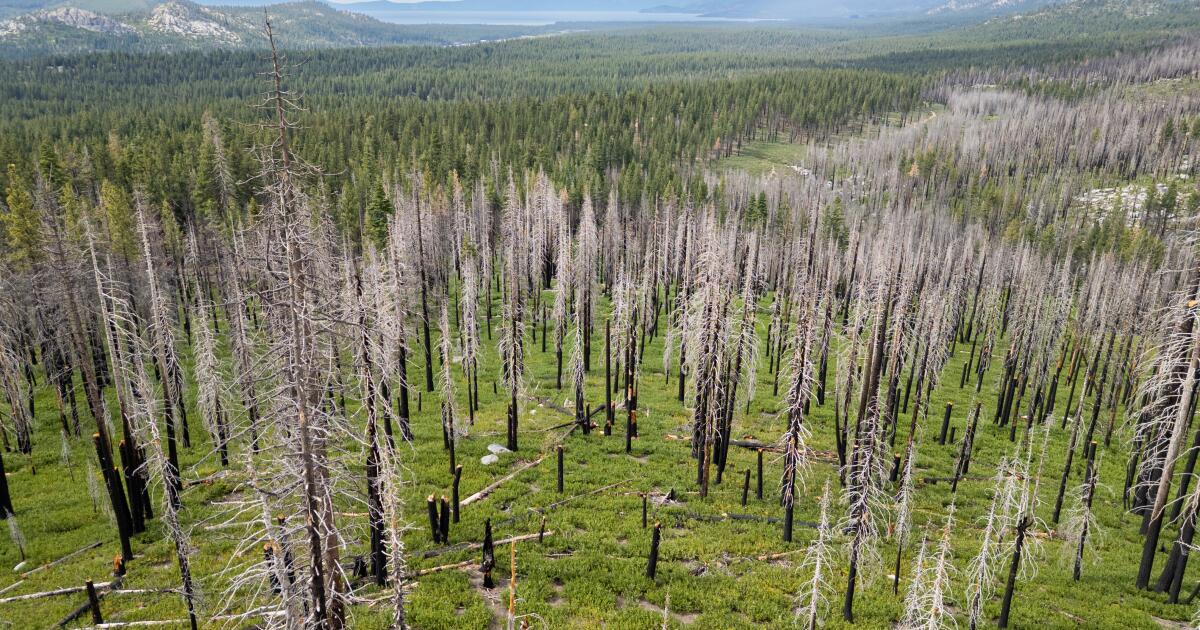
‘I’d rather my house burn down than get cancer’: Herbicide use upends California’s fight to save forests
-
 Sports30 minutes ago
Dodgers scheduled to visit White House in late July to celebrate 2025 World Series win
-

 World40 minutes ago
Former US Olympian pleads not guilty in DC reflecting pool vandalism case


