Hawaii
Bank of Hawaii (NYSE:BOH) shareholders have endured a 24% loss from investing in the stock three years ago


Many investors define successful investing as beating the market average over the long term. But if you try your hand at stock picking, you risk returning less than the market. We regret to report that long term Bank of Hawaii Corporation (NYSE:BOH) shareholders have had that experience, with the share price dropping 33% in three years, versus a market return of about 22%.
Now let’s have a look at the company’s fundamentals, and see if the long term shareholder return has matched the performance of the underlying business.
View our latest analysis for Bank of Hawaii
To quote Buffett, ‘Ships will sail around the world but the Flat Earth Society will flourish. There will continue to be wide discrepancies between price and value in the marketplace…’ One imperfect but simple way to consider how the market perception of a company has shifted is to compare the change in the earnings per share (EPS) with the share price movement.
During the three years that the share price fell, Bank of Hawaii’s earnings per share (EPS) dropped by 5.1% each year. This reduction in EPS is slower than the 12% annual reduction in the share price. So it seems the market was too confident about the business, in the past.
The image below shows how EPS has tracked over time (if you click on the image you can see greater detail).
It might be well worthwhile taking a look at our free report on Bank of Hawaii’s earnings, revenue and cash flow.
What About Dividends?
As well as measuring the share price return, investors should also consider the total shareholder return (TSR). The TSR is a return calculation that accounts for the value of cash dividends (assuming that any dividend received was reinvested) and the calculated value of any discounted capital raisings and spin-offs. Arguably, the TSR gives a more comprehensive picture of the return generated by a stock. As it happens, Bank of Hawaii’s TSR for the last 3 years was -24%, which exceeds the share price return mentioned earlier. This is largely a result of its dividend payments!
A Different Perspective
It’s nice to see that Bank of Hawaii shareholders have received a total shareholder return of 29% over the last year. Of course, that includes the dividend. There’s no doubt those recent returns are much better than the TSR loss of 2% per year over five years. The long term loss makes us cautious, but the short term TSR gain certainly hints at a brighter future. While it is well worth considering the different impacts that market conditions can have on the share price, there are other factors that are even more important. For instance, we’ve identified 1 warning sign for Bank of Hawaii that you should be aware of.
We will like Bank of Hawaii better if we see some big insider buys. While we wait, check out this free list of undervalued stocks (mostly small caps) with considerable, recent, insider buying.
Please note, the market returns quoted in this article reflect the market weighted average returns of stocks that currently trade on American exchanges.
Valuation is complex, but we’re helping make it simple.
Find out whether Bank of Hawaii is potentially over or undervalued by checking out our comprehensive analysis, which includes fair value estimates, risks and warnings, dividends, insider transactions and financial health.
View the Free Analysis
Have feedback on this article? Concerned about the content? Get in touch with us directly. Alternatively, email editorial-team (at) simplywallst.com.
This article by Simply Wall St is general in nature. We provide commentary based on historical data and analyst forecasts only using an unbiased methodology and our articles are not intended to be financial advice. It does not constitute a recommendation to buy or sell any stock, and does not take account of your objectives, or your financial situation. We aim to bring you long-term focused analysis driven by fundamental data. Note that our analysis may not factor in the latest price-sensitive company announcements or qualitative material. Simply Wall St has no position in any stocks mentioned.
Valuation is complex, but we’re helping make it simple.
Find out whether Bank of Hawaii is potentially over or undervalued by checking out our comprehensive analysis, which includes fair value estimates, risks and warnings, dividends, insider transactions and financial health.
View the Free Analysis
Have feedback on this article? Concerned about the content? Get in touch with us directly. Alternatively, email editorial-team@simplywallst.com


HONOLULU (HawaiiNewsNow) – A hiker was rescued after suffering a medical emergency on the Diamond Head Crater Trail Saturday morning.
The Honolulu Fire Department said crews responded at about 10:30 a.m. after a woman in her 30s became unable to descend from the top of the trail.
Firefighters climbed the trail on foot while another crew prepared a nearby landing zone for air operations.
HFD’s Air 1 helicopter inserted rescue personnel to the woman’s location, where they assessed her condition and provided basic life support.
The hiker was then airlifted to the landing zone and transferred to Honolulu Emergency Medical Services shortly after 11 a.m.
No firefighter injuries were reported.
Copyright 2026 Hawaii News Now. All rights reserved.
Hawaii
Filipino dignitaries embrace RIMPAC hospitality amid outside protests – Hawaii Tribune-Herald

Aboard the Philippine navy ship BRP Miguel Malvar on Wednesday night, prominent members of Honolulu’s Filipino community rubbed shoulders with military personnel and diplomats as they wined and dined on its deck in Pearl Harbor before the ship set sail to join other warships participating in the biennial Rim of the Pacific exercise.
“This warm atmosphere, the smiles, enthusiastic conversations truly echo the spirit of Filipino hospitality, or bayanihan … central to Filipino psychology, which means we see ourselves in others,” said Vice Admiral Jose Ezpeleta, the Philippine navy’s top officer, as he addressed attendees at Filipino Community Night reception.
“These cherished Filipino values and rich heritage are primarily reflected and carried out by you, our Filipino community,” Ezpeleta said. “Serving as a final bridge that links the Philippines to the United States cultures and peoples, and beyond defense and security, these vibrant people-to-people ties clearly form part of the foundational cornerstone of the Philippines and the United States of America.”
But outside the base’s gates on Kamehameha Highway, about 20 protesters carried signs and shouted slogans condemning the Philippine military’s participation in RIMPAC. During the protest, part of the group went to the base’s Halawa Gate and stood outside it until base security officials asked that they step back and return to the road.
The group included members of the Ho‘opae Pono Peace Project, Anakbayan Hawaii, Democratic Socialist of Oahu, Hawaii Coalition for Human Rights in the Philippines, the Party for Socialism and Liberation, Social Medicine Hawaii, and the Filipino Artist Movement.
“Everyone here is here because they love someone and they know someone that’s been impacted by U.S. militarism across the world” said Silayan Camson, a member of Filipino Artists Movement. “We’re all united in that struggle. U.S. militarism is one of the number one polluters in the world, and it has also spread across not only in the Asia-Pacific, but also in the Middle East, and that impacts day-to-day working people here, not only here in Hawaii, but across the oceans into the Philippines.”
In a statement preced-ing the protest, the HICHRP said that “while mainstream media views RIMPAC as providing valuable opportunities for the Philippine Navy to enhance interoperability with its allies and partners, the Philippines continues to enter into military agreements with the U.S. at the expense of its people.
“Filipino citizens risk becoming collateral damage amidst increasing U.S. tensions with China,” the group said. “Recent events, including the massacre of 19 individuals, including two Filipino-Americans in Negros Occidental, highlight the dire human rights situation in the Philippines.”
The American citizens in question were Lyle Prijoles, 40, and Kai Dana-Rene Sorem, 26. Both had friends in Hawaii, who gathered with local activists to hold vigils after their deaths. They were among a group of activists and researchers taking part in a program put together by leftist organizers taking them into the countryside.
They were killed in a controversial operation by Philippine army troops hunting down members of the New People’s Army — the armed wing of the Communist Party of the Philippines — in the town of Toboso.
The Philippine military described it as an hours-long gun battle with rebels that wounded one soldier before they ultimately called in air support, while activists say indiscriminate strafing fire from the sky rained down on helpless civilians below. The NPA has confirmed that 10 of those killed in the incident were armed members of the group, but maintains the other nine were unarmed civilians.
“The U.S. has been assisting and aiding the Philippine military and its human rights abuses,” argued Camson, who told the Honolulu Star-Advertiser that Prijoles and Sorem were “learning about Filipino struggles in the Philippines, they were unjustly murdered by the Philippines military, and the Philippines military has continually neglected its people.”
Manila has sought to deepen military ties with countries around the region as it has been locked in a bitter dispute with Beijing over maritime territorial and navigation rights in the South China Sea, a busy waterway that nearly one-third of all global trade travels through.
Beijing claims nearly the entire sea as its exclusive territory over the objections of most neighboring countries and many others around the world who depend on goods flowing through it. In 2016 an international court ruled in favor of the Philippines and found that China’s claims have “no legal” basis.
China rejected the ruling and has built bases on disputed islands and reefs. The Chinese military also has harassed and sometimes attacked fishermen and other marine workers from the Philippines, including scientists trying to study the ecological impacts of operations in the area.
“The officers and sailors aboard this ship are more than members of our Armed Forces of the Philippines,” said Consul General Arman Talbo, the Philippines’ top diplomat in Hawaii. “They are our fellow Filipinos, our sons, our daughters, our brothers, our sisters, who have chosen a life of service. Their dedication helps safeguard our nation’s sovereignty, protect our people, and contribute to regional peace”
“The presence of this remarkable ship in Honolulu is the source of great pride for the Filipino community here in Hawaii,” Talbo said. “As one of the Philippine navy’s newest and most capable vessels, BRP Miguel Malvar reflects our nation’s steadfast commitment to modernizing its armed forces and strengthening its ability to secure peace, security, and stability in the Indo-Pacific.”
The U.S. military, for its part, has conducted frequent “freedom of navigation” operations through the region, increasingly in partnership with other countries, and frequently makes use of Subic Bay and other ports in the Philippines to support its operations.
While U.S. troops left permanent bases in the country in the 1990s after nationalist protests led to their eviction, training rotations by American forces and now those from other countries have increased amid tensions with China along with port calls by warships. Last year, President Donald Trump and Philippine President Ferdinand Marcos Jr. announced plans for Subic Bay to become a new arms manufacturing hub.
Camson argued that “Filipinos and the Philippine budget should be going toward people’s rights and education … The working conditions and working-class people of the Philippines are struggling while their leaders are busy participating in RIMPAC when they should be focusing on how to help Filipinos both in the U.S. and back in the Philippines.”
The Philippines is also among the most likely staging areas U.S. troops would use to respond to a Chinese invasion of Taiwan. The Philippine military’s top commander, Gen. Romeo Brawner, told his troops in the northern tip of the country last year to “start planning for actions in case there is an invasion of Taiwan.”
Brawner, an alumnus of the Daniel K. Inouye Asia-Pacific Center for Security Studies in Waikiki, asserted in his remarks that “if something happens to Taiwan, inevitably we will be involved. There are 250,000 (overseas Filipino workers) working in Taiwan, and we will have to rescue them.”
The Philippine navy also has sent ships, including the Malvar, to train as far away as India and Australia. Talbo said that he sees it as a source of pride that the Philippine navy can now regularly sail its ships across the vastness of the Pacific, arguing that years ago that would have been unthinkable.
Star-Advertiser photo editor George Lee contributed to this report.
Hawaii
Evacuations ordered for Buildings 4 and 5 of the Lofts in Waikōloa as firefighters continue response to brush fire | Big Island Now

July 10, 2026, 6:19 PM HST
* Updated July 10, 6:20 PM
This story was updated at 6:19 p.m. July 10, 2026.
Hawai‘i Fire Department issued a wildfire warning and is responding to a brush fire in the Waikōloa area of South Kohala, with evacuations ordered for Buildings 4 and 5 of the Lofts in Waikōloa Village.
An evacuation shelter is open at Waikōloa Elementary School cafeteria, located at 68-1730 Hoʻokō St.
Waikōloa Road from Paniolo Avenue to Highway 190 is closed. Hawai’i Police Department advises motorists to avoid the area for at least the next 4 hours.
Only local traffic will be allowed on Waikōloa Road from Paniolo Avenue to Queen Ka‘ahumanu Highway.
More information will be provided as it becomes available. Hawai’i County Civil Defense is providing updates as conditions change.
-

 Health4 minutes ago
Last American to use an iron lung dies at 78 years old after childhood polio diagnosis
-

 Sports7 minutes ago
Conor McGregor’s long-awaited Octagon return cut short by apparent knee injury seconds into UFC 329
-

 Technology12 minutes ago
Robotaxi pit stops could pop up near you
-
 Business19 minutes ago
‘Moana’ debuted just 10 years ago. Why Disney is remaking it as a live-action movie
-
 Entertainment22 minutes ago
Wes Anderson’s needle-drop genius gets its due at his Hollywood Bowl tribute
-
 Lifestyle27 minutes ago
‘The Odyssey’ is the mother of bad-trip tales. Why are we obsessed with travel disasters?
-
 Politics34 minutes ago
Trump slashes wildlife protections, putting endangered California animals at risk
-
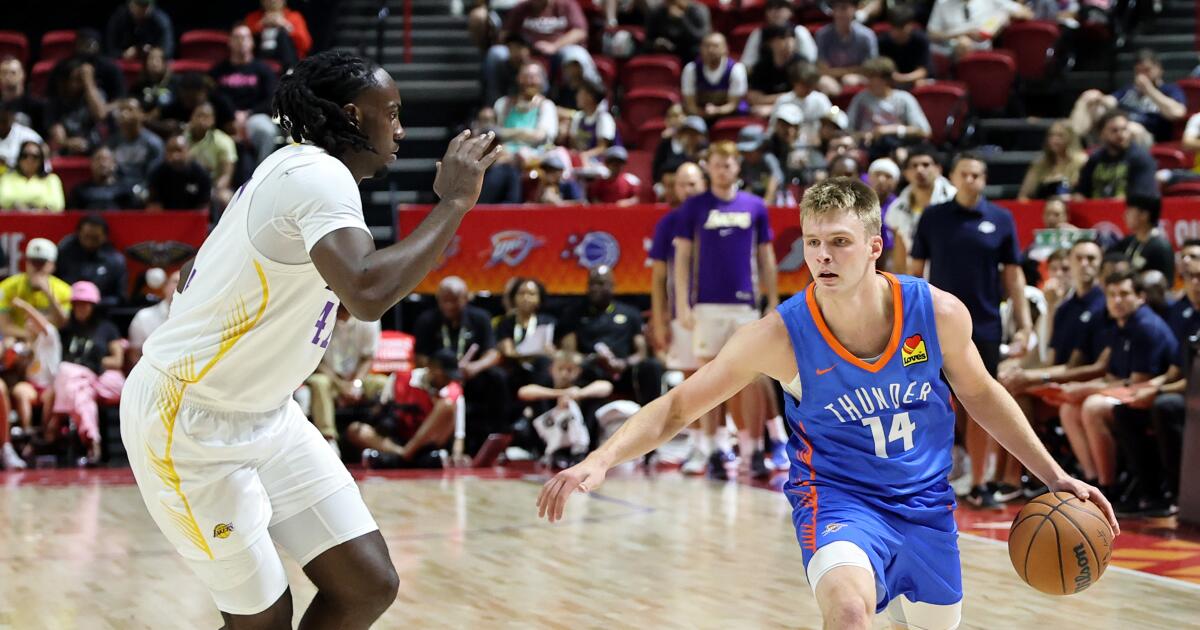 Sports42 minutes ago
Lakers’ Arthur Kaluma erupts for 34 points in breakout Summer League performance

