West
Haley says 'we didn't even count' Nevada after losing primary without Trump on ballot; calls caucus 'rigged'

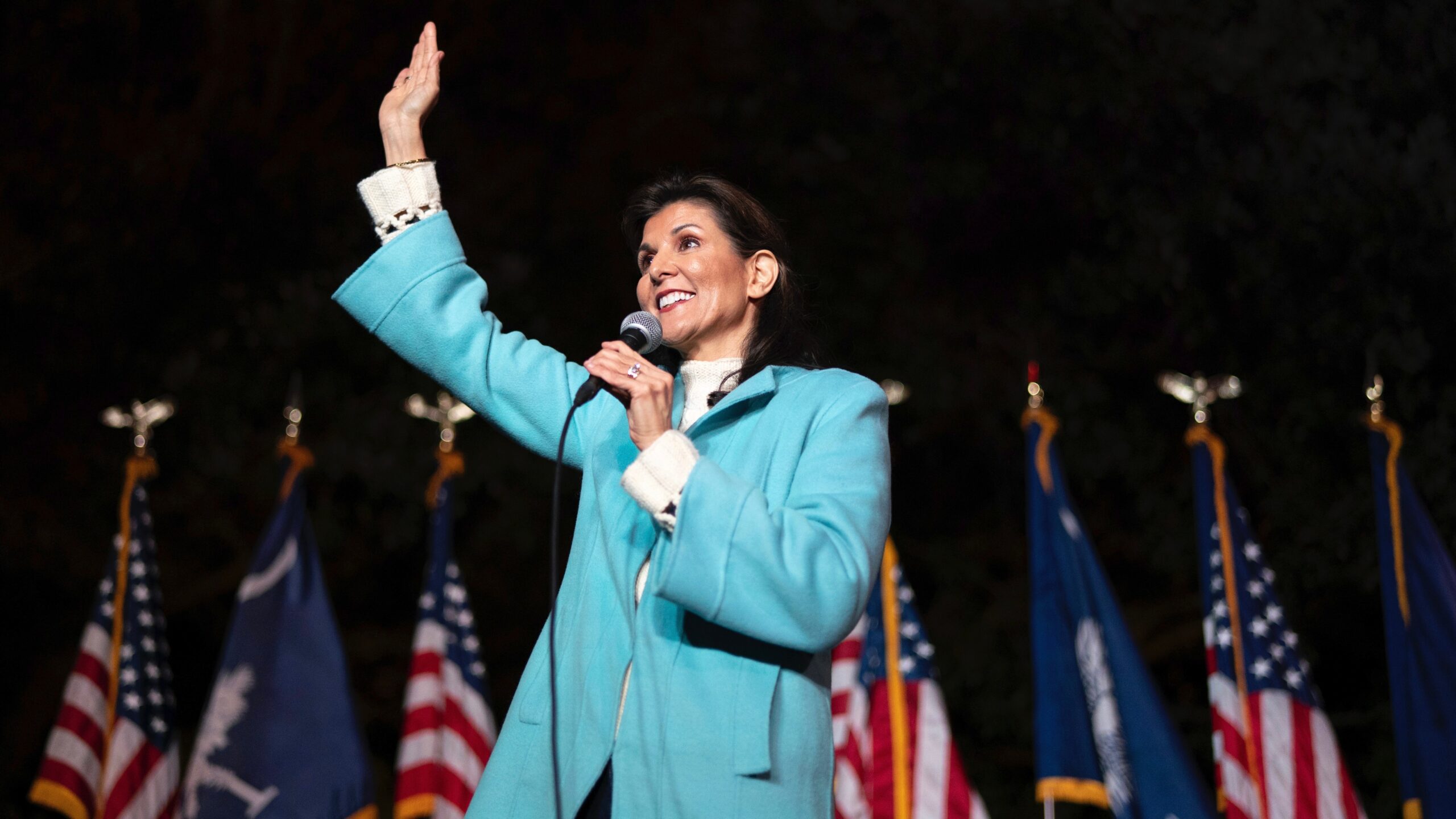
LOS ANGELES — Republican presidential candidate Nikki Haley has her eyes on the next major contest in the GOP nominating calendar — the primary later this month in her home state of South Carolina, as well as on Super Tuesday in early March.
And Haley is downplaying this week’s primary and caucus in Nevada, saying they weren’t “anything we were looking at” and charging that the caucus is “rigged” for former President Donald Trump.
Haley made her comments Wednesday, one day after she lost by a more than two-to-one margin to the “none of these candidates” option in Nevada’s state-run GOP presidential primary. The contest was open only to registered Republican voters.
HALEY LOSES NEVADA REPUBLICAN PRIMARY WHERE TRUMP WASN’T ON THE BALLOT
Republican presidential candidate former President Donald Trump motions before speaking at a campaign event in Las Vegas on Jan. 27. (AP Photo/John Loche)
Trump, the commanding front-runner for the Republican presidential nomination as he bids a third straight time for the White House, was not on Tuesday’s ballot. And voters casting ballots in the state-run Republican nominating contest couldn’t write in Trump’s name, but they could vote for a “none of these candidates” option.
Trump supporters that Fox News spoke with at polling stations on primary day in Las Vegas said they were casting a ballot for “none of these candidates.”
While Haley’s name was on the ballot, the former two-term South Carolina governor who later served as U.N. ambassador in the Trump administration ignored the Nevada primary.
HALEY CAMPAIGN CHARGES NEVADA GOP CAUCUSES ‘RIGGED’
Haley didn’t campaign in Nevada ahead of the primary and hasn’t been in the state since speaking in late October at the Republican Jewish Coalition’s annual leadership conference.
“In terms of Nevada, we have not spent a dime nor an ounce of energy on Nevada,” Haley campaign manager Betsy Ankney told reporters on Monday. “So Nevada is not and has never been our focus.”
Haley, speaking Wednesday in separate interviews with Fox News Digital and with FOX 11 Los Angeles during stops in Southern California, emphasized that “we knew months ago that we weren’t going to spend a day or a dollar in Nevada, because it wasn’t worth it. And so we didn’t even count Nevada. That wasn’t anything we were looking at.”
Former U.N. ambassador and former South Carolina Gov. Nikki Haley, a Republican presidential candidate, signs autographs following a campaign rally at American Legion Hollywood Post 43, on Feb. 7, 2024 in Los Angeles, California (Fox News – Paul Steinhauser)
Hours earlier, as the votes were being counted on Tuesday night, the former president took to his Truth Social network to take aim at Haley.
“A bad night for Nikki Haley. Losing by almost 30 points in Nevada to “None of These Candidates.” Watch, she’ll soon claim Victory!” he argued.
And Trump campaign senior adviser Chris LaCivita charged: “More embarrassment coming in South Carolina …the @NikkiHaley Delusional Tour continues,’ he claimed in a social media post.
BIDEN HITS THE JACKPOT IN NEVADA’S DEMOCRATIC PRESIDENTIAL PRIMARY
While Trump wasn’t on the primary ballot, his name will be listed on Thursday in a presidential caucus being run by the Nevada GOP.
The confusion over having two competing contests dates to 2021, when Democrats, who at the time controlled both Nevada’s governor’s office and the legislature, passed a law changing the presidential nominating contest from long-held caucuses to a state-run primary.
The Nevada GOP objected, but last year their legal bid to stop the primary from going forward was rejected. In a twist, the judge in the case allowed the state Republicans to hold their own caucuses, where all 26 delegates will be up for grabs.
A voting sign is seen outside a polling station in Las Vegas on Tuesday as Nevada holds its presidential primary. (Fox News – Monica Oroz )
The state GOP ruled that candidates who put their name on the state-run primary ballot could not take part in the caucuses.
Haley and some of the other now-departed Republican presidential candidates viewed the Nevada GOP as too loyal to Trump and decided to skip a caucus they believed was tipped in favor of the former president.
Nevada GOP chair Michael McDonald and both of the state’s members of the Republican National Committee are supporting Trump.
WHAT NIKKI HALEY TOLD FOX DIGITAL ABOUT WHAT SHE NEEDS TO DO TO KEEP RUNNING
“We made the decision early on that we were not going to pay $55,000 to a Trump entity that, you know, to participate in a process that was rigged for Trump,” Ankney argued on Monday.
And Haley on Wednesday charged that “Nevada – it’s such a scam. They were supposed to have a primary. Trump rigged it so the GOP chairman – who’s been indicted – would go and create a caucus.”
“We knew that it was rigged from the start,” Haley argued in her Fox News interview.
Republican presidential candidate Nikki Haley waves to the crowd during a campaign event at New Realm Brewing Co. in Charleston, South Carolina, on Sunday. (AP Photo/Sean Rayford)
McDonald, responding, claimed that Haley “is not a real serious candidate.”
“The fact of the matter is she didn’t show up. She did not campaign in Nevada and neither did ‘none of the above’ and ‘none of the above’ won,” the Nevada GOP chair told Fox News Digital.
Haley, looking ahead, reiterated that “our focus is on South Carolina, Michigan, Super Tuesday.”
Michigan holds its primary on Tuesday, Feb. 27, three days after the South Carolina Republican primary. Fifteen states, including the behemoths of California and Texas, hold contests a week later, on Super Tuesday.
Former U.N. ambassador and former South Carolina Gov. Nikki Haley, a Republican presidential candidate, holds a campaign rally at American Legion Hollywood Post 43, on Feb. 7, 2024 in Los Angeles, California (Fox News – Paul Steinhauser)
Haley’s two campaign stops on Wednesday in California were her first to date in any of the Super Tuesday states. And the swing to the Golden State appears in part to be a marker for Haley as she pushes back against calls by some Republicans to drop out of the race and give up her uphill climb for the nomination.
The trip also included a series of fundraisers. And as Fox News Digital first reported on Wednesday, Haley hauled in $1.7 million in fundraising during her two days in California.
Get the latest updates from the 2024 campaign trail, exclusive interviews and more at our Fox News Digital election hub.
Read the full article from Here


Ahmed Ali Mazen can’t remember the last time he missed the call to prayer.
Five times a day, he heads out the back of his restaurant, Old Jerusalem at 25th and Mission streets, and climbs the stairs to his rooftop, which overlooks the Mission and Bernal Heights.
He always concludes the routine with a Marlboro Gold and a scorching-hot cup of tea with fresh mint.
It’s a lifetime away from the farm where Mazen, now age 58, was raised, one of 11 children, in a small village named Saffa in Ramallah, Palestine. His family grew cucumbers, tomatoes, watermelon and, on the village’s mountaintop, olives.
The Mazen family raised cows, sheep and goats. Mazen had his own pet donkey, which he said he loved dearly.
“Donkeys were for those who couldn’t afford horses,” he said. “Those who couldn’t afford donkeys walked.”
Mazen’s donkey was his most prized possession. He would use it to plow the family’s land and carry produce back from the top of the mountain.
He looks back on his childhood fondly, remembering the village’s ceremonial olive harvest and the fiercely competitive soccer matches.
He and his friends would wait outside the nearby girls’ school in the afternoons, each picking who they said they would one day marry.
“Of course, we never had the guts to go up to them and introduce ourselves. It was just fun to love from afar. That’s what kids do.”
Mazen was 19 during the first intifada in 1987, a political uprising against Israel in which more than 1,100 Palestinians, many of them children, were killed.
“Nothing was ever the same,” he says.
He was still in his teens when he left to start a new life in the United States. In San Francisco, he worked all sorts of odd jobs: Bagging groceries at Mike’s on Mission Street, tow-truck driver, and endless kitchen gigs.
Next came an arranged marriage. “She had seen a photo of me beforehand, I didn’t, but I didn’t really care,” he recalled. “I just wanted to get married.”
His bride was another Palestinian from Ramallah, possibly one of the girls he’d admired from afar during his school days.
He said falling in love and wanting to raise a family motivated him to be self-sufficient by starting his own business. Mazen felt there was a gap to be filled, that existing Middle Eastern restaurants weren’t serving “true” Palestinian food.
One day, Mazen noticed a new “for sale” sign in a window on his commute home. The asking price was far above his price range, but with loans from a bank, family and friends, he cobbled together enough money to buy it.
Old Jerusalem Restaurant opened in 2005. At first, business was so slow that he had to borrow another $40,000 loan from a friend, but eventually it picked up.
Now, 21 years later, Old Jerusalem offers authentic Palestinian dishes like pistachio-crusted lamb chops and Nablusi kunefe, a dessert made of crispy, shredded phyllo, layered with melted cheese and soaked in sweet, fragrant syrup.
“We serve the food I ate growing up, no compromises,” Mazen said.
On its face, Mazen’s story is one of the many successful stories of Palestinian immigrants. He has a wife and three kids, all of whom went to college, and a longstanding business.
He has friends in the Palestinian community here, like Sami Rami, who owns the nearby Middle Eastern market. These days he goes to countless weddings for his friends’ grown children. And he has come to love this sanctuary city.
“This place has everything you need to love it,” he said. “There is so much diversity here: Arab, Chinese, Black, you name it. If you want to get to work in this country, there’s also the money for it.”
Yet Mazen longs for the life he left behind. The annual olive harvest has become nearly impossible due to the current conflict, he says, but he still visits home about once a year to check in on his mother.
“Do you want me to tell you what is good for the story, or do you want me to be honest?” he asked. “I’m so grateful for what God has given me, but if I could go back 20 years from now, I would have never left.”
“The biggest mistake anyone can make is to leave their country,” he said.
“Money doesn’t fix anything. It doesn’t fix that feeling of comfort hearing the mosque’s call to prayer, or seeing your children gather with your nephews, and grow up alongside their cousins. No matter how much money you make, you’ll never be able to get what you once had at home.”

If you were a single Slavic pagan in ancient times, the path to finding true love was fairly straightforward and considerably more exciting than going on a blind date. All you had to do was weave a garland of wildflowers, grab your intended by the hand, hurl yourselves over the roaring flames of a bonfire, and plunge nude into the nearest body of water.
In other words, ancient midsummer festivals of romance were fairly high stakes.
While you likely won’t find anyone risking third-degree burns or stripping nude in Boulder this weekend, chef Bo Porytko is reviving similar energy for a sprawling 10-course fine-dining experience where feast-goers can party like it’s 900 A.D.
The Midsummer Farm Dinner takes place on Sunday at Esoterra Culinary Garden, 8985 Valmont Road, Boulder. The event will bring together a collective of 10 chefs from some of Denver’s buzziest restaurants — including Molotov, Somebody People, Hearth, Odell’s Bagel, Petit Chelou, Margot, Bear Leek, La Diabla and Rougarou — for a collaborative, long-table meal built around Esoterra’s summer produce. The outdoor feast will begin with arrivals at 5 p.m., followed by dinner at 6 p.m. Tickets start at $260.
Porytko, the chef behind Denver’s Molotov restaurant, said the dinner series was inspired by his heritage.
“In Ukrainian culture, we have something called Ivana Kupala, which dates back to ancient times,” Porytko said. “Basically, it’s their midsummer festivities that also act as a mating holiday.”
Don’t worry, coupling up is not required for this event.
“Midsummer is just kind of a fun time,” Porytko said. “It was a good way to harness these weird, culty vibes that kind of suit the farm setting.”
The ancient East Slavic festival of Kupala was celebrated on the evening of June 23-24.
For guests wondering how that ancient atmosphere translates to a modern dinner on a 100-acre Boulder property, the evening starts on a hospitable note. Guests arrive for James Beard-recognized cocktails mixed by the team from Denver’s Yacht Club. From there, diners have time to explore the farm.
“The way the actual event begins is people come to the farm and get about an hour with welcome cocktails,” Porytko said. “Then you’re supposed to wander, check out the space, take in the farm, and there’s a little bit of education too.”
Attendees are asked to arrive dressed entirely in white. An LED flower wreath will be placed at each setting around a massive table built for 100 people. A maypole will be erected nearby, and a live DJ will guide the evening’s soundtrack. The music will begin to vibe with standard dinner fare before veering into unexpected territory.
“The DJ will play normal music, but then take, for example, a Kelly Clarkson song and turn down the beats per minute so she sounds like she’s speaking in Viking tones,” Porytko said, adding that the DJ will also mix in random Gregorian chants to fit the scene.
As the wine flows, the initial formality of the long table quickly disappears. Porytko said guests naturally start getting up, making friends and moving around the property after a few courses.
“After 10 courses and eight glasses of wine, people just kind of take it in whatever direction they want,” Porytko said.

To translate those festive vibes into an actual 10-course meal, the participating chefs rely on a highly democratic planning process. Justin Freeman, the executive chef of Somebody People in Denver, will help coordinate the logistics, beginning with a digital inventory of whatever Esoterra is currently pulling from the soil.
“There’s a Google Doc that we all use,” Freeman said. “We just ask the owner of Esoterra — Mark DeRespinis — what he’s growing, and then everyone signs up for what ingredients they want to cook with. We really just try to showcase what Mark has.”
Chefs look over the active list, claim the specific vegetables they want to work with and design a dish around them. Freeman then steps in to help arrange the final layout of the courses. He said the event has become an ongoing annual collaboration to give a little praise to the people who are doing all the hard work — the farmers.
The resulting menu leans heavily into hyper-seasonal creativity, starting with Porytko’s own intricate contribution.
“The idea is to highlight items from the farm,” Porytko said. “For me, I’m highlighting their beets, their Badger Flame beets.”
Porytko is preparing a guinea hen roulade cured in the juice of the Badger Flame beets and stuffed with a chocolate mint mousseline. The dish will be served with a beet mole, a gummied Badger Flame beet and traditional roasted beets.
The rest of the collective will showcase the farm’s harvest through a variety of distinct culinary styles. Freeman is serving grilled fennel with a creamy pistachio sauce, pickled celtuce and seasoned breadcrumbs. Andrew Van Stee of Hearth is contributing Moroccan pistachio carrot rolls, while Miles Odell of Odell’s Bagel is pairing dry-aged ocean trout with a coconut pea puree. Justin Fulton of Margot is preparing charred cucumbers with agretti, coconut broth and yuzu kosho, and Rema Maaliki and Harrison Porter of Bear Leek are bringing braised leeks with leek soubise, albufera and crispy leeks. The lineup also features plates from James Beard chef finalist José Avila of La Diabla, JohnDavid Wright of Rougarou and pastry work by Ali Spahr of Hearth .

The actual preparation happens entirely outdoors. The chefs arrive early in the morning to set up tables, tents and their own Japanese konro grills packed with binchotan charcoal.
“It all happens out in the field, in the middle of Mark’s gardens,” Freeman said. “We set up that morning. We’ll set up the tables, the tents, everything. Then we do all the cooking in front of everyone.”
Diners can stand right by the workspace and watch the dishes come together. For the chefs, the open-air format offers a rare chance to step away from their respective restaurant kitchens and collaborate directly with their fellows.
“For us, as chefs, we just don’t get to see each other very often, so it’s really fun and special when we do,” Porytko said. “We definitely have our own little hangout in the kitchen area with all the chefs, you know — all the weirdos in the corner.”
Freeman echoed the sentiment, noting the benefit of the format for the guests as well.
“With this one, you’re getting 10 different chefs with 10 different views all coming together under one roof,” Freeman said.
Cooking in an open field does, however, mean operating at the whim of Colorado’s summer elements. Freeman recalled a previous year when a sudden onset of mountain weather forced the culinary crew to quickly shift from grilling to structural defense.
“The first year we had a little bit of rain at the start of it,” Freeman said. “Then the wind was crazy, where we all had to come and grab the tent so it didn’t blow away.”
Hopefully, on Sunday, the weather will remain tame, but guests should prepare for whatever Mother Nature has to throw at them, just in case.
The event takes place on Sunday, with arrival at 5 p.m. and dinner at 6 p.m. The location is Esoterra Culinary Garden, 8985 Valmont Road, Boulder. Tickets start at $260 and are available through Tock.

SEATTLE — Seattle is preparing for one of its busiest weekends of the year as Pride celebrations and the FIFA World Cup converge across the city.
Hundreds of thousands of people are expected to attend parades, festivals, concerts, and sporting events Friday through Sunday, with city officials encouraging people to plan ahead for street closures and use public transportation.
Pride weekend begins Friday with the FIFA World Cup Group G match between Egypt and Iran at Seattle Stadium.
ALSO SEE | Seattle Pride festivities to kick off with ‘Seattle Pride in the Park’ at Volunteer Park
Local organizers have designated the game as the tournament’s Pride Match Day, with community celebrations planned throughout the day. The designation has drawn objections from the Egyptian Football Association and the Iranian Football Federation, but local organizers say Pride events will move forward as planned.
Saturday’s events include Trans Pride Seattle at Volunteer Park, one of the nation’s largest transgender Pride celebrations, along with PrideFest Capitol Hill, which will transform Broadway and Cal Anderson Park into a daylong street festival featuring live music, food vendors, artists, and community organizations.
The ticketed Queer/Pride Festival will also continue throughout the weekend on Capitol Hill.
RELATED | FIFA to allow rainbow flags at Egypt-Iran World Cup ‘Pride Match’ in Seattle
The weekend culminates on Sunday with the Seattle Pride Parade, which begins at 11 a.m. along Fourth Avenue in downtown Seattle before ending near Seattle Center. Following the parade, PrideFest Seattle Center will feature live entertainment, food vendors, beer gardens, and community exhibitors through the afternoon and evening.
Seattle Pride traces its roots to 1974 and has grown into one of the nation’s largest LGBTQ+ celebrations, drawing hundreds of thousands of people each year.
Officials are urging attendees to expect heavy crowds and traffic throughout downtown and Capitol Hill, particularly on Sunday.
Organizers recommend using the Link light rail, buses, or other forms of public transportation whenever possible.
-

 Los Angeles, Ca43 minutes ago
About 20 detained after armed suspect call sparks LAPD response in Koreatown
-

 Detroit, MI1 hour ago
With Jack Flaherty returning, AJ Hinch ponders Tigers’ starting rotation
-
San Francisco, CA1 hour ago
Serving up a slice of Palestine at Old Jerusalem in the Mission District
-

 Dallas, TX1 hour ago
All-day restaurant and patio coming to Dallas’ Knox and more top stories
-

 Miami, FL1 hour ago
Bugtopia takes center stage at Zoo Miami
-

 Boston, MA1 hour ago
What JJ Peterka Will Add to the Bruins’ Roster, ‘He’s Got an Elite Shot’ | Boston Bruins
-

 Denver, CO2 hours ago
This Boulder farm dinner serves up midsummer Slavic vibes with James Beard-worthy fare
-

 Videos2 hours ago
Destruction in Venezuela after deadly earthquakes | BBC News

