West
Fresno restaurant reopens after anti-Asian pressure forces closure

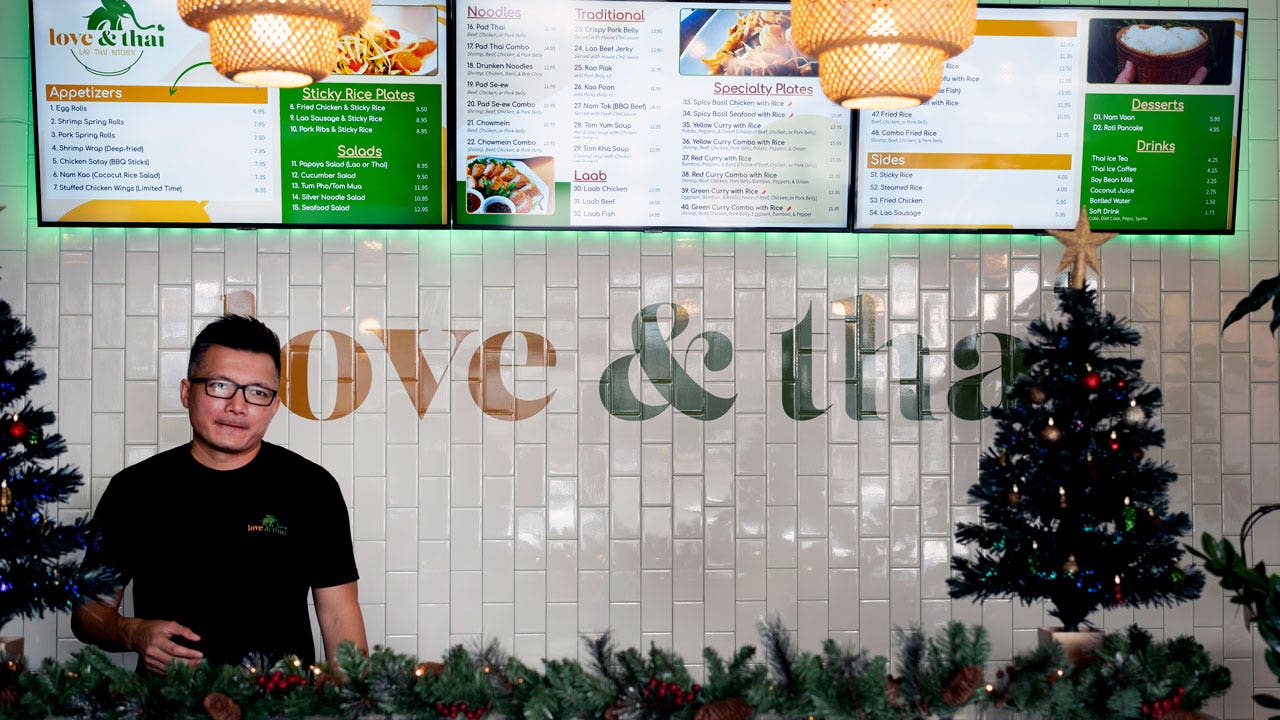
David Rasavong’s cultural pride is evident all throughout his restaurant.
It’s on the wall of family portraits and where a stunning mural depicts his family’s journey from Laos to California. It’s on the menu filled with Lao and Thai dishes like the crispy coconut rice salad of Nam Khao and the stir-fried rice noodles of Pad See Ew.
And it’s in the fact that Love & Thai in Fresno, California, restaurant is open at all. A baseless accusation grounded in a racist stereotype about Asian food using dog meat brought a six-month barrage of harassment so heated that Rasavong, 41, closed down its previous location over fears for his family’s safety.
ASIAN-AMERICAN FAMILIES WORRY RACE STILL A ‘HIDDEN FACTOR’ IN COLLEGE ADMISSIONS AFTER SUPREME COURT DECISION
His earlier restaurant had itself only been open for seven months when a so-called animal welfare crusader in May implied on social media that a pitbull tied up at an unconnected home next door was going to be served on the menu.
A day after the initial commentary, vitriolic statements, voicemails and calls rained down. Rasavong’s body still tenses up when recounting, in particular, a call from an elderly woman.
“She was so disgusted by me and yelling and screaming, and the only thing I can remember hearing her say at the end was ‘Go back to the country you came from you dog-eating mother-effer,’” Rasavong recently told The Associated Press.
David Rasavong is seen here at his restaurant “Love & Thai” in Fresno, Calif., on Dec. 20, 2023. (AP Photo/Richard Vogel)
Within days, he closed that restaurant because it no longer felt safe between the harassment and people loitering in the parking lot outside of business hours.
The false accusation tapped into a longstanding slur against Asian cuisines and cultures that has persisted in the U.S. for over 150 years, dating back to the xenophobia that grew in the U.S. after Chinese immigrants started arriving in more visible numbers in the 1800s and other Asian communities followed. It’s also one that Asian American communities are fighting against.
It may be astonishing to some that a claim rooted in a racist stereotype took down a family’s restaurant three years after “Stop Asian Hate” became a rallying cry. But for many Asian Americans and Pacific Islanders, it’s something they’ve heard before as an insult or under the guise of a “joke,” along with other negative reactions to the actual foods of their cultures. In December, a comedian received some backlash for dressing like a UPS delivery driver and walking into an Asian restaurant with caged puppies for a social media video.
There is hope though that more people will learn to tell truth from trope. Since the pandemic first fueled anti-Asian hostilities, AAPI communities themselves have tried to take control of the narrative that Asian food is “dirty,” “weird” yet “exotic.” Furthermore, the appetite to learn about food from the Asian diaspora has only grown across traditional and new media.
Still, there were moments where Rasavong felt like nobody, even media, was on his side. He said a few reporters approached him assuming the claims were true.
But he soon received tons of community support, and the closure ended up being a new beginning.
A shopping center property manager offered him the chance to take over a suite vacated by another restaurant. Nkundwe P. van Wort-Kasyanju, a graphic designer in the Netherlands, and Los Angeles-based interior designer Danny Gonzales proffered their services for free. Hana Luna Her, a local artist, painted the mural. By the Nov. 3 grand opening of the new space, Love & Thai definitely felt the love. The place was bustling all day, Rasavong said, and the city presented a proclamation.
Rasavong is holding onto the belief that he went through this whole saga for a reason.
“There’s a journey that we’re supposed to go on,” said Rasavong, who declined to say if he’ll pursue legal action. “Don’t get me wrong. People need to realize this business is not easy … But you know, we believe in what we’re doing and so far so good.”
In actuality, consuming dog meat is something that has happened in various parts of the world for centuries, where they weren’t seen as domesticated family pets, said Robert Ku, author of “Dubious Gastronomy: The Cultural Politics of Eating Asian in the USA.” Greeks and Romans referenced it. The French also ate dog meat during World War II.
But when Chinese immigrants came to the U.S., it was linked to them as part of “the myths that the Chinese were these bizarre people who had bizarre diets,” Ku said. “It was one of the attractions of actually going to Chinese restaurants back in the day because it came with ‘danger.’”
As other Asian immigrant groups came, the stereotype spread to include them.
“This is a real just blurring of the Asian identity where it doesn’t matter if you’re Thai or Korean or Vietnamese or Cambodian. You’re all the same,” Ku said.
Along with the false allegation of eating dog meat, Asian Americans and Pacific Islanders over the generations have often faced disgust and worse from others when they’ve brought their cultures’ foods from home to public spaces like school or work.
They’re taking steps to fight back, like in 2021, when San Francisco-Bay Area-based writers Diann Leo-Omineto, Anthony Shu and Shirley Huey self-published “Lunchbox Moments,” a compilation of over two dozen personal essays and illustrations that raised $6,000 for charity.
The project became “a powerful thing for all of us,” Leo-Omineto said.
“We tried to show it’s not always about being in relation to being American or being white or assimilated,” she said. “You can have moments of joy, too…I hope that it opened people’s minds a little bit more — or made them want to try new foods.”
It’s actually been a big year in publishing and food media for Asian cuisine. Publishers Weekly dedicated a feature in August entirely to Chinese and Taiwanese food after observing nine new cookbooks on the subjects were coming out this year. Several of the authors grew up outside of Asia. The titles range from “Vegan Chinese Food,” to “Kung Food” and “A Very Chinese Cookbook” from America’s Test Kitchen. Also, children’s book author Grace Lin released “Chinese Menu,” which relays folklore behind favorite Chinese American dishes. They all share personal anecdotes and readers often seem drawn to “personality-driven” cookbooks, said Carolyn Juris, features editor.
“It’s not just about the recipes. It’s about the stories behind them and I think people respond to that,” Juris said.
Like any other culture, Asian cultures encompass many different regional cuisines and nuances. With the growing Asian diaspora, it’s not strange that so many cookbooks can be mined and “publishers are savvy enough to know that there is a market for these books,” Juris added.
Back at Love & Thai, Rasavong is busy filling online orders for a waiting third-party delivery driver. He is optimistic about keeping up business now that the initial hoopla around his restaurant renaissance has calmed down. Rasavong also hopes his situation will remind others to think before they speak.
“People say these jokes and they think it’s just fun and just light-hearted,” he said. “There are certain things that you shouldn’t say that really do cross a line.”
Read the full article from Here


Some Republicans believe results of the legislative primary mean it’s time for the Montana Republican Party to mend an intraparty fight and move in a new direction.
Rep. George Nikolakakos, R-Great Falls, even said GOP Chairman Art Wittich should step down.
“What he has done is divided the party, created a war, and now we’re basically in shambles, putting Humpty Dumpty back together again,” said Nikolakakos, who won a primary race over current Public Service Commissioner Randy Pinocci with 68%.
This week, some heavyweight conservatives that earned the ire of the Montana Republican Party secured victories in state legislative primaries — but not all.
Republican Reps. Llew Jones of Conrad, David Bedey of Hamilton, and Nikolakakos of Great Falls won their Senate primaries, and Rep. Brad Barker of Red Lodge did so in the House.
But the state GOP also saw some Republican incumbents it had sought to remove ousted. Those include Sen. Shelley Vance, among a group of GOP senators that collaborated with Democrats in the Senate in 2025.
In red Montana, primaries can be decisive races in many legislative districts.
Winning candidates at odds with the state GOP said they crossed the finish line in the primary despite bruising campaigns, significant pressure from the state GOP and Wittich, and hundreds of thousands of dollars in attack ads.
But Wittich said Democrats tried to improperly influence Republican primaries, and the state GOP fought Republicans who didn’t push back and will continue to fight that influence through the general election.
“This was unprecedented. We gave them the opportunity to reject that interference, and instead of rejecting it, Brad Barker told me to go to hell,” Wittich said.
Wittich also said it isn’t surprising to see sitting lawmakers such as Jones and Bedey win given they’re known names, and he rejected the idea he should turn over the reins.
He may double down.
“If anything, I’m going to accelerate this process of looking at legislators’ votes and making sure they account when they are voting to weaken Republican leadership, voting to weaken Republican policies, and voting to weaken the Republican party,” Wittich said.
State GOP ‘message to purge fell flat’
In some cases, Republicans who pushed against their own party said they were helped when voters took offense at smear tactics. They said it took punch and persistence to counter unrelenting attack ads.
“The more people fought, the better they did,” Nikolakakos said.
Wednesday, Nikolakakos said Wittich’s attempt to take control of the party failed, as did the costly ads by the GOP and outside groups.
“They savaged me,” he said.
In 2025, nine Republicans in the Senate worked with Democrats as an ad hoc majority of 27, marginalizing a more conservative faction of Republicans.
That sometimes fragile coalition helped steer significant legislation including residential property tax relief — albeit a controversial version that landed in court.
Primary outcomes mean in 2027, the Senate could operate with a similar working majority of 26.
Wittich was elected chairman in June 2025 with a mission to further deepen the shade of red in Montana, but Nikolakakos said he ran his race bucking the idea he needs to bow to the state GOP.
“With my first speech on the Senate floor, I’m gonna call him (Wittich) out and remind him I do not work for him, that I work for the people of my district,” Nikolakakos said.
Jones, in his 10th election for the Montana Legislature, said he’s never seen more falsehoods in a campaign, and he’s glad the primary is in the rearview mirror.
The chairman of the House Appropriations Committee has shaped the state budget and was a top state GOP target.
In some cases, Jones, of Conrad, said the smears from outside groups offended voters that supported him and helped turn people out. Jones beat Rep. Zach Wirth, elected in 2024, by 4 points.
“Chair Wittich’s message of purging those who don’t swear fealty to the platform on his biggest targets didn’t work,” Jones said. “It fell flat.”
An ‘existential threat’ to the state GOP
Wittich earlier said the state GOP wanted to root out Republican candidates who were actually more aligned with Democrats.
To that end, the state GOP targeted some Republican lawmakers it viewed as out of step with its platform, including Nikolalakos, Jones, Bedey and Barker.
Bedey edged out his GOP opponent with just 51% of the vote in red Ravalli County, and Barker pulled in 64% of the vote in Carbon County.
Wittich said in general, incumbents largely win, so wins by known lawmakers in this primary shouldn’t be considered a rejection of the state GOP. But he said the GOP’s message isn’t about individuals.
“This is an existential threat to the Montana Republican Party, and we had to speak with a clear and loud voice to reject that interference,” Wittich said.
Among the wins for the state GOP was the ousting of Vance, of the Belgrade area, and defeat of the challenge by Sen. Jason Ellsworth in a House race hundreds of miles from Hamilton, where he’s lived and held a Senate seat.
Vance and Ellsworth were two of “The Nine” senators who broke with party leadership in 2025 to work across the aisle and pass major bills, leading to admonishment by the state GOP.
Ellsworth, who was all but removed from office last session, lost to Montana Freedom Caucus Chairman Jerry Schillinger, of Circle, who had support from the state GOP and bested Ellsworth with 86% of the vote.
Vance, the only member of “The Nine” seeking reelection to the Senate, lost to Rep. Caleb Hinkle by 48 points. Hinkle, in the Legislature the last three sessions, is backed by the state GOP.
Finley Warden, who bested incumbent Rep. Linda Reksten with 65% of the vote, said he rejected the idea a split exists with Republicans — he said some candidates use the GOP label to win but are “fake Republicans.”
Warden, on a state GOP Honor Roll, said talking to Republican voters at a grassroots event in nearly any part of the state is evidence.
“They will tell you that they want true conservative Republican representatives that actually follow through on the things that Republicans promise,” Warden said, pointing to smaller budgets as an example.
Into the general election, legislative session
Even staunch conservatives such as Speaker of the House Brandon Ler, of Savage, and the state GOP’s own vice chairperson, Stacy Zinn, of Billings, failed to earn the party’s nod in the Honor Roll it released in April. But they won Tuesday.
Wittich said he wasn’t on the committee that named Honor Roll candidates “supporting Republicans.
But he said it’s possible Ler, as speaker, was held to a higher standard, given the Democrats at the end of the 2025 session said “they got everything they wanted.”
Ler, who could not be reached for comment after the primary, won with 56% of the vote.
Wednesday, Zinn said her opponents tried to cast her as a “malcontent,” but she said asking questions doesn’t mean you’re not a team player.
She also said it’s time to reevaluate the Honor Roll and the strategies of the state GOP and end the fragmentation. Zinn won with 61% of the vote.
“I can tell you right now people (Republicans) are not going to be Kumbaya initially, but it’s time to put the voters and constituents first,” Zinn said.
Editor’s note: Reporter Micah Drew contributed to this story.

RENO, Nev. (News 4 & Fox 11) — A wrinkle in Nevada’s election laws means the Republican primary for Washoe County District Attorney in 2026 is a winner-take-all contest — whoever wins the GOP primary will appear on the November general election ballot unopposed and win the seat outright.
Only two Republicans tossed their hats in the ring — incumbent Chris Hicks and Sparks city attorney Wes Duncan. And because no Democrats, nonpartisans or third-party candidates filed to run, the GOP primary will determine the next district attorney.
Washoe DA GOP primary is winner-take-all because of 2015 law signed by Gov. Sandoval
FULL RACE PREVIEW: Washoe County DA race: GOP primary between Hicks, Duncan will decide next top prosecutor
The unusual dynamic leaves over two-thirds of the Washoe County electorate with no say whatsoever in selecting the county’s top prosecutor for the next four years. So why is it this way?
It’s not because of a decades-old provision in Nevada Revised Statutes, rather an intentional law change passed in 2015 and signed by then-Gov. Brian Sandoval.
Prior to 2015, if only one major party had candidates file for an office, there was no primary contest under Nevada law. Instead, all of that party’s candidates automatically advanced to the general election, where voters from all parties would select the winner.
But in 2015, Senate Bill 499 changed all of that. SB 499, sponsored by the Senate Committee on Legislative Operations and Elections, originally sought to create a top-three open primary with ranked choice voting in the general, said Doug Goodman, founder and executive director of Nevadans for Election Reform.
Goodman, who supports increasing participation for Nevada’s growing nonpartisan voting bloc, initially backed that legislation. But on amendment, those provisions were stripped out entirely and replaced with entirely different language.
Under the amended bill, a party primary must be held regardless of the number of candidates. That primary contest would determine the party’s one nominee, who would advance to the general election unopposed.
It received unanimous bipartisan support in the Nevada Senate and passed with a two-thirds majority in the Nevada Assembly. 14 Assembly Republicans voted no on Senate Bill 499, but it passed anyways and was signed into law by Gov. Sandoval.
TMCC political science professor Fred Lokken told News 4-Fox 11 he believes it’s created an undemocratic scenario.
I see this as the most undemocratic concept of elections that has ever been perpetrated.
“It’s done in a number of states, Nevada’s not the only one, but a primary is not a deciding election. There should be no decision for the fall election made months in advance when voters aren’t paying attention,” Lokken said. “It’s all in favor of the parties. It cuts down in those elections, the notion that they have to go through another round.”
In contrast, many others would argue that only a party’s voters should be able to select a party’s nominee.
Attempts to undo this change have been unsuccessful. In 2019, Assembly Bill 259 would’ve reversed that provision of the 2015 legislation — it passed in the Assembly 30-10 but never came up for a vote in the Senate that year.
Another possible solution would be to make countywide offices such as district attorney, clerk and assessor nonpartisan contests. Lokken even floated that such positions should be appointed.
“I really hope that the 2027 (Nevada) legislature is willing to reopen this and consider fixing it. A partial open primary makes a whole lot of sense, and not allowing it to be the decision-maker makes a lot of difference … I would suggest that a lot of these positions should be appointed, not elected. There are too many elections.”
Email reporter Ben Margiott at bjmargiott@sbgtv.com. Follow @BenMargiott on X and Ben Margiott KRNV on Facebook.

SANTA FE, N.M. — The New Mexico Department of Justice is now suing online prediction market platform, Kalshi, after four of the state’s tribes sued the platform in May.
The NMDOJ, led by state Attorney General Raul Torrez, is alleging Kalshi unlawfully offers online sports betting in the state by allowing people to place wagers on sporting events on its online platform.
In New Mexico, sports betting is legal but is limited to in-person wagering at tribal casinos. The NMDOJ cited this framework as the basis for suing Kalshi, accusing the platform of trying to skirt state gaming laws and regulations.
“New Mexico has a longstanding and carefully balanced system for regulating gaming that protects consumers, ensures accountability and respects tribal sovereignty,” Torrez said. “The only lawful gaming in New Mexico operates either under tribal-state gaming compacts or under strict state regulations to ensure honest gaming free from corruption and licenses gaming operators only after they explain how they plan to address compulsive gambling. Kalshi has ignored that framework entirely while offering online sports betting within the state.
“We are filing this lawsuit to protect the integrity of our laws, our regulatory system and, most importantly, consumers.”
The NMDOJ accused Kalshi of using “event contracts” to effectively make online sports betting happen in the state. They alleged these contracts function in the same way as traditional sports bets and operate in the state without any gaming license.
NMDOJ also pointed out Kalshi operates with a minimum betting age of 18 years old, three years younger than the minimum age at the state’s tribal casinos.
In May, the Sandia, Isleta and Pojoaque Pueblos and the Mescalero Apache Tribe filed their own lawsuit, pointing out the minimum age and alleging people are using it on their lands in violation of their exclusive rights to offer betting services.
In its lawsuit, NMDOJ is looking to halt Kalshi’s operations in New Mexico and prevent the company from continuing to offer sports-related wagering through its platform.
KOB has yet to receive a statement from Kalshi on either lawsuit.
MORE:
-

 Maine4 minutes ago
Pilots aboard hydrogen balloon are attempting to cross Atlantic Ocean from Maine
-

 Maryland7 minutes ago
Maryland troopers attend high school graduation of student whose dad died in line of duty
-

 Michigan12 minutes ago
Michigan football beats out Alabama, Texas for 4-star DB Blake Jenkins
-

 Massachusetts19 minutes ago
Cheers! Mass. House passes proposal to extend bar hours to 3 a.m. during World Cup, putting bill on fast track. – The Boston Globe
-

 Minnesota22 minutes ago
The Scoop – June 4
-

 Mississippi27 minutes ago
Mississippi lawmakers talk school consolidation, closures in state
-

 Missouri34 minutes ago
Arapahoe County Mounted Unit heading to Missouri for the 2026 FIFA World Cup
-

 Montana38 minutes ago
Montana Republican Party called on to end GOP fighting • Daily Montanan

