West
FBI captures Bangladeshi fugitive extradited in massive online child sextortion case

NEWYou can now listen to Fox News articles!
A Bangladeshi national extradited from Malaysia this week is accused of carrying out one of the most prolific online child exploitation schemes the United States has ever seen in a wide-ranging alleged sextortion operation.
Prosecutors allege Zobaidul Amin posed as a teenager on Instagram and Snapchat and coerced hundreds of minor victims — some as young as 11 — into producing sexually explicit images and videos. Authorities said he then threatened to share those images with friends, family and classmates unless the victims sent more.
Many of his victims were located in Alaska, while others were targeted across the United States and abroad, the Department of Justice said.
Zobaidul Amin is accused of coercing hundreds of minor victims — some as young as 11 — into producing sexually explicit images and videos in what prosecutors described as one of the most prolific online child exploitation schemes alleged in U.S. history. (Department of Justice)
Prosecutors further allege Amin demanded specific numbers of sexually explicit photos and videos each day, continued threatening victims for months even after his accounts were deleted, worked with others to store and distribute the material online and used multiple fake accounts to evade social media platform bans.
“This FBI is back to doing what it does best, locking up predators, dismantling violent gangs and holding criminals accountable no matter who they are,” FBI Director Kash Patel said in a statement to Fox News Digital.
“In just 24 hours, our agents captured a fugitive accused of running an international child exploitation ring, took down the 18th Street Gang in Los Angeles and arrested a contractor who allegedly stole more than $46 million from the U.S. Marshals Service. Criminals everywhere should understand the message: This FBI is coming for you.”
Amin appeared in federal court Thursday in Alaska, a day after arriving in the United States. He pleaded not guilty during his initial appearance in Anchorage, according to Bloomberg.
Amin faces 13 federal counts, including conspiracy to produce child pornography, conspiracy to receive and distribute child pornography, child exploitation enterprise, production of child pornography, cyberstalking, aggravated identity theft and wire fraud.
‘SADISTIC’ MAN LINKED TO NIHILISTIC VIOLENT EXTREMISM CHARGED WITH GROOMING CHILD INTO SEXUAL ACTS, SELF-HARM
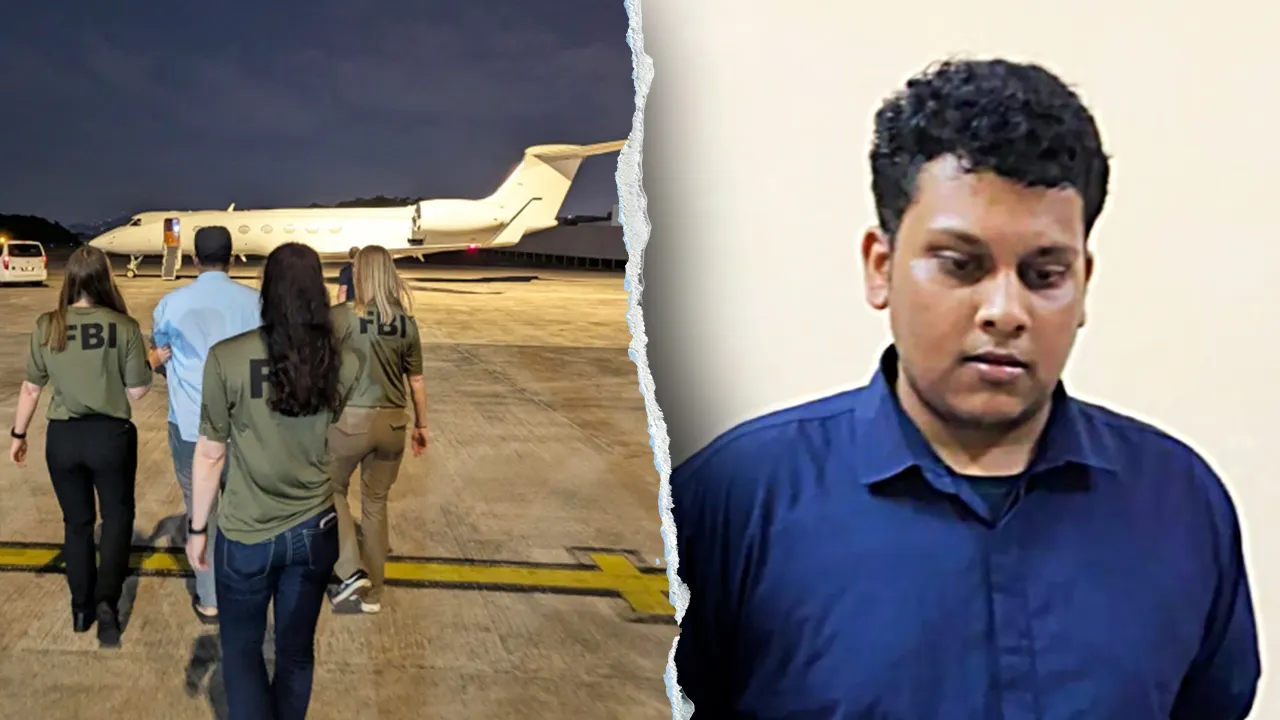
FBI agents escort Zobaidul Amin after his transfer from Malaysia to the United States to face charges in an alleged international sextortion and child exploitation scheme. (Department of Justice)
Prosecutors said Amin used more than 80 Snapchat accounts and 40 Instagram accounts to evade bans.
Court documents say he and co-conspirators organized images in Dropbox folders by victim and shared links to extort more material. The indictment also alleges he placed at least one victim in fear of serious bodily harm and used false pretenses to obtain explicit images, forming the basis for cyberstalking and wire fraud charges.
Prior to the U.S. charges, Amin was living in and attending medical school in Malaysia.
In September 2022, he was charged by the Attorney General’s Chambers of Malaysia with 13 counts related to the possession and production of child pornography. The FBI and the Justice Department worked in coordination with Malaysian authorities, and Amin was transferred from Malaysia to Alaska March 4.
FBI agents stand on the tarmac as a plane arrives carrying Zobaidul Amin after his extradition from Malaysia to face federal charges in Alaska. (Department of Justice)
“The impact of this case is that of international magnitude. It stands as one of the most prolific cases of alleged online child exploitation the United States has ever seen,” said Michael Heyman, U.S. attorney for the District of Alaska.
“We are grateful for the steady, strong collaboration among the Justice Department’s Office of International Affairs, law enforcement agencies and Malaysian partners that made this transfer possible, enabling us to move forward and seek justice for victims.”
CLICK HERE TO DOWNLOAD THE FOX NEWS APP
U.S. Magistrate Judge Kyle F. Reardon ordered Amin held without bail as the case moves forward. Amin waived his right to a speedy trial and requested a jury trial.
Related Article

Read the full article from Here



San Francisco, CA
San Francisco fishermen recount harrowing rescue after boat capsizes near Alcatraz

SAN FRANCISCO – While one person died after a cabin cruiser sank in the San Francisco Bay on Tuesday afternoon, a harrowing rescue near Alcatraz Island saved 16 lives.
The U.S. Coast Guard and the San Francisco Fire Department continue to search for three missing people who went overboard after the vessel went down around 3:30 p.m.
Clifford Joseph Boisa, 79, of Sutter County, was pronounced dead following the incident. However, 16 others were brought to safety, many of them rescued by civilian boaters who rushed to help. Among the Good Samaritans were fishermen Mike Montoya and Justin Marceline, who were aboard the Khea, a 22-foot Boston Whaler.
At a Wednesday afternoon press conference, Coast Guard Incident Commander Jarod Toczko praised the fishermen and a nearby kiteboarder for their heroic actions.
A rush to help
Dig deeper:
Montoya and Marceline were on the water when they noticed signs of trouble nearby.
“I turned around and I saw a plume of either smoke or steam,” Montoya said. “I just knew that somebody was in distress.”
Montoya told his partner they needed to move their boat closer to investigate. When they arrived, they found people struggling to stay afloat in the Bay’s frigid waters.
The rescuers began throwing life jackets and flotation devices to those in the water, pulling victims aboard as quickly as possible. Many of the victims were exhausted and unable to pull themselves out of the water.
Witnesses recount people ‘trapped’ inside
What they’re saying:
As they pulled survivors aboard, Montoya said he saw people trapped inside the cabin of the sinking vessel, banging on the windows.
“We were throwing fishing weights at the window, trying to get it to break, and we handed a guy a fishing weight that was in the water, and he didn’t have a life jacket on,” Montoya said.
In total, Montoya and Marceline pulled nine people onto their boat and brought them to safety.
Marceline was prepared to jump into the Bay to help more victims, but Montoya stopped him, warning of debris and other dangers beneath the surface.
“My first thought was to kick my shoes off and get down to my underwear and jump in and start to get the elderly people off the boat, because it was elderly people helping elderly people and it wasn’t going fast enough,” Marceline said.
Memorial service turns tragically fatal
Survivors told the fishermen they had gathered on the water for a memorial service. Authorities later confirmed that the victims and survivors were relatives and close friends holding a memorial when the boat went down.
Toczko said the 50-foot cabin cruiser was capable of carrying the number of people on board, but noted that investigators must consider several factors regarding the boat’s stability.
The investigation into what caused the vessel to sink is ongoing.

Denver police arrested two boys on suspicion of first-degree murder after detectives said they shot and killed a 33-year-old man in Sunnyside.
Investigators believe Christopher Nabors confronted the boys, who are 12 and 14 years old, after he found them either breaking into or trying to steal his vehicle in the 4300 block of North Pecos Street on June 30.
The boys, who have not been publicly identified because they are juveniles, were arrested by Denver Police Department officers on July 1 after police spotted them in a stolen vehicle and they fled when officers tried to pull them over.
Denver police also accused the 14-year-old of being involved with a shooting about 15 minutes before the Sunnyside shooting, when the teen and two other juveniles shot a fourth juvenile near Park Avenue and East 20th Avenue. The juvenile victim was injured but survived, agency officials said.
Detectives are still investigating a homicide that happened under the same circumstances in the 15000 block of East Olmsted Drive in the early hours of June 24.
Jacob Lopez, 19, was killed in that shooting, according to the Denver Office of the Medical Examiner.
Following the deaths of Nabors and Lopez, Denver police warned the public against confronting would-be car thieves.
“We offer this warning, in no way to shame the victims for their attempts to protect their vehicles, but to bring awareness to this disturbing trend and to encourage everyone to call 911 if they see something suspicious or a crime in progress,” Chief Ron Thomas said in a statement on July 2. “The brazen actions of these suspects go against the fiber of our community, and our investigations teams are working to identify and arrest them.”
Sign up to get crime news sent straight to your inbox each day.
Seattle, WA
Outreach groups respond to the reported relocation cycle of Ballard’s homeless population

SEATTLE — As people voice concerns about an encampment in Seattle’s Ballard neighborhood, outreach groups are detailing their efforts and fighting back against encampment removals.
The outreach group We Heart Seattle said it checks on the people in an encampment of at least 20 people weekly to offer water, snacks, personal hygiene items, and access to treatment.
RELATED | Ballard encampment grows after city removes nearby site along Burke-Gilman Trail
The group told KOMO it believes more can be done at the city level, from policy to housing, to get the homeless connected with shelter and services.
A woman working at the Fred Meyer off NW 45th Street and 9th Avenue captured video of a fire near tents at an encampment across the street. A day later, off camera, she told KOMO News she worries about the safety of the people living in the tents and Ballard neighbors, in addition to concerns about alleged open-air drug use at the encampment.
“We became homeless because of certain situations, and we turned to drugs, and unfortunately, addiction comes next, you know?” Crystal Rawlings told KOMO News. She has set up her tent on multiple streets in Ballard, and said she’s approaching one year of being opioid-free.
She believes there’s been more city outreach since the start of the new mayoral administration to connect people living on the streets with services, but knows there’s not enough transitional housing for everyone who needs or wants it.
She and the Ballard Community Task Force on Homelessness and Hunger urge the city to stop encampment removals that push this group to another block.
RELATED | City removes Ballard encampment as neighboring businesses raise housing concerns
“We’re not abominations. We’re not obstructions, and we’re not trash, so stop sweeping us,” Rawlings stated.
The city is still aiming to reach Mayor Katie Wilson’s goal of adding 1,000 new units of shelter in 2026 and recently opened a tiny home village in nearby Interbay, but fell short of the goal of 500 new units by June.
Andrea Suarez with We Heart Seattle estimates at least 20 people living on the street keep getting moved around Ballard, from behind the Albert Lee store to Leary Avenue to NW 45th Street behind the Fred Meyer.
“This encampment has people that’ve been homeless for more than five years. We know their names and faces. They’re still here. They’re still stuck in late-phase addiction, frankly because it’s permitted,” Suarez explained.
RELATED | Viral makeshift homeless shelter with chimney dismantled by Seattle city crews
She believes a camping ban on city sidewalks would help encourage more people to accept shelter, and help stop the cycle of moving people without
“It is an underserved community. I think it is unfair,” Suarez added. “We’ve tried to balance between enablement and really giving people a hand up, but without the teeth and backup for the work of outreach workers, it starts to feel futile, and that’s why we get burned out.”
The mayor’s office was working to send data about its homeless response in Ballard as of Wednesday afternoon.
The Ballard Community Task Force on Homelessness and Hunger estimates there have been nine Ballard-area encampment removals so far this year.
-
Politics12 minutes ago
Fate of Blanche’s Nomination Could Rest on One Republican Senator
-
 Lifestyle48 minutes ago
Trump relished in being compared to dictators like Hitler and Stalin, journalist says
-

 Technology60 minutes ago
Skullcandy’s bass-boosting Crusher headphones now come with Bose’s ANC
-

 World1 hour ago
WATCH: Russian soldier thrown through air as Soviet-era helicopter gun spins out of control
-

 Politics1 hour ago
Lindsey Graham’s final act reverberates in Senate as sister is urged to “keep pedaling”
-

 Health1 hour ago
Is lettuce still safe to eat amid Taco Bell illness probe? Doctors answer
-

 Sports1 hour ago
Marcello Hernández roasts Jake Paul, Tiger Woods and Bill Belichick in ESPYS monologue
-

 Technology1 hour ago
You paid for it. So why is your device showing ads?

