West
Crop-rich California region may fall under state monitoring to preserve groundwater flow

California might step in to regulate groundwater use in part of the crop-rich San Joaquin Valley, which would be a first-of-its-kind move that comes a decade after lawmakers tasked local communities with carefully managing the precious but often overused resource.
At issue is control over a farming-dependent area where state officials say local water agencies haven’t come up with a strong enough plan to keep the water flowing sustainably into the future. The State Water Resources Control Board will hold a hearing Tuesday to decide whether to place the region under monitoring, which would mean state, not local, officials would temporarily watch over and limit how much water could be pumped from the ground.
CALIFORNIA CONSIDERS ADDING TREATED WASTEWATER TO DRINKING SUPPLY THROUGH NEW PROPOSAL
“It’s a huge deal,” said Dusty Ference, executive director of the Kings County Farm Bureau, which represents regional farmers. “What you gain in having local control is the ability to build groundwater recharge projects and some flexibility with how water is used and moved and traded or not.”
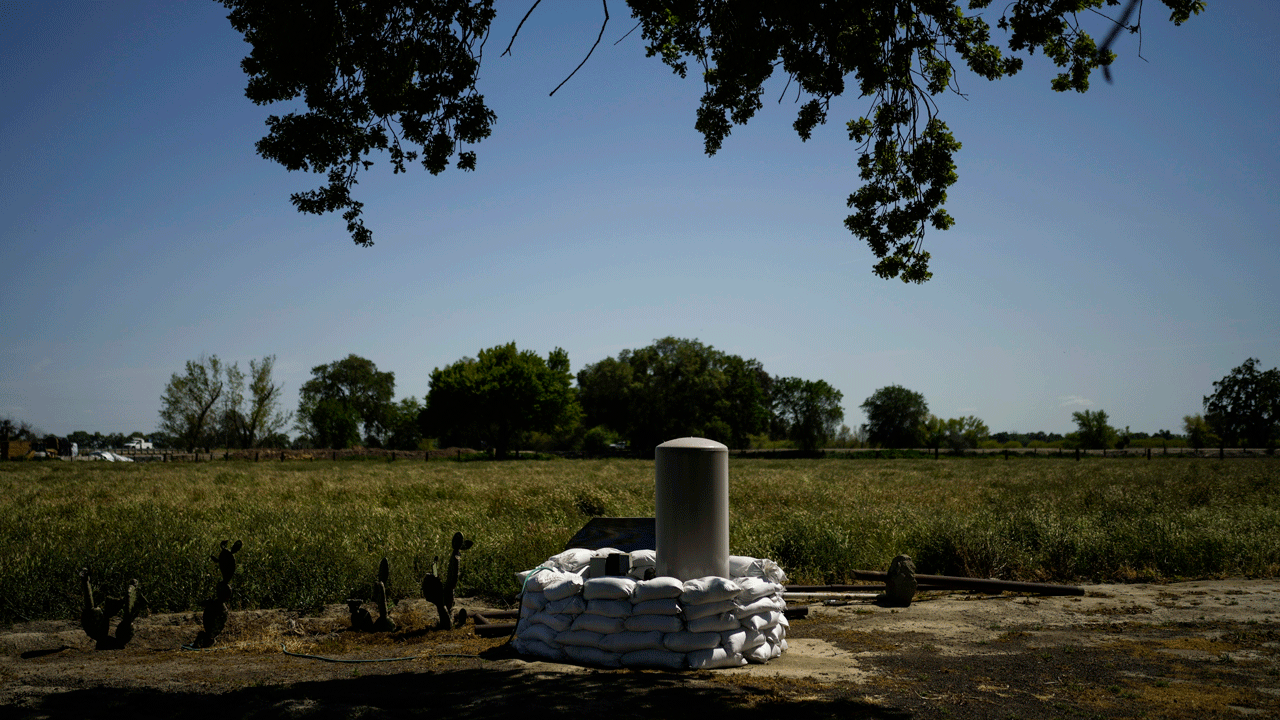
Sandbags are stacked around a well in anticipation of flooding of the Kings River in the Island District of Lemoore, Calif., April 19, 2023. California officials are considering whether to take over monitoring groundwater use in the fertile San Joaquin Valley under a landmark law aimed at protecting water flow to homes and farms. The Tuesday, April 16, 2024, hearing before the State Water Resources Control Board is the first of its kind since California passed a groundwater management law a decade ago. (AP Photo/Jae C. Hong)
Ference said the state board wouldn’t have the local expertise or staff to do this.
“It will just be, ‘Here’s the pumping amount we authorize. Do with it what you can.’”
The hearing is seen as a test of how California’s groundwater rules are working 10 years after lawmakers passed them. The limits came after years of overpumping and drought led to a host of problems ranging from residential wells running dry to sinking land. The goal was to make the most critically overdrafted groundwater basins sustainable.
Communities have since formed groundwater sustainability agencies and drafted management plans. In the Tulare Lake Subbasin, five local agencies worked on a single proposal, only to see it rejected last year by the state Department of Water Resources over concerns about lowering groundwater levels, sinking land and degrading groundwater quality.
If the state water board steps in after Tuesday’s hearing, officials could require anyone who extracts more than a minimal amount of groundwater to report how much they take and pay fees for it. The state could also require larger pumpers to install and use meters that measure water use.
The Tulare Lake Subbasin covers a stretch of Kings County, which is home to about 150,000 people halfway between Los Angeles and San Francisco. The county is a major producer of milk, pistachios, cotton and processed tomatoes, according to a county agricultural report.
It’s also home to Tulare Lake, a large, dry basin that fills with water in rainy years. The lake most recently reappeared in 2023 after intense winter downpours that flooded farms and roads.
Doug Freitas, an almond grower who owns property in areas governed by three different groundwater agencies, said each agency has been talking about what to do next. He said he knew about the state’s groundwater law, but like most small farmers, he was so busy trying to make ends meet that he couldn’t foresee the impact.
“As a farmer, my opinion is we need more time,” Freitas said. “I would like to go to that meeting and beg for mercy and ask for them to let us come back to the table.”
One of the agencies, the Mid-Kings River Groundwater Sustainability Agency, proposed an April 23 vote on charging landowners fees and limiting pumping. The move has met with some resistance, and agency director Dennis Mills recently told residents something must be done if they want to try to keep the state from stepping in.
“They will not accept more promises at this point,” Mills said. “Just a revised plan is not good enough. They need to see concrete steps as to how we’re addressing these things.”
Then there are people like Joaquin Contente, a longtime dairy farmer in Kings County, who said pumping fees and caps spell trouble for him, whether they are imposed by local or state officials. He relies on groundwater to grow the alfalfa he feeds his 800 cattle.
“I know there’s a lot of people losing sleep over it, because I am one of them,” Contente said.
Ference, the farm bureau director, said he supports local control so that farmers can have a say in what happens and communities can invest in local recharge projects.
“This is a community, countywide issue that, if it’s not managed properly, will be catastrophic,” he said.
Read the full article from Here

San Francisco, CA
San Francisco rolls out heightened security measures ahead of World Cup knockout match, 4th of July

The city of San Francisco is taking heightened police and security measures in advance of two major events in the Bay Area this week – the 4th of July and the first knockout round of the FIFA World Cup.
Mayor Daniel Lurie hosted a press conference Monday to address the public on how the city plans to manage the overlapping swarms of soccer fans and 4th of July revelers.
“No matter the occasion, our top priority, and my top priority, remains the same: keeping San Francisco residents and visitors alike safe,” said Lurie.
The two events would be major draws for crowds independently, but combined, and with special occasions marking both, the city wants to ensure that security is a top priority.
The World Cup has already brought hundreds of thousands of people from across the country and the world to the Bay Area, but this week’s game at Levi’s Stadium in Santa Clara is especially notable for the San Francisco as the host city and the United States as a host nation. The stadium, renamed San Francisco Bay Area Stadium for the duration of the World Cup, will host the knockout round match between the U.S. and Bosnia and Herzegovina on Wednesday.
Official fan zones and watch parties for the U.S. match, as well as for Mexico’s match against Ecuador on Tuesday, will be held at multiple locations in San Francisco, including at Thrive City at the Chase Center and at the Pier 39 Fan Zone.
This year’s 4th of July in San Francisco, which already boasts large crowds across the city each year, will have another draw as the city prepares to celebrate the nation’s 250th birthday. The city will be hosting a fireworks show on the Golden Gate Bridge on Saturday night – only the third time that pyrotechnics have ever been set off from the iconic San Francisco landmark. Fireworks will be launched off the two towers of the bridge and from barges in the water.
The Golden Gate Bridge show will be the only official one in the city – fireworks are illegal in San Francisco.
Authorities advised attendees to use public transportation and to leave plenty of time on both ends of their travel for traffic and delays. Caltrans has announced road closures and detours on U.S. Highway 101 and the entire Golden Gate Bridge for the fireworks show.
San Francisco Police Chief Derrick Lew said the department is collaborating with multiple state and local agencies to keep people safe, and that police officers have had their days off cancelled to meet the staffing needs that July 4 will require.
“This week will be safe because that’s what we’ve been doing every day,” Lurie said. “It is a glorious time to be here in San Francisco.”
Lurie cited past heavily attended events like Sunday’s San Francisco Pride Parade and Super Bowl 60 in February as examples of the city’s successful management of major crowds.

The Nuggets are declining Jalen Pickett’s fourth-year team option for the 2026-27 season, releasing him from his contract, league sources told The Denver Post.
Former Nuggets general manager Calvin Booth drafted Pickett with the 32nd overall pick in 2023. The 6-foot-2 reserve combo guard has struggled to break into Denver’s everyday rotation throughout his first three years in the league.
His $2.41 million salary next season would’ve offered the Nuggets a sliver of cap relief, but they chose instead to move on from the former Penn State star. Monday was the deadline to make a decision on his option.
Pickett, 26, averaged 5.2 points, 2.3 rebounds and 2.3 assists in 16.1 minutes per game last season. He appeared in 50 games, highlighted by a career-high 29-point, seven-assist performance in January to lead the Nuggets in an upset over Philadelphia without their entire starting lineup.
Pickett is shooting 38.7% from the 3-point line on two attempts per game in his first three years. He also boasts a sturdy 3.63 career assist-to-turnover ratio.
But he’s remained a deep bench option under two different head coaches in Denver, from Michael Malone to David Adelman. Booth was fired in April 2025. Then, new co-general managers Jon Wallace and Ben Tenzer signed veteran point guard Tyus Jones off the buyout market late last season when the Nuggets wanted ball-handling depth. Jones received playoff minutes over Pickett during their first-round series against the Timberwolves.
Want more Nuggets news? Sign up for the Nuggets Insider to get all our NBA analysis.

Skip to content
-
 Sports3 minutes ago
Lions release cornerback Terrion Arnold soon after judge sets his bond at $1 million
-

 World11 minutes ago
EU will ‘come to its senses’ on Israel, former Netanyahu adviser says
-
 News36 minutes ago
Senate Ethics Committee dismisses complaint against Sen. Ruben Gallego
-

 New York2 hours ago
Read the Indictment of Malik Beasley
-

 Los Angeles, Ca2 hours ago
Stolen Sea Scouts boat found in Marina del Rey, suspect arrested
-

 Detroit, MI2 hours ago
Michigan House passes bill to restrict big investors from amassing single-family homes
-

 San Francisco, CA2 hours ago
San Francisco rolls out heightened security measures ahead of World Cup knockout match, 4th of July
-

 Dallas, TX3 hours ago
Klyde Warren Park reveals expansion plans, construction timeline

