Colorado
Watch a livestream of Colorado’s ‘mega den’ of pregnant rattlesnakes

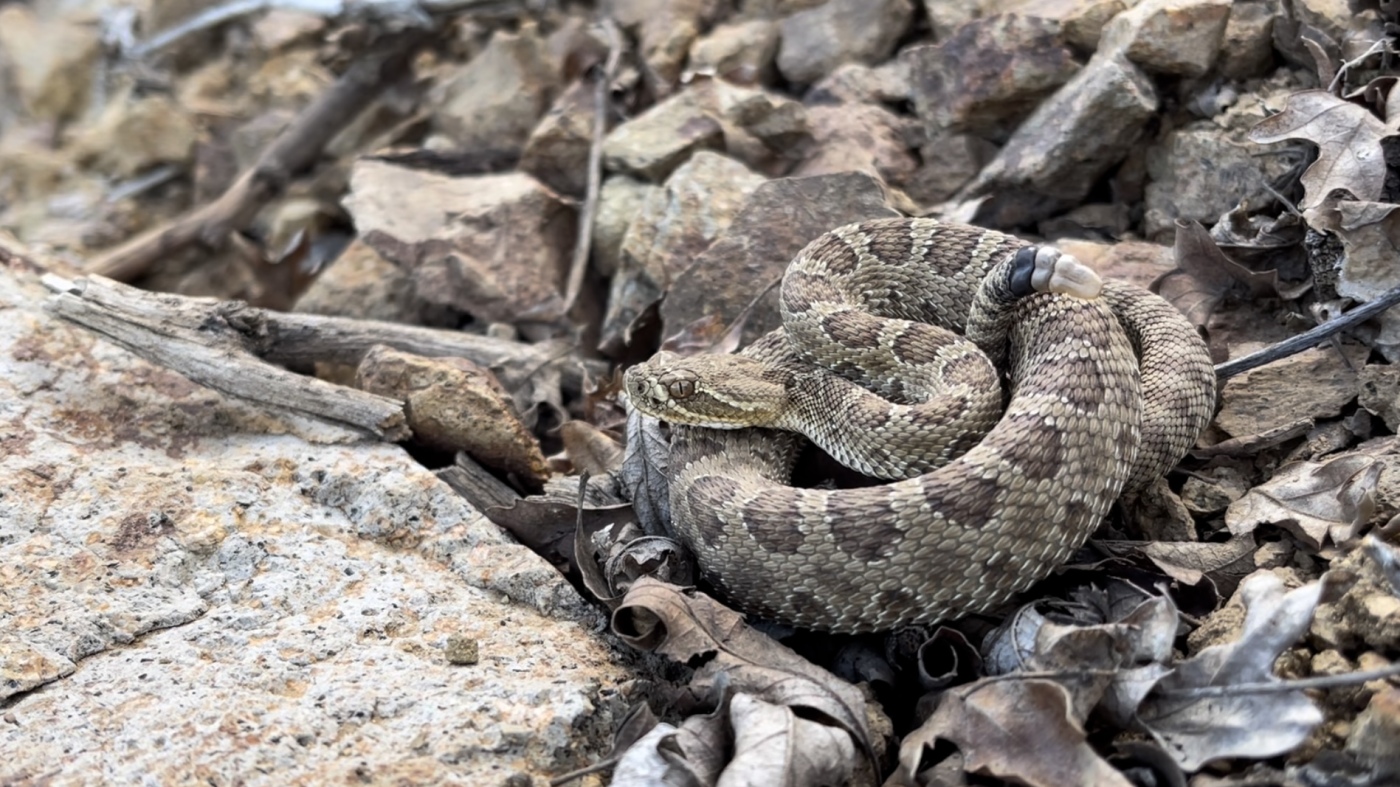
Project RattleCam lets people observe rattlesnakes with a live webcam.
Scott Boback
hide caption
toggle caption
Scott Boback
On a rocky hillside in Fort Collins, Colo., is a “mega den” of hundreds of rattlesnakes.
They live between the rocks year-round, but in the summer, the only snakes to remain in the area are preparing to give birth.

“So this is not quite what we might expect, like a black bear den or a grizzly bear den or something,” says Scott Boback, professor of biology at Dickinson College and co-leader of Project RattleCam.
“This is more like a rock face, where there’s a number of holes that go underground — crevices and cracks in between the rock — and you will see snakes go in and out of these holes. We don’t quite understand exactly what’s going on beneath the surface.”
YouTube
Project RattleCam, a research project based in California, is making it possible for people to observe the snakes with a live webcam. Cameras tucked away in the hillside livestream the snakes to their website.
Boback says this is an especially interesting time to watch the snakes because of their behavior during pregnancy.

A still from the livestream.
Scott Boback
hide caption
toggle caption
Scott Boback
Unlike other snakes, rattlesnakes give birth to live babies — or “pups” — and care for their young for a few weeks after birth. Typically, snakes live solitary lifestyles, but when they’re pregnant they coalesce around nurseries called “rookeries.”
“So when they are aggregated together, as scientists, you got to ask the question about why, what’s going on,” Boback says. “And so that’s one of the things that we’re doing with the camera, is we are interested in how these animals may be interacting with one another. Like, do they tolerate each other?”

Project RattleCam permits Boback and his colleagues to observe the snakes without disruption. It also allows the public to participate.
“We’re sort of right next to the general public who are helping us in that way by making certain observations,” he says. “They’re identifying individual snakes. They can go back and they can rewind the video and they can stop at certain frames, identify unique features on an individual and name the snake. And that allows us to sort of move forward in tracking individuals.”
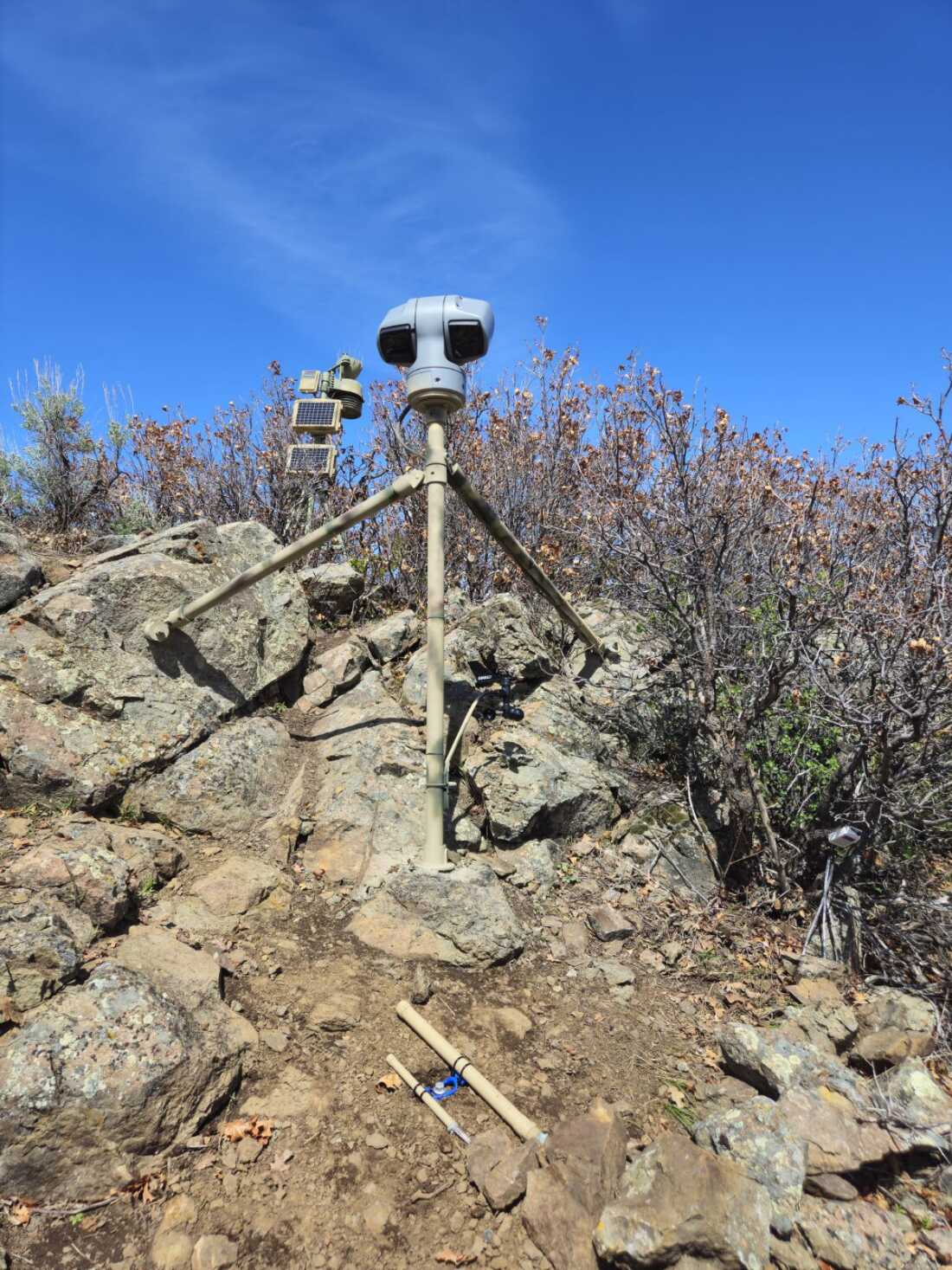
Cameras monitor the area around the den.
Emily Taylor
hide caption
toggle caption
Emily Taylor
Researchers from Project RattleCam understand some of the species’ strange behaviors, like rain harvesting, where the snakes coil up like a teacup and collect water in their body.
Other data is still being studied, but focuses towards the interactions of the mothers during their gestation period.
“If you have a whole bunch of expectant mothers together, they don’t all give birth exactly at the same time,” Boback says. “Essentially, what you have is the opportunity for other mothers to babysit for the mother that actually has given birth to those pups.”
Boback says that observing these traits helps correct wrongful assumptions about the species.
In a study published by the journal Biology of the Rattlesnakes, Cale Morris, a researcher and educator at the Phoenix Herpetological Sanctuary, used a fake leg to mimic stepping on 175 rattlesnakes. In the entire study, only six snakes struck back at the prop.

In May, NPR visited the rattlesnake training course taught by Morris in Scottsdale, Ariz. He told the class: “I just want you to look at this for what it is. This is not an aggressive animal. I see a shy, scared animal.”
Boback says there are many more mysteries to the social behavior of rattlesnakes, and RattleCam is adding insight to a neglected portion of zoology.
“The way that we have always measured sociality is often with primates,” he says. “Things like us, where we smile and we frown and we look at each other and have these very specific facial expressions.”
“Because a snake doesn’t do that, we maybe assumed that there is no socialization going on when, in fact, the snakes are getting a sense of smell from each other every time they stick their tongue out. And so there are chemicals in their skin that we believe they’re using to understand each other. Who is who? They have a way, perhaps, of detecting each individual. Is this my sister? Is this my aunt?”



Denver Film is hosting its Silent Film Festival beginning Friday, including eight feature films and 11 shorts with live musical accompaniment.
Howie Movshovitz, Programmer for the Denver Silent Film Festival, joined CBS Colorado in the studio on Tuesday to highlight the film “Queen Kelly” and share what festivalgoers have to look forward to.
In the film “Queen Kelly”, produced in 1928-1929, a convent girl is abducted and seduced by a prince betrothed to a mad queen, an event that drastically changes the course of her life.
“People talk about ‘Queen Kelly’ as a restoration, but it isn’t because it was never finished. In 1928, Gloria Swanson got together with her producer/lover Joseph Kennedy, father of JFK, and they got together with Eric von Stroheim, a celebrity director, and they went to make Queen Kelly. And about halfway into it, Gloria Swanson fired him,” Movshovitz said.
He said that it’s unlikely the three of them would have been able to get along. Although the film was incomplete, he says there have been many attempts to restore it.
“A man named Dennis Doros and his partner/wife, Amy Heller, at Milestone Films did a reconstruction of it, and then a reconstruction of it. It’s been done a number of times, and this is the most recent,” Movshovitz explained. “They work from script. They work from outtakes, the visual quality of what von Stroheim shot, he was a genius, is fabulous. But it’s, of course, an imaginative response to a 1929 movie.”

Movshovitz says the love of silent films is not just about nostalgia.
“There are many films that are utterly brilliant, utterly fabulous, and still work perfectly well today,” he said. “So, it’s a kind of film that people don’t look at very much, but it doesn’t need sympathy, it doesn’t need nostalgia. It needs people to understand that, just as we read old books and don’t think of them as old books, silent film has its own majesty.”
Watching silent films with musical accompaniment makes the experience unique, said Movshovitz, adding that the festival has a skilled group of musicians performing.
The Denver Silent Film Festival runs from April 10-12 at the Sie Film Center in Denver. Click here to learn more about the featured films and to purchase tickets.
Colorado
Colorado’s New Speed Cameras Can’t Be Outsmarted by Waze or Radar Detectors for Good Reason

- Colorado has launched an automated speed camera program on a stretch of I-25, where cameras calculate average speed versus a single instant reading.
- The cameras make radar detectors and alerts from apps such as Waze obsolete, but they’ve greatly reduced excessive speeds in high-risk areas like work zones.
- Violators face a $75 fine mailed to their registered address, with no points added to their license; vehicles without license plates can evade fines.
Since 2023, the Colorado Department of Transportation has had the power to implement speed cameras in what it deems high-risk corridors where speeding is prevalent, such as work zones. The Colorado Speed Enforcement Program has been used in the past to better patrol a stretch of Colorado Highway 119 between Boulder and Longmont during construction, and it’s now popping up along a stretch of I-25 south of Fort Collins, about 35 miles north of Denver, where workers are adding new express lanes.
Speeding in construction zones has obvious dangers for drivers and workers, as well as law enforcement. Using automated detection is easier and safer than trying to patrol construction zones, which tend to have narrow lanes and little or no usable shoulders.
Enforcement for the five-mile corridor began on April 2. Prior to that, there was a 30-day warning period during which would-be violators received a notice but no fine by mail. Before monetary penalties went into effect, CDOT saw a 90 percent reduction of excessive speed in the targeted zone.
Waze May Not Help
Alerts from apps like Waze that warn you to slow down for speed cameras won’t necessarily save you from a fine here. Instead of taking an instant speed reading at one location like radar-based units, the system uses pairs of cameras—officially automated vehicle identification systems—set a distance apart that snap photos of each car, specifically its license plates. Average speed over the stretch is then calculated using the time it took to cover the known distance.
If that average is over the posted speed limit—some outlets are reporting a grace threshold of 10 mph—a bill of $75 for the civil penalty will be mailed to the vehicle’s registered address. In part because the system doesn’t know who was driving at the time, the owner and driver do not receive points on their license. CDOT says most of the revenue collected goes back into funding the Speed Enforcement Program.
The cameras are marked and preceded by warning signs set at least 300 feet up the highway. If you happen to be speeding when passing the first photo location, you still have a shot at avoiding a fine. As long as you slow down enough before reaching the next camera, you can bring the average down to something legal.
License Plates Required
Unfortunately, this is yet another incentive for drivers in Colorado to run their cars without license plates or skip registering them at all (ahem, sovereign citizens), which is already a big problem in the state. License-plate readers used to enforce express-lane tolling have the same issue. We have contacted CDOT to ask what happens if a vehicle without a license plate speeds through the enforcement zone; we’ll update this story if we hear back.
➡️ Skip the lot. Let Car and Driver help you find your next car.
Shop New Cars Shop Used Cars

Ever since David was a wee Car and Driver intern, he has kept a spreadsheet listing all the vehicles he’s driven and tested. David really likes spreadsheets. He can parallel-park a school bus and once drove a Lincoln Town Car 63 mph in reverse. After taking a break from journalism to work on autonomous vehicles, he’s back writing for this and other automotive publications. When David’s not searching for the perfect used car, you can find him sampling the latest in gimmicky, limited-edition foodstuffs.
Colorado
Road to Mount Blue Sky expected to open Memorial Day weekend after 2024 closure, construction


Byron Allen’s “Comics Unleashed” replacing Colbert’s “Late Show”

SoMa residents file complaint with state, accusing SF of pushing unhoused resources to their area

CGY@DAL Postgame: Wyatt Johnston | Dallas Stars

Strong storm topples trees, damages homes in a Miami-Dade neighborhood, with days of cleanup ahead for residents

How RFK Jr. changed my mind about Dunkin’ – The Boston Globe

Florida High School Football Rankings: Top 25 teams – Oct. 21

How old is Bo Nix? What to know about Oregon quarterback ahead of 2024 NFL Draft

Cleary's 21 help Le Moyne down Central Connecticut State 69-64 in OT

99th annual Pony Swim held in Virginia

Indiana Members Credit Union announced as new anchor tenant at Bottleworks District

Democrat swing candidate called Biden’s border handling ‘a huge misstep’ after backing his approach as mayor

‘Policy of abuse’: Women march in Cuba against US energy blockade

Acting AG says ‘Nobody has any idea why’ Pam Bondi was fired except for Trump | CNN Politics

Ilhan Omar calls Trump an ‘unhinged lunatic,’ urges booting him out of office
Between Budapest and Brussels: Péter Magyar’s political tightrope
-

 Atlanta, GA3 days ago
1 teenage girl killed, another injured in shooting at Piedmont Park, police say
-

 South-Carolina1 week ago
South Carolina vs TCU predictions for Elite Eight game in March Madness
-

 Movie Reviews6 days ago
Vaazha 2 first half review: Hashir anchors a lively, chaos-filled teen tale
-

 Vermont1 week ago
Skier dies after fall at Sugarbush Resort
-

 Politics1 week ago
Trump’s Ballroom Design Has Barely Been Scrutinized
-

 Politics1 week ago
JD Vance says he was ‘obsessed’ with UFOs, believes aliens are actually ‘demons’
-

 Atlanta, GA1 week ago
Fetishist ‘No Kings’ protester in mask drags ‘Trump’ and ‘JD Vance’ behind her wheelchair
-
 Entertainment6 days ago
Inside Ye’s first comeback show at SoFi Stadium