Colorado
Opinion: Colorado caregivers fight for basic rights as billionaires lobby for AI


I have spent the last seven months learning to be a volunteer lobbyist — registering with the Colorado General Assembly, showing up with research, hoping someone will listen.
I became a lobbyist because I became a caregiver. In Colorado, you can be fired or denied workplace flexibility simply because you’re caring for an aging parent, a child with disabilities or a seriously ill spouse. There’s no law protecting you.
Meanwhile, big tech and AI interests have poured significant resources into federal lobbying, shaping regulations for rapidly evolving technologies like artificial intelligence. By contrast, people provide $600 billion in unpaid care annually, with broader national studies valuing unpaid care at over $1 trillion each year. Yet caregivers have virtually no voice in our state capitol.
This isn’t just unfair. It’s economically irrational.
AARP Colorado reports that one in five adult Coloradans — over 1 million people — are employed family caregivers: We’re the accountant leaving at 3 p.m. for Mom’s dialysis. The nurse needing Tuesday mornings for her son’s physical therapy. The engineer working remotely to care for his husband with ALS.
We’re not asking for special treatment. We’re asking not to be punished for keeping our families alive.
National caregiver studies show family caregivers face average lifetime wage losses of $295,000, with 36% reporting moderate to high financial strain. Many quit jobs entirely, losing income, health insurance and retirement precisely when they need stability most.
But here’s what businesses miss: This isn’t just a family problem. It’s an employer problem.
Companies hemorrhage experienced workers because they won’t provide basic flexibility. Replacing an employee costs 50% to 200% of their annual salary. Applied to Colorado’s caregiver workforce, this translates to hundreds of millions in employer losses annually. Supporting caregivers through reasonable accommodations could save employers tens of millions each year in reduced turnover.
That’s why I’m developing the Colorado Caregiver Accommodations and Rights Enhancement, or CARE, Act with legislators for the 2026 session.
The bill would do three things:
First, it would add family caregiver status as a protected class under Colorado’s Anti‑Discrimination Act. Workers couldn’t be fired simply for caring for a parent with dementia or a child with cerebral palsy. Surveys show 42% of Colorado caregivers quit or cut hours due to these demands, and wrongful termination tied to family responsibilities is documented in state and local law.
Second, it would require employers to provide reasonable accommodations — flexible schedules, telework for remote-capable positions, brief phone access for care coordination — unless doing so creates genuine hardship. Many good employers already do this. We’re ensuring everyone has access.
Third, it would create streamlined pathways for family members to become certified paid caregivers through existing Medicaid programs. Right now, families often can’t provide paid care for relatives, forcing them into institutional settings that cost taxpayers far more. This fixes that — at zero cost to the state budget.
The projected impact? Supporting caregivers through reasonable accommodations reduces costly turnover and protects small businesses through mandatory mediation.
I shouldn’t need to become a lobbyist to advocate for basic dignity. But when big tech pours millions into shaping policy for hypothetical AI risks while real people lose jobs caring for family members, grassroots advocacy isn’t optional — it’s survival.
I founded CASI because caregivers don’t have PACs or super PACs. We have stories, data, lived experience and moral authority. In a democracy, that should be enough.
But it’s not always enough. That’s why we need legislators willing to champion working families, not just corporate donors. That’s why we need Coloradans to tell their representatives: “I’m a caregiver” or “This matters.”
Because here’s the truth: We were all cared for at birth. Many of us will need care in aging. Most of us will provide care at some point. Care isn’t a niche issue — it’s the universal human experience.
I’m working to introduce the CARE Act in the 2026 session, pending final sponsor commitments. Meetings with legislators are ongoing to review the proposal.
If we secure sponsors, caregivers will testify about denied promotions and lost wages. Business owners will share how supporting caregivers improved retention. Policy experts will present data showing this isn’t charity — it’s infrastructure for an aging state.
Then legislators will vote. That vote will answer whether Colorado values family caregivers or only listens to those who can afford massive lobbying budgets.
I’m betting on Colorado. I’m betting on legislators taking time to understand this issue. I’m betting on employers who recognize that flexibility is a competitive advantage. I’m betting on everyday Coloradans who understand that supporting caregivers strengthens families, businesses and communities.
But I’m not leaving it to chance. I’m organizing, mobilizing and lobbying. Contact your legislator and say: “I’m a caregiver,” “I know a caregiver,” or “Support the CARE Act when it’s filed.”
Because if big tech can spend millions shaping the future of machines, surely we can invest in the people caring for humans.
Mark Fukae, of Brighton, is the founder of CASI, a Colorado caregiver advocacy organization, and serves as Director of Advocacy for Professionals Who Care, a national nonprofit supporting family caregivers.
The Colorado Sun is a nonpartisan news organization, and the opinions of columnists and editorial writers do not reflect the opinions of the newsroom. Read our ethics policy for more on The Sun’s opinion policy. Learn how to submit a column. Reach the opinion editor at opinion@coloradosun.com.
Follow Colorado Sun Opinion on Facebook.



The Colorado Avalanche’s head coach will not travel with the team this week due to injuries he sustained after being hit with a puck during a game over the weekend.
Jared Bednar will stay at home as the team travels for two of its last regular season games in Canada, according to a statement from the team. Bednar was diagnosed with facial fractures and a corneal abrasion, but is expected to make a full recovery without surgery.
During Saturday night’s game against the Vegas Golden Knights, a stray puck hit by the Knights’ Keegan Kolesar went over the boards and into the Avalanche’s bench. Bednar was struck on the right side of his face and taken to the hospital to be evaluated.
The assistant coaching staff, which includes Dave Hakstol and Nolan Pratt, took over after Bednar left the game. Pratt told reporters in the postgame press conference that the hit was “unnerving.”
“It’s scary when the pucks are flying in there, it happens all the time,” Pratt said, adding that it was “unfortunate tonight.”
But the team recalibrated and returned to play, Pratt said.
The Avalanche lost in overtime, but have already secured their playoff spot.
Pratt and Hakstol will lead the Avalanche in the Monday night game against the Edmonton Oilers and Tuesday’s game against the Calgary Flames. The team will return to Denver’s Ball Arena for its final home game before playoffs on Thursday.


208 “ranked peaks” are located within Grand County. These are defined as peaks that rise more than 300 feet above its closest connecting ridge or saddle. Many of these high points reside in one of the two largest microclimates in Grand County: the northern and southern mountains.
These mountainous microclimates typically experience more precipitation than surrounding valleys due to mountains creating extra lift for clouds — fueling the development of showers both in the winter and summer months.
They can also experience months of temperatures below freezing from early November through early April according to data from the PRISM Group. These higher elevations, especially below timberline, often hold snow for months after the last major snowstorm. As such, these vast regions are responsible for keeping the Colorado River’s streamflow healthy year round.
This year, many stream flows have already peaked after a March heatwave fueled rapid runoff.
The northern mountains
Including prominent peaks such as Parkview Mountain — the highest peak in the Rabbit Ears Range — Elk Mountain, Little Gravel and Gravel Mountain, the northern mountains have many important tributaries into the Colorado River.
According to data from the United States Department of Agriculture’s Office of Sustainability and Climate, the Antelope, Troublesome, Corral, Willow, Stillwater and Supply Creeks supply healthy amounts of water year-round into the Colorado from the wide expanses of public land that encompass the area enclosed by U.S. Highway 40 to the south and west, and U.S. Highway 34 to the east.
Taking Colorado Highway 125 brings you along one of these major tributaries, Willow Creek, and sends you into Jackson County once you hop Willow Creek Pass.
Willow Creek and Muddy Creek above Antelope Creek are both flowing stronger than usual due to early melting of snowpack. They typically see peak streamflow in late April through early May, but is already slowing down after much of the snowpack feeding this stream has already melted.
As of April 6, the Upper Colorado basin is only at 26% of median during the same period we typically reach our usual peak in snowpack, according to the Natural Resources Conservation Service.
Muddy Creek above Antelope Creek were flowing above average, peaking for the season at over 200 cubic feet per second on March 27. Since then, flows have been falling back to 50 cubic feet per second, without ample snowpack to keep feeding the stream.

The southern mountains
With more peaks above timberline than you can name along the southern county border, Byers Peak marks the most prominent peak on the county’s interior and shines in the middle of Fraser’s webcam.
With major tributaries sourced from this region including Williams Fork, Little Muddy, Tenmile, Crooked, Saint Louis and Vazquez Creeks, the slightly higher peaks that line the southern mountains are responsible for a significant portion of headwater flows.
This region can be explored by taking County Road 3 towards Ute Pass and branching off onto the numerous curvy, rougher roads that can be used for various recreation opportunities.

Similar stories of earlier-than-average peak flows can be found scattered through the more numerous sensor suites that measure stream discharge along these southern tributaries.
Williams Fork has likely already peaked for the season when streamflow usually only starts rising in early April. Saint Louis Creek has also been seeing high early streamflow above last year’s mark since mid-late March. While Vazquez Creek is usually still muddled by ice and slow flows around five cubic feet per second, flows have been marked above 10 cubic feet per second since March 20.
Both of these microclimates’ month-early peaks in streamflow have met calls for immediate action with Kremmling instating level three watering restrictions and the declaration of stage three drought by the Grand County Drought Preparedness Committee.
Similar downturns in water supply forecasts from the United States Department of Agriculture for the Colorado River have lifted red flags for water scarcity and extreme drought, not just in Grand County but along the Colorado River as a whole.
The Weather Corner is your go-to column for valuable information about Grand County’s weather.
Source link

PBR | No. 1 John Crimber goes 4-for-4, tops final three rounds to win First PREMIER Bank PBR Sioux Falls

Tennessee immigration bill sparks nonprofit concerns over unintended impacts on vulnerable US citizens

Texas AG opens investigation into Austin over APD guidance on ICE warrants
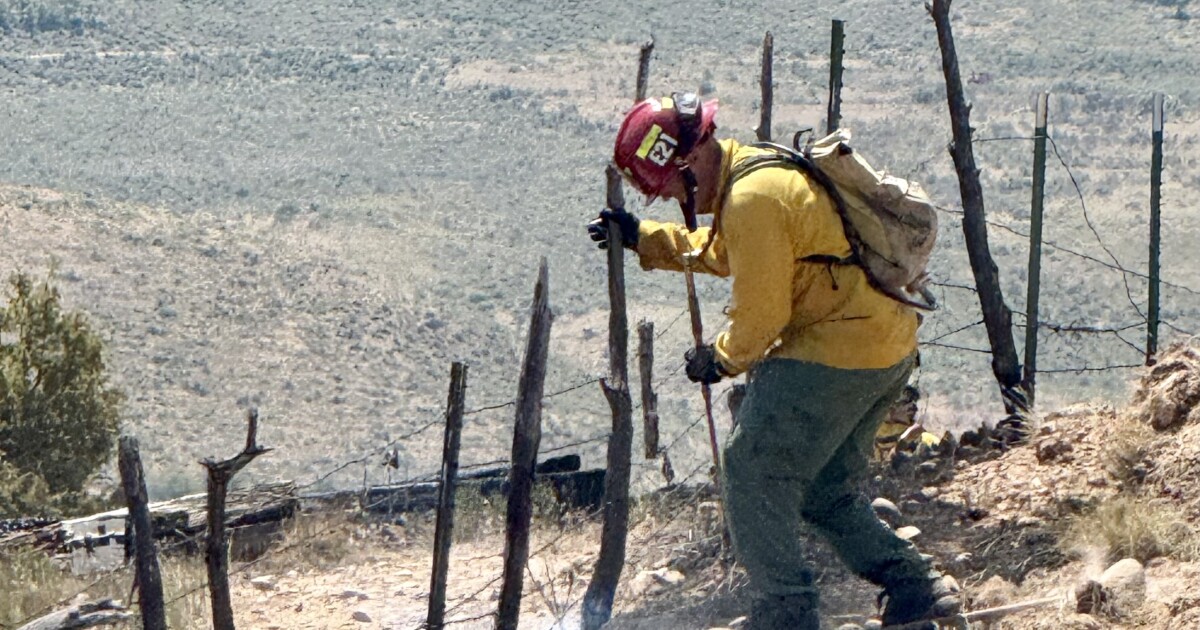
Utah delays imposing fee for wildfire mitigation program
Noah Kahan, Vermont consumers and venues voice support for ticket resale limits

Florida High School Football Rankings: Top 25 teams – Oct. 21

How old is Bo Nix? What to know about Oregon quarterback ahead of 2024 NFL Draft

Cleary's 21 help Le Moyne down Central Connecticut State 69-64 in OT

99th annual Pony Swim held in Virginia

Indiana Members Credit Union announced as new anchor tenant at Bottleworks District

Embattled Rep Tony Gonzales announces plans to resign amid sexual misconduct allegations

UN experts slam attacks on Gaza shelters, forced displacement in West Bank

DOJ fires at least 4 prosecutors involved in FACE Act cases during Biden administration

Melania Trump’s Epstein remarks turn up the heat on DOJ, Acting AG Todd Blanche to do more
Newsletter: Cautious optimism in Brussels as Orbán ousted in landslide Hungarian opposition win
-

 Atlanta, GA1 week ago
1 teenage girl killed, another injured in shooting at Piedmont Park, police say
-

 Georgia6 days ago
Georgia House Special Runoff Election 2026 Live Results
-

 Arkansas3 days ago
Arkansas TV meteorologist Melinda Mayo retires after nearly four decades on air
-

 Pennsylvania1 week ago
Parents charged after toddler injured by wolf at Pennsylvania zoo
-
 Milwaukee, WI1 week ago
Potawatomi Casino Hotel evacuated after fire breaks out in rooftop HVAC system
-

 Technology1 week ago
Anthropic essentially bans OpenClaw from Claude by making subscribers pay extra
-

 Austin, TX6 days ago
ABC Kite Fest Returns to Austin for Annual Celebration – Austin Today
-

 World1 week ago
Zelenskyy warns US-Iran war could divert critical aid from Ukraine