Colorado
Neighbors make a final stand against massive oil and gas drilling plan near Aurora Reservoir


A contentious plan to drill up to 166 oil and gas wells on the southeastern fringe of metro Denver, near hundreds of homes and the Aurora Reservoir — a drinking water source for nearly 400,000 people — will finally land before state energy regulators this week for a key decision on its fate.
Neighbors worried about potential health and ecological impacts from the project want the Colorado Energy and Carbon Management Commission to say no to the plan after an extensive hearing that’s set to begin Tuesday. The oil and gas producer behind it hopes to install hydraulic fracturing operations at eight sites across Lowry Ranch in Arapahoe County over the next four years.
“The main problem is the effect on public welfare, safety and health,” said Marsha Kamin, who moved to Aurora’s Southshore neighborhood 18 months ago from Michigan. “We’re talking about thousands and thousands and thousands of people.”
As Colorado’s population has ballooned in recent decades, especially in Denver’s northern and eastern suburbs that overlay the mineral-rich Denver-Julesburg Basin, friction has grown between new and expanding neighborhoods and the oil and gas operations set up nearby. Six years ago, the evolving standoff led to an attempt by a citizen group to appreciably increase the required distance between wells and homes through a statewide ballot initiative. Voters shot it down.
Less than a year later, the legislature passed Senate Bill 19-181 and Gov. Jared Polis signed it into law. The law prioritized public health, safety and the environment when state officials consider oil and gas development — a profound change from the industry-focused approach Colorado had taken for decades with energy extraction.
Kamin and her neighbors, hundreds of whom are part of the Save the Aurora Reservoir advocacy group, are putting their hopes in Colorado’s five-year-old oil and gas reform law to halt the project. The group has been working to derail Crestone Peak Resources’ proposed fracking plan for the better part of two years.
“It’s disheartening that an industry can have this much power over people,” Kamin said.
But Lowry Ranch opponents may face a bumpy road this week, following a recommendation by the Energy and Carbon Management Commission’s director, Julie Murphy, that the board of commissioners approve the comprehensive area plan for the project.
In her final determination this month, Murphy wrote that Crestone’s plan “complies with all applicable requirements” in the ECMC’s rules.

The commission’s Tuesday hearing is scheduled to go all day, with a second meeting set for Friday if more time is needed. A decision to deny, approve or stay the plan is expected by week’s end, agency spokesman Chris Arend told The Denver Post.
If the overall plan wins approval, more hearings would be needed to consider individual well pads and wells, at both the state and county levels. Though the opponents largely live nearby in Aurora, Colorado’s third-largest city, the pads would be on state-owned land in an unincorporated part of the county just over Aurora’s city line.
While the ECMC approved more than 800 oil and gas wells in 2022 and more than 700 last year, it has denied applications to drill in recent years. In 2022, it said no to a plan from Kerr-McGee to drill 33 wells near a Firestone neighborhood. The commissioners’ main objection centered on 62 houses that would have been too close to a well pad, violating the state’s minimum 2,000-foot setback from homes and schools.
In January, the commission denied permits for 18 wells at Coyote Trails near the border of Erie and Broomfield.
Ann Hussain, who lives in Southshore with a sweeping backyard view of the Aurora Reservoir, said she learned about Crestone’s plans only in the spring. She worries that drilling under the reservoir could result in contaminants leaking into the body of water or into aquifers.

She also worries about air pollution generated at the well pads, one of which would lie less than a mile from a school. One of the eight pads, dubbed State Sunlight-Long, would be just 3,200 feet from her back fence. Thirty-two wells are planned for Sunlight-Long.
“I can’t believe you can take a community and set up an industry right outside these backyards,” Hussain said. “How is it that this can be done so close to people’s homes?”
Plan meets more expansive county buffer
The answer to that question lies in the state’s oil and gas rules, which permit drilling outside a 2,000-foot buffer from schools and neighborhoods. Last fall, Arapahoe County commissioners imposed even wider setbacks than what the state requires, mandating a 3,000-foot buffer between wells and occupied structures, landfills and reservoirs — both existing and planned.
That rule-making followed an attempt by project opponents in April 2023 to get Arapahoe County to impose a six-month halt on issuing new permits to energy companies to drill. The county commissioners voted 3-2 to reject a moratorium.
Rich Coolidge, a spokesman for Crestone parent company Civitas Resources, said not only does the Lowry Ranch plan comply with state rules, it also hews to Arapahoe County’s oil and gas regulations.
“The redundant safeguards and subsequent monitoring have shown that oil and natural gas development can safely occur without impacting groundwater and surface water sources,” Coolidge wrote in an email. “In fact, multiple layers of steel casing and cement underneath more than a mile of rock separate the wellbore from our state’s aquifers and surface water like the Aurora Reservoir.”

Crestone plans to drill 7,500 feet below the surface before running its wells horizontally. Coolidge said wells have “been drilled over a mile below tens of thousands of homes in the Front Range, with no impacts.”
Crestone will implement measures to mitigate impacts at its well sites, he said, including soundwalls, electric-powered drilling rigs, low-emission engines and low-odor mud during the drilling phase. Oil, gas and water will travel off-site by pipe, he said, “to reduce truck traffic during the production phase.”
Dan Haley, the president and CEO of the Colorado Oil and Gas Association, said the state’s 2019 oil and gas law was meant to “create the most environmentally protective rules in the country … without banning the production of this vital resource.”
“Arapahoe County, and others, have passed regulations that exceed the state’s already stringent protections,” he said, “and our members are meeting those high expectations and producing this resource cleaner and better than most anywhere in the world.”
Congressman focuses on Superfund site
But such assurances haven’t quieted concerns about the unique features at Lowry Ranch, a 26,500-acre sweep of prairie owned by the Colorado State Land Board.
The property encompasses the 480-acre Lowry Landfill, a Superfund site at the northeast corner of Quincy Avenue and Gun Club Road, where an estimated 138 million gallons of liquid industrial waste are buried. An underground plume of contaminated water has migrated several miles from what is considered one of the country’s most contaminated toxic waste sites.
Some of the proposed well pads’ proximity prompted U.S. Rep. Jason Crow to send a letter to the Environmental Protection Agency on July 15. He asked whether it had studied the potential for extractive seismic activity at the landfill and how that might impact “the safety of the Aurora Reservoir Dam and the reservoir itself.”
The Democratic congressman asked how the agency could “be certain the drilling will not cause fractures and instability that threaten the mitigation strategies EPA has in place at (the landfill).” He also inquired if the agency has considered expanding the boundaries of the Superfund site to include the underground plume.
Coolidge, from Civitas, said the company this year agreed not to drill underneath the Lowry Landfill.
“On claims around seismicity, there has been no reportable seismic activity caused by hydraulic fracturing in Colorado,” he wrote.
But Mike Foote, an environmental attorney representing Save the Aurora Reservoir — and a prime sponsor of SB19-181 when he was a state senator — said “drilling can cause earthquakes.”
The United States Geological Service says that while most induced earthquakes are not directly the result of fracking, they can be triggered by the “disposal of waste fluids that are a byproduct of oil production.”
“You don’t want to cause earthquakes, and Crestone hasn’t studied or addressed the issue anywhere close to adequately enough to allow them to drill,” Foote said.

Drilling could begin next year
Matt Sura, an oil and gas attorney who represents local governments and conservation organizations, said the five-year-old law was a critical step in more effectively regulating the energy industry and giving local governments a bigger voice in the process. Sura is not involved in the Lowry Ranch proposal.
“Senate Bill 181 required that there be public hearings on locations (of wells and equipment) and allowed the public to speak to the decision-makers, rather than those decisions (being) made administratively,” he said. “That was a huge sea change.”
Where there is still room for improvement, Sura said, is in state regulators addressing the cumulative impacts of oil and gas development, specifically when it comes to air pollution. The ECMC will start hearings on rules for that in mid-September.
“I’m hopeful the commission is going to be willing to set limits on oil and gas development and drilling — and the amount of pollution that can be emitted from the oil and gas industry,” he said.
But those rules won’t be in place this week when the ECMC meets to consider the Lowry Ranch comprehensive area plan.
The Front Range for years has been out of compliance with the National Ambient Air Quality Standards. In 2022, the EPA designated the nine-county northern Front Range region — including metro Denver — as being in “severe nonattainment,” triggering more federal regulations to clean the air.
That frustrates Kamin, the Southshore resident who watches wildlife move through the neighborhood on their way to and from the rolling hills of Lowry Ranch to the east.
“We’ve been a nonattainment area for years and they want to add more pollution to the area,” she said. “It makes no sense.”
If Crestone’s plan receives the blessing of the ECMC this week, drilling could begin as early as 2025.
Denver Post reporter Judith Kohler contributed to this story
Stay up-to-date with Colorado Politics by signing up for our weekly newsletter, The Spot.
Originally Published:



DENVER — Five of the seven law enforcement officers in a rural Colorado county, including the sheriff, have been indicted in an investigation into allegations of misconduct, prosecutors said Friday.
A grand jury indicted Costilla County Sheriff Danny Sanchez and former Deputy Keith Schultz on charges of allegedly mishandling human remains discovered in October 2024, according to court documents. A man who found the remains and reported them to the sheriff’s office said Sanchez and Schultz took only the skull and left the other remains behind, including teeth, court documents state.
Two months passed before Schultz wrote a report, saying he left bones in a bag on his desk and went on another call, the documents state. A coroner’s official said he received the skull in an unlabeled paper bag from the sheriff’s office, the documents state.
Separately, Undersheriff Cruz Soto, Sgt. Caleb Sanchez — the sheriff’s son — and Deputy Roland Riley are charged in connection with the use of a Taser against a man who was suffering a mental health crisis in February and tried to leave when they insisted he go to the hospital, according to the documents. The man said he was “roughed up” by deputies and was left with broken ribs, according to the indictments.
Soto was charged with failing to intervene and third-degree assault, according to court documents. Caleb Sanchez and Riley were charged with second- and third-degree assault.
In announcing the indictments, 12th District Attorney Anne Kelly said she’s committed to investigating and prosecuting crimes no matter the offender.
“I cannot and will not ignore violations of the trust that a community should have in their police. No citizen of the San Luis Valley should have any doubts about the integrity of their police force,” Kelly said at a news conference Friday evening.
A person who answered the phone Friday at the sheriff’s office said it had no immediate comment but planned to post a statement online. Phone numbers listed for Danny Sanchez, Soto and Riley did not work. Caleb Sanchez did not have a listed number. An unidentified person who answered a number for Schultz referred The Associated Press to an attorney, Peter Comar. The AP left a message Friday for Comar seeking comment.
__

As a result of a snow drought and a heat wave that have both set records, some Colorado residents face the earliest restrictions on their water use ever imposed.
Denver Water announced Wednesday that it is seeking a 20% cut in water use, asking people to turn off automatic watering systems until mid-May and restricting the watering of trees and shrubs to twice a week.
“The situation is quite serious,” said Todd Hartman, a spokesperson for the utility. “We’re in such a dire situation that we could be coming back to the public in two or three months and saying you’re limited to one day a week.”
It is the earliest in the year that Denver Water has ever issued a restriction, Hartman said.
Colorado’s snowpack peaked at extremely low levels on March 12 — nearly a month earlier than usual — then cratered during the recent heat wave that cooked nearly every state in the West.
“We already had the lowest snowpack we’ve seen since at least 1981, and now, with the heat wave conditions, we’ve already lost about 40% of the statewide snowpack” since the March 12 peak, said Peter Goble, Colorado’s assistant state climatologist. “Conditions are looking more like late April or early May.”
The water restrictions are a harbinger of what’s to come in many Western states as officials try to manage widespread drought concerns. Nearly every snow basin in the Mountain West had one of its warmest winters on record and is well behind normal when it comes to water supply, according to the U.S. drought monitor. The dwindling snowpack is likely to raise the risk of severe wildfires, hamper electricity generation at hydropower dams and force water restrictions for farmers.
Hartman said nearly every community east of the Rockies, along Colorado’s front range, is in much the same boat as Denver.
City Council members in Aurora are considering similar water restrictions; reservoirs there stand at about 58%, according to the city’s website. In the town of Erie, officials declared a water shortage emergency on March 20 after they observed a massive spike in consumption.
Gabi Rae, a spokesperson for the town, said Erie was perilously close to having taps run dry because so many residents had started watering their lawns early amid the unseasonable heat.
“We were a day away from running out of water. That’s why it was such an emergency,” she said.
Erie officials demanded that residents stop using irrigation systems altogether.
Goble said this month’s heat wave has set records in every corner of Colorado, sometimes by double digits.
“I can’t remember seeing a single heat wave that broke this many records, and seeing it across such a large portion of the country is certainly eye-popping,” he said, adding: “I’m located in Fort Collins, and we got up to 91 last Saturday. The previous record for March was 81, so we smashed that record. And it wasn’t just one day, either.”
Denver Water, which serves about 1.5 million residents in the city and its surrounding suburbs, gets about half of its water from the Upper Colorado River Basin and the South Platte River Basin. The latter’s snowpack was at about 42% of normal Tuesday, the utility reported. The Upper Colorado River Watershed was at 55%.
Systemwide, Denver Water’s reservoirs are about 80% full, which is only about 5 percentage points lower than in a typical year.
“That sounds pretty good,” Hartman said. “Except that what we’re not going to be able to rely on is that rush of water that will bring those reservoirs back up, because the snowpack is so low.”
In other words, the snowpack — a natural water reservoir — is mostly tapped already and won’t replenish reservoirs later this spring and into summer, when runoff usually peaks.
In Erie, city workers plan to aggressively police water use until sometime next week using smart meters that monitor residential usage. Rae said the city is also sending utility workers to patrol neighborhoods and look for sprinklers that are turned on.
“People have been kind of annoyed with how aggressive we were, and I don’t necessarily think they understand the ramifications if we weren’t,” Rae said. “It is an actual serious emergency situation. We were so close to reaching empty, there would literally be no water coming out of the taps — hospitals, schools, fire hydrants, your home would have no water.”
Although the limits on outdoor watering will be lifted soon, Rae expects more restrictions later this spring and summer.
Colorado
Suddenly hazy skies in Denver prompt some residents concerned about wildfire smoke to call 911

Some people who live in the Denver metro area on Thursday afternoon were making calls to 911 after skies became noticeably hazy and winds kicked up. It was due to smoke from wildfires in Nebraska moving into Colorado. A cold front also was moving through the Front Range, and there is dust in the air.
The poor air conditions led to reduced visibility downtown after 3 p.m. Several of CBS Colorado’s City Cams showed dust or smoke in the air.
Temperatures were expected to drop by as much as 20 to 30 degrees with the cold front.
The suddenly dusty skies prompted at least one fire agency to put out a plea to residents to please only call 911 “if you see flames.” That warning was put out by South Metro Fire Rescue, which shared a photo on X of an office building with haze visible outside.
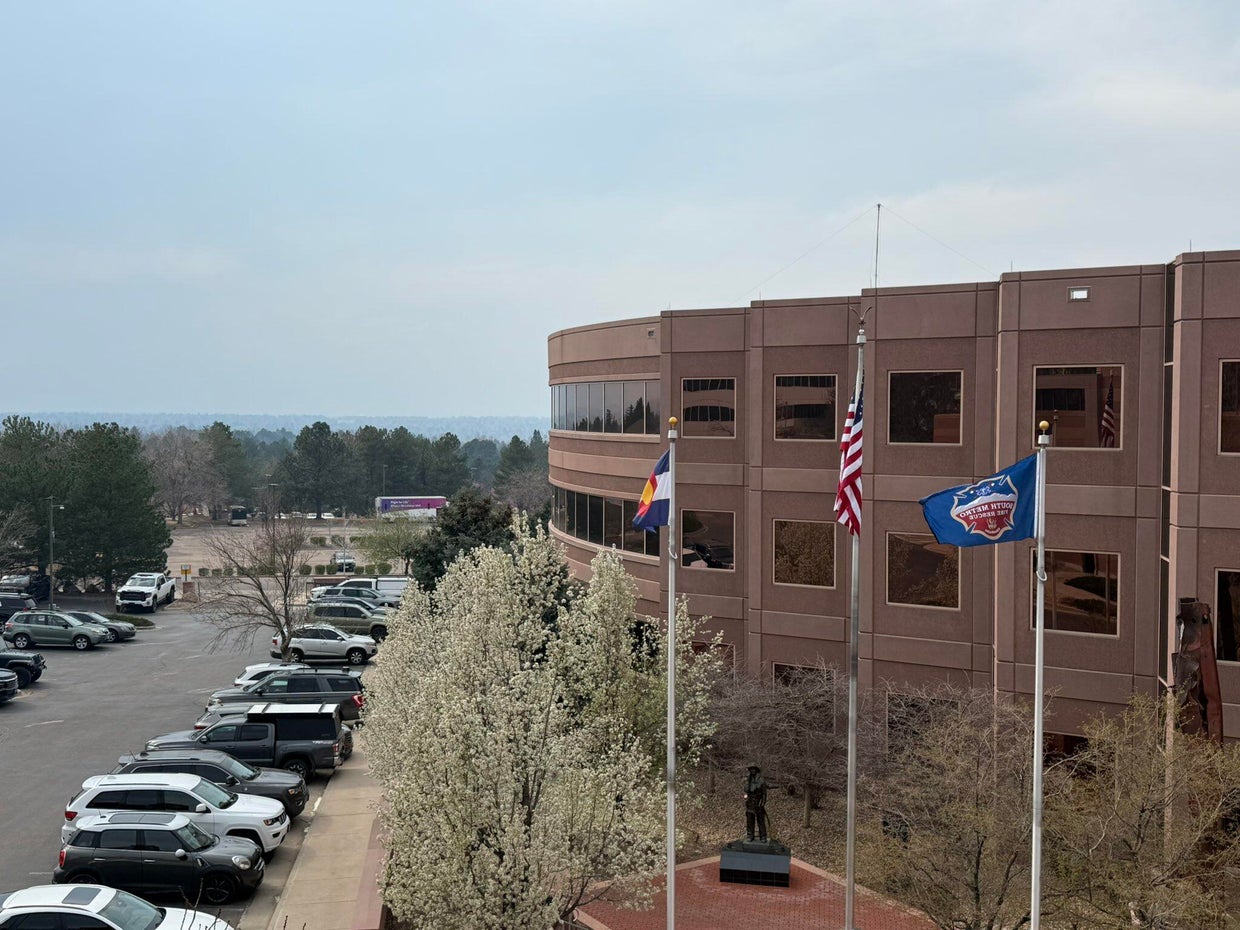
South Metro Fire Rescue said in their post that the smoke is from Colorado’s neighbor to the east. They called it a “significant haze” in the air.
Earlier this month, the Morrill Fire and the Cottonwood Fire burned a significant amount of Nebraska grassland and ranchland. They have mostly been contained by firefighters. Nebraska Gov. Jim Pillen said those two fires combined with several others have burned approximately 800,000 acres of land. On Thursday, Pillen announced that he is signing several executive actions intended to ease the burden caused by the fires.
There were no wildfires burning in the Denver metro area on Thursday afternoon.

Travelers see shorter lines at Milwaukee Mitchell despite the ongoing partial government shutdown

Minnesotans mobilize for third and potentially biggest No Kings Day

Saints open with road victory in Indianapolis

Pittsburgh has rainiest March in nearly 60 years as flooding causes issues across area

Augusta’s Turpin neighborhood to get affordable homes with $1.85M federal grant

Florida High School Football Rankings: Top 25 teams – Oct. 21

How old is Bo Nix? What to know about Oregon quarterback ahead of 2024 NFL Draft

Cleary's 21 help Le Moyne down Central Connecticut State 69-64 in OT

99th annual Pony Swim held in Virginia

Indiana Members Credit Union announced as new anchor tenant at Bottleworks District

WATCH: Senate hearing goes silent after Angel Father confronts top Dem over daughter’s death

US diplomat Marco Rubio denounces settler violence, tolls in Hormuz strait

Iran-linked hackers have breached FBI Director Kash Patel’s personal emails | CNN Politics

Live: CPAC 2026 Day 2

Video: Will ICE Change Under Its New Leader?
-

 Detroit, MI1 week ago
Drummer Brian Pastoria, longtime Detroit music advocate, dies at 68
-

 Movie Reviews1 week ago
‘Youth’ Twitter review: Ken Karunaas impresses audiences; Suraj Venjaramoodu adds charm; music wins praise | – The Times of India
-

 Sports6 days ago
IOC addresses execution of 19-year-old Iranian wrestler Saleh Mohammadi
-

 New Mexico5 days ago
Clovis shooting leaves one dead, four injured
-
 Business1 week ago
Disney’s new CEO says his focus is on storytelling and creativity
-

 Technology5 days ago
YouTube job scam text: How to spot it fast
-

 Tennessee4 days ago
Tennessee Police Investigating Alleged Assault Involving ‘Reacher’ Star Alan Ritchson
-

 Texas1 week ago
How to buy Houston vs. Texas A&M 2026 March Madness tickets