Colorado
Lower Basin states reject agreement on management of Colorado River with Valentine’s Day deadline looming


One day before the deadline, states in the Upper Colorado River Basin reached consensus on how to manage water rights and dwindling resources moving forward, but the Lower Basin states rejected the plan as unfair.
Representatives from Colorado, Utah, Wyoming, New Mexico, California, Nevada and Arizona have been working to reach a new agreement as demand and threats to the river’s water supply continue to increase. Management of Colorado River resources has been governed by the Colorado River Compact since 1922, but disputes over water use and resource constraints have led to lawsuits in recent years.
The Bureau of Reclamation says several decision documents and agreements governing the river’s operation are set to expire at the end of this year. The western states have been working to renegotiate the water use pact for over two years and missed the November deadline to reach a new agreement. A new deadline was set for Feb. 14.
Representatives of the seven states entered talks in the nation’s capital at the end of January.
On Friday, the four Upper Basin states, Colorado, Utah, Wyoming and New Mexico, announced that they reached consensus on a “durable, long-term, basin-wide agreement on post 2026 Colorado River operations.” They say that everyone in the basin must learn to live within the available supply, and that the Upper Basin is preparing for necessary and painful cuts to its water supplies.
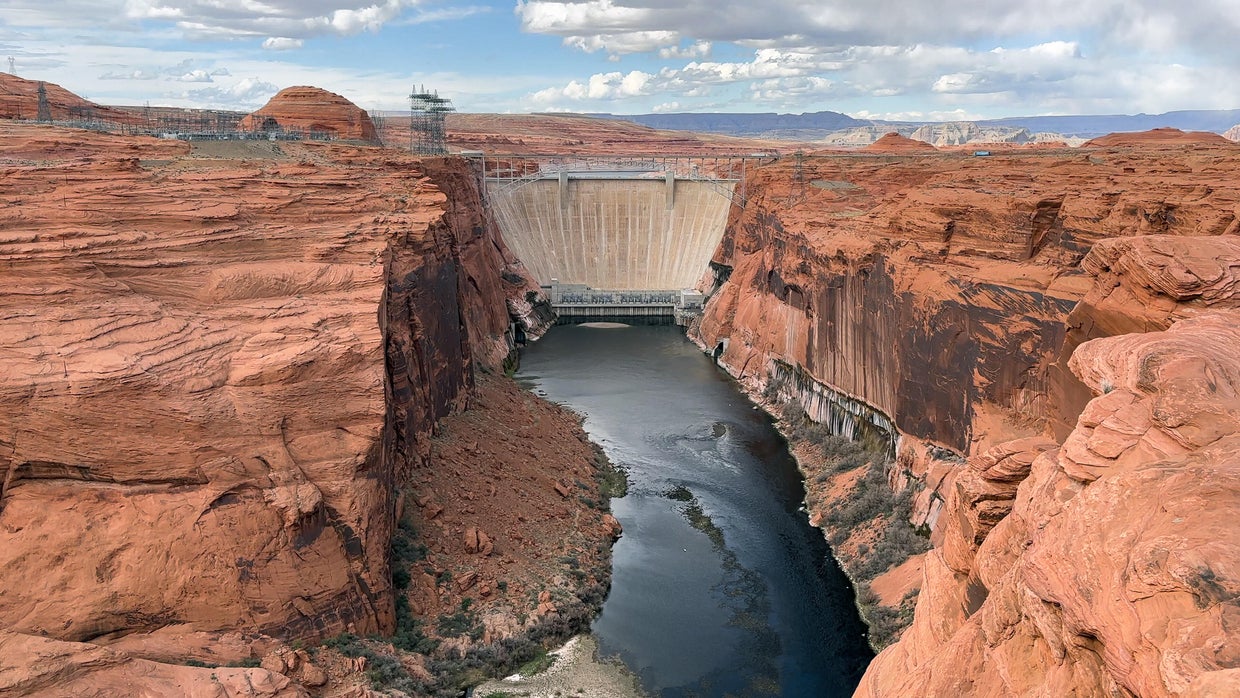
A statement issued by the Upper Basin states on Friday said, “Upper Basin water users are preparing for reductions of more than 2.0 MAF this year. Across the entire Upper Basin, this will amount to reductions greater than 40% of the proven water rights. Meanwhile, our downstream neighbors are seeking to secure water from the UDS that simply does not exist.”
John Entsminger, general manager of the Southern Nevada Water Authority in Las Vegas, also issued a statement on Friday, explaining that the states have “failed to reach an agreement to collectively protect our respective communities and economies in the face of almost certain reductions to our use of the river.”
Arizona Gov. Katie Hobbs, California Gov. Gavin Newsom and Nevada Gov. Joe Lombardo said in a news release that management of the river “must be built on a foundation of shared contribution and innovation, with all Colorado River water users stretching to conserve water.” They asserted that the Lower Basin states have already offered to reduce their share and asserted that their stance remains “firm and fair.”

The Lower Basin states added that they contain approximately 75% of the population, employment, and crop sales supported by the river. They also include 25 Indigenous tribes that depend on it. Utah, Arizona and Nevada are also among the top ten states in percent growth from 2024 to 2025.
Upper Colorado River Commission Chair and Colorado Commissioner, Becky Mitchell, said, “We’re being asked to solve a problem we didn’t create with water we don’t have. The Upper Division’s approach is aligned with hydrologic reality and we’re ready to move forward.”
New Mexico Commissioner Estevan Lopez warned that unrealistic demands on the system will damage the entire basin.
“The River is telling us the truth every year,” he asserted. “We can either negotiate based on real conditions, including this year’s critically low hydrology in the Upper Basin, or we can keep repeating outdated assumptions until the system breaks. The Upper Division is choosing realism and responsibility.”



New Mexico United vs Colorado Springs Switchbacks FC
New Mexico United vs Colorado Springs Switchbacks FC LIVE GAME: New Mexico United vs Colorado Springs Switchbacks FC look to seize control of thrilling New Mexico United vs Colorado Springs Switchbacks FC. Every team in the New Mexico United vs Colorado Springs Switchbacks FC has two wins apiece as we go into the final two game weeks. New Mexico United vs Colorado Springs Switchbacks FC will host New Mexico United vs Colorado Springs Switchbacks FC at New Mexico United vs Colorado Springs Switchbacks FC Park Stadium with the New Mexico United vs Colorado Springs Switchbacks FC a single point ahead of New Mexico United vs Colorado Springs Switchbacks FC in the standings and just one behind leaders New Mexico United vs Colorado Springs Switchbacks FC.
Colorado
‘It doesn’t look good’: Colorado transportation officials will use $12 million in leftover snowplowing funds to up roadside wildfire mitigation amid drought

Amid a historically hot and dry winter, the Colorado Department of Transportation will repurpose $12 million in unused snowplow funds for summertime wildfire mitigation efforts along the state’s highways.
CDOT Deputy Director of Operations Bob Fifer told the Colorado Transportation Commission at its work session this month that amid a record-low snowpack statewide, the transportation department is shifting its strategy to proactively address wildfire risk.
“It just doesn’t look good for us,” Fifer said at the March 18 meeting. “We are expecting a drought across the state.”
Almost the entire state saw snowfall totals well-below average this past winter, Fifer said. Most years, the state’s snowpack doesn’t peak until April, but this year the snowpack has already peaked and has melted off rapidly, he said.
According to the latest U.S. Drought Monitor report, more than half the state is experiencing severe drought, Level 2 of 4, with the northwest corner of Colorado experiencing extreme drought, or Level 3 of 4, and parts of Summit, Grand, Eagle, Routt, Garfield and Pitkin counties facing exceptional drought, or Level 4 of 4.
By June, Colorado’s Western Slope — including the Interstate 70 mountain corridor — is expected to be at above-average risk of significant wildland fires, according to the National Interagency Fire Center.
To determine where to focus the highway vegetation management, Fifer said the transportation department will leverage a Colorado State Forest Service Wildfire Risk Map to target roadside mitigation to the areas of the state that have the highest probability of burning.
“When you have 9,000 miles, or 24,000 lane miles, of road, where do you start mitigation?” Fifer asked. “What’s the most surgical area? How can we do it to get the most bang for the limited dollars we have? We’re going to use this data to drive that decision-making and we’re going to start with the most vulnerable areas.”
After choosing priority areas, Fifer said the transportation department will remove diseased trees and trees that are 50% dead or more, especially within the first 15 feet of the right-of-way. He said most of the wood will be chipped and slashed, then left on site to decompose, while larger blocks and diseased trees will be removed.
Ladder fuels, like lower branches, that could carry a fire up into the crown of the forest, will also be removed from trees within the right-of-way, Fifer said. He said stumps will be cut to about 4 inches off the ground.
In addition to their importance as evacuation routes, Fifer noted that “the highways are natural fire lines or fire breaks” that can help slow the spread of wildfires and that firefighters can use to strategically hold the fire at bay.
CDOT Deputy Director of Maintenance Jim Fox told the Transportation Commission that crews typically mow the right-of-way along the state’s highways twice a year, once in the spring and once in the fall.
So far this fiscal year, which began last July, Fox said the transportation department has already completed nearly 28,000 swath miles of roadside mowing, or slightly more than it did in the previous one-year period. He said the transportation department has also removed 3,848 trees from the right-of-way so far this fiscal year, compared to 2,453 trees in the previous fiscal year.
CDOT Director of Maintenance and Operations Shawn Smith noted that the $12 million in snow and ice contingency funds that are left over from the winter, due to the low snowfall, are among the dollars that will help fund the increased roadside wildfire mitigation.
Although the transportation department already has some funds to dedicate toward increasing roadside wildfire mitigation, Fifer said, “We’ll probably need more to handle this.”
He did not provide an estimate for what the additional wildfire mitigation might cost.

DENVER — Five of the seven law enforcement officers in a rural Colorado county, including the sheriff, have been indicted in an investigation into allegations of misconduct, prosecutors said Friday.
A grand jury indicted Costilla County Sheriff Danny Sanchez and former Deputy Keith Schultz on charges of allegedly mishandling human remains discovered in October 2024, according to court documents. A man who found the remains and reported them to the sheriff’s office said Sanchez and Schultz took only the skull and left the other remains behind, including teeth, court documents state.
Two months passed before Schultz wrote a report, saying he left bones in a bag on his desk and went on another call, the documents state. A coroner’s official said he received the skull in an unlabeled paper bag from the sheriff’s office, the documents state.
Separately, Undersheriff Cruz Soto, Sgt. Caleb Sanchez — the sheriff’s son — and Deputy Roland Riley are charged in connection with the use of a Taser against a man who was suffering a mental health crisis in February and tried to leave when they insisted he go to the hospital, according to the documents. The man said he was “roughed up” by deputies and was left with broken ribs, according to the indictments.
Soto was charged with failing to intervene and third-degree assault, according to court documents. Caleb Sanchez and Riley were charged with second- and third-degree assault.
In announcing the indictments, 12th District Attorney Anne Kelly said she’s committed to investigating and prosecuting crimes no matter the offender.
“I cannot and will not ignore violations of the trust that a community should have in their police. No citizen of the San Luis Valley should have any doubts about the integrity of their police force,” Kelly said at a news conference Friday evening.
A person who answered the phone Friday at the sheriff’s office said it had no immediate comment but planned to post a statement online. Phone numbers listed for Danny Sanchez, Soto and Riley did not work. Caleb Sanchez did not have a listed number. An unidentified person who answered a number for Schultz referred The Associated Press to an attorney, Peter Comar. The AP left a message Friday for Comar seeking comment.
__
SD Lottery Powerball, Lotto America winning numbers for March 28, 2026

Has Tennessee ever made a Final Four? Vols hope third time’s a charm under Barnes

Texas chose John Cornyn as a principled conservative, not a Trump lackey | Opinion

POST-GAME: André Tourigny 3.28.26 | Utah Mammoth

Skier dies after fall at Sugarbush Resort

Florida High School Football Rankings: Top 25 teams – Oct. 21

How old is Bo Nix? What to know about Oregon quarterback ahead of 2024 NFL Draft

Cleary's 21 help Le Moyne down Central Connecticut State 69-64 in OT

99th annual Pony Swim held in Virginia

Indiana Members Credit Union announced as new anchor tenant at Bottleworks District

JD Vance says he was ‘obsessed’ with UFOs, believes aliens are actually ‘demons’
The EU's recipe for trade deals : easy on beef, tough on wine

Photos: ‘No Kings’ protests across the country

Jeffries declines to break with indicted Democrat after ethics panel’s guilty verdict

Hundreds of thousands march through London in stand against the far right
-

 Sports1 week ago
IOC addresses execution of 19-year-old Iranian wrestler Saleh Mohammadi
-

 New Mexico7 days ago
Clovis shooting leaves one dead, four injured
-

 Tennessee6 days ago
Tennessee Police Investigating Alleged Assault Involving ‘Reacher’ Star Alan Ritchson
-

 Technology7 days ago
YouTube job scam text: How to spot it fast
-

 Minneapolis, MN3 days ago
Boy who shielded classmate during school shooting receives Medal of Honor
-

 Science1 week ago
Record Heat Meets a Major Snow Drought Across the West
-

 Texas1 week ago
How to buy Houston vs. Texas A&M 2026 March Madness tickets
-

 Politics1 week ago
Schumer gambit fails as DHS shutdown hits 36 days and airport lines grow