Connect with us

Colorado

How Colorado oil and gas economics can coexist with the environment | OPINION

Published

on

How Colorado oil and gas economics can coexist with the environment | OPINION


Advertisement

Kait Schwartz


In the intricate web of Colorado’s economic landscape, the continued production of oil and gas emerges as a vital thread, weaving together prosperity, employment and energy security. As of 2021, the industry directly sustained more than 50,000 jobs in the state and injected more than $15 billion into Coloradans’ income. Acknowledging America’s current record oil production is largely attributed to previous administrations’ investments and supportive policies, it becomes imperative for Colorado to recognize and uphold the importance of its role in this national narrative.

However, the path ahead is not without challenges. The shifting dynamics of energy policies demand our state remains committed to investing in smart, forward-thinking strategies that balance economic growth with environmental responsibility. As we navigate the complexities of a changing energy landscape, it is essential for our state and federal administration to foster an environment that encourages continued oil and gas production while also pioneering sustainable solutions. The stakes are high, with the livelihoods of thousands of Coloradans hanging in the balance, underscoring the gravity of the decisions our government makes today in shaping a resilient and energy-secure tomorrow.

In safeguarding our nation’s security, the oil and gas industry emerges as a linchpin, crucial for fostering resilience. Colorado, as the fifth-highest producer of oil and gas in the United States, plays a pivotal role in this strategic landscape. The link between energy and national security is profound, and restricting oil and natural gas production and investment risks creating new dependencies on unstable regions worldwide. This perilous trajectory threatens to return us to the energy scarcity experienced half-a-century ago, a vulnerability we cannot afford in an increasingly complex geopolitical climate.

The presence of American military installations in Colorado, such as Buckley Air Force Base in Aurora or Fort Carson in El Paso County, underscores the intertwined nature of energy security and defense capabilities in our state. The ability to produce energy domestically is paramount, ensuring we are not beholden to unfriendly nations for our vital resources. Dependence on foreign sources not only jeopardizes our economic stability but also compromises our geopolitical autonomy.

Advertisement

Stay up to speed: Sign up for daily opinion in your inbox Monday-Friday

Colorado’s contribution to the national energy landscape is not merely an economic endeavor but a strategic imperative, fortifying our nation against external pressures. As we navigate the challenges of the 21st century, the importance of the oil and gas industry in preserving our national security cannot be overstated — it’s a clarion call to uphold energy independence and secure the foundations of our sovereignty.

In the pursuit of American energy independence, investing in robust energy infrastructure is an imperative that cannot be overstated. Restrictive policies can impede necessary infrastructure investments, hinder access to energy, be costly and impede the adoption of technologies that could expedite environmental progress. It is a paradoxical situation where a forward-looking vision for domestic energy production in the state and across the country are hampered by insufficient infrastructure support. The oil and gas produced in Colorado adheres to some of the strictest environmental standards in the nation.

As we acknowledge the necessity of oil and gas in our current energy landscape, it becomes paramount to produce in regions like Colorado, where stringent environmental standards are already in place. The synergy between energy production and environmental stewardship is achievable with strategic infrastructure investments, paving the way for a sustainable energy future that balances our reliance on oil and gas with a commitment to more efficient environmental technologies.

What is imperative now is the wholehearted endorsement of a bold and strategic energy vision by policymakers, championing the paramount role of American oil and natural gas. In particular, lawmakers must proactively support policies aimed at reinstating American energy leadership, a leadership that draws considerable inspiration from the state of Colorado. It is in this context the American Petroleum Institute recently unveiled its “Lights On Energy” campaign, offering actionable solutions to America’s pressing energy challenges. It recognizes the indispensable role of American oil and gas in meeting the demands of the present and future.

Advertisement

As our nation strives for a sustainable energy transition, “Lights On Energy” becomes a guiding beacon, and Colorado, with its strategic significance and commitment to responsible energy practices, stands as a key player in the realization of these critical objectives. The plan not only addresses the immediate need for reliable energy but also charts a course toward a future where economic prosperity and environmental responsibility coexist.

Colorado’s pivotal role in this endeavor should showcase the state’s dedication to meeting the country’s increasing energy demands, providing a model for responsible and sustainable energy practices that can illuminate the path forward for the entire nation.

Kait Schwartz is director of API Colorado, a division of the American Petroleum Institute.


Source link

Advertisement

Colorado

Colorado residents face earliest water restrictions ever — a harbinger of worse to come

Published

on

Colorado residents face earliest water restrictions ever — a harbinger of worse to come


As a result of a snow drought and a heat wave that have both set records, some Colorado residents face the earliest restrictions on their water use ever imposed.

Denver Water announced Wednesday that it is seeking a 20% cut in water use, asking people to turn off automatic watering systems until mid-May and restricting the watering of trees and shrubs to twice a week.

“The situation is quite serious,” said Todd Hartman, a spokesperson for the utility. “We’re in such a dire situation that we could be coming back to the public in two or three months and saying you’re limited to one day a week.”

It is the earliest in the year that Denver Water has ever issued a restriction, Hartman said.

Advertisement

Colorado’s snowpack peaked at extremely low levels on March 12 — nearly a month earlier than usual — then cratered during the recent heat wave that cooked nearly every state in the West.

“We already had the lowest snowpack we’ve seen since at least 1981, and now, with the heat wave conditions, we’ve already lost about 40% of the statewide snowpack” since the March 12 peak, said Peter Goble, Colorado’s assistant state climatologist. “Conditions are looking more like late April or early May.”

The water restrictions are a harbinger of what’s to come in many Western states as officials try to manage widespread drought concerns. Nearly every snow basin in the Mountain West had one of its warmest winters on record and is well behind normal when it comes to water supply, according to the U.S. drought monitor. The dwindling snowpack is likely to raise the risk of severe wildfires, hamper electricity generation at hydropower dams and force water restrictions for farmers.

Hartman said nearly every community east of the Rockies, along Colorado’s front range, is in much the same boat as Denver.

City Council members in Aurora are considering similar water restrictions; reservoirs there stand at about 58%, according to the city’s website. In the town of Erie, officials declared a water shortage emergency on March 20 after they observed a massive spike in consumption.

Advertisement

Gabi Rae, a spokesperson for the town, said Erie was perilously close to having taps run dry because so many residents had started watering their lawns early amid the unseasonable heat.

“We were a day away from running out of water. That’s why it was such an emergency,” she said.

Erie officials demanded that residents stop using irrigation systems altogether.

Goble said this month’s heat wave has set records in every corner of Colorado, sometimes by double digits.

“I can’t remember seeing a single heat wave that broke this many records, and seeing it across such a large portion of the country is certainly eye-popping,” he said, adding: “I’m located in Fort Collins, and we got up to 91 last Saturday. The previous record for March was 81, so we smashed that record. And it wasn’t just one day, either.”

Advertisement
Skiers at Breckenridge Ski Resort as temperatures reached into the 50s this month. Michael Ciaglo / Getty Images

Denver Water, which serves about 1.5 million residents in the city and its surrounding suburbs, gets about half of its water from the Upper Colorado River Basin and the South Platte River Basin. The latter’s snowpack was at about 42% of normal Tuesday, the utility reported. The Upper Colorado River Watershed was at 55%.

Systemwide, Denver Water’s reservoirs are about 80% full, which is only about 5 percentage points lower than in a typical year.

“That sounds pretty good,” Hartman said. “Except that what we’re not going to be able to rely on is that rush of water that will bring those reservoirs back up, because the snowpack is so low.”

In other words, the snowpack — a natural water reservoir — is mostly tapped already and won’t replenish reservoirs later this spring and into summer, when runoff usually peaks.

In Erie, city workers plan to aggressively police water use until sometime next week using smart meters that monitor residential usage. Rae said the city is also sending utility workers to patrol neighborhoods and look for sprinklers that are turned on.

Advertisement

“People have been kind of annoyed with how aggressive we were, and I don’t necessarily think they understand the ramifications if we weren’t,” Rae said. “It is an actual serious emergency situation. We were so close to reaching empty, there would literally be no water coming out of the taps — hospitals, schools, fire hydrants, your home would have no water.”

Although the limits on outdoor watering will be lifted soon, Rae expects more restrictions later this spring and summer.


Source link

Continue Reading

Colorado

Suddenly hazy skies in Denver prompt some residents concerned about wildfire smoke to call 911

Published

on

Suddenly hazy skies in Denver prompt some residents concerned about wildfire smoke to call 911


Some people who live in the Denver metro area on Thursday afternoon were making calls to 911 after skies became noticeably hazy and winds kicked up. It was due to smoke from wildfires in Nebraska moving into Colorado. A cold front also was moving through the Front Range, and there is dust in the air.

Advertisement

CBS


The poor air conditions led to reduced visibility downtown after 3 p.m. Several of CBS Colorado’s City Cams showed dust or smoke in the air.

Temperatures were expected to drop by as much as 20 to 30 degrees with the cold front.  

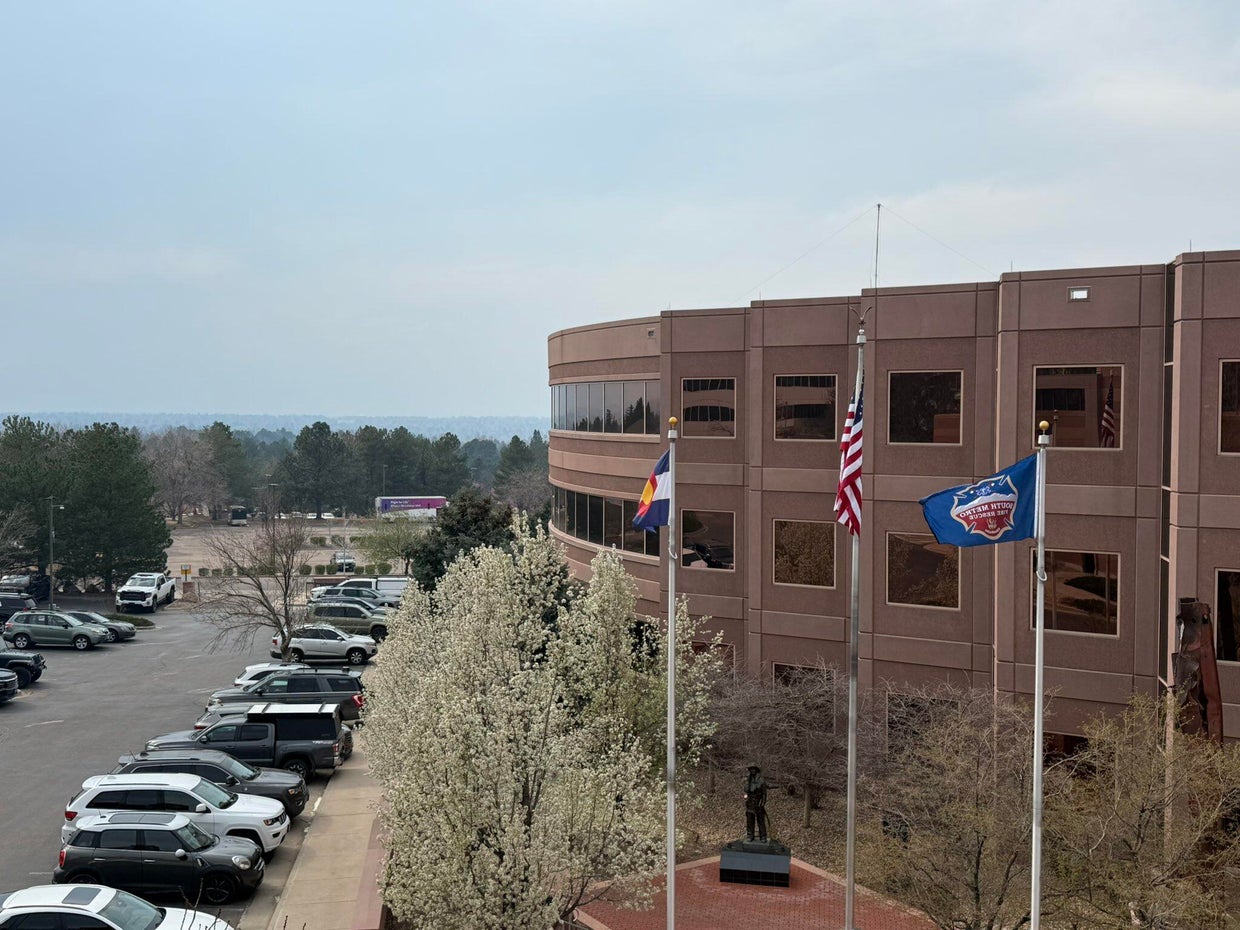
The suddenly dusty skies prompted at least one fire agency to put out a plea to residents to please only call 911 “if you see flames.” That warning was put out by South Metro Fire Rescue, which shared a photo on X of an office building with haze visible outside.

haze.jpg

Advertisement

South Metro Fire


South Metro Fire Rescue said in their post that the smoke is from Colorado’s neighbor to the east. They called it a “significant haze” in the air.

Earlier this month, the Morrill Fire and the Cottonwood Fire burned a significant amount of Nebraska grassland and ranchland. They have mostly been contained by firefighters. Nebraska Gov. Jim Pillen said those two fires combined with several others have burned approximately 800,000 acres of land. On Thursday, Pillen announced that he is signing several executive actions intended to ease the burden caused by the fires.  

There were no wildfires burning in the Denver metro area on Thursday afternoon.

Advertisement


Source link

Continue Reading

Colorado

Colorado homicide suspect wanted in fentanyl-related death arrested in Colombia

Published

on

Colorado homicide suspect wanted in fentanyl-related death arrested in Colombia


ARAPAHOE COUNTY, Colo. (KKTV) – A homicide suspect based out of Colorado, wanted in a fentanyl-related death, is back in the state after being captured in Colombia.

The Arapahoe County Sheriff’s Office (ACSO) said 33-year-old Max Arsenault had been on the run since January 17.

Deputies said this stemmed from an incident in May 2023, where deputies responded to a call for a man named Nicholas Dorotik, who was found unresponsive.

ACSO said the cause of death was a mixed drug overdose involving meth and fentanyl, having about three times the lethal amount of fentanyl in his system.

Advertisement

One year later, Arsenault was arrested. He was scheduled for trial in January 2026 when deputies said he fled the country while on bond three days before the trial was set to start.

He was caught in Medellin, Colombia, on March 4, following a two-month international investigation. He has since been extradited back to Denver, where he is facing charges and awaiting trial.


Source link

Advertisement
Continue Reading

Trending