On a sunny morning two years ago, a group of state officials stood in the mountains of northwestern Colorado in front of a handful of large metal crates. With a small crowd watching them, the officials began to unlatch the crate doors one by one. Out of each came a gray wolf — arguably the nation’s most controversial endangered species.
Colorado
Colorado has wolves again for the first time in 80 years. Why are they dying?


This was a massive moment for conservation.
While gray wolves once ranged throughout much of the Lower 48, a government-backed extermination campaign wiped most of them out in the 19th and 20th centuries. By the 1940s, Colorado had lost all of its resident wolves.
But, in the fall of 2020, Colorado voters did something unprecedented: They passed a ballot measure to reintroduce gray wolves to the state. This wasn’t just about having wolves on the landscape to admire, but about restoring the ecosystems that we’ve broken and the biodiversity we’ve lost. As apex predators, wolves help keep an entire ecosystem in balance, in part by limiting populations of deer and elk that can damage vegetation, spread disease, and cause car accidents.
In the winter of 2023, state officials released 10 gray wolves flown in from Oregon onto public land in northwestern Colorado. And in January of this year, they introduced another 15 that were brought in from Canada. Colorado Parks and Wildlife (CPW) — the state wildlife agency leading the reintroduction program — plans to release 30 to 50 wolves over three to five years to establish a permanent breeding population that can eventually survive without intervention.
“Today, history was made in Colorado,” Colorado Governor Jared Polis said following the release. “For the first time since the 1940s, the howl of wolves will officially return to western Colorado.”
Fast forward to today, and that program seems, at least on the surface, like a mess.
Ten of the transplanted wolves are already dead, as is one of their offspring. And now, the state is struggling to find new wolves to ship to Colorado for the next phase of reintroduction. Meanwhile, the program has cost millions of dollars more than expected.
The takeaway is not that releasing wolves in Colorado was, or is now, a bad idea. Rather, the challenges facing this first-of-its-kind reintroduction just reveal how extraordinarily difficult it is to restore top predators to a landscape dominated by humans. That’s true in the Western US and everywhere — especially when the animal in question has been vilified for generations.
Why 10 of the reintroduced wolves are already dead
One harsh reality is that a lot of wolves die naturally, such as from disease, killing each other over territory, and other predators, said Joanna Lambert, a wildlife ecologist at the University of Colorado Boulder. Of Colorado’s new population, one of the released wolves was killed by another wolf, whereas two were likely killed by mountain lions, according to Colorado Parks and Wildlife.
The changes that humans have made to the landscape only make it harder for these animals to survive. One of the animals, a male found dead in May, was likely killed by a car, state officials said. Another died after stepping into a coyote foothold trap. Two other wolves, meanwhile, were killed, ironically, by officials. Officials from CPW shot and killed one wolf — the offspring of a released individual — in Colorado, and the US Department of Agriculture killed another that traveled into Wyoming, after linking the wolves to livestock attacks. (An obscure USDA division called Wildlife Services kills hundreds of thousands, and sometimes millions, of wild animals a year that it deems dangerous to humans or industry, as my colleague Kenny Torella has reported.)
Yet, another wolf was killed after trekking into Wyoming, a state where it’s largely legal to kill them.
Colorado Parks and Wildlife has, to its credit, tried hard to stop wolves from harming farm animals. The agency has hired livestock patrols called “range riders,” for example, to protect herds. But these solutions are imperfect, especially when the landscape is blanketed in ranchland. Wolves still kill sheep and cattle.
This same conflict — or the perception of it — is what has complicated other attempts to bring back predators, such as jaguars in Arizona and grizzly bears in Washington. And wolves are arguably even more contentious. “This was not ever going to be easy,” Lambert said of the reintroduction program.
Colorado is struggling to find more wolves to ship in
There’s another problem: Colorado doesn’t have access to more wolves.
The state is planning to release another 10 to 15 animals early next year. And initially, those wolves were going to come from Canada. But in October, the Trump administration told CPW that it can only import wolves from certain regions of the US. Brian Nesvik, director of the US Fish and Wildlife Service, a federal agency that oversees endangered species, said that a federal regulation governing Colorado’s gray wolf population doesn’t explicitly allow CPW to source wolves from Canada. (Environmental legal groups disagree with his claim).
So Colorado turned to Washington state for wolves instead.
But that didn’t work either. Earlier this month, Washington state wildlife officials voted against exporting some of their wolves to Colorado. Washington has more than 200 gray wolves, but the most recent count showed a population decline. That’s one reason why officials were hesitant to support a plan that would further shrink the state’s wolf numbers, especially because there’s a chance they may die in Colorado.
Some other states home to gray wolves, such as Montana and Wyoming, have previously said they won’t give Colorado any of their animals for reasons that are not entirely clear. Nonetheless, Colorado is still preparing to release wolves this winter as it looks for alternative sources, according to CPW spokesperson Luke Perkins.
Ultimately, Lambert said, it’s going to take years to be able to say with any kind of certainty whether or not the reintroduction program was successful.
“This is a long game,” she said.
And despite the program’s challenges, there’s at least one reason to suspect it’s working: puppies.
Over the summer, CPW shared footage from a trail camera of three wolf puppies stumbling over their giant paws, itching, and play-biting each other. CPW says there are now four litters in Colorado, a sign that the predators are settling in and making a home for themselves.
“This reproduction is really key,” Eric Odell, wolf conservation program manager for Colorado Parks and Wildlife, said in a public meeting in July. “Despite some things that you may hear, not all aspects of wolf management have been a failure. We’re working towards success.”



Colorado
Suddenly hazy skies in Denver prompt some residents concerned about wildfire smoke to call 911

Some people who live in the Denver metro area on Thursday afternoon were making calls to 911 after skies became noticeably hazy and winds kicked up. It was due to smoke from wildfires in Nebraska moving into Colorado. A cold front also was moving through the Front Range, and there is dust in the air.
The poor air conditions led to reduced visibility downtown after 3 p.m. Several of CBS Colorado’s City Cams showed dust or smoke in the air.
Temperatures were expected to drop by as much as 20 to 30 degrees with the cold front.
The suddenly dusty skies prompted at least one fire agency to put out a plea to residents to please only call 911 “if you see flames.” That warning was put out by South Metro Fire Rescue, which shared a photo on X of an office building with haze visible outside.
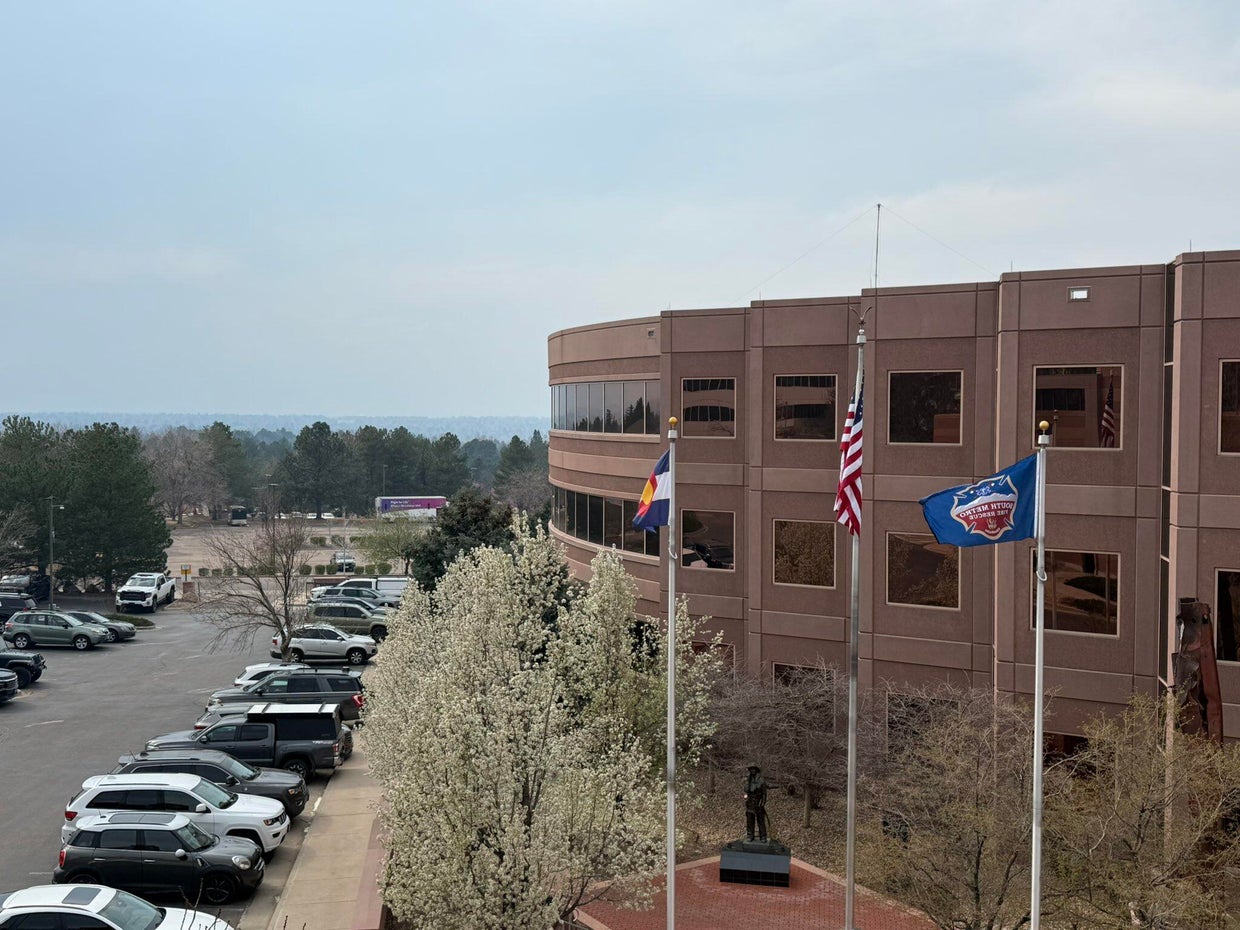
South Metro Fire Rescue said in their post that the smoke is from Colorado’s neighbor to the east. They called it a “significant haze” in the air.
Earlier this month, the Morrill Fire and the Cottonwood Fire burned a significant amount of Nebraska grassland and ranchland. They have mostly been contained by firefighters. Nebraska Gov. Jim Pillen said those two fires combined with several others have burned approximately 800,000 acres of land. On Thursday, Pillen announced that he is signing several executive actions intended to ease the burden caused by the fires.
There were no wildfires burning in the Denver metro area on Thursday afternoon.

ARAPAHOE COUNTY, Colo. (KKTV) – A homicide suspect based out of Colorado, wanted in a fentanyl-related death, is back in the state after being captured in Colombia.
The Arapahoe County Sheriff’s Office (ACSO) said 33-year-old Max Arsenault had been on the run since January 17.
Deputies said this stemmed from an incident in May 2023, where deputies responded to a call for a man named Nicholas Dorotik, who was found unresponsive.
ACSO said the cause of death was a mixed drug overdose involving meth and fentanyl, having about three times the lethal amount of fentanyl in his system.
One year later, Arsenault was arrested. He was scheduled for trial in January 2026 when deputies said he fled the country while on bond three days before the trial was set to start.
He was caught in Medellin, Colombia, on March 4, following a two-month international investigation. He has since been extradited back to Denver, where he is facing charges and awaiting trial.
Copyright 2026 KKTV. All rights reserved.

A deceased male was found at Black Canyon of the Gunnison National Park on the morning of March 24, according to the Montrose County Sheriff’s Office. Upon arriving at the scene around 8:40 a.m., deputies talked with possible witnesses and determined that a deceased male was located in the canyon. The man’s body was below […]

News12 minutes ago
A surprise resignation could open the door for an independent to win a Montana Senate seat

Detroit, MI2 hours ago
Metro Detroit weather forecast, March 26, 2026 — 11 p.m. Update

San Francisco, CA2 hours ago
Man convicted in the deadly 2021 assault of a Thai grandfather in San Francisco avoids prison

Dallas, TX2 hours ago
Dallas Mayor Eric Johnson is confident about cost estimates to repair, rehab City Hall and insists the process has been transparent

Miami, FL3 hours ago
Miami Gardens community rallies to help retired teacher rebuild after a fire tore through his home

Florida1 year ago
Florida High School Football Rankings: Top 25 teams – Oct. 21

Oregon2 years ago
How old is Bo Nix? What to know about Oregon quarterback ahead of 2024 NFL Draft

Connecticut2 years ago
Cleary's 21 help Le Moyne down Central Connecticut State 69-64 in OT

Virginia2 years ago
99th annual Pony Swim held in Virginia

Indiana2 years ago
Indiana Members Credit Union announced as new anchor tenant at Bottleworks District
News12 minutes ago
A surprise resignation could open the door for an independent to win a Montana Senate seat

News10 hours ago
Video: Savannah Guthrie Says She Believes Her Mother Was Taken for Ransom

Politics11 hours ago
Stefanik grills University of Michigan leader on lack of audit after string of Chinese national arrests

World12 hours ago
Photos: More than one million displaced by Israel’s evacuations in Lebanon

News12 hours ago
DHS shutdown live updates as Senate holds test vote on funding bill
-

 Detroit, MI1 week ago
Drummer Brian Pastoria, longtime Detroit music advocate, dies at 68
-

 Science1 week ago
How a Melting Glacier in Antarctica Could Affect Tens of Millions Around the Globe
-

 Movie Reviews1 week ago
‘Youth’ Twitter review: Ken Karunaas impresses audiences; Suraj Venjaramoodu adds charm; music wins praise | – The Times of India
-
 Science1 week ago
I had to man up and get a mammogram
-

 Sports5 days ago
IOC addresses execution of 19-year-old Iranian wrestler Saleh Mohammadi
-

 New Mexico4 days ago
Clovis shooting leaves one dead, four injured
-

 Texas7 days ago
How to buy Houston vs. Texas A&M 2026 March Madness tickets
-

 Tennessee3 days ago
Tennessee Police Investigating Alleged Assault Involving ‘Reacher’ Star Alan Ritchson