Colorado
As Colorado water deaths trend lower, this rescue team trains in “the most difficult conditions” to keep people safe


The first weekend of summer has been a scorcher, with temperatures flirting with triple digits in metro Denver for the first time this year.
With the heat comes a burst of desire to head to a river, creek or lake to seek relief. But waterways across the state — flush with recently melted snowpack — are often still a bone-chilling 45 degrees or so.
Fall in, jump in or get tossed in, and things can turn deadly serious in a flash, said Todd Miner, a retired senior instructor in the Department of Emergency Medicine at the University of Colorado School of Medicine.
“You get in that cold water, and it’s really tough to stay in control,” he said. “People don’t recognize how debilitating that can be.”
Add to the cold a formidable current, and chances for serious accidents — even fatal ones — only multiply. Stand up in the creek, and expect to get your foot wedged and pinned in between rocks on the creek bed, said Capt. Harold Osborn with North Metro Fire Rescue.
“A lot of times, (people) don’t understand the flow dynamics of the river,” he said.
Osborn was one of 15 members of the North Area Technical Rescue Team practicing water rescues on a roaring Clear Creek last week west of Golden. The 150-member organization, now in its 30th year and made up of emergency officials from nine local fire departments, performs specialized rescues in Denver’s northern suburbs, including rope rescues, confined space rescues, trench rescues and collapse rescues.
On Wednesday, the focus was water rescue training in Clear Creek Canyon. A rescuer was tethered to the shore or was free swimming across a raging current, then grabbing hold of a free-floating “victim” and pulling them back to land. Lt. Jacob Charney, with North Metro Fire Rescue, was in charge.
“Because the water’s so high, we do the training in the spring,” he said, wearing a dry suit and helmet as a bloated Clear Creek rushed past. “It’s the most difficult conditions because of the velocity of the water.”
Less than two weeks ago, the Jefferson County Sheriff’s Office closed the creek through downtown Golden to belly boats, inner tubes and single-chambered rafts — as well as body surfing and swimming — until water levels subside. People on kayaks, river boards, whitewater canoes and multi-chambered, professionally guided rafts can still ride the creek.
The closure comes after three years of particularly deadly water activity in Colorado. More than 30 people died on the state’s waterways and water bodies last year. There were 32 deaths in 2023 and a record 42 fatalities in 2022, according to an unofficial tally kept by Colorado Parks and Wildlife.
This year, so far, has been a departure from that deadly record. As of Friday, the state had seen eight deaths recorded in 2025, according to news releases from CPW.
In comparison, by the first few days of June last year, there had already been a dozen deaths on Colorado waters.
“We are not on the same pace as last year, and that is fantastic news,” CPW spokeswoman Kara Van Hoose said.
She credits the drop in water deaths to a cooler and wetter May, with Memorial Day weekend almost a total washout.
“When it rains, people are less likely to be out on the water,” Van Hoose said.
This year’s deaths in Colorado waters have largely been on lakes, rather than rivers. The incidents began in late February with the discovery of the body of a 65-year-old fisherman who had fallen through the ice at Cherry Creek Reservoir. In mid-April, the body of a man who fell from a canoe was recovered from Spinney Reservoir in Park County.
Last month, a fisherman using a bellyboat — a small, inflatable tube — got caught in strong wind gusts at Steamboat Lake State Park and drowned, authorities said. He was not wearing a life jacket. In the Arkansas Headwaters Recreation Area, a popular rafting and kayaking spot near Buena Vista, a kayaker died after his vessel capsized.
Another four deaths have occurred at Lake Pueblo State Park, including a drowning on Thursday. In most of the Lake Pueblo deaths, the victim did not wear a life jacket.
“Any water can be deadly if you’re not wearing a life jacket,” Van Hoose said.
Employees at Golden River Sports hand out life jackets and helmets to all customers who rent their tubes. But Jon Baskin, who has worked seasonally at the tube and kayak rental store in downtown Golden for five years and was a raft guide for a decade, sees many on Clear Creek not wearing protective gear.

“I see people without PFDs,” he said, referring to personal flotation devices. “Clear Creek on a weekend day is like a carnival — there are hundreds and hundreds of tubes. But it’s still a wild river, it’s not like the lazy river at Elitch’s.”
Golden has taken measures in recent years to control, and even restrict, the crowds that mob the waterway near downtown Vanover Park on warm, sunny days. The city places daily limits on the number of tubes the two concessionaires in town can rent to the public. It also embeds radio frequency identification tags in tubes to track their usage.
Last year, Golden discussed the introduction of a reservation system, like the timed-entry system used at Rocky Mountain National Park. It has not yet put in place such a system to control access to the creek.
Whether 2025’s less-deadly trend on Colorado’s waters continues into July and beyond, CPW’s Van Hoose said, will ultimately come down to individual behavior and precautions taken.
“We hope we continue to see good numbers — but it’s up to the people,” she said.
Get more Colorado news by signing up for our daily Your Morning Dozen email newsletter.
Originally Published:



As a result of a snow drought and a heat wave that have both set records, some Colorado residents face the earliest restrictions on their water use ever imposed.
Denver Water announced Wednesday that it is seeking a 20% cut in water use, asking people to turn off automatic watering systems until mid-May and restricting the watering of trees and shrubs to twice a week.
“The situation is quite serious,” said Todd Hartman, a spokesperson for the utility. “We’re in such a dire situation that we could be coming back to the public in two or three months and saying you’re limited to one day a week.”
It is the earliest in the year that Denver Water has ever issued a restriction, Hartman said.
Colorado’s snowpack peaked at extremely low levels on March 12 — nearly a month earlier than usual — then cratered during the recent heat wave that cooked nearly every state in the West.
“We already had the lowest snowpack we’ve seen since at least 1981, and now, with the heat wave conditions, we’ve already lost about 40% of the statewide snowpack” since the March 12 peak, said Peter Goble, Colorado’s assistant state climatologist. “Conditions are looking more like late April or early May.”
The water restrictions are a harbinger of what’s to come in many Western states as officials try to manage widespread drought concerns. Nearly every snow basin in the Mountain West had one of its warmest winters on record and is well behind normal when it comes to water supply, according to the U.S. drought monitor. The dwindling snowpack is likely to raise the risk of severe wildfires, hamper electricity generation at hydropower dams and force water restrictions for farmers.
Hartman said nearly every community east of the Rockies, along Colorado’s front range, is in much the same boat as Denver.
City Council members in Aurora are considering similar water restrictions; reservoirs there stand at about 58%, according to the city’s website. In the town of Erie, officials declared a water shortage emergency on March 20 after they observed a massive spike in consumption.
Gabi Rae, a spokesperson for the town, said Erie was perilously close to having taps run dry because so many residents had started watering their lawns early amid the unseasonable heat.
“We were a day away from running out of water. That’s why it was such an emergency,” she said.
Erie officials demanded that residents stop using irrigation systems altogether.
Goble said this month’s heat wave has set records in every corner of Colorado, sometimes by double digits.
“I can’t remember seeing a single heat wave that broke this many records, and seeing it across such a large portion of the country is certainly eye-popping,” he said, adding: “I’m located in Fort Collins, and we got up to 91 last Saturday. The previous record for March was 81, so we smashed that record. And it wasn’t just one day, either.”
Denver Water, which serves about 1.5 million residents in the city and its surrounding suburbs, gets about half of its water from the Upper Colorado River Basin and the South Platte River Basin. The latter’s snowpack was at about 42% of normal Tuesday, the utility reported. The Upper Colorado River Watershed was at 55%.
Systemwide, Denver Water’s reservoirs are about 80% full, which is only about 5 percentage points lower than in a typical year.
“That sounds pretty good,” Hartman said. “Except that what we’re not going to be able to rely on is that rush of water that will bring those reservoirs back up, because the snowpack is so low.”
In other words, the snowpack — a natural water reservoir — is mostly tapped already and won’t replenish reservoirs later this spring and into summer, when runoff usually peaks.
In Erie, city workers plan to aggressively police water use until sometime next week using smart meters that monitor residential usage. Rae said the city is also sending utility workers to patrol neighborhoods and look for sprinklers that are turned on.
“People have been kind of annoyed with how aggressive we were, and I don’t necessarily think they understand the ramifications if we weren’t,” Rae said. “It is an actual serious emergency situation. We were so close to reaching empty, there would literally be no water coming out of the taps — hospitals, schools, fire hydrants, your home would have no water.”
Although the limits on outdoor watering will be lifted soon, Rae expects more restrictions later this spring and summer.
Colorado
Suddenly hazy skies in Denver prompt some residents concerned about wildfire smoke to call 911

Some people who live in the Denver metro area on Thursday afternoon were making calls to 911 after skies became noticeably hazy and winds kicked up. It was due to smoke from wildfires in Nebraska moving into Colorado. A cold front also was moving through the Front Range, and there is dust in the air.
The poor air conditions led to reduced visibility downtown after 3 p.m. Several of CBS Colorado’s City Cams showed dust or smoke in the air.
Temperatures were expected to drop by as much as 20 to 30 degrees with the cold front.
The suddenly dusty skies prompted at least one fire agency to put out a plea to residents to please only call 911 “if you see flames.” That warning was put out by South Metro Fire Rescue, which shared a photo on X of an office building with haze visible outside.
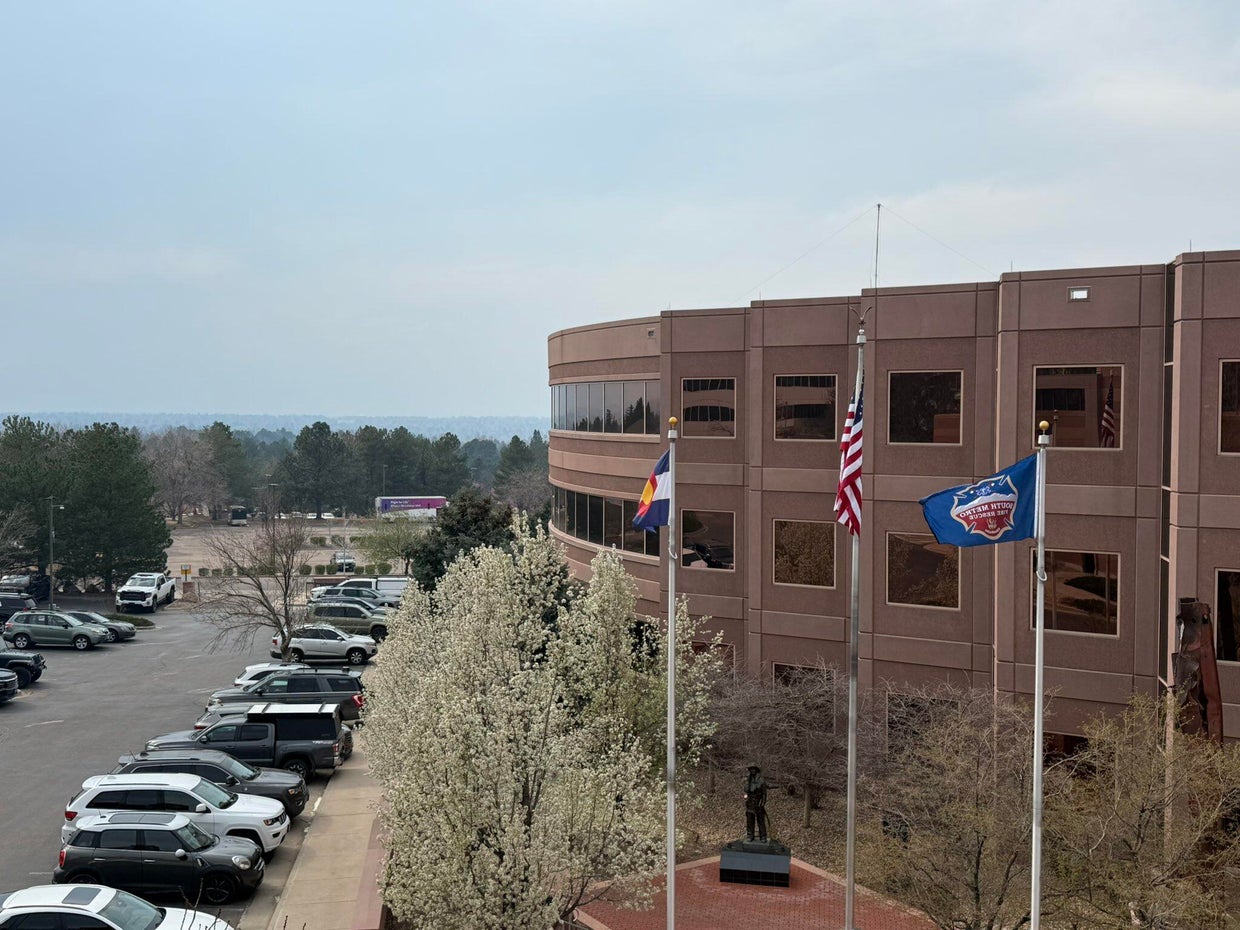
South Metro Fire Rescue said in their post that the smoke is from Colorado’s neighbor to the east. They called it a “significant haze” in the air.
Earlier this month, the Morrill Fire and the Cottonwood Fire burned a significant amount of Nebraska grassland and ranchland. They have mostly been contained by firefighters. Nebraska Gov. Jim Pillen said those two fires combined with several others have burned approximately 800,000 acres of land. On Thursday, Pillen announced that he is signing several executive actions intended to ease the burden caused by the fires.
There were no wildfires burning in the Denver metro area on Thursday afternoon.

ARAPAHOE COUNTY, Colo. (KKTV) – A homicide suspect based out of Colorado, wanted in a fentanyl-related death, is back in the state after being captured in Colombia.
The Arapahoe County Sheriff’s Office (ACSO) said 33-year-old Max Arsenault had been on the run since January 17.
Deputies said this stemmed from an incident in May 2023, where deputies responded to a call for a man named Nicholas Dorotik, who was found unresponsive.
ACSO said the cause of death was a mixed drug overdose involving meth and fentanyl, having about three times the lethal amount of fentanyl in his system.
One year later, Arsenault was arrested. He was scheduled for trial in January 2026 when deputies said he fled the country while on bond three days before the trial was set to start.
He was caught in Medellin, Colombia, on March 4, following a two-month international investigation. He has since been extradited back to Denver, where he is facing charges and awaiting trial.
Copyright 2026 KKTV. All rights reserved.

Iran-linked hackers have breached FBI Director Kash Patel’s personal emails | CNN Politics

Retired Detroit sergeant faces new sexual assault charge involving 14-year-old victim from 2002

Trump floats sending federal agents to San Francisco to tackle crime

Dallas ISD will offer free pre-K starting next school year

Norwegian Cruise Line offers a first look at Luna, new cruise ship setting sail from PortMiami – WSVN 7News | Miami News, Weather, Sports | Fort Lauderdale

Florida High School Football Rankings: Top 25 teams – Oct. 21

How old is Bo Nix? What to know about Oregon quarterback ahead of 2024 NFL Draft

Cleary's 21 help Le Moyne down Central Connecticut State 69-64 in OT

99th annual Pony Swim held in Virginia

Indiana Members Credit Union announced as new anchor tenant at Bottleworks District
Iran-linked hackers have breached FBI Director Kash Patel’s personal emails | CNN Politics

Live: CPAC 2026 Day 2

Video: Will ICE Change Under Its New Leader?

DHS shutdown breakthrough comes at cost for Republicans as funding fights nears end

Rubio joins crucial G7 talks as Iran war set to dominate second day
-

 Detroit, MI1 week ago
Drummer Brian Pastoria, longtime Detroit music advocate, dies at 68
-

 Science1 week ago
How a Melting Glacier in Antarctica Could Affect Tens of Millions Around the Globe
-

 Movie Reviews1 week ago
‘Youth’ Twitter review: Ken Karunaas impresses audiences; Suraj Venjaramoodu adds charm; music wins praise | – The Times of India
-

 Sports6 days ago
IOC addresses execution of 19-year-old Iranian wrestler Saleh Mohammadi
-

 New Mexico5 days ago
Clovis shooting leaves one dead, four injured
-
 Business1 week ago
Disney’s new CEO says his focus is on storytelling and creativity
-

 Technology5 days ago
YouTube job scam text: How to spot it fast
-

 Tennessee4 days ago
Tennessee Police Investigating Alleged Assault Involving ‘Reacher’ Star Alan Ritchson